
On this page
Start here
Quick answer
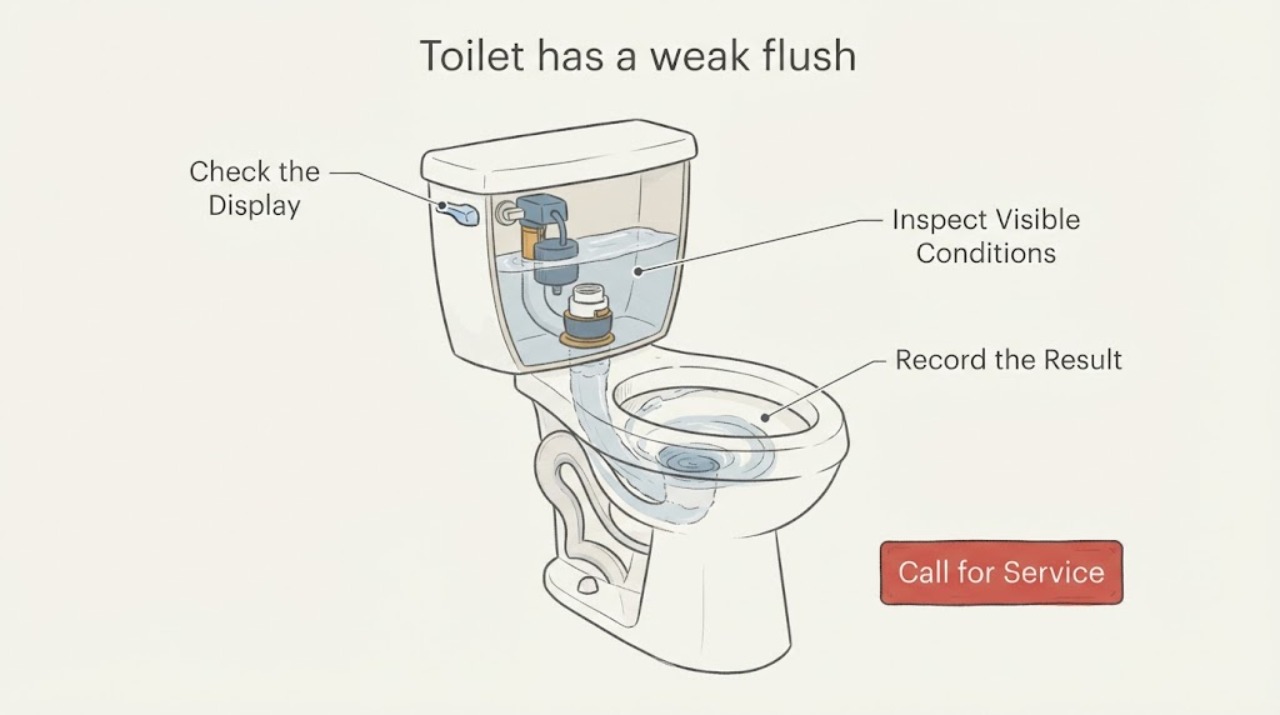
A weak toilet flush can come from a low or interrupted tank fill, a handle or flush mechanism that does not open fully, mineral buildup visible at the rim, a partial drain restriction, or a problem shared by other fixtures. Make one normal flush while watching the bowl and listening for the refill, then inspect only visible indicators: the bowl's water movement, any visible tank water line or warning, the rim holes, supply-valve position, and nearby drain behavior. Do not repeatedly flush, mix chemicals, use high-pressure tools, remove the tank or toilet, or work on hidden pipes. If the bowl rises, sewage backs up, more than one fixture drains slowly, or water is leaking, stop using it and call a plumber.
Work through in order
Diagnostic checks
Use only checks that match the exact appliance or system and its official guide.
-
Check 1
With the bowl at its normal level and the floor dry, perform one ordinary flush using the existing control, then watch the bowl from a safe position until the water movement stops and listen for the refill to finish.
Expected result: The bowl clears but the swirl is weak; the water rises and drains slowly; the bowl nearly overflows; or the toilet does not refill to its usual visible level.
Next step: Record which pattern occurred and do not repeat the flush as a test. Use the bowl-level, other-fixture, and visible-rim checks below to choose between monitoring and a plumber.
Stop if: If the bowl rises, water approaches the rim, sewage appears, or water reaches the floor, stop flushing, keep the area clear, and call a plumber.
Why this matters
Why: A weak but contained movement points toward flush delivery or a partial restriction. A rising bowl is an immediate overflow warning, while an unusual refill points toward the supply or tank mechanism rather than the drain alone.
-
Check 2
Look at the exterior of the tank and the supply connection without removing covers or operating hidden mechanisms. Note any visible water line or level indicator after the normal cycle, a refill that continues unusually long, a closed-looking supply valve, or a damp connection.
Expected result: The visible level and refill sound look normal and the connection is dry; or the level is visibly low, refill continues, the supply valve appears closed, or water is present outside the tank.
Next step: Record what is visible and follow the model's owner instructions or arrange plumbing service for an abnormal level, refill, or leak. Do not remove the tank lid or adjust internal parts during this observation.
Stop if: Stop immediately for active leaking, a cracked tank, water near electrical equipment, an uncontrolled refill, or any need to disassemble the tank.
Why this matters
Why: A normal refill makes a simple low-tank-volume explanation less likely. A low level or abnormal refill can reduce flush volume, while a damp connection is a leak condition rather than a reason to keep flushing.
-
Check 3
From above the bowl, inspect the visible rim holes and bowl surface without inserting tools or cleaners. Look for an uneven water pattern, obvious mineral deposits, or a section that does not appear to receive water during the single observed flush.
Expected result: Water appears to enter evenly with no obvious deposit pattern; or one area is visibly dry, the rim has heavy deposits, or the flush pattern is visibly uneven.
Next step: Photograph or note the location for a plumber and consult the fixture manufacturer's care instructions. Do not scrape, poke, pour chemicals into, or dismantle the rim or bowl.
Stop if: Stop if deposits are loose or falling into the bowl, the ceramic is cracked, cleaning would require a chemical mixture, or the bowl level begins to rise.
Why this matters
Why: An uneven visible pattern can explain a weak swirl, but the observation cannot prove which passage is restricted. A clean-looking rim shifts attention back to tank operation and the drain path.
-
Check 4
Observe nearby sink, tub, or shower drains without adding water for a prolonged test. Note whether another fixture is also slow, gurgles, or shows a change in water level when the toilet is used normally.
Expected result: Only this toilet has a weak flush and nearby fixtures behave normally; or more than one fixture is slow, gurgling, or backing up.
Next step: Keep water use modest while you arrange service if more than one fixture is affected. Give the plumber the locations and sequence of the symptoms.
Stop if: Stop all flushing and avoid adding water if any nearby fixture receives sewage, a drain backs up, or a sewer odor is strong or persistent.
Why this matters
Why: An isolated symptom is more consistent with the toilet or its immediate branch. Multiple affected fixtures or shared backup signs raise concern about a shared drain or sewer issue and should not be treated as a toilet-part problem.
-
Check 5
Review the recent context and the control type: note whether the weakness began after a change in water service, cleaning, a new fixture installation, or an object being flushed, and whether a dual-flush control was used in its reduced or full mode.
Expected result: The symptom follows a recent event or reduced-flush selection; or it occurs on every normal flush with no recent change.
Next step: Record the control type and onset, then use the manufacturer's operating guidance for the correct normal mode. If every normal flush remains weak, call a plumber with the observations from this guide.
Stop if: Stop if the object may be lodged, the bowl rises, sewage returns, or correcting the control would require opening the tank or bypassing a safety feature.
Why this matters
Why: A recent event or reduced mode may explain a single weaker result. A persistent weak flush without a trigger needs diagnosis of the fixture and drain path rather than repeated user experiments.
Use your observations
Decision map
Find the observation that best matches what you see, then follow the next safe action.
-
PATH 01Next step
What you see
One normal flush was weak but the bowl did not rise, the toilet refilled normally, and nearby fixtures are normal.
Do this next
Monitor without repeated test flushes, record whether the next ordinary use changes, and arrange service if the weakness persists.
-
PATH 02Next step
What you see
The visible tank level or refill is abnormal, or the exterior tank or supply connection is damp.
Do this next
Stop treating the symptom as a flush-power adjustment. Follow model-specific owner guidance or call a plumber for the fill and leak condition; do not remove the tank lid or disassemble the valve.
-
PATH 03Next step
What you see
The bowl shows an uneven rim pattern or obvious mineral deposits but there is no overflow.
Do this next
Document the visible pattern and ask a plumber or the manufacturer about an approved cleaning or service method. Do not poke passages or use mixed chemicals.
-
PATH 04Next step
What you see
More than one drain is slow, gurgling, or backing up, or sewage appears.
Do this next
Stop flushing and limit water use. Call a plumber for the shared drain or sewer concern rather than trying high-pressure equipment or hidden-pipe work.
-
PATH 05Next step
What you see
The bowl rises toward the rim, water reaches the floor, the tank or bowl is cracked, or the object flushed may be lodged.
Do this next
Stop flushing, keep people away from the affected area, and arrange urgent plumbing service. Do not mix chemicals, use high-pressure tools, dismantle the toilet, or handle sewage.
Helpful context
Understand the symptom
Start with one safe observation
A weak flush is not always a defective toilet. A tank that has not refilled, a flush that is being interrupted, a visible mineral pattern around the rim, or resistance farther down the drain can produce similar symptoms. Use one ordinary flush only if the bowl is at its normal level and the floor is dry. Watch the water rather than trying to make the toilet repeat the symptom.
What not to try
Keep the checks non-invasive. Do not lift or remove the tank, poke rim holes, take apart the flush valve, remove the toilet, push a cable into the drain, mix drain chemicals, or use compressed-air or high-pressure equipment. A weak flush that is actually a developing blockage can turn into an overflow if it is tested repeatedly.
Only after diagnosis
Potential parts
- toilet flapper
Consider this category only if a model-specific diagnosis finds that the flapper is worn, leaking, or failing to provide the intended flush action; a weak flush alone does not identify it.
Confirm the exact toilet model and flush mechanism before ordering; flapper shapes and operating requirements vary. - toilet flush valve kit
Consider this category only after service diagnosis links the weak flush to the flush valve or its opening travel, rather than a rim or drain restriction.
Use the toilet model and manufacturer instructions to confirm fit; do not remove the tank as a diagnostic step. - toilet tank fill valve
Consider this category only when a visible low tank level or abnormal refill is confirmed and a professional or model-specific diagnosis identifies the fill valve.
Confirm the exact tank and valve configuration before ordering; a low visible level can have more than one cause.
When checks do not resolve it
Need a professional?
Call a plumber when the weak flush repeats on normal use, the bowl drains slowly, the tank level or refill is abnormal, the rim pattern is uneven, or more than one fixture is affected. Seek urgent service for rising water, sewage, active leaking, a cracked fixture, or an object that may be lodged.
Have this ready
- What happened during the one normal flush and whether the bowl rose
- Visible tank-level, refill, supply-connection, or leak observations
- Rim pattern, mineral deposits, and any crack or damage
- Whether nearby fixtures are slow, gurgling, or backing up
- When the weakness began and which control mode was used
Common questions
FAQ
Should I flush the toilet again to see if it improves?
No. Make one normal observation only. Repeated flushing can turn a partial restriction into an overflow, especially if the bowl level is already rising.
Can a low tank level cause a weak flush?
It can reduce the available flush volume, but a visible low level or abnormal refill does not identify the cause. Record the observation and have the model-specific fill and flush mechanisms assessed.
What if the toilet is weak and the sink or tub is also slow?
Multiple affected fixtures suggest a shared drain or sewer concern rather than only a toilet part. Stop flushing, limit water use, and call a plumber.
Can I use drain cleaner or a high-pressure tool?
Do not mix chemicals or use high-pressure equipment for this observation-only workflow. Those methods can create a hazard, damage the fixture, or worsen an overflow; use a plumber when the weak flush persists or the bowl rises.
Read the exact guide
Official sources
- Residential ToiletsU.S. Environmental Protection Agency WaterSense · Government guidance about tank-type toilet performance and efficiency; it does not diagnose an individual fixture.
- Touchless Toilet Installation and Care GuideKohler Co. · Official Kohler guide for a specific touchless-toilet installation; use only for the general diagnostic distinction and not as a model-independent adjustment procedure.
Community feedback
Share a repair observation
Share a plain-text repair observation. Accepted observations are published automatically; this page may take a moment to update.