
On this page
Start here
Quick answer
Stop using the toilet when water is present at the base until the source is identified. From a dry, safe position, observe whether the water appears only after a flush, is clean supply water, or may be waste-contaminated; check the visible tank and supply connection without removing parts; and note whether the bowl rocks, the floor is soft, or the leak is spreading. A base leak can involve the bowl-to-floor seal, a flange or floor condition, a supply connection that is running down the fixture, or water escaping from the tank or bowl. Do not remove the toilet, loosen closet bolts, lift the bowl, or perform a flush test while water is on the floor. Arrange prompt plumber service, and keep people and pets away from wet or contaminated flooring.
Before you begin
Safety first
- This is an observation-only guide. Do not flush to test, remove or lift the toilet, loosen closet bolts, disconnect the supply, force the shutoff, scrape contamination, or apply a new seal over an unresolved leak.
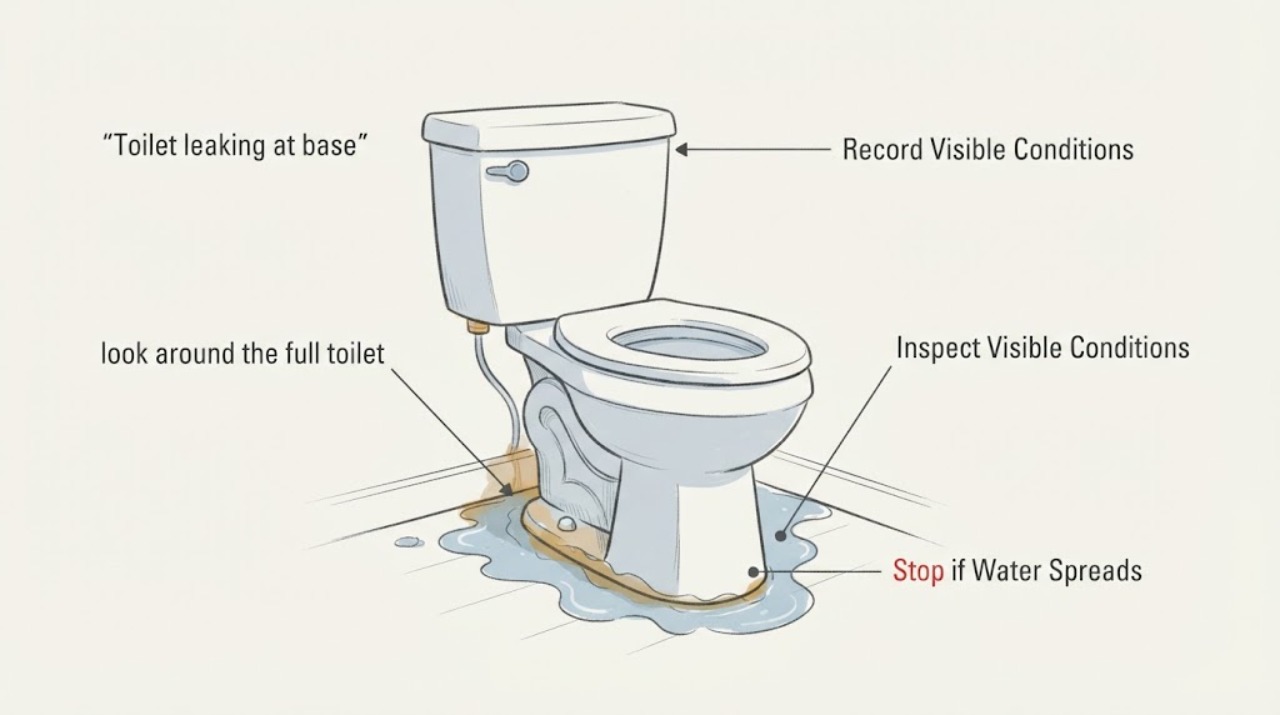
Work through in order
Diagnostic checks
Use only checks that match the exact appliance or system and its official guide.
-
Check 1
From a dry standing position, look around the full toilet base, the rear corners, the tank underside, and the visible supply connection without touching wet surfaces or removing covers.
Expected result: Note the first visible wet point, whether water tracks down porcelain, whether the tank or supply connection is wet, and whether the floor is wet all around or only on one side.
Next step: Photograph the path and keep the toilet out of service while arranging plumber assessment; do not wipe across an uncertain source in a way that spreads possible contamination.
Stop if: Stop immediately if water is spreading toward electrical equipment, the flooring is collapsing or soft, or the source may be sewage or contaminated water.
Why this matters
Why: A wet tank or supply path can imitate a base leak, while water beginning at the bowl-to-floor joint points to a different professional inspection path; the visible path does not confirm the failed seal.
-
Check 2
Record whether the water was first noticed after a flush, while the toilet was unused, after the tank refilled, or during another nearby water event; do not flush to reproduce the leak.
Expected result: Note whether the wet area grows with time while idle, appears only after normal use, or is unrelated to toilet operation.
Next step: Keep the toilet unused and give the timeline to the plumber, including whether the water was clear, stained, or had an odor.
Stop if: Stop observing if the leak becomes active, foul-smelling, or large enough to create a slip hazard; isolate the area and seek urgent service.
Why this matters
Why: Flush-linked water can indicate a bowl-to-floor or bowl-related path, while an idle leak can indicate supply, tank, condensation, or another plumbing source; the timing narrows the technician's inspection.
-
Check 3
Look at the visible bowl, tank, and floor transition for cracks, chips, staining, mold-like growth, a visible gap, or a bowl that appears to move when someone walks nearby; do not rock or press the toilet to test it.
Expected result: Note any porcelain damage, uneven floor transition, soft or swollen flooring, staining beneath trim, or movement that is visible without contact.
Next step: Keep weight and traffic away from the area, photograph the visible condition, and request a plumber or appropriate building professional; do not tighten or remove hardware.
Stop if: Stop and keep clear if the bowl or tank is cracked, unstable, leaking rapidly, or the floor gives way.
Why this matters
Why: A crack, movement, or damaged floor changes the risk beyond a simple seal symptom and may require fixture, flange, flooring, or structural evaluation.
-
Check 4
From a safe position, inspect the visible water-supply shutoff area and flexible connection for active droplets, a loose-looking connection, corrosion, or water that is clearly running down from above; do not turn a stiff valve or disconnect the line.
Expected result: Note whether the connection is dry, damp, actively dripping, or inaccessible, and whether the water reaches the base without starting there.
Next step: Tell the plumber the visible connection status and keep the area clear; if the shutoff is easy to reach without contact with water and the leak is active, follow local emergency plumbing guidance rather than forcing it.
Stop if: Stop if the valve will not move normally, the connection is under pressure, water is spraying, or contact would require stepping into contaminated or electrically hazardous water.
Why this matters
Why: A supply-side observation can redirect service toward the inlet or tank connection, but a dry connection does not rule out a concealed or flush-related base leak.
-
Check 5
Inspect nearby flooring, baseboards, and the room below if it can be viewed safely from an ordinary finished area, without lifting flooring, opening ceilings, or entering a crawlspace.
Expected result: Note staining, swelling, soft spots, odor, ceiling marks below, or a wet area that extends beyond the toilet footprint.
Next step: Limit access and provide the extent and timing to the plumber and, if needed, a water-damage professional; keep wet porous materials undisturbed until advised.
Stop if: Stop and isolate the area for widespread moisture, suspected sewage, mold-like growth with symptoms, structural softening, or water near electrical systems.
Why this matters
Why: Spread beyond the fixture can indicate longer-running water damage or a concealed path, so replacing a visible seal alone may not address the affected building materials.
Use your observations
Decision map
Find the observation that best matches what you see, then follow the next safe action.
-
PATH 01Next step
What you see
Water is active at the base, the source is uncertain, or the floor is wet after a flush.
Do this next
Keep the toilet out of service, limit access, treat the water conservatively as potentially contaminated, and request prompt plumber service.
-
PATH 02Next step
What you see
The tank or visible supply connection is wet and the water appears to run down from above rather than begin at the bowl-to-floor joint.
Do this next
Tell the plumber the observed path and keep the fixture unused; do not disconnect the supply line or force the shutoff.
-
PATH 03Next step
What you see
The bowl appears unstable, the floor is soft or swollen, porcelain is cracked, or the wet area extends into nearby materials.
Do this next
Keep people away and arrange plumbing plus appropriate flooring or building assessment; do not attempt to stabilize, lift, or reseal the toilet yourself.
-
PATH 04Next step
What you see
The area is dry now but a prior base leak is documented or staining/odor remains.
Do this next
Do not resume normal use until a plumber determines the source and the affected floor is assessed; provide the timing, photos, and any prior repair history.
Helpful context
Understand the symptom
Water at the base is a location, not a diagnosis. Water from the tank or supply line can travel down the porcelain and appear at the floor, while a leak that starts at the bowl-to-floor joint may be visible only after flushing. The safest first step is to stop use and document the timing and location without disturbing the toilet.
Keep the distinction between clean water and possible waste water conservative. If the source is uncertain, treat the floor as contaminated, limit access, avoid hand contact, and tell the plumber whether the leak followed flushing or appeared while the toilet was idle.
A rocking bowl, soft flooring, staining, or an expanding wet area can indicate a broader plumbing or building problem. Do not try to stabilize the toilet by forcing hardware or masking the joint with a new seal; the complete assembly and floor condition need professional assessment.
Only after diagnosis
Potential parts
- toilet wax ring
Consider this category only after a plumber confirms the bowl-to-floor seal is the failed component and identifies the toilet/flange configuration.
Confirm toilet type, flange height, floor condition, and local installation requirements; do not assume a universal seal will correct movement or a damaged flange. - toilet closet bolts
Consider this category only if a plumber finds failed or missing securing hardware and confirms that the bowl and flange are otherwise suitable.
Hardware choice depends on the flange, bowl, corrosion condition, and required clearance; do not tighten by feel or use hardware to force a rocking fixture flat. - toilet flange repair ring
Consider this category only after professional inspection confirms a flange or floor-interface defect and selects a compatible repair approach.
Confirm flange material, height, damage, subfloor condition, and local plumbing requirements; a ring is not a substitute for resolving active water damage or unstable flooring.
When checks do not resolve it
Need a professional?
Arrange prompt plumber service for any water at the toilet base, especially when the source is uncertain or the leak follows flushing. Escalate urgently for suspected waste water, rapid flow, soft or collapsing flooring, a cracked or unstable bowl, widespread water damage, or water near electrical equipment.
Safety scope: This is an observation-only guide. Do not flush to test, remove or lift the toilet, loosen closet bolts, disconnect the supply, force the shutoff, scrape contamination, or apply a new seal over an unresolved leak.
Common questions
FAQ
Can I keep using the toilet if the leak is only a few drops?
Do not keep using it to test the leak. Water at the base can be clean supply water or waste-contaminated water, and continued flushing can spread moisture or damage the floor. Arrange prompt plumbing assessment.
Is a toilet base leak always a failed wax ring?
No. Water can run down from the tank or supply connection, and a damaged flange, bowl, floor, or another plumbing source can look similar. Record the first wet point and timing for the plumber.
Should I tighten the bolts if the toilet rocks?
Do not tighten or remove the bolts as a home test. A rocking toilet may involve the bowl, flange, floor, or seal, and forcing hardware can crack porcelain or hide the underlying problem.
What should I do with wet flooring around the toilet?
Keep people and pets away, avoid hand contact with uncertain water, and do not scrape or disturb materials. Report the extent, odor, staining, and any softness to the plumber and water-damage professional.
Read the exact guide
Official sources
- Troubleshooting: Water Leaking From ToiletKohler Co. · Kohler's troubleshooting flow distinguishes tank/bowl and supply connection locations and directs users toward manufacturer or service help; model-specific steps are not generalized here.
- Home MaintenanceU.S. Environmental Protection Agency WaterSense · EPA advises investigating toilet problems and contacting a local plumber when they are not resolved by ordinary maintenance, supporting service escalation for a base leak with an uncertain source.
- Fix a Leak WeekU.S. Environmental Protection Agency WaterSense · EPA WaterSense identifies common toilet leak mechanisms and recommends investigation or licensed plumbing help when toilet problems persist; this article applies those principles to a visible base leak without giving disassembly instructions.
Community feedback
Share a repair observation
Share a plain-text repair observation. Accepted observations are published automatically; this page may take a moment to update.