
On this page
Start here
Quick answer
The assigned condition is the exact text “after water flow is terminated e.” The final “e” is ambiguous, so do not assume it means after a flush, after the toilet shutoff is closed, or after the home's main water is turned off. Treat it as a clue that water is noticed after an incoming flow has stopped: leave the toilet out of use, confirm which valve was closed, dry the area, and locate the first point where water returns. Moisture at the supply connection or shutoff points to the supply side; moisture at the tank-to-bowl joint, tank base, or bowl base points elsewhere. Do not repeatedly restore water, force a valve, remove a supply line, or press on porcelain. If water continues, the valve will not isolate the toilet, the tank or bowl is cracked, water is contaminated, or water reaches electrical equipment or a ceiling below, call a qualified plumber promptly.
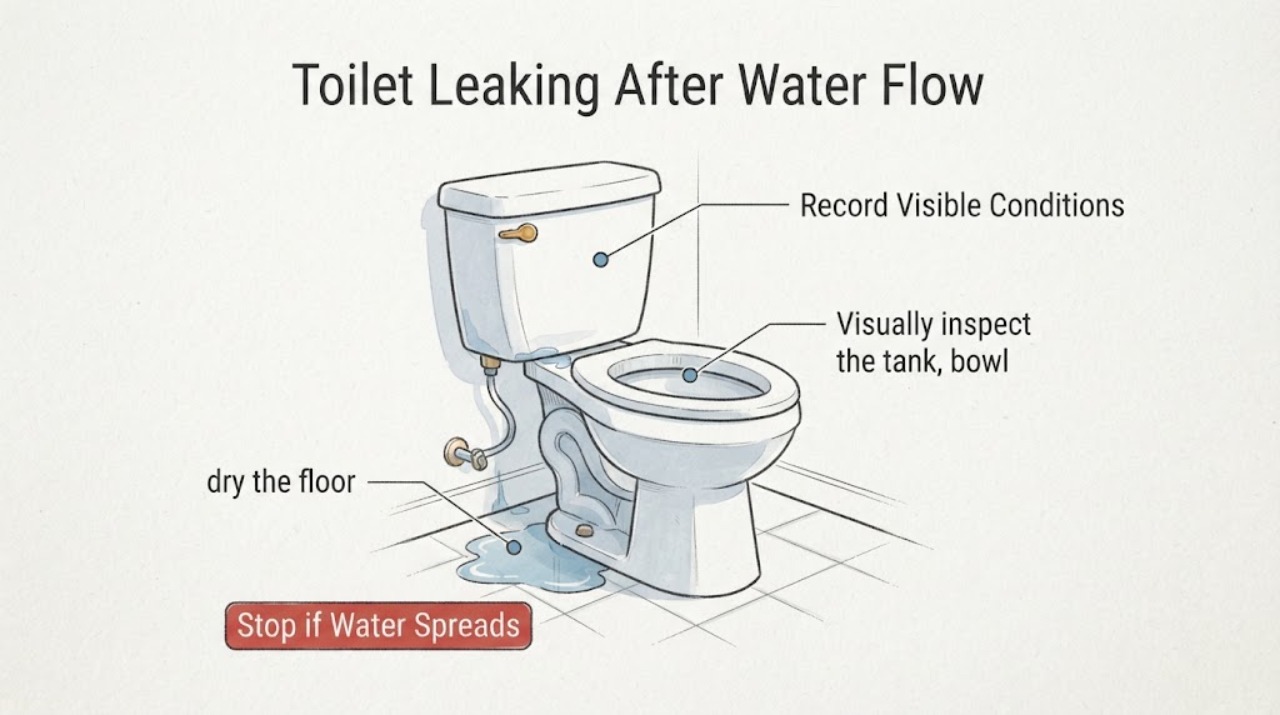
Work through in order
Diagnostic checks
Use only checks that match the exact appliance or system and its official guide.
-
Check 1
Write down exactly what “water flow is terminated” meant in this incident: the toilet's fixture valve, the home's main valve, a flush ending, another fixture stopping, or an unknown event. If the toilet valve is accessible and turns normally, close it gently clockwise; do not force it or flush.
Expected result: Water that stops after the toilet valve closes supports an incoming toilet-side source. Water that continues, or a valve that does not move or isolate, keeps stored water, an upstream supply, or another source in scope.
Next step: Keep the toilet out of use and record the valve response. Call a plumber if the valve is stiff, leaks when touched, will not close, or water continues after isolation.
Why this matters
Why: The trailing “e” is not enough to identify the event, so the exact shutoff context is a required first observation.
-
Check 2
After the known water source is isolated, dry the floor and the outside of the toilet. Place clean dry tissue against the shutoff body, supply connections, tank inlet, tank-to-bowl seam, and bowl base without loosening or tightening anything.
Expected result: The first tissue to become wet at the shutoff or supply connection supports a valve, line, or connection seal. Wetness beginning at the tank seam supports a tank gasket or mounting seal. Wetness beginning at the base or wall points elsewhere.
Next step: Note the location and keep water isolated. Do not remove the tank, disconnect a line, or restore pressure to repeat a leak that has already been localized.
Why this matters
Why: The first wet point distinguishes a leak that merely collects near the toilet valve from one that begins at the valve itself.
-
Check 3
Visually inspect the tank, bowl, shutoff valve, and supply line for cracks, chips, movement, corrosion, mineral tracks, bulges, or water running down from above. Do not press on porcelain or touch a wet fitting.
Expected result: A crack, shifting tank, damaged line, or corroded valve is a stop condition. An intact tank with water first appearing at its joint keeps a gasket or mounting seal in scope, while a clean tank with a wet base points to another branch.
Next step: Leave the supply off and call a plumber for any crack, movement, active corrosion, or persistent seepage. Do not tighten hardware by guesswork.
Why this matters
Why: Visible structural or connection damage changes the response from a gasket check to immediate plumbing service.
-
Check 4
Check whether the event is an external leak or water silently passing from the tank into the bowl by listening for refill noise and observing the bowl surface without reaching into the tank. Do not disturb the fill valve, trip lever, flapper, or flush seal.
Expected result: A ripple or steady flow into the bowl with no outside wetness is an internal running-toilet branch. Water on the floor, valve, supply line, or porcelain exterior is an external leak branch.
Next step: Keep the supply off if internal flow persists or an external leak is also present, and request model-specific plumber or manufacturer guidance.
Why this matters
Why: A leak noticed after water flow stops may be residual or internal flow rather than a failed shutoff valve or tank gasket.
-
Check 5
Look at the surrounding wall, baseboard, floor edge, ceiling below if safely visible, and nearby fixtures for a shared source. Note whether water appears only after another fixture runs or after the home supply is restored; do not restore water solely as a test.
Expected result: Water that begins away from the toilet or follows another fixture keeps a concealed supply, drain, or neighboring fixture in scope. A wet ceiling, expanding wall stain, or water near electrical equipment raises the urgency.
Next step: Stop using the affected fixtures, keep water away from electrical equipment, and call a plumber for a concealed, cross-fixture, drain, or structural source.
Why this matters
Why: The toilet may be where water collects after a flow event rather than where the leak originates.
-
Check 6
Prepare a service note without repeating the flow event: preserve the exact condition text, identify which flow was stopped, record the first wet point and time delay, valve behavior, water cleanliness, tank and base observations, and whether the area below or nearby fixtures were affected.
Expected result: A valve-body result supports shutoff service; a line-end result supports supply-line service; a tank-joint result supports gasket or tank-hardware inspection; a base or remote result supports bowl, drain, or concealed-pipe investigation.
Next step: Keep the toilet isolated and give the note to a qualified plumber. Do not restore water until the leak source and safety condition are understood.
Why this matters
Why: Recording the ambiguity and the delay prevents a plumber from treating an inferred “after flush” event as established fact.
Use your observations
Decision map
Find the observation that best matches what you see, then follow the next safe action.
-
PATH 01Safety boundary
What you see
It is unknown whether the condition refers to the toilet valve, main water, a flush, another fixture, or an incomplete phrase ending in “e.”
Do this next
Preserve the exact wording, keep the toilet out of use, and use only safe external observations to identify the first wet point before any repair decision.
Why this path and its safety boundary
Why it matters: The event cannot safely be mapped to a specific repair branch.
Safety stop: Do not infer a flush or force a valve to recreate the event.
-
PATH 02Safety boundary
What you see
The shutoff valve is stiff, damaged, leaks around its body, or does not stop water when gently closed.
Do this next
Stop using the toilet, isolate the home's main supply only if safely accessible, and call a plumber.
Why this path and its safety boundary
Why it matters: The fixture cannot be safely isolated and the valve or upstream supply is in plumber scope.
Safety stop: Do not force the handle, remove the valve, disconnect the supply line, or work in standing water near electricity.
-
PATH 03Safety boundary
What you see
The first wet point returns at the shutoff body, wall/floor connection, supply line, or tank inlet after the flow is stopped.
Do this next
Keep the water isolated and have a plumber inspect the supply path without restoring pressure for repeated testing.
Why this path and its safety boundary
Why it matters: The valve, supply line, connector seal, or tank inlet is more likely than a tank-to-bowl gasket.
Safety stop: Do not loosen, disconnect, repack, seal, or replace the connection as a guess.
-
PATH 04Safety boundary
What you see
The first wet point is the tank-to-bowl seam or tank mounting area and the supply path remains dry.
Do this next
Leave the water off and arrange a model-appropriate plumber inspection of the joint and ceramic.
Why this path and its safety boundary
Why it matters: A tank gasket, mounting seal, hardware alignment, or porcelain condition is in scope; the leak is not established as a shutoff issue.
Safety stop: Do not overtighten tank hardware, remove the tank, or press on a cracked or shifting tank.
-
PATH 05Safety boundary
What you see
Water first appears at the bowl base, wall, floor edge, ceiling below, or only after another fixture runs.
Do this next
Stop using the toilet and related fixtures, keep water away from electrical equipment, and call a plumber.
Why this path and its safety boundary
Why it matters: A bowl seal, porcelain crack, drain, concealed pipe, or neighboring fixture may be involved; the timing after flow stops does not prove a toilet tank leak.
Safety stop: Do not lift the toilet, disturb a floor seal, enter contaminated water, or open a wall as a casual check.
-
PATH 06Safety boundary
What you see
Water continually moves from the tank into the bowl but no outside surface becomes wet.
Do this next
Keep the supply off if the flow persists and use exact manufacturer guidance or plumber service.
Why this path and its safety boundary
Why it matters: This is an internal fill, overflow, trip-lever, or flush-seal branch rather than proof of a leaking shutoff valve.
Safety stop: Do not repeatedly flush, add cleaners, or manipulate internal parts while an external leak or water-damage risk exists.
Helpful context
Understand the symptom
The condition text is “after water flow is terminated e.” That wording preserves an unknown event: the trailing “e” may be a typo, abbreviation, or unfinished phrase. Do not convert it into “after flushing” or “after closing the main.” Instead, record what was actually stopped and trace where moisture returns after the area is dry.
Water can run down porcelain or a supply line and collect at a lower point after the active flow has ended. The shutoff valve, supply connection, tank inlet, tank-to-bowl seam, and bowl base are different branches. A tank gasket is relevant only when the wet point supports the tank joint, not merely because the puddle is nearby.
Keep the investigation low force and sanitary. Do not press on cracked porcelain, repeatedly restore water to reproduce a leak, or work in sewage-contaminated water. EPA WaterSense recommends prompt attention to household leaks and directs persistent or unclear toilet problems toward plumbing help.
Safety boundary
Stop conditions
- Stop and isolate water when the valve will not close normally, water continues after isolation, the tank or bowl is cracked or moving, water reaches the floor or ceiling below, or electrical equipment may be wet.
- Do not force a shutoff, restore water repeatedly to reproduce the symptom, disconnect a pressurized supply line, remove the tank or toilet, overtighten porcelain hardware, or press on a cracked fixture.
- Treat sewage or contaminated water, flooding, structural damage, and wet electrical equipment as professional or emergency conditions. Keep people and pets away and do not use the toilet until the source is addressed.
Only after diagnosis
Potential parts
- toilet shutoff valve
Consider this only after a plumber confirms that the valve body or its connection is the first wet point and the upstream pipe can be safely serviced.
Valve type, connection, pipe material, access, and local requirements must be confirmed before selection. - toilet supply line
Consider this only when the first wet point is the supply line or connector and a plumber confirms the line or seal is the source.
Connection type, length, valve condition, and model-specific fit must be verified before replacement. - tank-to-bowl gasket
Consider this only when water is confirmed at the tank-to-bowl joint and the tank, bowl, hardware, and porcelain are sound.
Gasket shape and mounting hardware are model-specific; a gasket cannot correct cracked or distorted porcelain.
Common questions
FAQ
What does “after water flow is terminated e” mean?
The final “e” is ambiguous, so preserve the condition exactly and identify what flow was stopped. Do not assume it means after flushing or after closing a specific valve.
Why can a toilet appear to leak after the water has stopped?
Water may travel along a supply line or porcelain and collect later, or stored water may drain from a tank or bowl. Dry the surfaces and trace the first place that becomes wet.
Does water near the shutoff valve mean the shutoff valve failed?
Not necessarily. A leak can begin at the supply connection, tank inlet, tank-to-bowl seam, bowl base, wall, or floor and run down to the valve.
What should I do if the leak continues after the toilet valve is closed?
Stop using the toilet, do not force or disassemble the valve, and call a plumber. Continuing water may be stored, upstream, concealed, or evidence that the valve did not isolate.
Read the exact guide
Official sources
- Fix a Leak WeekU.S. Environmental Protection Agency · Household leak identification, toilet leak testing, water-line shutoff, and plumbing escalation
- Troubleshooting: Water Leaking From ToiletKohler · Toilet leak location, water-supply connection, tank-and-bowl joint, tank gasket, valve isolation, porcelain condition, and service escalation
- Toilet Constantly Leaking or RunningKohler Assist · Internal running-toilet symptoms, fill valve, overflow, trip lever, and flush-seal distinctions
- Home MaintenanceU.S. Environmental Protection Agency · Household leak monitoring, toilet maintenance, water damage awareness, and plumber escalation
Community feedback
Share a repair observation
Share a plain-text repair observation. Accepted observations are published automatically; this page may take a moment to update.