
On this page
Start here
Quick answer
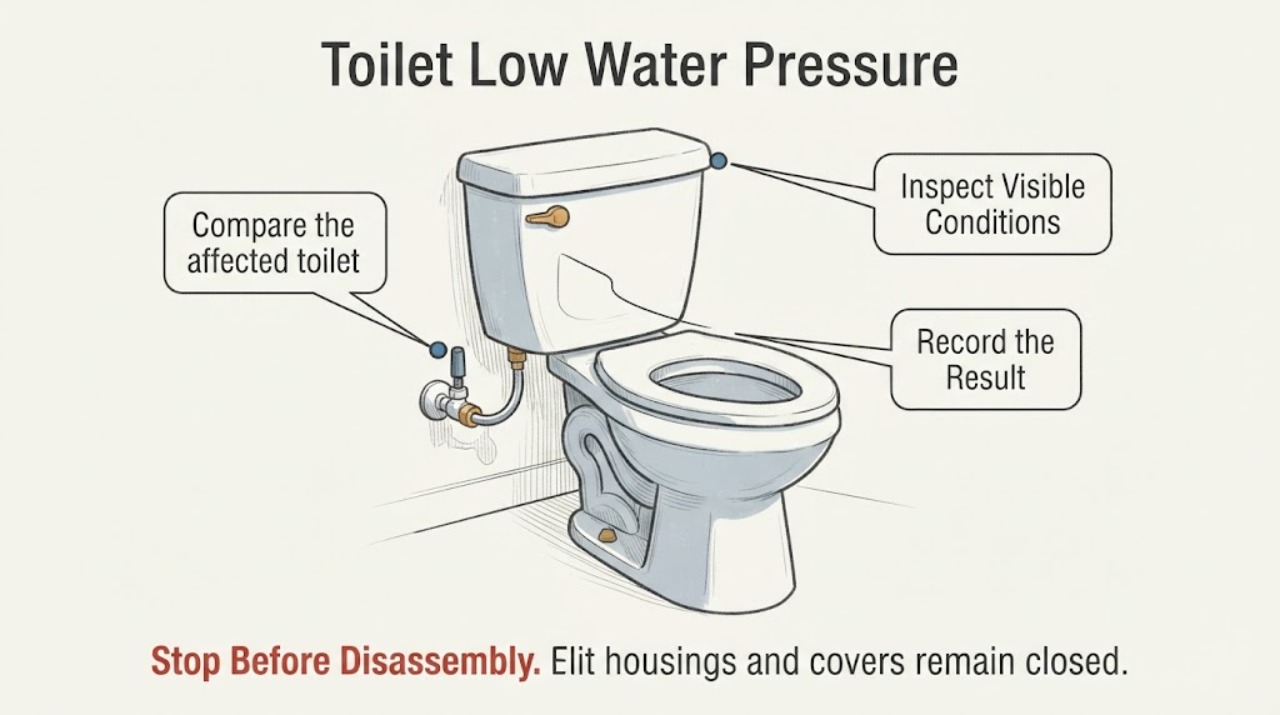
Toilet low water pressure usually appears as a slow tank refill, a low tank level, or a weak flush, but those symptoms can also come from a partly closed supply stop, a kinked or restricted supply line, a fill-valve inlet, a low tank setting, blocked rim or trapway, or low pressure in the home. Compare this toilet with another fixture first, then make only safe external checks. Confirm the toilet supply stop is open without forcing a stiff valve, inspect the hose for kinks or dampness, and look inside the tank for the marked water line and a normal refill. Do not use a drain chemical, force a corroded valve, remove a pressurized connection, or continue flushing an overflowing bowl. Call a plumber for low pressure throughout the home, a damaged shutoff or hose, a tank crack, persistent weak flush, or any leak or sewage backup.
Work through in order
Diagnostic checks
Use only checks that match the exact appliance or system and its official guide.
-
Check 1
Compare the affected toilet with a nearby sink or another toilet by running each fixture briefly at a normal, safe flow. Do not keep flushing the affected toilet if the bowl rises or drains slowly.
Expected result: Only this toilet has slow refill or weak flush, or several fixtures have weak flow at the same time.
Next step: Use the local-toilet checks for a single fixture. For several fixtures, reduce water use and arrange plumbing service rather than changing the toilet tank parts first.
Why this matters
Why: A single affected toilet points toward its supply stop, hose, inlet, fill valve, tank level, or local flush path. Several affected fixtures point toward a building shutoff, regulator, supply interruption, or wider plumbing issue.
-
Check 2
Look at the toilet supply stop and confirm the handle is in its normal open position. If it turns easily and the area is dry, open it gently as directed by the valve design; do not force a stiff, corroded, or leaking stop.
Expected result: The stop was partly closed, turns normally and is now open, or it is stiff, damaged, or damp at the stem or connection.
Next step: If the stop is now fully open and dry, observe one refill. If it is stiff, damaged, or leaking, close it only if it can be done safely and call a plumber; do not remove it under pressure.
Why this matters
Why: A partly closed stop can limit tank refill. A stiff or leaking stop may fail when operated and needs professional attention rather than force.
-
Check 3
Inspect the visible supply hose from the stop to the tank without loosening either end. Look for a sharp kink, crushing, corrosion, bulging, or moisture at a connection.
Expected result: The hose is kinked or damaged, a connection is wet, or the hose is straight and dry.
Next step: Do not bend a corroded hose or tighten a wet connection as a test. Keep the stop closed if water is actively leaking and call a plumber; otherwise continue with the no-disassembly tank observation.
Why this matters
Why: A kink or damaged connector can restrict flow or leak. A straight, dry hose makes a tank inlet, fill-valve, pressure, or flush-path issue more likely, but it does not clear the internal valve.
-
Check 4
With the lid lifted carefully and the toilet idle, observe the tank water level, the marked water line or overflow reference, the float movement, and the refill stream after one normal flush. Keep hands out of moving parts and do not remove the valve cap.
Expected result: The tank stops below its marked line, refills very slowly, refills with a weak or noisy stream, the float catches, or the tank reaches the line normally.
Next step: If the tank level is low, use only the exact adjustment described in the toilet manual and do not raise water above the overflow reference. If filling remains slow, noisy, or incomplete, call a plumber rather than dismantling the valve.
Why this matters
Why: A low stopping level or slow stream can limit flush volume and can involve the supply path, inlet, or fill valve. A catching float can interrupt filling. A normal tank level and refill shift attention toward bowl, rim, trapway, waste pipe, or vent conditions.
-
Check 5
Observe one flush only if the bowl is at a normal level and the toilet drains freely. Watch whether water enters the bowl from the rim, whether the bowl clears, and whether the tank refills to its line.
Expected result: The tank refills normally but the bowl has a weak swirl or incomplete clear, the bowl rises, or the flush and refill both behave normally.
Next step: Stop flushing if the bowl rises or drains slowly and call a plumber. If the tank and bowl both behave normally but the complaint remains intermittent, record when it occurs and arrange a model-specific evaluation.
Why this matters
Why: Normal tank refill with a weak flush points away from household pressure and toward the rim holes, trapway, waste pipe, vent, flush valve, or bowl level. A rising bowl indicates a blockage risk and should not be tested with more flushes.
-
Check 6
Check for a silent loss of tank water by marking the level with the lid off, closing the supply stop only if it operates safely and the toilet is not leaking, and observing later without disturbing the tank. Do not perform this if the stop is corroded or the tank is unstable.
Expected result: The tank level falls while the supply is closed, or it stays at the mark but the tank still fills slowly when the supply is open.
Next step: Call a plumber for a persistent internal leak, a valve that will not close, or any wet connection. Do not add in-tank chemicals or dismantle the tank assembly to chase the symptom.
Why this matters
Why: A falling level indicates water is leaving through a flush-valve seal or another internal path, so the fill valve is replacing lost water rather than showing simple low pressure. A stable level with slow refill keeps the supply, inlet, fill valve, or home-pressure path in focus.
Use your observations
Decision map
Find the observation that best matches what you see, then follow the next safe action.
-
PATH 01Next step
What you see
Several fixtures have weak flow or the whole home has low pressure.
Do this next
Arrange qualified service and follow the exact model guidance.
Why this path and its safety boundary
Why it matters: Treat this as a supply or building plumbing issue rather than a toilet tank adjustment. Limit water use and call a plumber or the appropriate water provider; do not alter a regulator or main valve without qualified guidance.
-
PATH 02Next step
What you see
Only this toilet is affected and the supply stop was partly closed, with no leak or damage.
Do this next
Arrange qualified service and follow the exact model guidance.
Why this path and its safety boundary
Why it matters: Open the stop gently if it operates normally, then observe one refill. If flow remains weak, call a plumber for the stop, hose, inlet, fill valve, or local restriction.
-
PATH 03Next step
What you see
The stop or hose is stiff, corroded, wet, bulging, or leaking.
Do this next
Arrange qualified service and follow the exact model guidance.
Why this path and its safety boundary
Why it matters: Do not force or remove it. Close the stop only if it can be operated safely without worsening the leak, protect the floor, and call a plumber.
-
PATH 04Next step
What you see
The tank stops below its marked line, the float catches, or the refill remains slow or noisy.
Do this next
Arrange qualified service and follow the exact model guidance.
Why this path and its safety boundary
Why it matters: Use only a model-specific tank-level adjustment that is clearly allowed by the manual. If the level or refill cannot be restored without valve disassembly, obtain plumbing service.
-
PATH 05Next step
What you see
The tank reaches its line and refills normally, but the flush is weak or the bowl rises.
Do this next
Arrange qualified service and follow the exact model guidance.
Why this path and its safety boundary
Why it matters: Do not keep flushing or add chemical drain cleaner. A rim, trapway, waste-pipe, vent, or bowl-path restriction needs safe plumbing diagnosis; call a plumber if the bowl rises or drains slowly.
-
PATH 06Next step
What you see
The tank level falls while the supply is closed or the fill valve cycles without a flush.
Do this next
Arrange qualified service and follow the exact model guidance.
Why this path and its safety boundary
Why it matters: Treat it as an internal tank leak or seal problem, not simply low pressure. Keep the supply closed when appropriate and arrange a plumber inspection.
-
PATH 07Next step
What you see
The toilet tank, bowl, floor, or nearby wall is cracked, unstable, contaminated by sewage, or exposed to uncontrolled water.
Do this next
Arrange qualified service and follow the exact model guidance.
Why this path and its safety boundary
Why it matters: Stop using the toilet, keep people away, protect the floor only if safe, and call urgent plumbing service. Do not lift, tilt, or dismantle a damaged fixture.
Helpful context
Understand the symptom
“Low water pressure” is not one toilet failure. A tank toilet stores most of its flush water, so a low tank level can weaken the flush even when the home supply is normal. A slow refill can point to the supply stop, hose, inlet, or fill valve. If the tank reaches its marked line but the bowl still clears poorly, the rim holes, trapway, waste pipe, or vent may be the limiting path instead.
Start with comparison and observation rather than a pressure adjustment. A single affected toilet suggests a local restriction or valve issue; several fixtures with weak flow suggest a building supply, shutoff, regulator, or utility issue. Exact pressure figures vary by toilet design and should not be guessed from a generic chart.
Keep the tank lid supported and the floor dry while observing. Do not remove a supply connection, force an old valve, add a chemical cleaner, or reach into sewage. A plumber can measure pressure, inspect the fill assembly, clear a safe branch blockage, and assess the waste path without turning a small flow problem into a leak.
Safety boundary
Stop conditions
- An active leak, burst hose, cracked tank or bowl, unstable toilet, or water reaching electrical equipment: stop using the toilet, keep clear, and obtain urgent plumbing help.
- The bowl rises, drains slowly, overflows, or shows sewage backup: stop flushing, keep people away from contaminated water, and call a plumber.
- A supply stop or connector is stiff, corroded, or leaking, or a tank valve requires disassembly: do not force or remove it under pressure; leave it for a plumber.
Only after diagnosis
Potential parts
- toilet fill valve
Consider only if a plumber or model-specific diagnosis confirms that the valve inlet, float, or fill mechanism is restricting refill or stopping below the proper line.
Confirm the exact toilet model, valve arrangement, water-level reference, and manufacturer fit information before selecting a part. - toilet supply stop or connector
Consider only if the external stop or connector is confirmed damaged, restricted, corroded, or unable to open safely.
A plumber must confirm connection type, pipe condition, shutoff location, and leak risk; do not choose a replacement by appearance alone. - flush valve seal or flapper
Consider only if a controlled tank-level observation confirms that water is leaving the tank without a flush and the seal is the diagnosed cause.
Confirm the toilet's flush-valve design and exact model before selecting a seal; avoid in-tank chlorine products that can damage fittings.
Common questions
FAQ
Does a weak toilet flush always mean low household water pressure?
No. A low tank level, partly closed stop, restricted hose or fill valve, blocked rim or trapway, or waste-path issue can produce a weak flush. Compare another fixture and observe the tank level before calling it a whole-home pressure problem.
How can I tell whether the tank is the problem?
Observe whether the tank refills slowly, stops below its marked line, has a catching float, or loses water when the supply is safely closed. If the tank reaches its line and refills normally, the bowl or waste path may be limiting the flush instead.
Can I force the toilet shutoff valve open?
No. A stiff or corroded stop can begin leaking or fail when forced. Leave it alone and call a plumber, especially if the stem or connection is damp.
What if the bowl rises while I am checking the flush?
Stop flushing immediately. A rising or slow-draining bowl can indicate a blockage or waste-path problem. Keep people away from contaminated water and call a plumber rather than adding chemical cleaner.
Read the exact guide
Official sources
- 6. TROUBLESHOOTINGKohler · Toilet tank level, supply stop, pressure, poor flush, fill-valve, flush-valve, and local waste-path troubleshooting
- สุขภัณฑ์ชิ้นเดียวKohler · Official one-piece toilet installation and troubleshooting guidance for supply stop, tank refill, low water, poor flush, and overflow boundaries
Community feedback
Share a repair observation
Share a plain-text repair observation. Accepted observations are published automatically; this page may take a moment to update.