
On this page
Start here
Quick answer
If a toilet has low refill flow after a mixed tap was installed, first confirm whether the restriction is only at the toilet or affects the cold supply elsewhere. Look for a partially closed toilet isolation valve, a kinked or strained supply hose, a disturbed stop tap, a leak, or a new pressure drop when the mixed tap is used. From a dry position, compare the toilet refill with the cold kitchen tap and other fixtures, and note whether neighbors are affected. Do not remove the mixer cartridge, disconnect a pressurized hose, alter a check valve, or force a stiff valve. If the toilet supply is the only weak point, the newly installed tap may have disturbed a local valve or branch; if the whole property is weak, contact the water supplier or a plumber. Shut the local valve if water is actively leaking and it is safe to reach, then arrange plumbing service.
Before you begin
Safety first
- Keep fittings intact and stop for leaks, spreading water, hot or discolored water, pipe movement, or water near electrical equipment. Pressurized-line, hidden-pipe, valve, cartridge, and shared-branch work belongs to a qualified plumber.
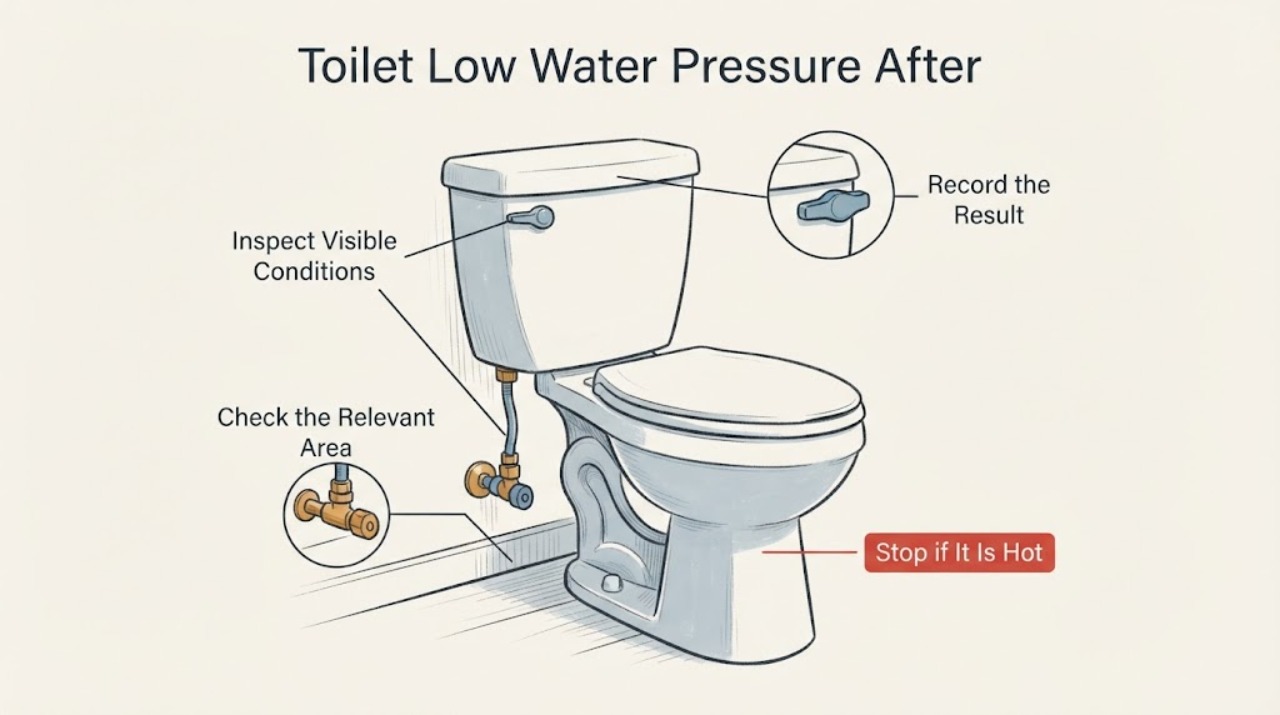
Work through in order
Diagnostic checks
Use only checks that match the exact appliance or system and its official guide.
-
Check 1
From a dry position, look at the toilet supply connection, isolation valve, visible hose, nearby mixed-tap connections, cabinet or floor, and ceiling below for active drips, pooling, dampness, bulging material, or water near electrical equipment; do not loosen a fitting or touch a wet electrical item.
Expected result: A joint is actively leaking, the hose or valve is wet, water is spreading, or the area is dry with no visible leak.
Next step: If water is actively escaping and the local isolation valve is safe and easy to reach, close it without force, protect the area, and call a plumber. If water is near electrical equipment, keep clear and arrange appropriate urgent help.
Stop if: Stop for active spray, a burst hose, spreading water, a valve that will not close, ceiling damage, or water near electrical equipment.
Why this matters
Why: Low refill flow may be caused by a valve or hose disturbance from the tap installation, while active water can quickly create property damage and may make the pressure symptom secondary.
-
Check 2
With no fitting disconnected, run the cold kitchen tap briefly and observe whether its flow is normal, weak, or absent; compare it with another cold outlet and the toilet's refill behavior, while noting whether the mixed tap is open or closed.
Expected result: The cold kitchen tap is normal while the toilet is weak, all cold outlets are weak, or flow changes when the mixed tap is used.
Next step: Record the comparison and keep the toilet and mixed-tap fittings intact. Use the local branch path for a plumber, or contact the water supplier when the whole property or neighborhood is affected.
Stop if: Stop if opening a tap causes a leak, water hammer, unusual vibration, or water near electrical equipment.
Why this matters
Why: Normal kitchen flow with a weak toilet points toward internal toilet or bathroom plumbing. Weak flow at several outlets suggests a stop tap, property supply, demand, or water-network issue; a change when the mixed tap runs suggests a shared branch or installation-related restriction that needs inspection.
-
Check 3
Look at the toilet's visible isolation valve and supply hose without disconnecting them; note whether the valve handle or lever appears partly closed, the hose is sharply kinked or crushed, the connection is strained, or the valve and hose look open and intact. Do not force a stiff valve or loosen the hose.
Expected result: The valve is not fully open, the hose is kinked or strained, the connection is wet, or the visible supply path looks open and intact.
Next step: If the valve moves freely and its design clearly permits a gentle open position, follow the fitting instructions without force; otherwise leave it and call a plumber. Do not remove the hose or disassemble the valve to search for debris.
Stop if: Stop for a stiff or corroded valve, a wet connection, a damaged hose, spray, or any need to disconnect a pressurized line.
Why this matters
Why: A partially closed valve or restricted hose can limit toilet refill flow after nearby plumbing work. A clear-looking path does not rule out debris, an internal valve problem, or a hidden restriction.
-
Check 4
Observe the toilet refill and the mixed tap separately: note whether the toilet is slow only while the mixed tap is running, whether hot and cold flow at the tap differ sharply, and whether the toilet remains weak when the tap is closed; do not remove the tap handle or cartridge.
Expected result: The toilet slows only during mixed-tap use, remains weak when the tap is closed, or the tap itself has abnormal flow after installation.
Next step: Record the exact relationship and ask the plumber to inspect the new tap connections, isolation valves, branch arrangement, and toilet supply without assuming a failed cartridge.
Stop if: Stop if the tap leaks, the water temperature is unexpectedly hot at a cold fixture, water discolors, or a connection needs to be opened.
Why this matters
Why: A shared-branch restriction, a valve left partly closed during installation, or a local mixer installation issue is possible. A toilet that remains weak with the tap closed points more toward the toilet branch or wider supply than normal simultaneous demand alone.
-
Check 5
Locate the property's internal stop tap or stopcock and observe its position and access without removing covers or forcing the handle; if it is clearly partly closed and moves normally, follow its normal operating direction to open it gently, then observe the toilet refill again.
Expected result: The stop tap is partly closed, fully open, inaccessible, stiff, or the toilet remains slow after a gentle documented adjustment.
Next step: Do not force or dismantle the stop tap. If it is stiff, inaccessible, leaking, or the pressure remains low, arrange plumber service; if several properties are affected, contact the water supplier as well.
Stop if: Stop for a leaking, seized, damaged, or inaccessible stop tap, or any need to remove a cover or apply force.
Why this matters
Why: A partly closed internal stop tap can reduce flow to the property, while a fully open or stiff stop tap shifts attention to the branch, valve, supply, or network. A slow toilet after the adjustment is not proof that the mixed tap cartridge is at fault.
-
Check 6
Record the time of day and whether showers, laundry, irrigation, or other high-demand use is occurring; ask a neighbor or building contact whether their cold-water pressure is also low, without entering another property or altering a shared valve.
Expected result: Pressure is worse during high demand, improves late at night, only this property is affected, or nearby properties report the same issue.
Next step: Repeat the safe comparison at a quieter time if there is no leak or hazard. Contact the water supplier for a wider network pattern; contact a plumber for a property-only problem or an issue that began after the mixed-tap installation.
Stop if: Stop if pressure changes cause leaks, pipe movement, water hammer, or water near electrical equipment.
Why this matters
Why: Demand and network conditions can change pressure, while a single-property problem points more toward internal plumbing. A shared low-pressure report makes a water-supplier issue more likely than a toilet part failure.
-
Check 7
Prepare a service note with the mixed-tap installation date, toilet refill timing, cold-kitchen and other-outlet comparisons, stop-tap position, toilet valve and hose appearance, tap-open versus tap-closed behavior, leaks, water color or temperature changes, time-of-day pattern, and neighbor observations; leave all pressurized connections intact.
Expected result: The toilet remains slow, the symptom began after installation, a valve or hose is suspect, or diagnosis would require opening the tap, hose, stop tap, wall, or shared branch.
Next step: Arrange a qualified plumber for the installation and toilet branch; contact the water supplier when the comparison shows a wider supply issue. Keep fittings closed and do not use a part as a substitute for diagnosis.
Stop if: Stop user diagnosis when any pressurized line, valve body, mixer cartridge, wall connection, shared branch, or hidden pipe would need access.
Why this matters
Why: The remaining possibilities include a local isolation or supply-hose restriction, debris or valve disturbance, shared-branch interaction, stop-tap issue, property pressure problem, or a water-network condition.
Use your observations
Decision map
Find the observation that best matches what you see, then follow the next safe action.
-
PATH 01Next step
What you see
A toilet hose, isolation valve, mixed-tap connection, floor, or ceiling below is actively wet or leaking.
Do this next
Close the nearest accessible valve without force if safe, keep clear of water near electrical equipment, protect the area, and call a plumber.
Why this path and its safety boundary
Why it matters: The recent installation may have disturbed a connection, and continued flow can cause damage.
-
PATH 02Next step
What you see
The cold kitchen tap and other outlets are normal, but the toilet refills slowly.
Do this next
Have a plumber inspect the visible valve, hose, new tap connections, and branch without disconnecting pressurized fittings yourself.
Why this path and its safety boundary
Why it matters: The restriction is likely in the toilet branch, isolation valve, supply hose, fill valve, or a local connection affected by the tap installation.
-
PATH 03Next step
What you see
The toilet slows when the mixed tap is used, or the tap and toilet share a branch affected by the installation.
Do this next
Stop balancing or dismantling the tap and arrange plumbing inspection of the new connections and branch arrangement.
Why this path and its safety boundary
Why it matters: A partly closed valve, installation restriction, or shared-branch interaction is possible; the mixed tap cartridge is not proven to be the cause.
-
PATH 04Next step
What you see
Several cold outlets are weak, the internal stop tap is partly closed or stiff, or only this property has low flow.
Do this next
Do not force the stop tap; arrange plumber service and provide the outlet comparison and installation history.
Why this path and its safety boundary
Why it matters: A property stop-tap, supply, or internal plumbing issue is more likely than a toilet-only part fault.
-
PATH 05Next step
What you see
Neighbors report low pressure or the problem follows time-of-day demand and improves when demand falls.
Do this next
Contact the water supplier with the time and scope pattern; use a plumber if the network is normal but this property remains affected.
Why this path and its safety boundary
Why it matters: A water-network or demand-related pressure condition may be affecting the toilet and other outlets.
Helpful context
Understand the symptom
The installation timing changes the first check
A mixed tap can be installed near a bathroom branch, but the toilet may be fed by a separate cold line. A toilet that fills slowly after the work could have a local isolation valve that is not fully open, a hose that is kinked or under strain, debris in a valve, or a wider supply change. The timing is a lead, not proof that the tap cartridge or a hidden pipe is faulty.
Compare points before touching fittings
The most useful safe split is local versus wide: compare the toilet with the cold kitchen tap, another cold outlet, and the mixed tap's own flow. Also note whether the pressure drops only when the mixed tap is opened. Water UK recommends using a cold kitchen tap and neighbors to distinguish internal plumbing from a water-network issue; WaterSafe notes that time of day and demand can change pressure.
Keep the water path intact
Do not loosen a supply hose, remove the mixed tap cartridge, dismantle a valve, or force a handle that will not move. If a joint is wet or water is running, close the nearest accessible isolation valve without forcing it and protect the floor. A persistent leak, a valve that will not close, or a pressure problem that began after the installation belongs with a qualified plumber.
Safety boundary
Stop conditions
- Stop for an active leak, burst hose, spreading water, a valve that will not close, ceiling damage, or water near electrical equipment.
- Do not disconnect a pressurized hose, remove a mixer cartridge, dismantle a valve, alter a check valve, open a wall or shared branch, or force a stiff stop tap.
- Stop if water becomes unexpectedly hot at a cold fixture, changes color, smells unusual, or appears to flow backward; isolate only when safe and arrange plumbing or water-supplier advice.
- Stop if pipe movement, water hammer, vibration, or a new leak occurs after a valve or tap is operated.
- If water damage is rapidly spreading or electrical equipment is wet, keep clear and use the appropriate urgent local service.
Only after diagnosis
Potential parts
- toilet isolation valve or supply hose
Consider this only if a plumber confirms that the visible toilet supply valve or hose is restricted, damaged, or leaking after the installation.
Match the connection type, dimensions, pressure rating, and local plumbing requirements after professional identification. - toilet fill valve
Consider this only if the toilet branch has adequate supply but the fill valve restricts refill flow or fails after the branch is confirmed clear.
Confirm the toilet model, inlet connection, height, and approved replacement before selecting a valve. - mixer-tap cartridge or isolation component
Consider this only if a plumber finds that the new mixed tap or its isolation arrangement restricts flow or creates the observed toilet interaction.
Identify the exact tap and connection configuration first; do not assume cartridges or valves are interchangeable.
When checks do not resolve it
Need a professional?
The toilet is the only weak outlet after the mixed-tap installation and a visible valve or hose restriction is suspected., The toilet slows whenever the mixed tap runs, or the new tap itself has abnormal hot or cold flow., Several outlets are weak, the stop tap is stiff or leaking, or only this property is affected after a wider supply check., Neighbors are also affected or pressure follows demand and time of day, requiring water-supplier follow-up., Diagnosis would require disconnecting a pressurized line, removing a cartridge, opening a wall or shared branch, or changing a valve.
Safety scope: Keep fittings intact and stop for leaks, spreading water, hot or discolored water, pipe movement, or water near electrical equipment. Pressurized-line, hidden-pipe, valve, cartridge, and shared-branch work belongs to a qualified plumber.
Common questions
FAQ
Why did toilet flow become weak after installing a mixed tap?
The timing can point to a partly closed valve, kinked hose, disturbed branch, or a pressure interaction, but it does not prove the mixer cartridge is faulty. Compare the toilet with cold outlets and note whether the mixed tap changes the refill flow.
How can I tell whether the problem is only the toilet?
Compare the toilet with the cold kitchen tap and another cold outlet. Normal kitchen flow with a weak toilet points toward internal plumbing, while several weak outlets or affected neighbors point toward a wider supply issue.
Should I remove the mixer tap cartridge to clear the pressure problem?
No. Do not dismantle the tap or disconnect a pressurized line. Record the tap-open and tap-closed behavior and have a plumber inspect the new connections and branch safely.
Read the exact guide
Official sources
- What should my water pressure be?WaterSafe Register · Domestic water-pressure variation, demand effects, internal stop-tap checks, and approved plumbing advice.
- Interruptions to water supplyWater UK · Customer guidance for no water or low water pressure, including local outlet, internal stop-valve, and neighbor comparisons.
Community feedback
Share a repair observation
Share a plain-text repair observation. Accepted observations are published automatically; this page may take a moment to update.