
On this page
Start here
Quick answer
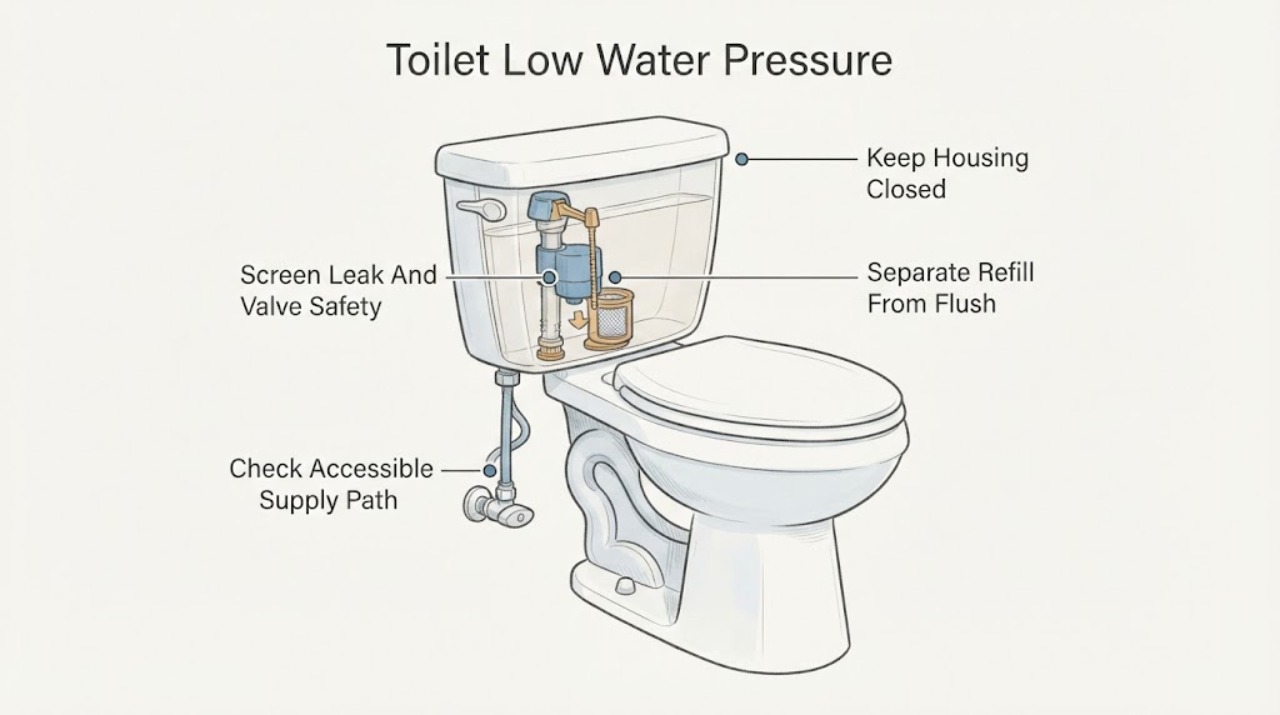
A toilet that seems to have low water pressure may have a partly closed or restricted supply stop, a kinked hose, debris in the inlet or fill valve, a low tank level, a weak flush setting, a flush-valve problem, or genuinely low pressure affecting the home. First separate slow tank refill from a weak bowl flush: watch the tank level after one flush, then compare another fixture and another toilet without repeatedly cycling a suspect valve. Turn the toilet's supply stop gently only if it is accessible and moves normally; do not force it, adjust an unknown pressure-reducing valve, or open a pressurized fitting. A pressure valve or fill valve should be replaced only after the exact toilet and valve type are identified. Stop for an active leak, overflow, damaged valve, water near electrical equipment, or a stuck shutoff, and call a plumber.
Before you begin
Safety first
- This article permits only safe observation, one normal flush/refill observation, a visible hose check, and gentle operation of a freely moving accessible toilet stop. It does not authorize pressurized disassembly, regulator adjustment, pressure-assist vessel removal, valve-housing work, chemical cleaning, or concealed plumbing work.
Work through in order
Diagnostic checks
Use only checks that match the exact appliance or system and its official guide.
-
Check 1
Stop flushing and look around the toilet, tank, supply hose, and wall or floor stop. If the toilet stop is accessible and turns normally, close it gently only when needed to control an active leak; keep clear of spreading water or water near electrical equipment.
Expected result: There is no leak, or the toilet is leaking, overflowing, the stop will not turn or close, the hose is damaged, or water is reaching an unsafe area.
Next step: Keep the toilet out of service and call a plumber urgently for uncontrolled water, a stuck or damaged stop, a cracked tank, or water near electrical equipment. Use the home's main shutoff only when safely accessible.
Stop if: Do not force the stop, loosen a wet pressurized connection, enter unsafe water, or keep flushing an overflowing toilet.
Why this matters
Why: A low-flow complaint with water damage or a failed shutoff is first a plumbing safety problem, not a pressure-valve adjustment problem.
-
Check 2
With the tank lid lifted safely and the floor dry, perform one normal flush and watch the tank refill and bowl action. Note whether the tank fills slowly, reaches its marked or manufacturer-specified level, or fills normally while the bowl flush remains weak; do not hold the handle down or repeat the flush.
Expected result: Refill is slow or incomplete, refill is normal but the bowl flush is weak, or both refill and flush are weak.
Next step: Continue with the branch that matches the symptom and record the tank level. Do not replace a pressure valve based only on a weak bowl flush when the tank refills normally.
Stop if: Stop if the tank water reaches the overflow, water escapes outside the tank, the handle or button sticks, or the bowl rises toward an overflow.
Why this matters
Why: Slow or incomplete refill points toward supply, hose, inlet, fill-valve, or upstream pressure. Normal refill with a weak flush points toward tank level, flush valve, bowl, or drain-path conditions rather than the inlet pressure valve alone.
-
Check 3
For slow refill, inspect the visible supply hose for kinks or crushing and observe the accessible stop without disconnecting it. Confirm the stop is fully open only if it operates freely; do not force a multi-turn or seized valve.
Expected result: The hose is kinked, the stop is partly closed, the stop is fully open with no visible damage, or the stop is stuck, wet, corroded, or noisy.
Next step: Correct only an obvious hose position or freely operable stop position, then make one normal refill observation. If the flow remains weak or the valve is stuck or leaking, close it if safely possible and call a plumber.
Stop if: Do not wrench the stop, remove the supply hose, open a wall fitting, or continue if the valve sprays, vibrates, or will not shut off.
Why this matters
Why: A kink or partly closed isolation valve can restrict the toilet alone. A fully open but damaged or noisy stop can indicate a valve or supply fault that should not be diagnosed by repeated operation.
-
Check 4
Without touching any pressurized plumbing, compare cold-water flow at a nearby faucet, another toilet, and—if safe and practical—the same toilet before and after one ordinary flush. Record whether the weakness is isolated to this toilet or affects multiple fixtures; do not deliberately create a high-demand test.
Expected result: Only this toilet refills slowly, several fixtures are weak, or the weakness is limited to hot or cold water or a particular part of the building.
Next step: For an isolated problem, provide the toilet model and valve observations to a plumber. For a whole-home or zone-wide problem, contact the building manager, water utility, or plumber rather than replacing the toilet's pressure valve.
Stop if: Do not adjust a main pressure-reducing valve, tamper with a meter, open a wall, or run appliances to reproduce low pressure.
Why this matters
Why: An isolated toilet suggests its stop, hose, inlet screen, fill valve, or toilet configuration. Whole-home or zone-wide weakness suggests a main valve, pressure-reducing valve, building supply, leak, or utility condition.
-
Check 5
If the problem is isolated and the tank can be observed without splashing, check whether the float moves freely, whether the fill stream is weak, and whether the refill water reaches the manufacturer's marked level without entering the overflow. Do not remove the fill-valve cap or clean an inlet screen unless the exact model instructions explicitly make that a user-safe procedure.
Expected result: The float binds, the fill valve has a weak stream, the tank stops below its marked level, debris or a filter is visible only at an accessible location, or the tank level is correct.
Next step: Follow the exact model manual for any permitted adjustment or cleaning; otherwise keep the supply available only if there is no leak and call a plumber for fill-valve or inlet diagnosis. Use the marked level, not a guessed height.
Stop if: Do not force the float, remove a pressure-assist vessel, use bleach or chlorine tablets, or work on the valve while water is uncontrolled.
Why this matters
Why: A binding float, restricted filter or flow controller, failing fill valve, or inadequate supply can cause slow refill or a low tank level. A correct tank level makes the fill valve a less likely explanation for a weak bowl flush.
-
Check 6
If the tank refills to the correct level but the bowl flush is weak, observe whether the handle or button fully releases, whether the flush valve opens as designed, and whether the bowl water level is unusually low or rises abnormally. Do not remove a flush valve, pressure-assist unit, or toilet trap to investigate.
Expected result: The tank level is correct but the handle/actuator releases early, the flush valve opens only partly, the bowl level is low, the bowl rises, or the flush remains weak with no visible clue.
Next step: Follow the model manual for a visible handle or button check and stop if the bowl rises. Call a plumber for a pressure-assist, flush-valve, drain, or concealed-flow issue.
Stop if: Do not use repeated flushes to clear a rising bowl, insert chemical drain cleaner, plunge against a pressure vessel, or dismantle the toilet.
Why this matters
Why: A flush-valve or actuator setting, bowl water-level issue, partial drain restriction, or model-specific pressure-assist problem may be involved; low inlet pressure is not proven when the tank is full.
-
Check 7
Record the toilet model and configuration, refill time as an observation rather than a universal target, tank level, supply-stop position and behavior, hose condition, other-fixture comparison, fill-valve sound or stream, bowl response, leaks, and any recent plumbing or utility work.
Expected result: The issue remains isolated and valve-related, affects the whole home or zone, involves a pressure-assist or flushometer system, or remains ambiguous.
Next step: Arrange plumbing service and ask the plumber to verify supply pressure and the correct valve type before replacing a pressure valve or fill valve. Contact the utility or building manager for a confirmed service-side pressure problem.
Stop if: Do not purchase a generic pressure valve, alter a pressure regulator, disconnect a supply line, or reopen a leaking connection for repeated testing.
Why this matters
Why: This evidence lets a plumber distinguish a toilet fill valve or supply stop from an upstream pressure-reducing valve, building supply issue, flush valve, drain restriction, or model-specific pressure system.
Use your observations
Decision map
Find the observation that best matches what you see, then follow the next safe action.
-
PATH 01Safety boundary
What you see
The toilet leaks, overflows, the bowl rises, the supply stop is stuck or damaged, or water is near electrical equipment.
Do this next
Stop flushing, close the accessible stop gently if safe, keep the area clear, and call a plumber urgently; use the main shutoff only when safely accessible.
Why this path and its safety boundary
Why it matters: Water control and damage prevention take priority over diagnosing low pressure.
Safety stop: Do not force the valve, enter unsafe water, loosen a wet connection, or keep operating the toilet.
-
PATH 02Safety boundary
What you see
The tank refills slowly or stops low, while other fixtures have normal flow.
Do this next
Check only the visible hose and freely operable stop, then use the exact manual for a permitted fill-valve check; call a plumber if flow remains weak or the valve is stuck.
Why this path and its safety boundary
Why it matters: The toilet's supply stop, hose, inlet restriction, fill valve, float, or model-specific filter is more likely than a whole-home pressure problem.
Safety stop: Do not remove pressurized fittings, force the stop, or replace a valve without exact model identification.
-
PATH 03Safety boundary
What you see
Several fixtures or a whole zone have weak flow, or only hot or cold water is affected beyond this toilet.
Do this next
Do not change the toilet valve first; contact the building manager, utility, or plumber to assess the supply and any pressure-control equipment.
Why this path and its safety boundary
Why it matters: An upstream main valve, pressure-reducing valve, supply leak, building system, or utility condition may be involved.
Safety stop: Do not adjust a pressure-reducing valve, tamper with a meter, or open pressurized plumbing.
-
PATH 04Safety boundary
What you see
The tank reaches its correct marked level, but the bowl flush is weak or incomplete.
Do this next
Check only the visible handle/button release and bowl response, then call a plumber for model-specific flush or drain diagnosis.
Why this path and its safety boundary
Why it matters: The flush actuator or valve, bowl level, pressure-assist mechanism, or drain path may be involved; low supply pressure is not established.
Safety stop: Do not repeatedly flush a rising bowl, use chemical drain cleaner, or dismantle the flush mechanism.
-
PATH 05Safety boundary
What you see
The toilet uses a pressure-assist or flushometer arrangement, the valve is hidden or damaged, or the symptom does not match a visible tank toilet path.
Do this next
Identify the model and have a plumber follow the manufacturer's service information and verify the supply conditions before changing a part.
Why this path and its safety boundary
Why it matters: The term pressure valve may refer to a model-specific control, vessel, stop, or upstream regulator, and a generic fill-valve fix could be unsafe or ineffective.
Safety stop: Do not remove a pressure vessel, adjust a regulator, or open the valve housing without qualified instructions.
-
PATH 06Safety boundary
What you see
Visible checks are normal but refill or flushing remains weak, or the source cannot be isolated.
Do this next
Keep the toilet usable only if there is no leak or overflow and arrange a plumber visit with the recorded observations; stop use if water control worsens.
Why this path and its safety boundary
Why it matters: A concealed supply restriction, pressure-control problem, fill or flush valve fault, drain restriction, or installation issue remains possible.
Safety stop: Do not guess a pressure-valve replacement, make repeated pressure tests, or use chemical cleaners to compensate.
Helpful context
Understand the symptom
Low pressure is not one toilet symptom
A tank toilet can refill slowly yet flush normally once the tank is full, or it can have a normal refill but a weak bowl flush because the tank level, flush valve, rim passages, or drain path is different. A toilet with low flow at the supply can also expose a restricted stop, hose, inlet screen, or fill valve. If sinks, showers, and other toilets are weak too, the cause may be upstream in a main valve, pressure-reducing valve, building supply, or utility service rather than the toilet's pressure valve. Record which symptom is present before selecting a part.
Use only safe, visible checks
A resident can observe the tank, verify the handle or flush button is not being held, inspect a reachable supply hose for a kink, and confirm that an accessible toilet stop is not obviously closed. It is safe to turn a normal stop gently, but an old or seized valve can break or leak if forced. Do not remove a pressurized valve, loosen a supply connection under pressure, adjust a house pressure-reducing valve without the correct procedure, or use chemicals to clear a toilet component. Keep the area dry and stop if water escapes.
Pressure valve and fill valve are conditional labels
A task may call the suspected component a pressure valve, but toilets use different arrangements: a tank fill valve, a supply isolation stop, a pressure-assist vessel, or a flushometer control stop. These are not interchangeable. A fill valve can have a filter or flow controller, while a flushometer requires the manufacturer's minimum supply conditions. Match the exact toilet model and valve configuration; if pressure is low throughout the home or the valve is hidden, damaged, or difficult to operate, have a plumber diagnose it.
Safety boundary
Stop conditions
- Stop flushing and isolate the toilet for an active leak, overflow, a bowl that is rising, a stuck or damaged shutoff, spreading water, or water near electrical equipment.
- Do not force the supply stop, disconnect a pressurized hose, adjust a main pressure-reducing valve, open a wall, remove a pressure-assist vessel, or work on a concealed or damaged pressure valve.
- Do not use bleach or chlorine tablets in the cistern, chemical drain cleaner, repeated flushes against a rising bowl, or a generic replacement valve without exact model and configuration confirmation.
- Call a licensed plumber for whole-home or zone-wide low pressure, a valve that leaks or will not operate, recurring weak flushes, a pressure-assist or flushometer system, hidden plumbing, or any unresolved diagnosis.
Only after diagnosis
Potential parts
- toilet fill valve
Consider only if the toilet is isolated from other pressure problems and the technician or exact manual confirms a restricted or failed fill valve after the supply stop and hose are checked.
Match the exact toilet model, tank configuration, inlet arrangement, and manufacturer's specifications before ordering or installing. - toilet supply stop or pressure-control valve
Consider only if a plumber confirms that the accessible stop or an upstream pressure-control valve is restricting flow or failing; whole-home symptoms should not be assigned to the toilet part by assumption.
Valve type, connection, pressure rating, local code, and installation access must be verified by the plumber; this is not a generic toilet-part match.
When checks do not resolve it
Need a professional?
Call a licensed plumber for a stuck or leaking supply stop, slow refill that persists after a safe visible hose/stop check, a weak flush with a correct tank level, whole-home or zone-wide low pressure, a pressure-assist or flushometer toilet, an upstream pressure valve, or an unknown cause. Use urgent service for overflow, spreading water, or water near electrical equipment.
Safety scope: This article permits only safe observation, one normal flush/refill observation, a visible hose check, and gentle operation of a freely moving accessible toilet stop. It does not authorize pressurized disassembly, regulator adjustment, pressure-assist vessel removal, valve-housing work, chemical cleaning, or concealed plumbing work.
Common questions
FAQ
Does a weak toilet flush always mean low water pressure?
No. If the tank reaches its correct level, a weak flush can involve the handle or button, flush valve, bowl level, pressure-assist mechanism, or drain path. Low supply flow is more likely when the tank refills slowly or stops below its marked level.
Why does my toilet tank refill slowly but other fixtures work normally?
An isolated slow refill can come from a partly closed or damaged stop, kinked supply hose, inlet restriction, filter or flow controller, float, or fill valve. Check only visible, freely accessible items and use the exact model manual before considering a fill-valve repair.
Should I adjust the pressure valve to improve toilet flow?
Do not adjust an unknown pressure-reducing or pressure-control valve. First determine whether the problem affects only the toilet or the whole home, then have a plumber identify the valve type, verify supply conditions, and select a model-appropriate repair.
When is low toilet pressure an urgent plumbing problem?
Treat it as urgent if the toilet leaks or overflows, the bowl is rising, the supply stop will not close, water is spreading, a valve is damaged, or water is near electrical equipment. Stop flushing, isolate water only when safe, and call a plumber.
Read the exact guide
Official sources
- Fill & flush valves for cisternsGeberit · Manufacturer cistern-valve information used to explain configuration differences; it does not identify a universal valve for an unknown toilet.
- Home MaintenanceU.S. Environmental Protection Agency WaterSense · Government home-maintenance guidance used for whole-home pressure branching and safe escalation; local system and fixture instructions control.
- Fill Valve For One-Piece ToiletsKOHLER · Manufacturer part information used only to show that fill valves are configuration-specific; it does not support compatibility with an unknown toilet.
- WaterSense at Work Section 3.1: Toilets (Water Closets)U.S. Environmental Protection Agency WaterSense · Government technical guidance used to distinguish tank and flushometer mechanisms; residential model instructions and local plumbing practice control.
- Low Water Level in the Toilet BowlKOHLER · Manufacturer support page used to separate low bowl-level symptoms from generic supply-pressure assumptions; exact model selection is required.
- Fluidmaster Torbeck Fill Valve SeriesFluidmaster · Manufacturer fill-valve troubleshooting used for conditional slow-refill paths; exact valve and region must be confirmed.
Community feedback
Share a repair observation
Share a plain-text repair observation. Accepted observations are published automatically; this page may take a moment to update.