
On this page
Start here
Quick answer
A TOTO toilet with a weak flush usually has one of four patterns: the bowl receives too little water, the water path or bowl openings are restricted, the trapway or drain is partly blocked, or the fixture is being used while its tank or supply is still recovering. Start by checking the visible shutoff valve, tank or control status, bowl water behavior, and any accessible filter or supply condition exactly as the model manual allows. Clean only exposed surfaces with a non-abrasive method, and use a toilet plunger only when the bowl drains slowly rather than as a substitute for a weak-flush diagnosis. Stop repeated flushing and arrange qualified plumbing service if the flush remains weak, the bowl rises, several fixtures are slow, the toilet leaks or rocks, or the cause requires opening the tank, concealed parts, or drain.
Before you begin
Safety first
- This article covers ordinary-access observation, manual-approved cleaning, and a toilet-plunger attempt only when the bowl drains slowly. Do not dismantle the tank or electronic unit, alter hidden valves, use chemicals, reach into the trapway, or open a drain cleanout.
Work through in order
Diagnostic checks
Use only checks that match the exact appliance or system and its official guide.
-
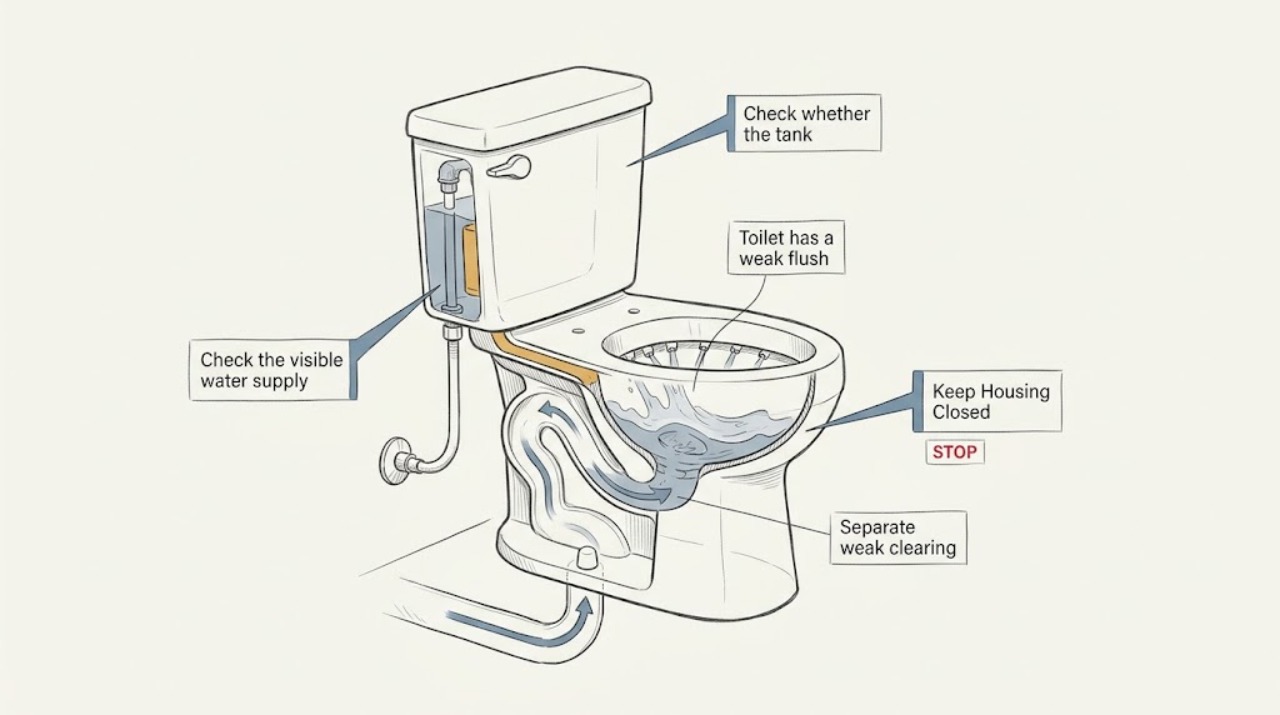
Separate weak clearing from a slow-draining bowl
From a dry, stable position, observe one normal flush only when the bowl is at a safe level. Watch whether the water rises and drains slowly, the bowl drains but leaves material behind, or the flush cycle does not deliver its usual water movement.
Expected result: The bowl rises toward the rim, drains slowly, clears but weakly, or has normal drainage with only surface residue remaining.
Next step: Stop flushing if the level rises or remains high. If drainage is normal, continue with the supply, water level, and visible bowl checks rather than plunging automatically.
Stop if: Do not repeat a flush to reproduce a weak result, hold a flush handle or button down, or continue when water can overflow or leak onto the floor.
Why this matters
Why: Rising or slow drainage supports a partial trapway or drain restriction; normal drainage with poor clearing shifts attention to water supply, flush volume, bowl openings, or residue. A cycle that does not deliver water can involve a valve, tank, sensor, or control state.
-
Check the visible water supply and shutoff position
Inspect the plainly visible shutoff valve and supply connection without loosening fittings. Confirm the valve is in its normal open position for the exact installation, and look for a kinked supply tube, moisture, or a recent water outage or pressure change.
Expected result: The valve is closed or partly closed, the tube is kinked or wet, water pressure changed when another fixture ran, or the visible supply appears normal.
Next step: If a plainly labeled valve is obviously not in its normal open position, follow the model manual's adjustment guidance without forcing it. For a wet connection, recurring pressure loss, or normal supply with a weak flush, arrange plumbing service.
Stop if: Do not force a seized valve, disconnect the supply, tighten a wet fitting, or continue using the toilet if water is escaping at the connection.
Why this matters
Why: A restricted or interrupted supply can reduce the water available for a flush. A normal-looking valve does not prove adequate pressure or rule out a hidden filter, inlet, control, or plumbing restriction.
-
Check whether the tank or electronic cycle is ready
For a tank model, look only through the open lid without touching the mechanism and note whether the tank has refilled to its normal marked level. For an electronic or WASHLET model, observe the display or indicators and use the normal full-flush control described by the manual; do not remove covers.
Expected result: The tank is still filling or below its normal level, the flush is being selected while another cycle is active, the display shows a warning, or the tank and controls appear ready.
Next step: Allow the exact model's normal refill or cycle to complete, then make one controlled observation. If the tank never reaches its normal level, a warning returns, or the problem persists, arrange service for the model-specific fill and control system.
Stop if: Do not bend the float, adjust a fill valve, change a control setting without the manual, open an electronic cover, or operate a tank with a leak or damaged component.
Why this matters
Why: TOTO manuals note that an incomplete flush can occur while a tank is filling, when the wrong flush selection is used, or when a water-supply or control state is abnormal. A ready tank or normal display with weak clearing moves the check toward the bowl, trapway, or internal flush path.
-
Inspect exposed bowl openings and residue
With the toilet idle and the water level normal, inspect the visible rim openings, jet area, bowl surface, and trapway entrance for mineral scale, paper, residue, or an object that can be removed without reaching into the passage. Clean exposed residue only with the non-abrasive method permitted by the TOTO manual.
Expected result: Openings or the bowl surface are visibly coated or obstructed, an object is visible but cannot be safely reached, or the exposed surfaces are clean.
Next step: Remove only loose surface material that is accessible without force and then compare one normal flush. If the weak flush remains or the obstruction is inside the passage, stop and arrange qualified plumbing service.
Stop if: Do not drill, wire, scrape porcelain, use abrasive pads or harsh chemicals, reach into the trapway, or force an object through the bowl.
Why this matters
Why: Residue or a blocked visible opening can reduce the swirl or water delivery, but a clean surface does not rule out an internal jet, flush valve, filter, trapway, or drain problem. An object that cannot be safely reached should not be pushed inward.
-
Check model-specific filter and competing water use
If the exact TOTO manual identifies an accessible water filter, inspect or clean it only by that manual's procedure. Also note whether another fixture was running during the weak flush; do not dismantle the supply or filter housing to search for a filter.
Expected result: The manual identifies a clogged accessible filter, another fixture was using water, the water supply was interrupted, or none of those conditions applies.
Next step: Restore normal water availability and perform one controlled flush after the manual-approved filter step. If the filter is inaccessible, the weak flush persists, or the same symptom returns, request service.
Stop if: Do not use a generic filter, bypass a filter, open a pressurized or concealed assembly, or clean a component that the manual does not identify as user-accessible.
Why this matters
Why: TOTO troubleshooting tables link incomplete flushing with a clogged water filter, water use elsewhere, or a water-supply interruption on applicable models. A clear filter and no competing use shifts concern toward the flush mechanism, bowl passage, or drain.
-
Use a plunger only when slow drainage indicates a blockage
If the bowl rises or drains slowly, stop adding water and use a toilet plunger whose cup fully covers the outlet, keeping the bowl and floor protected. If the bowl drains normally but the flush is simply weak, do not plunge as a substitute for checking water supply and flush components.
Expected result: The plunger changes the bowl level and drainage, does not create a seal or movement, or the weak flush returns after drainage improves.
Next step: After the bowl drains, make one controlled flush only. If the level rises again, the plunger cannot move the water, or the weak result recurs, leave the toilet out of service and arrange qualified plumbing diagnosis.
Stop if: Do not use chemical drain opener, an improvised rod, excessive force, or repeated flushes; stop for a cracked or rocking toilet, base leak, overflow, or sewage backup.
Why this matters
Why: A changing water level supports a local obstruction; no movement or a returning weak flush suggests a hard or partial blockage, flush-performance issue, or downstream restriction. Plunging cannot correct low tank fill, a faulty valve, or inadequate supply.
Use your observations
Decision map
Find the observation that best matches what you see, then follow the next safe action.
-
PATH 01Safety boundary
What you see
The bowl rises or drains slowly during a flush, regardless of whether the water delivery initially looks normal.
Do this next
Control the supply, use a properly sealed toilet plunger only if the bowl and fixture are safe, and arrange service if drainage does not restore or the symptom returns.
Why this path and its safety boundary
Why it matters: A partial trapway or downstream drain restriction is more likely than a simple low-volume flush, and continued flushing risks overflow.
Safety stop: Do not pour chemicals, reach into the trapway, use an improvised rod, or keep flushing a rising bowl.
-
PATH 02Safety boundary
What you see
The bowl drains normally but leaves material behind or produces a weak swirl, with no visible blockage at the bowl surface.
Do this next
Check the visible shutoff and model-specific tank, control, filter, and exposed-surface conditions in that order. Request service if the exact manual steps do not restore normal clearing.
Why this path and its safety boundary
Why it matters: Water volume, supply, tank or electronic cycle state, filter, bowl openings, flush valve, or internal passage is more likely than a simple bowl clog.
Safety stop: Do not plunge repeatedly, alter the flush valve or tank settings, or substitute an unverified component.
-
PATH 03Safety boundary
What you see
The tank is below its normal level, an electronic cycle is incomplete, the shutoff is restricted, another fixture is using water, or supply pressure changed.
Do this next
Allow the normal refill or cycle to complete, restore only a plainly visible normal valve position as the manual permits, and reassess once. Persistent low level or pressure needs plumbing or fixture service.
Why this path and its safety boundary
Why it matters: The flush may be under-supplied rather than blocked. TOTO identifies these conditions in model-specific troubleshooting guidance for incomplete flushing.
Safety stop: Do not bend floats, open hidden valves, disconnect tubing, or run the toilet with a wet or leaking supply connection.
-
PATH 04Safety boundary
What you see
A model-specific accessible filter is clogged, visible bowl or jet openings are coated, or the manual identifies a cleaning step for the affected area.
Do this next
Use only the manual-approved cleaning procedure and compare one flush. Stop if access requires disassembly or if the weak flush remains.
Why this path and its safety boundary
Why it matters: A localized restriction can reduce flush water or bowl washing, but the exact TOTO model determines whether that filter or opening is user-serviceable.
Safety stop: Do not drill openings, use abrasive or harsh chemicals, bypass the filter, or reach into concealed waterways.
-
PATH 05Safety boundary
What you see
The weak flush returns, several fixtures drain slowly or gurgle, or the same issue appears when another fixture uses water.
Do this next
Limit water use if other fixtures are affected, record the sequence and locations, and arrange qualified plumbing service for the shared path or fixture.
Why this path and its safety boundary
Why it matters: A partial trapway, branch, building drain, supply problem, or recurring fixture fault is more likely than a one-time residue issue.
Safety stop: Do not use chemical drain opener, open a cleanout, or keep flushing to force a shared restriction through.
-
PATH 06Safety boundary
What you see
The toilet rocks, porcelain is cracked, water leaks at the base or supply, sewage backs up, or a powered TOTO unit has an electrical or water warning.
Do this next
Stop using the toilet, close the visible shutoff if it can be reached safely, isolate the wet area, and arrange urgent qualified service. Follow the exact TOTO manual for powered-unit shutdown only when the area is dry and safe.
Why this path and its safety boundary
Why it matters: The problem has crossed from weak flushing into a fixture, water-damage, contamination, or electrical safety boundary.
Safety stop: Do not touch wet plugs or controls, tighten hidden hardware, lift the toilet, remove powered covers, or continue flushing.
Helpful context
Understand the symptom
Weak flush is different from a fully clogged toilet
A weak flush may leave material behind while the bowl still drains, or it may raise the water and drain slowly. Those patterns overlap, but they change the first check. A bowl that rises points toward a restriction and needs overflow control; a bowl that drains normally but has a poor swirl or incomplete clearing points toward water volume, supply, flush components, or a partial passage. Do not keep flushing to decide which pattern you have.
TOTO's model and flush type matter
TOTO sells gravity, electronic, WASHLET, and commercial flush systems, and their controls and water paths are not interchangeable. A TOTO manual may refer to a shutoff valve, tank fill, water filter, full or light flush selection, sensor, or power state depending on the model. Use the manual for the exact toilet and do not assume a hidden filter, tank component, or electronic sequence exists on every TOTO fixture.
Protect the bowl and drain while testing
Use only ordinary-access observations first: check the visible valve and controls, inspect the bowl and tank area without dismantling it, and clean exposed residue with a non-abrasive neutral toilet cleaner when the manual allows. If the water level rises, stop flushing and control the supply. Never pour chemical drain opener into the toilet or use a sharp or improvised tool in the trapway.
Safety boundary
Stop conditions
- Do not keep flushing a bowl that rises or drains slowly; control the visible supply and protect the floor first.
- Do not drill, wire, scrape, or pry bowl openings or the trapway, and do not use an improvised rod or chemical drain opener.
- Do not dismantle a tank, electronic unit, concealed valve, filter housing, or supply connection as an ordinary weak-flush test.
- Stop for a base or supply leak, cracked or rocking porcelain, sewage backup, water near electrical equipment, or a powered toilet warning.
- Arrange qualified plumbing or TOTO service when manual-approved checks do not restore clearing, the weak flush recurs, several fixtures are affected, or the internal cause is uncertain.
Only after diagnosis
Potential parts
- toilet water filter
Consider this category only if the exact TOTO manual identifies an accessible clogged filter and cleaning or replacement is confirmed as the cause of incomplete flushing.
Confirm the exact TOTO model and filter location, procedure, and fit information; do not bypass a filter or open a concealed housing. - TOTO flush valve or fill component
Consider this category only after service confirms that the tank cannot reach its normal level or the flush valve does not deliver the specified cycle after the supply and drain paths are assessed.
Confirm the exact TOTO model and valve arrangement before ordering; do not alter tank settings as a substitute for a plumbing diagnosis. - toilet trapway or drain-service tool
Consider this category only when a qualified plumber confirms a localized trapway obstruction and selects a toilet-specific method that will not damage the bowl or push an object farther downstream.
Use only a toilet-specific tool according to its instructions or have the plumber supply it; do not use wire, a coat hanger, or an improvised rod.
When checks do not resolve it
Need a professional?
Arrange qualified plumbing or TOTO service when a TOTO toilet remains weak after the visible valve, tank or control state, model-specific filter, and exposed-bowl checks are complete; when the flush returns weak, several fixtures are affected, or a concealed restriction is suspected; or when the toilet leaks, rocks, or has damaged porcelain. Stop use and seek urgent service for a rising or overflowing bowl, sewage backup, water near electrical equipment, or a powered toilet warning.
Safety scope: This article covers ordinary-access observation, manual-approved cleaning, and a toilet-plunger attempt only when the bowl drains slowly. Do not dismantle the tank or electronic unit, alter hidden valves, use chemicals, reach into the trapway, or open a drain cleanout.
Common questions
FAQ
Why does my TOTO toilet have a weak flush but still drain?
Normal drainage with incomplete clearing points toward water supply, tank fill, flush selection or controls, a model-specific filter, bowl openings, flush valve, or a partial passage rather than a fully blocked bowl. Check only the visible and manual-approved items, then arrange service if the weak result remains.
Can a partly closed shutoff valve cause a weak TOTO flush?
Yes, a restricted supply can reduce the water available for a flush. Inspect the plainly visible valve without forcing it and follow the exact TOTO manual. A normal-looking valve does not rule out pressure, filter, tank, valve, or plumbing problems.
Should I plunge a TOTO toilet that has a weak flush?
Plunge only when the bowl rises or drains slowly, which supports a blockage. If the bowl drains normally but the clearing action is weak, check supply and model-specific flush conditions instead. Stop if the plunger cannot seal, the water does not move, or the weak result returns.
Can I use drain cleaner to improve a weak toilet flush?
No. Do not pour chemical drain opener into the toilet. EPA advises avoiding chemical drain openers for a clogged drain, and chemicals do not diagnose low water, a flush-valve problem, a partial trapway, or a shared drain restriction.
When does a weak TOTO flush require a plumber?
Request service when model-approved checks do not restore clearing, the problem recurs, several fixtures are slow or gurgle, the bowl rises, the toilet leaks or rocks, a filter or valve is concealed, or a drain or flush component needs disassembly. Stop immediately for overflow, sewage backup, cracked porcelain, or water near electrical equipment.
Read the exact guide
Official sources
- EcoPower Flush Valve for ToiletTOTO U.S.A. · TOTO EcoPower commercial flush-valve manual used only for the principle that low flow can involve supply or valve conditions and that unspecified parts should not be dismantled; it does not define residential toilet fitment.
- TroubleshootingTOTO U.S.A. · TOTO owner manual used for model-specific examples of weak or incomplete flushing; exact controls and components vary by TOTO model.
- How to Care for Your Septic SystemU.S. Environmental Protection Agency · EPA wastewater guidance used for flushing-prevention and chemical-safety boundaries; the septic context is especially direct for septic homes, while the no-chemical caution is relevant to any connected drain.
- How to Unclog a ToiletAmerican Standard · American Standard's general toilet guidance used for the generic distinction between a weak flush and a slow-draining blockage; it does not establish TOTO model internals.
Community feedback
Share a repair observation
Share a plain-text repair observation. Accepted observations are published automatically; this page may take a moment to update.