
On this page
Start here
Quick answer
A TOTO toilet that appears to leak at the base may have a bowl-to-floor seal or flange problem, but water can also run down from the supply connection, tank fittings, or bowl. Close the accessible shutoff if water is actively escaping, dry the toilet and floor, and identify the first wet point before touching any fastener. If water appears at the bowl base only during a controlled flush, the bowl-to-floor seal, flange, mounting, or porcelain becomes more likely; if it starts at a supply or tank connection, the base puddle is downstream from that leak. TOTO installation instructions caution against moving the bowl after the seal is set and against over-tightening the bowl nuts. Do not keep flushing an active leak, rock or lift the toilet, or order a seal until the leak path and model are confirmed.
Work through in order
Diagnostic checks
Use only checks that match the exact appliance or system and its official guide.
-
Check 1
Stop flushing. If water is actively spreading and the toilet shutoff turns normally, close it without force. Dry the supply connection, tank, bowl exterior, base perimeter, and floor with separate towels, then observe from a standing position.
Expected result: Water returns while the toilet is idle, the supply is closed but the floor remains wet, the first wet point is above the base, or no source can yet be separated.
Next step: Keep the shutoff closed, contain and clean the water safely, and use the matching branch below. If the shutoff binds, water may be contaminated, or a ceiling below is affected, call a plumber promptly.
Why this matters
Why: An idle leak or a wet point above the base keeps the pressurized supply and tank paths in play; water can run down and imitate a failed floor seal. Residual water or an unknown source makes further flushing unsafe and prevents a reliable diagnosis.
-
Check 2
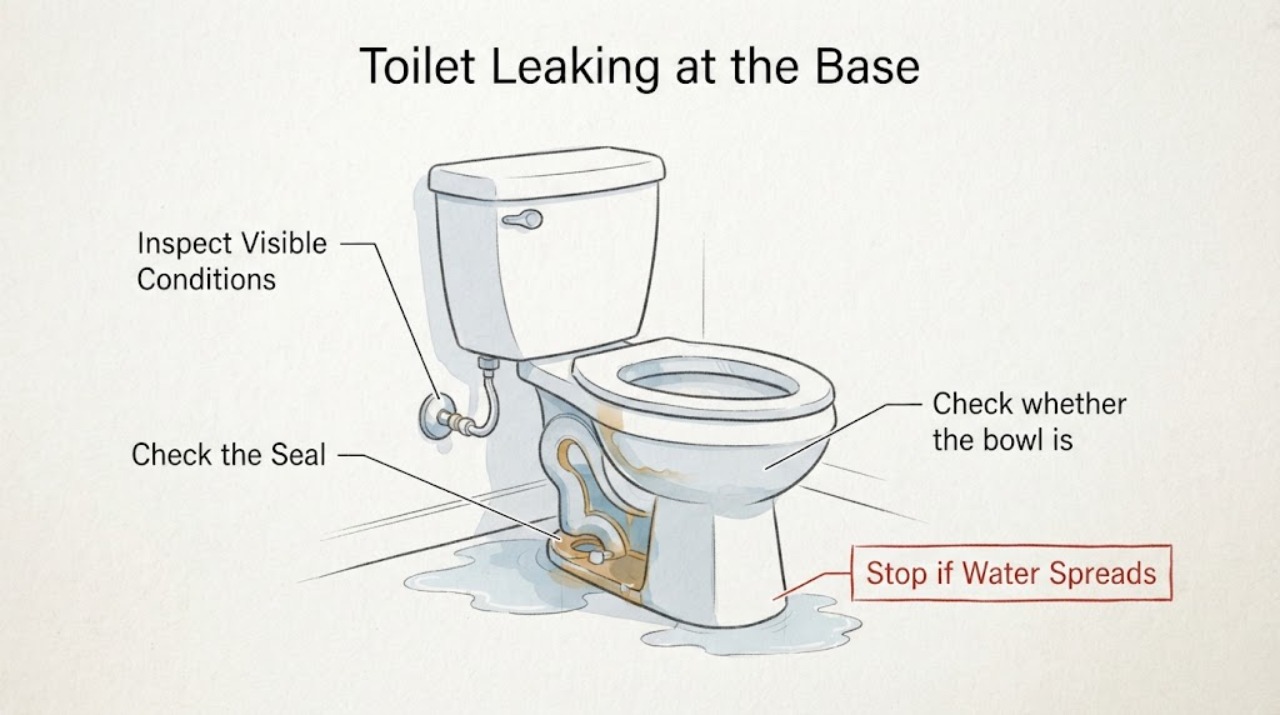
With the area dry and the supply controlled, inspect the visible supply line, shutoff connection, fill-valve entry, tank-to-bowl joint, and bowl rim for a fresh wet point, stain, crack, or drip trail. Do not twist the toilet or tighten hardware during this mapping check.
Expected result: The first moisture is at the supply connection, tank fitting or joint, bowl rim, or the base; or all visible surfaces remain dry.
Next step: Keep the water isolated for any confirmed connection leak. For a dry idle toilet, proceed to the timing check only if the bowl is stable, porcelain is intact, and one controlled flush can be stopped safely.
Why this matters
Why: A supply or tank wet point is an external connection or fitting issue that can run toward the floor. A base wet point with no higher source makes the bowl-to-floor seal, flange, mounting, or porcelain more likely. A dry idle toilet does not rule out a flush-only leak.
-
Check 3
Check whether the bowl is stable by looking for a gap, uneven contact, or visible rocking without pushing the bowl. Inspect the floor around the base for swelling, discoloration, or a fresh trail, but do not lift, rotate, or shim the installed toilet as a test.
Expected result: The bowl rocks, the floor is damaged or wet at the base, the base is visibly cracked, or the bowl is stable with no damage.
Next step: For rocking, cracked porcelain, or damaged flooring, keep the shutoff closed and arrange plumbing service; do not compensate by tightening the nuts. If stable and intact, continue only with the controlled timing check.
Why this matters
Why: Movement or damaged flooring can compromise the bowl-to-floor seal or hide a flange problem. A stable, intact bowl makes a mounting failure less obvious but does not exclude a seal that leaks only under flush flow.
-
Check 4
Only if there is no active leak, no wastewater on the floor, no crack, and the bowl is stable, reopen the shutoff normally and perform one controlled flush while watching the supply, tank joint, bowl rim, and base from a safe standing position. Close the shutoff again if any leak appears.
Expected result: Water appears at the base during or immediately after flushing, water starts at a higher connection, or no leak appears through the test.
Next step: For a base leak, stop flushing, close the shutoff, and have the bowl-to-floor connection inspected and resealed. For an upstream leak, keep the water off and repair the exact connection. If no leak appears, monitor after normal use and stop at the first recurrence.
Why this matters
Why: A flush-only base leak makes the bowl gasket or wax ring, closet flange, mounting, drain connection, or bowl more likely than a supply-line leak. A higher wet point identifies the upstream path instead. A negative test lowers the likelihood of an active leak but does not prove the seal is sound if the leak is intermittent.
-
Check 5
If the toilet is a TOTO WASHLET or another powered model, inspect only the visible water connection and shutoff while keeping the electrical plug and controls dry. Do not remove a water-filter component, top unit, panel, or hose while the shutoff is open.
Expected result: The visible water connection is wet, the leak stops when the shutoff is closed, the powered top unit or hose is involved, or the leak path remains uncertain.
Next step: Keep the shutoff closed and disconnect power only as the exact manual directs when water could reach electrical parts. Arrange qualified TOTO or plumbing service for a powered unit, concealed connection, or any leak that cannot be mapped safely.
Why this matters
Why: Powered TOTO models can have additional water connections and service boundaries. A leak that stops with the shutoff closed is still a water-path fault; it is not made safe by unplugging or cycling the unit. An uncertain path needs model-specific service.
-
Check 6
Record the TOTO model number, installation type, leak timing, first wet point, bowl stability, floor condition, whether the shutoff stopped the leak, and photographs of the safe exterior. Do not remove the bowl or tank solely to find an identifier.
Expected result: The model and installation manual are identifiable; only partial information is available; or the model cannot be identified without disassembly.
Next step: Give the record to a qualified plumber or TOTO support provider. Keep the toilet out of service for a base leak, rocking bowl, recurring leak, cracked porcelain, wet flooring, or any source that remains uncertain.
Why this matters
Why: TOTO bowl gaskets or wax rings, flange arrangements, tank fittings, WASHLET connections, and service methods differ by model. A missing identifier makes a generic seal or connector choice unreliable.
Use your observations
Decision map
Find the observation that best matches what you see, then follow the next safe action.
-
PATH 01Next step
What you see
The toilet leaks while idle or the first wet point is the supply line, shutoff, fill connection, or tank joint before the base gets wet.
Do this next
Keep the shutoff closed and repair the model-appropriate connection or fitting. Do not replace the bowl seal solely because water collected at the floor; use a plumber for a seized valve, cracked porcelain, or a leak that returns after a safe connection check.
-
PATH 02Next step
What you see
The toilet is dry while idle but fresh water appears at the bowl base only during or just after a flush.
Do this next
Treat the bowl-to-floor seal, closet flange, mounting, discharge connection, or bowl as more likely. Stop flushing, close the shutoff, and arrange inspection and resealing; do not rock or lift the bowl to confirm it.
-
PATH 03Next step
What you see
The bowl rocks, the floor is swollen or damaged, or porcelain is cracked near the base, even if the leak is intermittent.
Do this next
Keep the toilet out of service and call a plumber. TOTO warns against moving the bowl after the seal is set and against over-tightening the mounting nuts; the flange, seal, mounting, floor, and porcelain need a coordinated inspection.
-
PATH 04Next step
What you see
The leak appears around a powered WASHLET water connection or cannot be separated from the top unit, hose, or concealed plumbing.
Do this next
Close the shutoff, keep water away from electrical parts, and use the exact model manual or qualified service. Do not remove a filter, panel, hose, or top unit while the water is pressurized.
-
PATH 05Next step
What you see
No leak appears during one safe controlled test, but moisture returns later or the source cannot be located.
Do this next
Do not assume the base seal is sound. Keep the model and timing record, inspect after the next normal use without repeated flushing, and arrange service when the leak recurs or remains unexplained.
Helpful context
Understand the symptom
A puddle around the base is a location, not a diagnosis. Water from a supply hose, fill connection, tank-to-bowl joint, or bowl rim can travel over porcelain and collect at the floor. Dry the outside surfaces and watch for the first returning drop while the toilet is idle before deciding that the floor seal has failed.
The leak timing changes the next step. Moisture that returns while the tank fills points toward a pressurized connection or tank fitting; moisture that appears only during flushing points toward the discharge path, bowl-to-floor seal, flange, mounting, or a crack. A toilet that rocks can lose its seal, so do not test it by pushing or twisting the bowl.
Base-seal work requires moving or removing the bowl and is not a casual tightening adjustment. If the source is at the base, the bowl moves, the floor is soaked, or the leak could reach a lower ceiling, isolate the water and use a qualified plumber for inspection and resealing.
Safety boundary
Stop conditions
- Close the shutoff and stop flushing for water at the bowl base, wastewater on the floor, a ceiling stain below, spreading or uncontrolled water, or a leak that may be contaminated.
- Do not rock, twist, lift, or move the bowl after the seal is set, and do not over-tighten mounting nuts; porcelain or the seal can be damaged.
- Do not remove a WASHLET filter, hose, top unit, panel, or pressurized connection, and keep water away from electrical parts unless the exact model manual gives a safe procedure.
- A leak that returns after a safe connection check, a rocking or cracked toilet, damaged flooring, a concealed source, or an unidentified model requires qualified plumbing or TOTO service.
Only after diagnosis
Potential parts
- TOTO bowl wax ring or bowl gasket
Consider only when inspection confirms a leak at the bowl-to-floor connection during flushing and the bowl must be removed for resealing.
Seal type, bowl outlet, flange height, and installation method must be confirmed for the exact TOTO model; a used seal should not be reused after the bowl is moved. - closet flange mounting hardware or shims
Consider only when inspection finds a damaged or loose flange, uneven floor, or bowl movement contributing to the base leak.
Flange condition, floor construction, bolt arrangement, and bowl contact points require inspection; do not correct rocking by overtightening nuts. - toilet supply connector or seal
Consider only when the first wet point is the pressurized supply connection or fill-valve entry rather than the bowl base.
Connection type, length, seal, shutoff, and model arrangement must be verified before replacement. - TOTO tank-to-bowl gasket or fitting
Consider only when moisture starts at the tank-to-bowl joint and travels downward during filling or flushing.
Tank design, gasket profile, bolts, washers, and porcelain contact points are model-specific; over-tightening can damage the bowl or tank.
When checks do not resolve it
Need a professional?
Request qualified plumbing or TOTO service for a flush-only base leak, a rocking bowl, cracked porcelain, wet or damaged flooring, a leaking closet flange or floor connection, a concealed or powered WASHLET connection, an inaccessible shutoff, wastewater contact, or any leak that returns after the safe source-mapping checks.
Common questions
FAQ
Does water at the base prove the TOTO wax ring is bad?
No. Water can run down from the supply line, fill connection, tank joint, or bowl before collecting at the floor. Dry the toilet and identify the first wet point; a base leak that appears only during flushing makes the floor seal or flange more likely.
Should I tighten the nuts around my TOTO toilet base?
Do not tighten them as a diagnostic experiment. TOTO cautions that over-tightening can damage the china, and a rocking bowl or failed seal needs the flange, floor, mounting, and bowl assessed together by a plumber.
Why does the toilet leak only when flushed?
Flush water can load the bowl-to-floor seal, flange, discharge connection, or a tank joint in a way that does not occur while the toilet is idle. Perform at most one controlled test when safe, then close the shutoff and stop if water appears.
What should I do first if my TOTO toilet is leaking?
Stop flushing and close the accessible shutoff if it turns normally. Dry the supply, tank, bowl, base, and floor separately, then watch for the first returning wet point. If the valve binds or water is spreading, call a plumber.
Can I reuse the seal if I lift the TOTO toilet to inspect it?
TOTO installation guidance says to use a new bowl wax ring when installing and warns that moving the bowl after the seal is set breaks the seal. Bowl removal and resealing should be planned with the correct model and floor connection, not treated as a quick inspection.
Read the exact guide
Official sources
- Installation ManualTOTO USA · Supports the base-leak distinction and warnings for TOTO floor-mounted toilets; the exact model manual controls when designs differ.
- Installation ManualTOTO USA · Supports the same bowl-to-floor seal and mounting boundaries for another TOTO toilet installation family; model instructions remain controlling.
- D0G527X_LE(EN).indbTOTO USA · Supports the powered-model safety branch only; WASHLET and NEOREST components must follow their exact manual.
- TroubleshootingTOTO USA · Supports closing the shutoff for a TOTO water leak and seeking service when the issue persists; the document is for a powered TOTO toilet family, so its component details are not generalized.
Community feedback
Share a repair observation
Share a plain-text repair observation. Accepted observations are published automatically; this page may take a moment to update.