
On this page
Start here
Quick answer
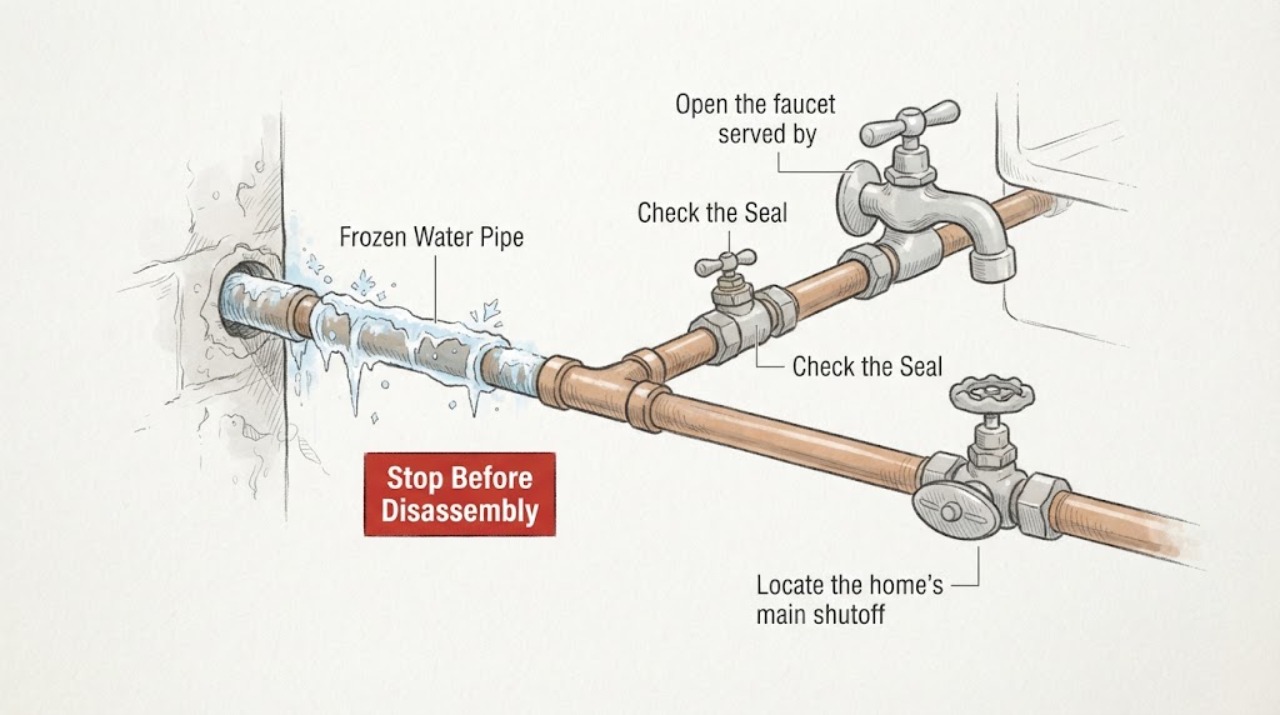
If a shutoff valve or the pipe beside it is frozen, do not force the handle or use a torch. First open a nearby faucet so melting water has somewhere to go, identify whether the pipe is accessible and intact, and be ready to close a normally operating main shutoff if thawing reveals a break. Warm an exposed section gradually with safe non-flame heat such as warm towels only when the area is dry and controllable. Stop for standing water, a crack, an inaccessible section, or a valve that will not move normally, and call a licensed plumber.
Work through in order
Diagnostic checks
Use only checks that match the exact appliance or system and its official guide.
-
Check 1
Open the faucet served by the suspected valve slightly and compare it with another nearby faucet; check only accessible areas such as an exterior wall, cabinet, crawl-space entry, garage, or foundation entry.
Expected result: The affected faucet gives only a trickle or no flow while another has normal flow, both are affected, or flow returns normally.
Next step: Leave the affected faucet open during any safe thawing attempt and move to the leak and shutoff check. If all water is absent or the location is unclear, stop and contact a plumber or utility.
Why this matters
Why: A trickle or no flow in one branch supports a local frozen section; several affected outlets suggest more than one frozen line or a wider supply problem. Normal flow means the suspected pipe may have thawed or the symptom has another cause.
-
Check 2
From a safe, dry position, inspect the exposed pipe, valve body, nearby joints, floor, wall, and ceiling for frost, bulging, cracks, dampness, staining, or water already escaping; do not move insulation or fittings aggressively.
Expected result: There is visible water or a crack, the pipe is swollen or damaged, or the accessible section is dry and appears intact.
Next step: If damage or water is present, do not thaw the line yourself: close a normally operating main shutoff only if it can be reached safely and call a plumber. If the section is intact and accessible, continue with the controlled warm-air check.
Why this matters
Why: A frozen pipe can be damaged before water is visible, and the break may reveal itself as thawing begins. A dry exterior is reassuring but does not prove the concealed section is sound.
-
Check 3
Locate the home's main shutoff and the branch valve serving the frozen section without forcing either handle; make sure the path to the valve and the area around it are dry and clear.
Expected result: A shutoff is clearly identified and moves normally, or the handle is stuck, damaged, inaccessible, or surrounded by water.
Next step: If no safe shutoff is available, do not start thawing; call a licensed plumber or the responsible utility/building contact. If a normal shutoff is ready, keep the faucet open and proceed only with a dry, visible pipe.
Why this matters
Why: A usable shutoff can limit flooding if the thaw exposes a break. A stuck or inaccessible valve removes that safety control, and forcing an old valve can cause additional damage.
-
Check 4
For a dry, exposed, intact section only, warm the pipe gradually with towels soaked in warm water or gentle room-temperature air while keeping the nearby faucet open; never use a torch, open flame, or fuel-burning heater.
Expected result: A steady flow returns, a leak appears as ice releases, or there is still no flow after the safe accessible area warms.
Next step: Watch every exposed joint while flow returns. If water appears, close the prepared shutoff and call a plumber. If there is no improvement or the section is not fully visible, stop warming and call a plumber.
Why this matters
Why: Returning flow shows that ice is releasing, but it can also reveal a crack that was hidden by the frozen blockage. No change suggests the freeze is elsewhere, deeper, or beyond the safe user-level area.
-
Check 5
After flow returns and no leak is visible, restore water slowly from a safe, normally operating shutoff and inspect the valve, joints, and nearby surfaces while the faucet runs briefly.
Expected result: Flow is normal and the area stays dry, or a joint begins leaking, pressure does not return, or the valve will not operate normally.
Next step: If any leak, weak flow, or valve fault appears, stop and call a licensed plumber. If it remains dry, insulate the exposed vulnerable section and correct drafts or unheated access conditions without covering a leaking or damaged line.
Why this matters
Why: A dry, normal flow suggests the immediate blockage has cleared, but the pipe still needs protection from refreezing. A leak or persistent restriction indicates freeze damage or an unresolved blockage.
-
Check 6
Once the pipe and valve are confirmed dry and sound, reduce future exposure by closing drafts, insulating accessible vulnerable pipe, opening cabinet doors around an exterior-wall line, and disconnecting and draining outdoor hoses where applicable.
Expected result: The valve or pipe is in an unheated or drafty location, or the line remains exposed despite these basic measures.
Next step: Use only materials and products appropriate for the pipe and follow their instructions. Have a plumber assess persistent freezing, concealed lines, or a valve that needs relocation or replacement.
Why this matters
Why: Unheated garages, crawl spaces, exterior walls, and cabinet voids are common freeze locations. Persistent exposure may need a planned insulation, heat-tape, rerouting, or building repair rather than repeated thawing.
Use your observations
Decision map
Find the observation that best matches what you see, then follow the next safe action.
-
PATH 01Next step
What you see
The frozen section is exposed, dry, intact, and a safe shutoff is available.
Do this next
Keep a nearby faucet slightly open and use gradual non-flame warming while watching the entire accessible section for a leak. Stop if any water escapes.
-
PATH 02Next step
What you see
A crack, active leak, wet wall or ceiling, bulging pipe, or water near electrical equipment is present.
Do this next
Do not thaw or handle the line. Close the main shutoff only if it operates safely and can be reached without entering a hazard, then call a licensed plumber; seek emergency help if water threatens electrical equipment.
-
PATH 03Next step
What you see
The valve is stuck, corroded, damaged, inside a wall, or unreachable without dismantling or forcing something.
Do this next
Leave the handle alone and call a licensed plumber. Do not use a wrench to force it, open the wall, or start thawing without a reliable way to stop the water.
-
PATH 04Next step
What you see
The safe accessible warming attempt does not restore flow, or more than one branch is affected.
Do this next
Stop user-level thawing and have a plumber or utility determine whether the frozen section is concealed, the service line or meter is affected, or another supply problem is present.
Helpful context
Understand the symptom
A frozen valve is a burst-pipe risk, not a stuck-handle challenge
Ice can block water flow and put pressure on the pipe wall. The weak point may be away from the visible ice or valve, and a crack can start leaking when thawing restores pressure. The useful decision is whether the section is safely accessible and intact, not whether the handle can be forced open.
Stop before heat or water creates a second hazard
Keep flames, torches, kerosene heaters, and improvised heat away from the pipe. Do not use an electrical device where there is standing water or wet electrical equipment. If water reaches an outlet, panel, furnace, or other electrical equipment, move away and obtain appropriate emergency help.
Safety boundary
Stop conditions
- Stop immediately for standing water, a crack, bulging pipe, active leak, water near outlets or panels, a fuel-burning or open-flame heat source, an electrical device in a wet area, an inaccessible frozen section, or a valve that is stuck or damaged. Never force the valve, open a wall, disconnect pressurized piping, or thaw with a torch or other open flame.
Only after diagnosis
Potential parts
- pipe insulation sleeve
Consider this only after the exposed pipe is dry, intact, and the correct insulation is selected for its location and material.
Insulation does not repair a cracked line or replace heat-source safety; confirm fit and clearance before installation. - shutoff valve
Consider this only when a plumber confirms the existing valve is damaged, frozen-related failure is present, or it cannot provide a reliable shutoff.
Valve size, connection, access, and local requirements are system-specific; do not replace or disconnect a pressurized valve yourself. - approved pipe heat cable
Consider this only for a recurring vulnerable location after the pipe condition, product suitability, installation route, and electrical safety have been assessed.
Use only a product approved for the pipe and environment and follow its instructions; never use it around standing water or damaged wiring.
When checks do not resolve it
Need a professional?
Call a licensed plumber when the valve will not move normally, the frozen section cannot be located or accessed, water or damage appears during thawing, flow does not return, several lines are affected, or the pipe or valve needs repair, replacement, insulation planning, or rerouting. Use emergency assistance when water threatens electrical equipment or causes active flooding.
Common questions
FAQ
How do I know whether the pipe at a valve is frozen?
A faucet supplied by that line may produce only a trickle or no flow, especially after freezing weather, while another outlet remains normal. Frost or a cold exposed section can support the suspicion, but a concealed freeze needs professional assessment.
Should I force a frozen shutoff valve open?
No. A stuck or corroded valve may break or begin leaking if forced. Leave it alone and call a licensed plumber, especially if you cannot identify a reliable main shutoff before thawing.
What is the safest way to thaw an accessible frozen pipe?
Keep a nearby faucet open and warm an exposed, intact section gradually with safe non-flame heat while watching for leaks. Never use a torch or open flame, and avoid electrical devices around standing water.
What should I do if the pipe leaks while thawing?
Stop warming, close a normally operating main shutoff if it can be reached safely, keep away from electrical hazards, and call a licensed plumber. A frozen blockage can hide a crack until thawing restores flow.
Read the exact guide
Official sources
- Preventing & Thawing Frozen PipesAmerican Red Cross · Guidance on suspected frozen pipes, keeping a faucet open, safe gradual heat, open-flame prohibition, and licensed-plumber escalation.
- Frozen Water PipesFairfax County Fire and Rescue · Fire and rescue guidance on shutoff planning, slow thawing, no torch, burst response, and water near electrical equipment.
- Freezing pipesCity of Bothell Public Works · Official guidance on main shutoff before thawing, warm-air methods, no flame, and slow restoration with leak checks.
- Prevent Frozen PipesCity of Bellevue Utilities · Official guidance on locating shutoffs, warming with non-flame methods, electrical-device and open-flame hazards, and plumber escalation.
- Preventing or Thawing Frozen Water PipesMaine Emergency Management Agency · Guidance on burst-pipe damage, locating shutoff capability, calling a plumber, never using open flame, and electric-shock awareness around standing water.
- Essential Tasks After it Warms UpNational Weather Service · Weather-safety guidance on faucet-open thawing, gradual heat, no open flame, pressure restoration, and plumber escalation.
- Protect Your Pipes from FreezingNew York City Department of Environmental Protection · Official guidance on opening a nearby faucet, gradual thawing, open-flame prohibition, and licensed-plumber escalation for inaccessible or damaged pipes.
Community feedback
Share a repair observation
Share a plain-text repair observation. Accepted observations are published automatically; this page may take a moment to update.