
On this page
Start here
Quick answer
A leaking shutoff valve is not automatically about to burst, but the response changes sharply with the leak pattern. A slow drip at a stem or packing area can be a serviceable valve leak; a bulging or cracked body, spray, rapidly growing wet area, frozen outside tap, or valve that will not close can become a flood risk. First identify whether the leak is at an outside tap, a local fixture valve, the valve body, or the main line. If water is gushing or a pipe has burst, close the home's main water shutoff only if it is safely reachable and turns without force; do not wrestle a stuck valve. Keep water away from electricity, disconnect a garden hose before freezing weather, never use an open flame to thaw a frozen pipe, and call a qualified plumber for a stuck, damaged, buried, pressurized, or actively failing valve.
Before you begin
Safety first
- Keep water isolated when safe and do not operate a stuck, cracked, bulging, frozen, or ineffective valve. Keep clear of flooding and wet electrical equipment; use the water utility or emergency services for a rapidly worsening or unsafe condition.
Work through in order
Diagnostic checks
Use only checks that match the exact appliance or system and its official guide.
-
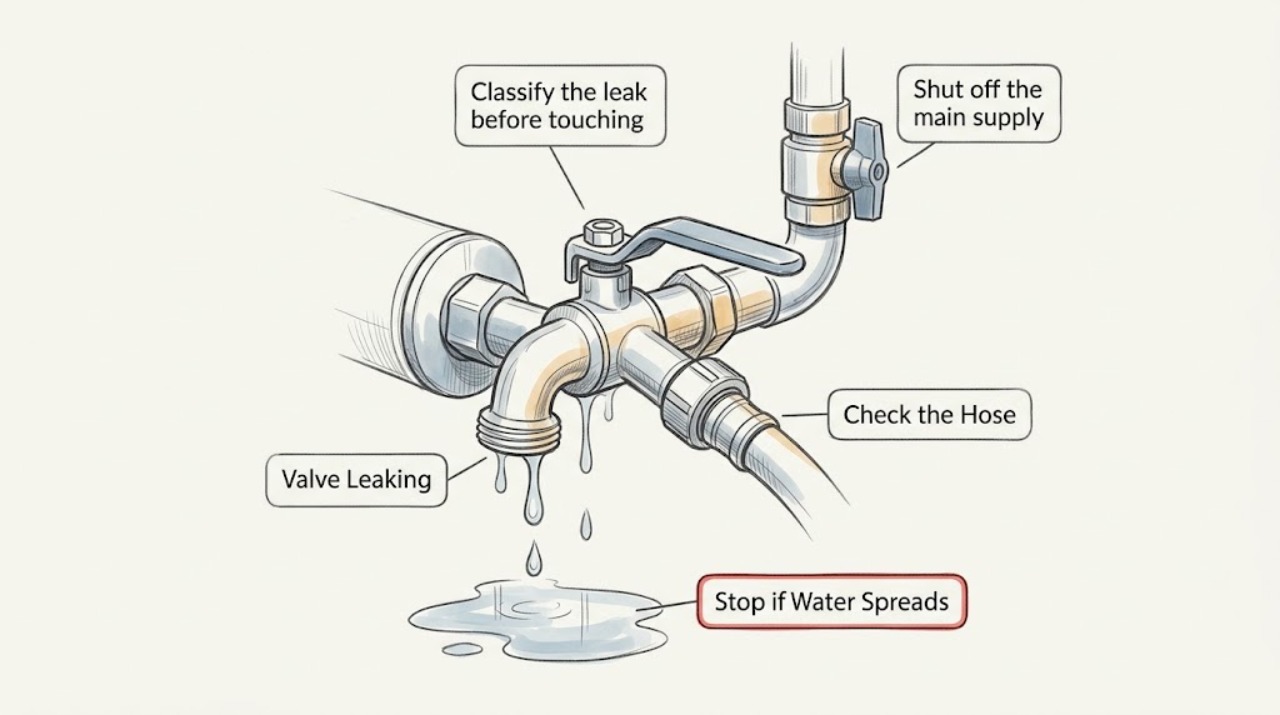
Classify the leak before touching the valve
From a dry, safe position, observe whether water is a drip, a steady stream, a spray, or a gush. Locate the first wet point: the handle or stem, packing area, threaded connection, valve body seam, attached hose or outside tap, pipe on either side, or buried service line. Do not wipe away evidence before locating the source and do not touch a bulging, cracked, frozen, or pressurized fitting.
Expected result: The leak is a slow stem drip, a connection leak, a body crack or bulge, a spray or gush, a frozen outside tap, or an underground wet area.
Next step: Continue only with safe isolation and documentation. Treat spray, gush, a crack or bulge, or a growing wet area as an urgent main-shutoff and plumber situation.
Stop if: Do not tighten, strike, heat, dismantle, or repeatedly cycle a leaking valve to discover where it fails.
Why this matters
Why: A slow localized leak may allow planned service, while a body failure, spray, gush, freeze-thaw symptom, or buried leak can overwhelm the valve or property quickly.
-
Shut off the main supply only for a severe leak and only if safe
If water is gushing, a pipe has burst, or the leak is rapidly spreading, locate the home's main water shutoff where the supply enters the property. Turn a familiar gate handle clockwise or a familiar ball-valve handle to its closed position slowly and without force. If the valve is stuck, broken, in a flooded or electrical area, or unsafe to reach, keep clear and contact the water utility or a plumber for emergency isolation.
Expected result: Flow stops or slows substantially, the valve will not move, the valve continues to leak under pressure, or water is coming from the street or meter side.
Next step: Keep the main closed if it controls the leak, avoid using fixtures, and call a plumber. Contact the water utility for a public-side or meter-area emergency or when the home valve cannot be operated.
Stop if: Do not force a stuck valve, remove a meter cover, use improvised tools on a buried valve, or enter standing water near electrical equipment.
Why this matters
Why: A working main shutoff can limit interior flood damage. A stuck or ineffective valve means the property cannot be safely isolated at that point; a street-side or meter-side issue may belong to the utility or require coordinated service.
-
Identify whether the outside tap has a hose or freeze exposure
For an outside tap, look for a garden hose, splitter, spray nozzle, insulation damage, ice, frost, or a wet wall and foundation area. Disconnect and drain a hose before freezing conditions only when it can be removed without force and without approaching a spray or damaged fitting. Do not turn a frozen handle or heat the tap with a flame.
Expected result: A hose was left connected, the tap or adjacent pipe is frozen, the tap body is split or bulging, water appears only during use, or the outside assembly is dry but an indoor line is wet.
Next step: Keep the local or main supply off if the tap is leaking, protect the area from further water, and call a plumber for a frozen, split, or inaccessible assembly. Do not attempt a forceful thaw.
Stop if: Do not use an open flame, torch, heat gun, or concentrated heat on a frozen tap or pipe, and do not force a frozen handle.
Why this matters
Why: A connected hose or freeze can trap water and increase the chance of a leak or burst at the tap or connected pipe. A split or bulging tap is an actual damage sign, not just a prediction.
-
Check whether a local shutoff still controls the fixture
If the leaking valve serves a faucet, toilet, appliance, or outside tap, identify the downstream fixture and keep people away from the wet area. If the local handle or lever is familiar and dry, close it gently while watching the leak; do not turn a stiff valve farther or remove its handle. If the valve is the main supply or the leak is upstream of it, do not rely on a local valve.
Expected result: The local valve stops the fixture flow, reduces it but continues to leak, does nothing, turns freely without controlling the fixture, or is stuck.
Next step: Leave a failed or stuck local valve alone, close the main only if the leak is severe and it is safe, and arrange plumbing service. Keep the affected fixture out of use.
Stop if: Do not force a handle, loosen packing nuts, remove the valve, or continue using the fixture to test a valve that is leaking or cannot isolate water.
Why this matters
Why: A local shutoff that works can limit the affected branch. Continued flow, a stuck handle, or water on the supply side indicates a valve or pipe fault requiring a plumber and possibly the main shutoff.
-
Check for ongoing flow after all fixtures are off
Once any safe local or main isolation is complete, turn off ordinary water use and observe the home's accessible meter or leak indicator only from a dry, safe location. Allow for the meter's display delay. Do not open a meter vault that is flooded, damaged, or designated for utility staff.
Expected result: The meter continues to show flow with all fixtures off, the indicator stops after isolation, or the leak appears between the meter and home or in a public right-of-way.
Next step: Keep water isolated as needed and call a plumber or leak-detection professional for a private line. Report heavy flow or a street-side break to the water utility; do not excavate or open the meter vault yourself.
Stop if: Do not enter a flooded meter box, dig around a pressurized line, or operate a utility-owned meter valve unless the utility authorizes it.
Why this matters
Why: Continuous flow supports an active leak somewhere in the private plumbing or service line. The location relative to the meter changes whether the homeowner, plumber, or utility is the next contact.
-
Document the valve and surrounding damage for service
Photograph the valve, handle position, first wet point, nearby pipe material, frost or corrosion, water path, meter or utility location, and any bulge or crack without moving the valve. Record whether the leak changes when a downstream fixture is used and whether the valve can be identified as a gate, ball, stop, hose-bib, or appliance valve.
Expected result: The leak is repeatable at the same point, worsens when downstream water is used, appears only during freezing or thawing, or cannot be safely reproduced.
Next step: Keep the affected valve isolated or unused and provide the evidence to the plumber or utility. Do not attempt a repair based on the photograph alone.
Stop if: Do not remove insulation, excavate, scrape corrosion, or cycle the valve repeatedly to produce a clearer symptom.
Why this matters
Why: These details help a plumber distinguish stem or packing leakage, body or connection failure, freeze damage, and a supply-line issue without risky disassembly.
-
Protect the area while waiting for a plumber
Move belongings away from the water only if the floor is stable and dry, place a container under a slow accessible drip without touching the valve, and keep children and pets away. If water reaches outlets, panels, appliances, or wiring, do not touch the equipment; isolate electrical power only from a safe dry position if that can be done without approaching the water.
Expected result: The container fills quickly, water spreads under walls or flooring, electrical equipment is wet, the ceiling or wall bulges, or the leak remains a slow contained drip.
Next step: Escalate immediately for a gush, spreading or concealed water, a bulging ceiling or wall, or wet electrical equipment. Keep the local or main water supply off and arrange plumber, utility, or emergency help.
Stop if: Do not stand in water to reach an electrical panel, use electrical appliances in the wet area, or leave a rapidly filling container unattended.
Why this matters
Why: Rapid accumulation, hidden water damage, or electricity exposure can make the situation more urgent than the visible valve drip suggests.
-
Set the professional repair boundary
After safe isolation and external observations, classify the valve as a slow stem or packing leak, a damaged or bulging body, a stuck or ineffective shutoff, a frozen outside tap, a buried or meter-side line, or a leak that continues after isolation. Keep the affected water supply off and do not remove the valve, adjust pressure, solder, or excavate.
Expected result: The leak continues, the valve does not isolate flow, the body or pipe is damaged, the valve is frozen or buried, or the source is uncertain.
Next step: Call a qualified plumber; contact the water utility for a public-side or meter-area issue. Provide the exact location, severity, isolation result, and photographs.
Stop if: Do not keep operating a valve that is stuck, cracked, bulging, or unable to stop flow, even if the leak temporarily slows.
Why this matters
Why: These patterns require plumbing diagnosis and may require utility coordination, replacement of the valve or connected pipe, freeze-damage repair, or water-damage mitigation.
Use your observations
Decision map
Find the observation that best matches what you see, then follow the next safe action.
-
PATH 01Next step
What you see
A slow drip is confined to a stem or packing area, the valve still isolates the downstream fixture, and there is no frost, bulge, crack, spray, or spreading water.
Do this next
Leave the valve in the stable position, keep the fixture unused, and schedule a plumber. Do not tighten or dismantle it without the correct repair procedure.
Why this path and its safety boundary
Why it matters: This looks more like a planned valve repair than an imminent burst, but pressure and age can change the leak.
-
PATH 02Next step
What you see
The valve body or adjacent pipe is cracked, bulging, split, spraying, or leaking faster during use or thawing.
Do this next
Close the main water shutoff only if familiar, reachable, and safe; do not force it. Keep clear and call a plumber or water utility for emergency isolation.
Why this path and its safety boundary
Why it matters: This is actual structural damage with a credible flood or burst risk, not merely a prediction.
-
PATH 03Next step
What you see
An outside tap had a hose attached during freezing weather, shows frost, or begins leaking as temperatures rise.
Do this next
Do not use flame or force the handle. Isolate water if safe, keep the area clear, and arrange a plumber to inspect the tap and connected pipe.
Why this path and its safety boundary
Why it matters: Trapped or frozen water may have damaged the tap or connected pipe and can reveal a leak during thawing.
-
PATH 04Next step
What you see
The local shutoff turns easily but does not stop water, is stuck, or becomes harder to turn while the leak continues.
Do this next
Stop cycling it, close the main only if safe, and call a qualified plumber. Do not remove the handle or packing nut.
Why this path and its safety boundary
Why it matters: The valve cannot provide reliable isolation; further force can break the stem or body and make flooding worse.
-
PATH 05Next step
What you see
The main shutoff stops interior flow but the meter still shows continuous flow, or water is emerging from the street, meter box, or public right-of-way.
Do this next
Keep the home supply isolated as needed and contact the water utility for the public or meter-side portion; have a plumber inspect the private line. Do not enter or excavate the meter area.
Why this path and its safety boundary
Why it matters: The leak may be on the service line or utility side rather than at the interior valve.
-
PATH 06Next step
What you see
The leak is a slow contained drip with no structural damage, but the area is near electrical equipment, hidden behind a wall, or producing a bulging ceiling or floor.
Do this next
Keep clear of wet electricity, isolate water and power only from safe dry locations, and arrange urgent plumber and appropriate emergency or electrical help.
Why this path and its safety boundary
Why it matters: The visible flow understates the property or electrical risk.
-
PATH 07Next step
What you see
Water is gushing, a container fills quickly, the main valve is stuck, or the leak continues after the expected isolation.
Do this next
Leave the wet or unsafe area, call the water utility or emergency plumber, and use emergency services for electrical danger or a life-safety event.
Why this path and its safety boundary
Why it matters: The property cannot be reliably protected by a local valve and may flood rapidly.
Helpful context
Understand the symptom
A prediction is not the same as a burst
A valve that drips does not, by itself, prove that it will burst. What matters is where the water comes from and whether the valve still controls flow. A drip at a stem or packing area is different from water coming through a crack in the valve body, a spray at a fitting, a frozen outside tap, or water that continues when the valve is closed. Treat the latter patterns as a shutoff and plumber problem, not as an invitation to tighten or dismantle the valve.
Use the main shutoff for an uncontrolled leak
A local shutoff may isolate a faucet, toilet, appliance, or outside tap, while the main shutoff controls the home's interior supply. City guidance recommends closing the main supply for a severe leak or burst pipe. Operate a familiar valve gently; if it is stuck, damaged, or unsafe to reach, call the water utility or a plumber rather than applying more force.
Outside taps need a cold-weather branch
Before freezing weather, disconnect and drain garden hoses and protect exposed taps and pipes. A connected hose can prevent an outside faucet from draining properly, and a frozen pipe may leak or burst when it thaws. Never thaw a suspected frozen pipe with an open flame or by heating one spot; if a freeze is suspected, be ready to shut off water and call a plumber.
Safety boundary
Stop conditions
- Stop immediately for gushing water, a cracked or bulging valve or pipe, a valve that cannot stop flow, flooding, water near electrical equipment, a collapsing or bulging ceiling or wall, or a leak at the street or meter side. Close the main only if it is familiar, reachable, and safe; otherwise keep clear and call the utility or a plumber.
- Do not force a stuck valve, remove a meter cover, excavate a buried line, loosen packing nuts, dismantle or replace a pressurized valve, solder, or use improvised tools to control a flood.
- For outside taps, disconnect hoses before freezing weather when safe, but never use an open flame, torch, heat gun, or concentrated heat on a frozen pipe and never force a frozen handle.
- Do not stand in water to reach electrical equipment, operate electrical devices in a wet area, or assume a slow drip means a valve is about to burst. The leak location and isolation result determine urgency.
Only after diagnosis
Potential parts
- shutoff valve assembly
Consider this only when a plumber confirms the valve body or mechanism is defective and identifies the correct isolation point, pipe material, size, pressure, and installation method.
Gate, ball, stop, hose-bib, appliance, and main-service valves are not interchangeable by appearance. Confirm the pipe and local code requirements before selection. - valve stem or packing seal
Consider this only when the leak is confirmed at a serviceable stem or packing area and a plumber verifies that the valve body and stem remain sound.
Packing and stem components vary by valve design and age. A seal is not appropriate for a cracked, bulging, frozen, or pressurized body failure. - outside tap or frost-resistant hose bib
Consider this only when a plumber confirms freeze or body damage at an outside tap and determines the correct replacement and shutoff arrangement.
Outside tap reach, connection, anti-siphon features, freeze protection, and installation vary. Confirm the exact existing setup and local requirements before purchase.
When checks do not resolve it
Need a professional?
Request plumbing service for a persistent stem or packing leak, failed local shutoff, cracked or bulging valve, outside-tap freeze damage, a buried or inaccessible valve, a leak that continues after isolation, or any repair requiring pressure, pipe, soldering, excavation, or valve replacement work.
Safety scope: Keep water isolated when safe and do not operate a stuck, cracked, bulging, frozen, or ineffective valve. Keep clear of flooding and wet electrical equipment; use the water utility or emergency services for a rapidly worsening or unsafe condition.
Common questions
FAQ
Does a leaking shutoff valve mean it is about to burst?
Not necessarily. A slow stem or packing drip is different from a cracked or bulging body, spray, gush, frozen outside tap, or valve that cannot stop flow. Those actual damage or control failures justify urgent isolation and plumbing service.
What should I do if the main water shutoff is stuck?
Do not force it. Keep clear of the leak, isolate water only at another familiar safe point if possible, and contact the water utility or a qualified plumber for emergency shutoff. Forcing a stuck valve can break the stem or body and worsen flooding.
Can an outside tap burst in freezing weather?
Yes, especially when water is trapped by a connected hose or a frozen section. Disconnect and drain hoses before freezing weather when safe, but never use an open flame or force a frozen handle. A tap that leaks during thawing needs a plumber's inspection.
When should I close the home's main water shutoff?
Close it for a severe, rapidly spreading, or burst-pipe leak when the valve is familiar, reachable, and safe to operate. Do not enter standing water near electricity or fight a stuck valve; call the utility or a plumber instead.
Should I tighten the packing nut on a leaking valve?
Do not assume that tightening is safe or appropriate. If the valve is old, stiff, corroded, cracked, bulging, pressurized, or unable to isolate water, further force can worsen the failure. Keep it stable and have a plumber identify whether a seal, valve, or pipe repair is needed.
Read the exact guide
Official sources
- How to Prepare Your Pipes for Frigid TemperaturesVillage of Ada, Ohio · Residential pipes and outside taps exposed to freezing temperatures
- Locating & Operating Water Shut-Off ValvesCity of Hamilton, Ohio · Residential water shutoff identification and emergency leak isolation; local layouts may differ
- Water LeaksCity of Bellevue Utilities · Residential leaks and water-service responsibility in Bellevue; use local utility rules elsewhere
- What to do if water pipes freeze, leak, or burst as temperatures risePortland Water Bureau · Residential water pipes and outside taps in freezing or thawing conditions; local utility procedures vary
Community feedback
Share a repair observation
Share a plain-text repair observation. Accepted observations are published automatically; this page may take a moment to update.