
On this page
Start here
Quick answer
First compare the temperature and flow at other hot-water fixtures. If the whole home has no hot water, the water heater or building supply is the priority and a plumber or property manager should be contacted. If cold water works at one shower or faucet but hot water does not, verify any accessible hot-side shutoff/check stop is open and identify the exact valve model. A reversed or restricted supply, debris in a balancing spool, or a worn cartridge can cause the symptom, but cartridge or valve-body work should follow the model instructions or be handled by a qualified plumber.
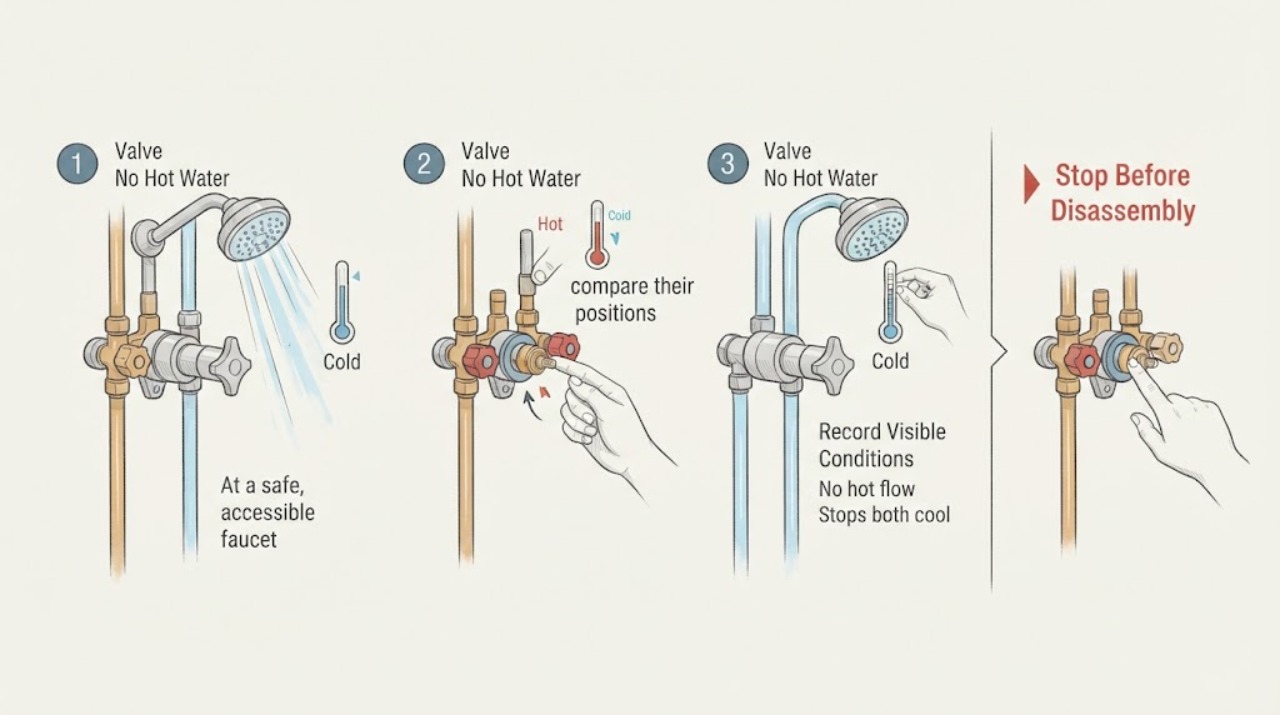
Work through in order
Diagnostic checks
Use only checks that match the exact appliance or system and its official guide.
-
Check 1
At a safe, accessible faucet, compare hot and cold flow and temperature at more than one fixture. Note whether hot water is absent everywhere, absent only at the affected valve, or present but weak.
Expected result: All fixtures lack hot water, or other fixtures have hot water while this valve does not.
Next step: If the whole home lacks hot water, check only the water-heater status that the owner manual permits and contact a plumber or property manager if it is not obvious. If other fixtures have hot water, continue with the affected valve's supply checks.
Why this matters
Why: A housewide absence points toward the water heater, building supply, or a system shutoff; a single-fixture absence points toward that valve's supply, cartridge, balancing mechanism, or installation.
-
Check 2
If the valve has accessible hot and cold shutoff valves or check stops, compare their positions with the manufacturer's instructions and confirm that the hot-side stop has not been closed after installation or service. Do not force a seized stop or disturb a concealed fitting.
Expected result: The hot-side stop is closed, partly closed, inaccessible, or uncertain; or both supplies appear open.
Next step: Use only the model-approved adjustment for an accessible stop. If the stop is inaccessible, seized, leaking, or already open, isolate water if safe and call a plumber for the valve and supply diagnosis.
Why this matters
Why: A mixing valve needs hot and cold supply to blend water. A closed hot-side stop can leave cold water available while the valve delivers no hot water.
-
Check 3
Identify the faucet/valve model and record whether the no-hot symptom began after installation, remodeling, or valve service. If supply pipes are safely accessible without opening the wall, note whether the hot and cold lines may have been reversed; do not dismantle the valve to investigate.
Expected result: The problem began after work, the model is unknown, the lines may be reversed, or the installation history is normal/unknown.
Next step: Use the exact model literature or have a plumber verify connections and calibration. Do not swap cartridge orientation or reinstall a valve based on a generic diagram.
Why this matters
Why: Moen identifies installation error, reversed hot/cold lines, and missing supply pressure as possible causes for temperature-specific problems. Valve families use different cartridges and adjustment methods.
-
Check 4
On a multi-outlet shower system, compare the affected showerhead, hand shower, or body spray with another outlet while the mixing valve is set normally. If the outlet device can be removed without exposing plumbing or creating a leak, follow its model instructions; do not open a concealed valve.
Expected result: Only one outlet lacks flow/hot water, or every outlet on the system has the same temperature-specific problem.
Next step: For one-device-only flow, inspect the device for an accessible blockage according to its instructions. For all outlets or persistent no-hot flow, treat the mixing valve, supply, or cartridge as the service path.
Why this matters
Why: Moen distinguishes a transfer valve problem affecting one showering device from a mixing valve problem affecting the entire system or a specific temperature.
-
Check 5
With water isolation and model identification left to the manufacturer instructions or plumber, characterize the valve symptom: cold only, hot only, no mixture, low flow only on hot, or unstable temperature. Note any recent sediment, renovation, or pressure change without trying to flush a concealed valve.
Expected result: The valve has cold-only flow, low hot-side flow, no mixture, unstable temperature, or a device-specific flow loss.
Next step: Give the symptom pattern and model to a qualified plumber or manufacturer support. Cartridge, balancing-spool, inlet-screen, or valve-body work requires the exact valve procedure and safe water isolation.
Why this matters
Why: Moen associates cold-only/hot-only symptoms with a balancing spool obstruction, insufficient pressure, calibration, or cartridge issue; Delta notes mineral deposits can affect the pressure-balance spool and restrict temperature behavior.
-
Check 6
Look for water escaping around the trim, handle, wall, or accessible supply connection while the valve is operated normally. Do not continue operating a valve that cannot shut off or is leaking into a wall or cabinet.
Expected result: There is a leak, damp wall/cabinet, uncontrolled flow, or no visible leak.
Next step: If leaking, isolate the fixture's water supply if safely accessible and call a plumber promptly. If dry, continue only with model-specific temperature diagnosis; persistent no-hot flow still needs service.
Why this matters
Why: A leak can damage the structure and may indicate a failed cartridge, retaining seal, valve body, or connection; visible trim does not reveal the full condition behind the wall.
-
Check 7
Stop user troubleshooting when the hot-water system is not operating, a stop is seized or hidden, the valve leaks, hot/cold lines may be reversed, the model cannot be identified, or the valve still supplies no hot water after safe supply checks.
Expected result: A supply, installation, leak, model-identification, or persistent valve fault remains.
Next step: Contact a licensed plumber or the valve manufacturer with the model, fixture scope, hot/cold comparison, stop status, and installation history. Do not guess at a replacement cartridge or leave the valve operating with an unresolved leak.
Why this matters
Why: Diagnosis may require water isolation, access behind trim or a wall, pressure testing, cartridge removal, or correction of hot/cold connections—work that can cause flooding or scalding if done incorrectly.
Use your observations
Decision map
Find the observation that best matches what you see, then follow the next safe action.
-
PATH 01Next step
What you see
No hot water is available at multiple fixtures
Do this next
Treat the water heater, building supply, or system shutoff as the priority and contact a plumber or property manager if the cause is not obvious from safe owner checks.
-
PATH 02Next step
What you see
Cold water works at the affected valve but hot water does not
Do this next
Check accessible hot-side shutoffs/check stops and then identify the valve model; persistent cold-only flow points toward supply, cartridge, balancing, or installation diagnosis.
-
PATH 03Next step
What you see
The problem started after installation or valve service
Do this next
Have a plumber verify hot/cold line orientation, check stops, pressure, and calibration for the exact valve; do not reverse lines or cartridges based on guesswork.
-
PATH 04Next step
What you see
Only one shower outlet lacks flow or hot water
Do this next
Follow the outlet device's model-specific blockage guidance; a transfer/diverter path may be involved rather than the temperature mixing valve.
-
PATH 05Next step
What you see
All outlets have temperature-specific low flow or cold-only water
Do this next
Use the mixing-valve branch: a balancing spool, cartridge, inlet screen, supply restriction, or calibration may need qualified service.
-
PATH 06Next step
What you see
The valve leaks, cannot shut off, or water is entering a wall/cabinet
Do this next
Isolate water if safely accessible and call a plumber; do not remove trim or continue temperature tests while water damage is possible.
Helpful context
Understand the symptom
Start by deciding whether the valve is actually the problem
“No hot water at the valve” can mean no hot water anywhere, normal hot water at other fixtures but not this one, or normal temperature with very low flow. Those are different paths. A shower mixing valve cannot make hot water that is absent at the water heater or supply, and a transfer valve can affect one shower device without being the temperature-control valve.
Do not open a concealed valve casually
Before removing a handle, cartridge, or trim, identify the valve model and know where the water isolation is. A hidden valve body may be behind a wall, and an incorrect cartridge or reversed installation can create temperature and leak problems. If you cannot isolate water safely, stop and call a licensed plumber.
Hot-water scald risk remains even while troubleshooting
If hot water suddenly returns, do not assume the temperature is safe. Test cautiously and follow local plumbing requirements and the valve manufacturer's temperature guidance. Stop if the valve leaks, cannot shut off, or produces unstable temperatures.
Only after diagnosis
Potential parts
- mixing-valve cartridge
Consider only after the hot supply and shutoffs are verified and a qualified diagnosis confirms cartridge restriction or failure.
Cartridges are valve-model-specific; identify the exact manufacturer and model before selection and follow the approved isolation procedure. - balancing spool or pressure-balance assembly
Consider only when a qualified plumber confirms debris, mineral restriction, or failure in the balancing mechanism causing cold-only or temperature-specific flow.
Balancing components differ by valve family and are not interchangeable based on appearance. - hot-side check stop or shutoff assembly
Consider only if an accessible stop is damaged, seized, or leaking and a plumber confirms replacement is needed.
Confirm valve family, connection, and local plumbing requirements; do not force or substitute a concealed stop. - transfer or diverter cartridge
Consider only when one showering device lacks flow and the transfer/diverter path—not the mixing valve—is confirmed as the cause.
Transfer cartridges are model-specific and do not replace a temperature-mixing cartridge.
When checks do not resolve it
Need a professional?
Call a plumber or property manager when hot water is absent at multiple fixtures, or when a valve has no hot water after safe supply checks. Escalate promptly for a leak, concealed or seized shutoff, suspected reversed lines, unstable temperature, water entering a wall/cabinet, or an unidentified valve. Use the exact manufacturer procedure before any cartridge or valve-body work.
Common questions
FAQ
Why is there no hot water at one shower valve but hot water elsewhere?
The affected valve may have a closed hot-side stop, restricted supply, reversed installation, balancing mechanism, or cartridge problem. Confirm the fixture scope and model first; persistent cold-only flow needs a plumber or manufacturer-specific diagnosis.
Can a shutoff valve cause no hot water?
Yes. A mixing valve needs hot and cold water supplied to its inlets. A closed or restricted hot-side check stop can leave cold water available while preventing hot water from reaching the valve.
Could the cartridge be the reason a valve has no hot water?
It can be, but the hot-water system, supply pressure, shutoffs, line orientation, and valve model should be checked first. A cartridge or valve-body replacement must match the exact valve and follow safe water-isolation instructions.
What if only one showerhead has no hot water?
A transfer/diverter or outlet blockage may affect one device while the mixing valve is working. Compare another outlet and follow its model-specific guidance; if all outlets are affected, the mixing-valve or supply path is more likely.
Read the exact guide
Official sources
- The water in the shower is either hot or cold; I cannot get any temperature in between. What is wrong?Delta Faucet · Official Delta guidance for the cited Monitor pressure-balance valve families; do not generalize part fit to another valve.
- No WARM water (no mixture of hot and cold) on tub shower units.Moen Solutions · Official Moen guidance; identify the exact faucet model before applying a valve-specific procedure.
- Shower Faucet: Low Flow- Independent Transfer ValvesMoen Solutions · Official Moen guidance for multi-device shower systems; model-specific valve and device instructions apply.
- No COLD (just hot) or No HOT (just cold) water on tub shower unitsMoen Solutions · Official Moen guidance for tub/shower valve families; exact model and installation instructions control.
- Troubleshooting water pressure and flowCity of Portland · Official municipal water guidance; building and fixture conditions vary.
Community feedback
Share a repair observation
Share a plain-text repair observation. Accepted observations are published automatically; this page may take a moment to update.