
On this page
Start here
Quick answer
A gas water-heater pilot that repeatedly goes out should not be relit over and over. If you smell gas, hear gas escaping, a carbon-monoxide alarm sounds, or anyone has headache, dizziness, nausea, confusion, or faintness, leave immediately and contact emergency or gas authorities from outside. If there is no gas or CO warning, follow the lighting instructions on the heater exactly once and observe when the pilot fails: immediately after the control is released points toward flame or thermocouple sensing, while a pilot that fails when the main burner starts, a fan runs, a door closes, or wind changes makes draft, venting, or combustion-air trouble more likely. Do not open the burner compartment, adjust gas pressure, test draft with a flame or smoke, or alter vent openings. A recurring outage, visible vent spillage or soot, weak or unstable flame, or any uncertainty about the vent requires a qualified gas-appliance or plumbing professional.
Before you begin
Safety first
- This article supports hazard screening, reading the model label, one label-directed relight attempt only when no gas or CO warning exists, and safe external observation. Do not open burner compartments, adjust gas controls or pressure, perform draft tests, alter combustion-air openings, touch hot venting, or repair gas or vent components.
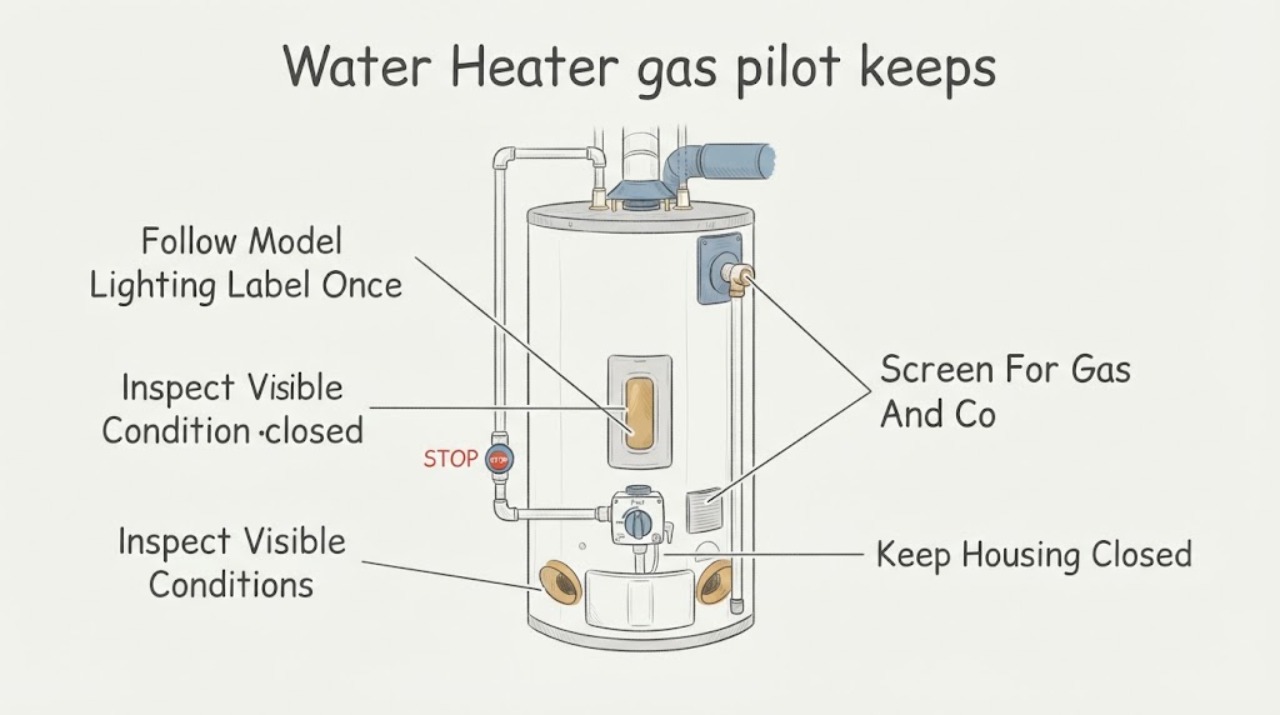
Work through in order
Diagnostic checks
Use only checks that match the exact appliance or system and its official guide.
-
Check 1
If the pilot is out, stop trying to relight it and assess from a safe position whether there is a gas odor, a hissing sound, a carbon-monoxide alarm, smoke or soot, or anyone with headache, dizziness, nausea, confusion, weakness, or faintness.
Expected result: Record whether any gas or combustion warning is present and whether the heater room or nearby living areas are occupied.
Next step: For any gas or CO warning, leave immediately without operating switches or electronics and contact emergency or gas authorities from outside; for no warning, keep the heater off while identifying the failure moment.
Stop if: Do not light a match, operate a switch, use a phone inside, search for a leak, or remain in the home to troubleshoot when gas or CO danger is suspected.
Why this matters
Why: Gas odor or sound, a CO alarm, symptoms, or signs of combustion spillage is an immediate safety event rather than a pilot-repair clue. No warning allows only the model-label lighting check and external observation described below.
-
Check 2
Only when there is no gas odor, no CO warning, and the appliance label permits homeowner relighting, read the exact lighting instructions on the heater, use only the specified control and igniter, and make one careful relight attempt without opening the burner compartment.
Expected result: Note whether the pilot lights, whether it remains lit while the control is held as the label directs, and the exact point at which it goes out after the control is released or the main burner is called.
Next step: Turn the control to the model-specified safe position and arrange service after a failed attempt; do not keep repeating relights to force the heater back into operation.
Stop if: Do not use generic relighting steps, bypass the safety control, hold the control indefinitely, or relight repeatedly after an outage.
Why this matters
Why: Failure immediately after release makes flame contact, thermocouple sensing, or the gas-control safety circuit more likely. Failure only after the main burner starts or airflow changes makes draft, venting, combustion air, or flame stability more concerning.
-
Check 3
Without removing doors or panels, observe the pilot only through the designated viewing area while following the heater's instructions and keeping clear of the burner and vent surfaces.
Expected result: Record whether the flame is steady or wavering, repeatedly lifts or blows away, appears weak or unusual for the model, fails to contact the sensing tip, or goes out when the main burner begins.
Next step: Stop operation and give the observation to a qualified technician; do not clean an orifice, bend the sensing tip, adjust the gas valve, or modify the burner compartment as a homeowner workaround.
Stop if: Do not open the sealed or guarded burner area, reach near the flame, scrape the pilot, change gas pressure, or continue operation with a visibly unstable or sooting flame.
Why this matters
Why: A flame that does not consistently heat the sensing tip can point to a pilot assembly, thermocouple, gas-control, or flame-quality fault. A flame disturbed by burner ignition or room airflow raises concern about draft, venting, combustion air, or an unstable installation.
-
Check 4
From a safe distance and without placing a flame, smoke, mirror, hand, or tool at the vent, note whether the outage coincides with the main burner starting, a clothes dryer or exhaust fan running, a door closing, strong wind, or a seasonal change in the heater room or attic.
Expected result: Record which airflow event, if any, precedes the outage, and whether there is visible soot, rust, condensation, an unusual exhaust odor, a loose-looking vent section, or other evidence of vent trouble.
Next step: Leave the gas water heater off and request a qualified draft, vent, and combustion-air inspection; do not attempt to seal, extend, reposition, or test the vent yourself.
Stop if: Do not run exhaust appliances to reproduce the failure, perform a flame or smoke draft test, touch a hot vent, or operate the heater after suspected spillage.
Why this matters
Why: A repeatable airflow trigger or vent-spillage sign makes improper draft, backdrafting, blocked venting, or combustion-air imbalance more likely than an isolated relighting error. A pilot that fails with no airflow trigger still needs service if it repeatedly goes out.
-
Check 5
With the heater off and cool enough to approach safely, inspect only the exterior around the unit for stored items, lint, snow, or other visible blockage at designed combustion-air openings and for an obviously displaced vent; do not remove guards or change the opening size.
Expected result: Record whether the heater is in a confined room, garage, closet, or attic; whether designed openings are blocked; and whether the vent route looks disconnected, corroded, or obstructed from the accessible exterior.
Next step: Keep the appliance off, clear only loose storage that can be removed without touching the heater or vent, and have a qualified professional verify the required air supply and venting before relighting.
Stop if: Do not cut new openings, seal existing openings, climb into an attic to inspect the flue, move the heater, or remove vent components.
Why this matters
Why: Blocked combustion-air paths or a changed installation environment can make the pilot unstable. A disconnected, damaged, or obstructed vent is a combustion-spillage risk, not a homeowner cleaning or adjustment task.
-
Check 6
Record the water-heater model and fuel type, the lighting instruction used, the time the pilot goes out, any airflow trigger, flame appearance, gas or CO warnings, visible soot or vent concerns, and whether hot water returns; keep the heater off after a recurring outage.
Expected result: Confirm whether the likely path is immediate post-release failure, main-burner or airflow-related failure, environmental combustion-air concern, or an unknown internal fault.
Next step: Give the record and rating-plate photo to a qualified gas-appliance technician or plumber; request a venting and combustion-safety check when the failure is draft-related or unexplained.
Stop if: Do not resume operation after repeated outage, suspected spillage, soot, damaged venting, or any gas or CO warning until a qualified professional has evaluated it.
Why this matters
Why: A precise failure sequence helps a technician separate the pilot-sensing assembly from draft, vent, combustion-air, gas-control, or other causes. Repeated relighting without that diagnosis can leave a safety control or venting fault unresolved.
Use your observations
Decision map
Find the observation that best matches what you see, then follow the next safe action.
-
PATH 01Safety boundary
What you see
There is a gas odor or hissing sound, a CO alarm or combustion-spillage sign, or anyone has possible CO symptoms.
Do this next
Leave the home immediately without operating switches or electronics, get to fresh air, and contact emergency or gas authorities from outside. Do not re-enter to relight or inspect the heater.
Why this path and its safety boundary
Why it matters: The immediate issue is a possible gas leak or combustion exposure, regardless of whether the pilot also has a thermocouple fault.
Safety stop: Do not troubleshoot, use a phone inside, strike a match, or turn appliances on or off while leaving.
-
PATH 02Safety boundary
What you see
The pilot lights but goes out as soon as the model lighting instruction allows the control to be released, with no gas or CO warning.
Do this next
Stop after the single label-directed attempt and arrange service for pilot-flame, thermocouple, and gas-control diagnosis; do not change gas settings or replace a part without model confirmation.
Why this path and its safety boundary
Why it matters: Incorrect flame contact, a weak or dirty pilot, a thermocouple or sensing connection, or a gas-control safety fault is more likely than a room draft alone.
Safety stop: Do not hold the control indefinitely, bypass the safety circuit, or keep relighting the heater.
-
PATH 03Safety boundary
What you see
The pilot remains lit until the main burner starts or until a fan, dryer, door, wind, or other airflow change occurs.
Do this next
Leave the heater off and have a qualified professional inspect draft, venting, combustion air, and flame stability before any further relight.
Why this path and its safety boundary
Why it matters: Draft, backdrafting, combustion-air imbalance, vent restriction, or flame lift is more concerning than a pilot that simply failed to establish.
Safety stop: Do not reproduce the trigger, perform a flame or smoke draft test, touch the vent, or alter openings.
-
PATH 04Safety boundary
What you see
Outages began after storage was placed near the heater, a room or closet was sealed, snow or debris appeared at an opening, or the heater is in a hot or poorly ventilated attic or confined space.
Do this next
Keep the heater off, remove only loose storage that can be cleared without touching the appliance, and have the required combustion-air and venting arrangement checked by a professional.
Why this path and its safety boundary
Why it matters: The combustion-air environment or attic ventilation may have changed enough to destabilize the pilot or draft.
Safety stop: Do not create, enlarge, seal, or relocate air openings, move the heater, or treat an attic-temperature concern as a DIY vent repair.
-
PATH 05Safety boundary
What you see
The pilot repeatedly goes out with no obvious airflow trigger, or it looks weak, unstable, sooting, or unlike the model's normal flame.
Do this next
Keep the appliance off and provide the technician with the model, flame observation, and outage timing for a complete gas-appliance and venting diagnosis.
Why this path and its safety boundary
Why it matters: A pilot assembly, thermocouple, gas-control, pilot-orifice, gas-supply, or combustion fault remains possible; the absence of an obvious draft does not make repeated relighting safe.
Safety stop: Do not clean internal gas parts, adjust gas pressure, replace a gas valve, or continue operating with an abnormal flame.
Helpful context
Understand the symptom
Treat a recurring pilot outage as a safety symptom
A standing pilot is meant to remain lit during normal operation. Repeated outages can result from a flame-sensing or pilot-assembly fault, but they can also be a sign of unstable combustion, a blocked or misdrafted vent, insufficient combustion air, or a draft at the base of the heater. Because a gas water heater shares the room's air and exhaust path, the safe response depends first on gas odor, carbon-monoxide warnings, and where in the lighting sequence the flame disappears.
Use the failure moment as the diagnostic clue
If the pilot dies as soon as the lighting control is released, the flame may not be heating the thermocouple correctly, or the sensing circuit may not be holding the gas valve open. If it stays lit until the main burner starts, an airflow, venting, combustion-air, or flame-stability problem becomes more concerning. A pilot that goes out when a door, exhaust fan, clothes dryer, or strong wind changes the room airflow should not be treated as a simple relight problem.
Draft checks belong to a qualified technician
Do not hold a match, lighter, smoke, mirror, or other object at the draft hood or vent to diagnose draft yourself. A venting problem can spill combustion products, and the vent can be hot. From a safe position, you may note soot, rust, unusual exhaust odor, a visibly disconnected vent, or a flame that is being disturbed, but shut the appliance down and arrange professional inspection instead of trying to correct the vent or combustion-air openings.
Do not choose a part before the safety cause is known
A thermocouple or pilot assembly may be relevant when a model's troubleshooting identifies a flame-sensing or pilot-flame fault. A gas control valve, vent repair, combustion-air correction, or pilot-orifice service requires model-specific diagnosis. A generic replacement or a gas-pressure adjustment can mask the underlying problem and create a combustion hazard, so record the rating-plate information and the exact failure pattern for the technician.
Safety boundary
Stop conditions
- Leave immediately for gas odor, a hissing sound, a CO alarm, combustion-spillage sign, or possible CO symptoms; contact emergency or gas authorities from outside.
- Do not relight repeatedly after a pilot outage, bypass a safety control, adjust gas pressure, clean an internal orifice, or replace a gas control as a guess.
- Do not perform a flame, smoke, mirror, or hand draft test; do not touch a hot vent or open the burner compartment.
- Keep the heater off for a pilot that goes out when the main burner or room airflow changes, or when soot, rust, condensation, unusual exhaust odor, or damaged venting is visible.
- Do not create, seal, enlarge, or relocate combustion-air openings or attempt an attic or chimney repair; arrange qualified vent and combustion-safety inspection.
Only after diagnosis
Potential parts
- water-heater thermocouple
Consider this part only after a model-specific diagnosis confirms that the pilot flame and positioning are correct but the flame-sensing circuit does not hold the gas valve open after the lighting control is released.
Match the exact water-heater model, gas-control design, connection, length, and manufacturer's service instructions; do not use a thermocouple to mask a draft or combustion-air problem. - gas water-heater pilot assembly
Consider this class only when a qualified diagnosis confirms a damaged, restricted, weak, or model-specific pilot assembly after draft and combustion safety have been assessed.
Match the exact fuel type, water-heater model, pilot bracket, flame-sensing arrangement, and approved assembly; gas-burner work requires qualified service. - gas water-heater gas control valve
Consider this class only when a qualified technician confirms the safety control or gas valve is failing after pilot, thermocouple, gas-supply, draft, and combustion-air causes are ruled out.
Match the exact model, fuel, control type, connection, safety features, and installation requirements; never substitute or adjust a gas control based only on repeated pilot outages.
When checks do not resolve it
Need a professional?
Arrange prompt qualified gas-appliance or plumbing service after any repeated pilot outage, especially when the pilot goes out after the main burner starts, during fan or wind changes, or after an installation or room-air change. Request a venting and combustion-air inspection for a wavering or lifted flame, soot, rust, condensation, unusual exhaust odor, suspected spillage, or a vent that looks disconnected or blocked. Treat gas odor, hissing, a CO alarm, or possible CO symptoms as an immediate emergency: leave the home and contact emergency or gas authorities from outside.
Safety scope: This article supports hazard screening, reading the model label, one label-directed relight attempt only when no gas or CO warning exists, and safe external observation. Do not open burner compartments, adjust gas controls or pressure, perform draft tests, alter combustion-air openings, touch hot venting, or repair gas or vent components.
Common questions
FAQ
Why does my gas water-heater pilot keep going out in a draft?
A draft or backdraft can disturb the pilot, especially when the main burner starts or when a fan, dryer, door, wind, attic condition, or combustion-air change affects airflow. Because a venting fault can spill combustion products, leave the heater off and have a qualified technician inspect draft, venting, and combustion air rather than testing it with a flame or smoke.
What does it mean if the pilot goes out when I release the button?
If the pilot lights but fails immediately when the model instructions allow the control to be released, flame contact, pilot strength, thermocouple sensing, wiring, or the gas-control safety circuit may be involved. Make only the label-directed attempt and arrange model-specific service if it fails again.
Is it safe to keep relighting a water-heater pilot?
No. A pilot should not require repeated relighting in normal operation. Stop for any gas odor, hissing, CO alarm, symptoms, soot, unusual exhaust odor, or a pilot that goes out repeatedly, and keep the heater off until the cause is professionally checked.
Can I test a water-heater draft with a match or smoke?
Do not perform a flame, smoke, mirror, or hand draft test yourself. The vent may be hot and a venting fault can expose the home to combustion products. A qualified technician should test draft and verify safe venting and combustion-air conditions.
Read the exact guide
Official sources
- TROUBLESHOOTING GUIDELINESAmerican Water Heaters · American Water Heaters troubleshooting guide; model-specific instructions and qualified gas service take precedence.
- Protect Your Family and Yourself from Carbon Monoxide PoisoningU.S. Environmental Protection Agency · EPA household carbon-monoxide safety factsheet applicable to fuel-burning water heaters and their venting systems.
- HVAC Direct Vent EquipmentU.S. Department of Energy, Building Science Education · DOE educational explanation for direct-vent combustion appliances; the actual heater's vent type must be confirmed from its model documentation.
- Atmospheric Vent Gas Water Heaters and Attic InstallationsBradford White For The Pro · Bradford White professional guidance for atmospheric-vent gas water heaters, especially attic installations; it does not replace a heater's model manual or a site inspection.
- Technical Service Bulletin: Pilot Outage TroubleshootingRheem Manufacturing Company · Rheem/Ruud technical bulletin for standing-pilot gas water heaters; exact heater instructions and qualified service control the diagnosis for other models.
- How often do I have to light the pilot?Bradford White Water Heaters · Bradford White consumer FAQ for gas water heaters; repeated pilot outages on other models also require model-specific qualified diagnosis.
- Winter Storms Aren’t Over; CPSC Warns of Deadly Carbon Monoxide Risks and Fires During Power OutagesU.S. Consumer Product Safety Commission · CPSC household safety guidance; emergency and local gas-authority procedures control in an actual incident.
Community feedback
Share a repair observation
Share a plain-text repair observation. Accepted observations are published automatically; this page may take a moment to update.