
On this page
Start here
Quick answer
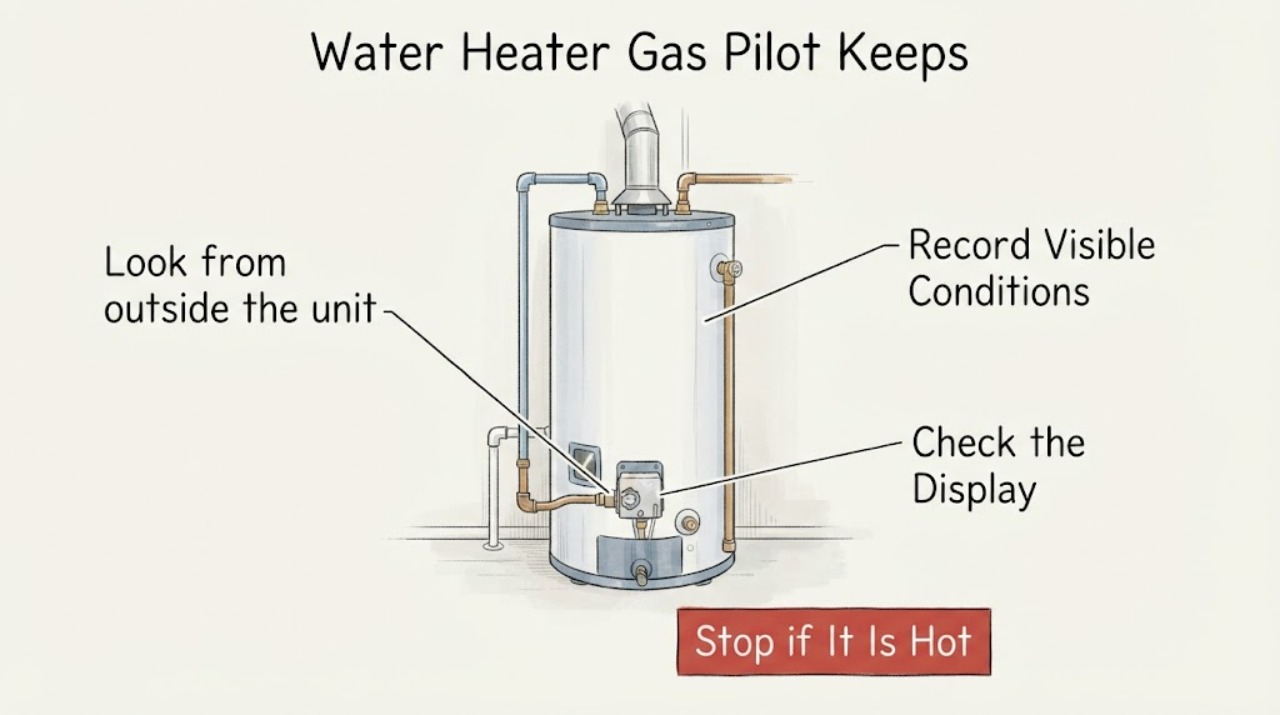
No gas smell does not make a repeatedly extinguishing pilot safe to keep relighting. Confirm the appliance uses a standing pilot, note whether it goes out immediately, when the control is released, or when the main burner starts, and follow the lighting label for that exact model only once after the required wait. From outside the combustion compartment, look for obvious blocked air or vent openings and check for an abnormal or weak flame through the viewing window if provided. If the pilot will not stay lit, the issue returns, a status light indicates a fault, or any gas, carbon monoxide, soot, overheating, or electrical symptom appears, leave the appliance off and call a qualified plumber or gas-appliance technician.
Before you begin
Safety first
- Gas piping, combustion, venting, flame-sensing, thermocouple or thermopile, gas-control, and burner-compartment work should be performed by a qualified professional.
Work through in order
Diagnostic checks
Use only checks that match the exact appliance or system and its official guide.
-
Check 1
Confirm whether the unit has a standing pilot that should remain lit, or an electronic ignition system that does not use a continuously burning pilot. From the outside, record the model label, status-light pattern if present, and whether the pilot goes out immediately, after the control is released, or when the main burner starts.
Expected result: The appliance has a standing pilot and a repeatable failure stage, or the appliance is electronic ignition and the reported pilot may be a mistaken description of another fault.
Next step: Use the exact model label and lighting instructions for the next step. If identifying the model requires removing a cover, stop and give the technician the visible information instead.
Stop if: Do not remove combustion-compartment doors, disconnect gas tubing, or continue if there is any gas odor, smoke, or carbon monoxide alarm.
Why this matters
Why: The failure stage selects different diagnostic paths; the exact model and control type are needed before interpreting a light pattern or choosing a part.
-
Check 2
If there is no gas odor and the appliance label permits relighting, wait for the label's specified interval, then follow that label exactly for one relight attempt. Watch the pilot only through the intended viewing port and keep the control held for the label's required time; do not improvise a sequence.
Expected result: The pilot establishes a steady flame and remains lit after the control is released, or it goes out during the attempt or soon afterward.
Next step: If it goes out again, set the control to the safe position specified by the label, leave the water heater off, and arrange qualified service. If it stays lit, monitor one normal heating cycle and stop if the symptom returns.
Stop if: Stop immediately if gas odor appears, the flame behaves abnormally, the control will not operate as labeled, or ignition produces a bang or flashback.
Why this matters
Why: A successful single attempt does not prove the system is healthy, while a repeat failure confirms that the safety or ignition problem remains; gas odor absence cannot distinguish the cause.
-
Check 3
With the water heater off and cool enough to inspect safely, look from outside the unit for obvious lint or dust at designated air openings, a blocked exterior vent termination, or a displaced draft path. Do not remove a burner, flame arrestor, vent section, or access panel.
Expected result: An opening or termination is visibly blocked or damaged, or the accessible air and vent areas look clear while the pilot still fails.
Next step: Remove only loose debris that the exact manual explicitly identifies as an owner-level exterior check; otherwise leave it untouched and call a qualified technician. Do not restart with a damaged or obstructed vent.
Stop if: Do not use a flame, smoke, mirror, compressed air, or a tool inside the vent or burner compartment to test draft or blockage.
Why this matters
Why: Combustion-air or vent restrictions can disturb pilot operation or trigger a safety shutdown, but a clear exterior does not rule out internal blockage, draft, gas, or flame-sensing problems.
-
Check 4
Observe the failure timing without repeated relighting: note whether the pilot extinguishes as soon as the control is released, when the main burner attempts to ignite, or when a furnace, air handler, exhaust fan, or other nearby equipment starts.
Expected result: The flame fails at control release, at main-burner ignition, or only when another appliance or fan operates.
Next step: Record the sequence and leave the water heater off for service. Do not adjust the gas valve, alter ductwork, or perform a draft test yourself.
Stop if: Stop all observation if there is flame rollout, soot, unusual noise, overheating, smoke, or any gas or carbon monoxide warning.
Why this matters
Why: Failure at release can involve flame sensing or the gas control; failure at burner ignition can involve pilot stability, draft, or combustion conditions; a fan-linked failure can indicate an air or vent interaction.
-
Check 5
Check the immediate area for a fuel odor, carbon monoxide alarm, soot or discoloration, water contacting controls, or signs that the unit has overheated. Keep the area clear of flammable materials and do not touch the burner or gas controls during this visual check.
Expected result: A safety symptom is present, or the only symptom is the recurring pilot outage with no odor detected.
Next step: For gas odor, do not operate switches or use a phone in the building; leave and follow gas-supplier or emergency instructions. For a carbon monoxide alarm, smoke, fire, or severe overheating, leave the area and obtain emergency help. Otherwise, keep the appliance off and call a qualified technician.
Stop if: Stop immediately for gas odor, a carbon monoxide alarm, smoke, fire, water on controls, or abnormal flame behavior.
Why this matters
Why: A gas, combustion, overheating, water, or electrical symptom takes priority over pilot troubleshooting. Even without odor, repeated outage requires diagnosis because the safety device may be shutting gas off for a reason.
Use your observations
Decision map
Find the observation that best matches what you see, then follow the next safe action.
-
PATH 01Next step
What you see
Do this next
Do not keep relighting or replace the sensor blindly. Leave the unit off and have a qualified technician evaluate the pilot assembly, sensor, wiring, and gas control.
Why this path and its safety boundary
Why it matters: The flame-sensing path may not be proving the pilot, or the pilot flame may not be heating the sensor adequately; the gas control is doing a safety shutdown rather than confirming which component failed.
-
PATH 02Next step
What you see
Do this next
Leave the appliance off and arrange service for a combustion and venting evaluation. Do not adjust the gas valve or attempt to test draft with improvised tools.
Why this path and its safety boundary
Why it matters: The transition may expose a pilot, gas-supply, combustion-air, or draft problem that is not visible during the pilot-only stage.
-
PATH 03Next step
What you see
Do this next
Stop using the water heater and report the timing and nearby equipment to a qualified technician. Do not relocate ductwork or modify venting yourself.
Why this path and its safety boundary
Why it matters: Air movement, return-air interaction, or vent drafting may be disturbing the pilot; odor absence does not rule out a venting or combustion-safety fault.
-
PATH 04Next step
What you see
Do this next
Keep the appliance off. Remove only loose exterior debris explicitly allowed by the model manual; otherwise obtain qualified service before operation.
Why this path and its safety boundary
Why it matters: The appliance may not be receiving or exhausting combustion air correctly, and restarting it could create unsafe combustion or repeated lockout.
-
PATH 05Next step
What you see
Do this next
Leave the water heater off and call a qualified plumber or gas-appliance technician; follow emergency guidance immediately for gas odor, fire, or carbon monoxide symptoms.
Why this path and its safety boundary
Why it matters: The recurring safety shutdown or hazard requires professional diagnosis and cannot be cleared safely by repeated ignition attempts.
Helpful context
Understand the symptom
Why the absence of gas odor is not a diagnosis
A standing pilot is monitored by a flame-sensing safety device. If the flame is not proven, the gas control is designed to stop gas flow. That can happen because the pilot flame is weak or unstable, the sensor is not being heated, gas or combustion air is inadequate, a draft disrupts the flame, or a safety control has operated. A home that does not smell gas can still have a combustion or equipment fault.
Use one controlled relight attempt, not repeated resets
The lighting instructions vary by gas control and water-heater model. Read the label on the appliance and follow its wait and ignition sequence exactly. If the pilot goes out again, preserve the status-light pattern and timing for the technician instead of repeatedly opening the combustion area or replacing a part by guesswork.
Safety boundary
Stop conditions
- Stop relighting after the pilot goes out again following one exact label-directed attempt; leave the water heater off and arrange qualified service.
- Do not remove burner or access panels, disconnect gas tubing, adjust the gas valve, bypass a safety device, or test vent draft with improvised methods.
- Leave the area and follow emergency instructions for gas odor, a carbon monoxide alarm, smoke, fire, flame rollout, or severe overheating.
- Call a qualified plumber or gas-appliance technician for a pilot that fails at control release or burner ignition, a status-light fault, a blocked or damaged vent, or a failure that returns even when no gas smell is detected.
Only after diagnosis
Potential parts
- pilot thermocouple or thermopile
Consider this only when testing confirms that the pilot flame is adequate but the flame-sensing device or its connections do not sustain the gas-control safety circuit.
Confirm the exact water-heater model, gas-control assembly, and manufacturer-approved part with a qualified technician before ordering. - pilot assembly or pilot orifice
Consider this only when diagnosis identifies a weak, unstable, contaminated, or incorrectly positioned pilot assembly and rules out gas supply, draft, and combustion-air causes.
Pilot assemblies are model- and fuel-specific; do not select one from a photograph or generic symptom. - water-heater gas control valve
Consider this only after a qualified professional confirms the gas control or its safety circuitry is defective rather than responding correctly to another fault.
Gas type, control family, sensor arrangement, and water-heater model must all be confirmed before ordering or installation.
When checks do not resolve it
Need a professional?
Contact a qualified plumber or gas-appliance technician when the pilot will not stay lit after the model's permitted attempt, when the failure follows control release or main-burner ignition, or when air, venting, gas supply, or safety-control involvement is possible.
Safety scope: Gas piping, combustion, venting, flame-sensing, thermocouple or thermopile, gas-control, and burner-compartment work should be performed by a qualified professional.
Have this ready
- Provide the water-heater brand and model, fuel type, status-light pattern, exact relight sequence used, failure timing, pilot appearance through the viewing port, nearby fans or equipment that were operating, and any visible vent or air-opening issue.
Common questions
FAQ
Why does the pilot keep going out if I do not smell gas?
A pilot can go out because its flame is weak, the flame-sensing device is not proving it, combustion air or venting is disturbed, or a safety control responds to another fault. No odor does not identify the cause or make repeated relighting safe.
Can I keep relighting the water-heater pilot?
Follow the exact appliance label for one permitted attempt after its required wait. If the pilot goes out again, leave the unit off and arrange qualified service rather than repeating the sequence.
What does it mean if the pilot goes out when I release the control?
The flame-sensing path may not be proving the pilot, or the flame may not be heating the sensor adequately. The thermocouple or thermopile is not proven bad from this symptom alone; a technician should test the pilot, connections, and gas control.
Could a vent or air problem extinguish the pilot?
Yes. Manufacturer troubleshooting includes combustion-air and vent restrictions or draft interactions as possible causes. Inspect only obvious exterior conditions allowed by the manual and leave vent or burner work to a qualified technician.
When is a pilot outage an emergency?
Leave the area and follow emergency guidance for gas odor, a carbon monoxide alarm, smoke, fire, flame rollout, or severe overheating. Keep the water heater off and obtain qualified help for any repeated outage or abnormal flame.
Read the exact guide
Official sources
- Gas Tank Water Heater InformationAmerican Water Heaters · Manufacturer overview distinguishing standing-pilot and electronic-ignition models and explaining the need for proper venting and safety components.
- 322253-001 AWHC HW MHG.inddAmerican Water Heaters · Manufacturer manual used for model-specific examples; the appliance label and exact manual control the actual relight procedure.
- Water Heating Plumbing Terminology 101Rheem Manufacturing Company · Manufacturer explanation of the pilot, thermocouple, gas valve, and why a flame-sensing device can shut off gas.
- 7 Signs You Need to Call a PlumberRheem Manufacturing Company · Manufacturer guidance that a pilot that will not stay lit is a plumber-service condition.
Community feedback
Share a repair observation
Share a plain-text repair observation. Accepted observations are published automatically; this page may take a moment to update.