
On this page
Start here
Quick answer
If a gas water-heater pilot lights and then goes out, the control is usually not receiving a reliable flame-safety signal, or the pilot flame, gas supply, combustion air, or venting is not stable. Before any relight attempt, check for gas odor, smoke, soot, flame rollout, or a carbon-monoxide alarm; if any is present, stop and leave the area as appropriate. Otherwise, follow the exact lighting instructions on the heater or in its model manual once, observe the pilot through the designed sight glass or opening, and note whether it dies as soon as the control is released or later during a heating cycle. Do not open the sealed burner door, adjust gas pressure, clean an orifice, bypass the thermocouple or thermopile safety, or keep forcing repeated relights. A pilot that will not remain lit needs qualified gas-appliance service; a gas odor or combustion hazard needs the gas utility or emergency service from a safe location.
Before you begin
Safety first
- This article supports hazard screening, ordinary-access observation, and one model-specific lighting attempt only. Do not open the combustion chamber, alter the gas train, bypass flame safety, adjust pressure or air, or dismantle venting.
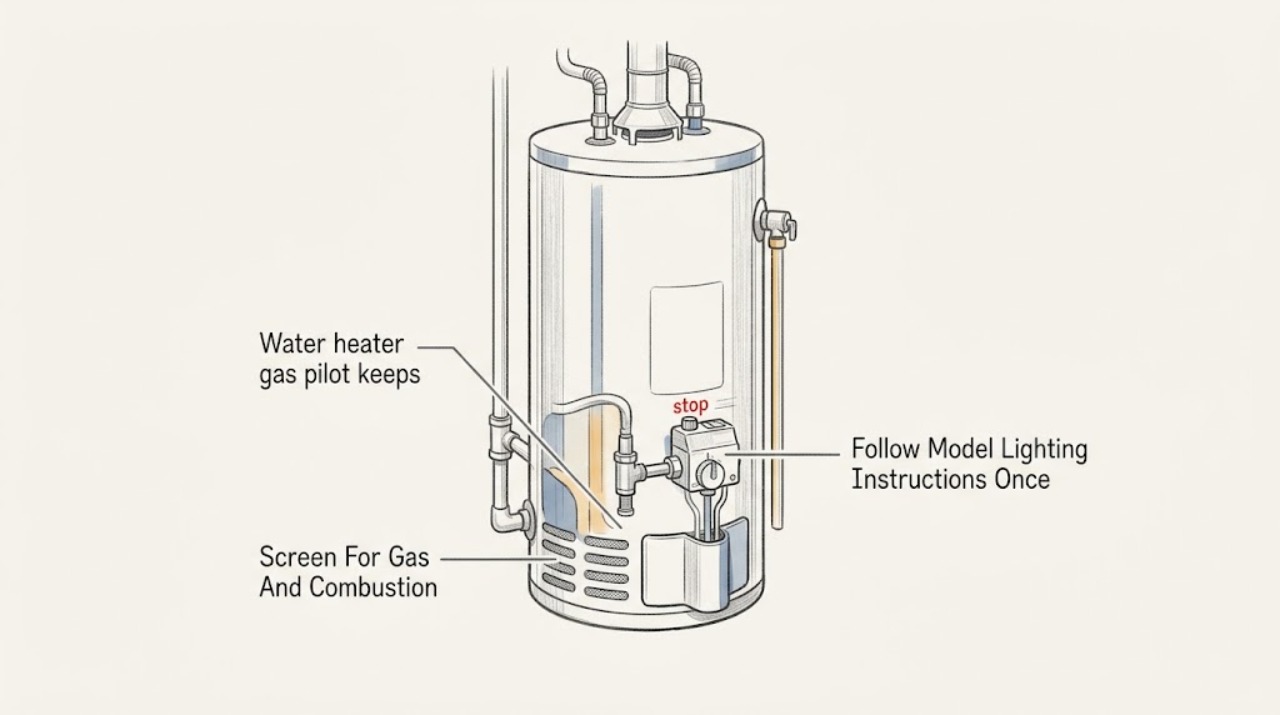
Work through in order
Diagnostic checks
Use only checks that match the exact appliance or system and its official guide.
-
Check 1
Before trying to relight anything, stand clear of the burner opening and check only from ordinary safe access for a gas odor, hissing, smoke, soot or discoloration, flame outside the intended viewing area, an unusual combustion odor, or a carbon-monoxide alarm. Do not use a match, lighter, switch, or tool to investigate.
Expected result: There is no gas odor, smoke, soot, flame rollout, unusual combustion odor, alarm, or other immediate hazard, or one of those warning signs is present.
Next step: If a warning sign is present, do not relight or operate the heater; leave the area when appropriate and contact the gas utility or emergency service from a safe location. If none is present, continue only with the exact lighting instructions for the installed model.
Stop if: Stop immediately for gas odor, hissing, smoke, soot, flame rollout, an alarm, or an appliance part that appears damaged or has been under water.
Why this matters
Why: A clean visual and odor screen permits only the model-specific relight check. Any gas or combustion warning makes relighting unsafe and can indicate a leak, venting, or combustion problem rather than a simple pilot adjustment.
-
Check 2
With no hazard signs present, read the lighting label and the exact model manual, set the control only as instructed, and use the built-in igniter or other specified method. Keep the burner door and any sealed combustion barrier in the configuration required by the manual; do not use tools or hold a control against its stop.
Expected result: The pilot produces the expected flame and remains lit after the manual's release step, or it goes out immediately at release, will not light, or requires repeated attempts.
Next step: If the pilot remains lit, observe it during a normal heating call without opening the compartment. If it dies or needs repeated attempts, turn the control to the manual's safe position and arrange qualified service; do not keep relighting it.
Stop if: Do not open an inner burner door, hand-light a sealed assembly, bypass a thermocouple or thermopile, force a knob, or continue if the knob does not operate as instructed.
Why this matters
Why: A pilot that dies at release makes the flame-sensing path, pilot flame, connection, or gas control more likely. A pilot that will not light points instead toward the igniter, gas supply, pilot tube or orifice, or control position. Repeated failure is not a successful repair.
-
Check 3
Without removing doors or panels, observe the pilot through the heater's intended viewport or viewing opening while following the model instructions. Note whether the flame is steady and reaches the flame-sensing tip, is very small or yellow, flickers in a draft, or cannot be seen clearly.
Expected result: The flame is stable and appropriately directed, or it is weak, yellow, lifting, repeatedly disturbed, or not contacting the sensor as the design requires.
Next step: Record the flame behavior and the exact model for the technician. Do not poke the pilot, insert wire, clean an orifice, reposition a sensor, or alter the gas-air mixture from the viewing area.
Stop if: Stop use for a yellow or lazy flame, flame lifting or rolling out, soot, combustion odor, or any need to remove the burner door or touch the pilot assembly.
Why this matters
Why: A stable flame that still drops out shifts suspicion toward the thermocouple or thermopile connection, safety circuit, or gas control. A weak or abnormal flame can reflect a restricted pilot path, low gas pressure, cold draft, inadequate combustion air, or venting trouble; those causes require service-level diagnosis.
-
Check 4
From a safe position, inspect the accessible air-intake openings, the area around the heater, and the visible vent termination for dust, stored items, nests, snow, leaves, or other obvious blockage. Move only loose household items that can be removed without opening the heater, climbing, disassembling venting, or touching gas components.
Expected result: The intake and visible termination are clear, or an obstruction, strong draft, damaged vent, or inaccessible section is found; note whether the pilot fails immediately or only after the burner has run.
Next step: If an obvious loose obstruction outside the heater can be removed without contact with the appliance, remove only that item and leave the heater off until the manual allows a single restart. If the vent is damaged, blocked, inaccessible, or the pilot still fails, arrange qualified service.
Stop if: Do not remove vent sections, open the combustion chamber, clean a flue internally, climb to an unsafe termination, or operate the heater with a damaged or obstructed vent.
Why this matters
Why: Clear openings do not prove that combustion air and venting are correct, but an obstruction or a failure that occurs during a heating cycle makes air, draft, or venting concerns more plausible. The service manual also lists inadequate combustion air and incorrect or clogged vent systems for periodic pilot outages.
-
Check 5
Without changing gas settings, note whether other gas appliances work normally and record the water-heater control type, fuel type, status-light pattern if present, exact model and serial information, and when the pilot goes out: immediately at release, during a burner call, or after a longer interval.
Expected result: Only this heater has the symptom, several gas appliances also lose fuel, the control reports a diagnostic pattern, or the timing is repeatable during heating cycles.
Next step: Give the observations, photos from safe access, model information, and the exact relight result to the gas utility or qualified water-heater technician. Do not measure pressure or electrical output yourself.
Stop if: Stop all testing for gas odor, abnormal flame, soot, combustion odor, an alarm, or any request to bypass a safety control or open the gas train.
Why this matters
Why: A broader loss of gas service makes a utility-side supply issue more plausible; a single heater with an immediate dropout points toward its pilot-sensing or gas-control path; a periodic dropout during heating keeps combustion air, venting, and supply stability in the decision. A status-light code is model-specific and should not be guessed.
Use your observations
Decision map
Find the observation that best matches what you see, then follow the next safe action.
-
PATH 01Safety boundary
What you see
Gas odor, hissing, smoke, soot, flame rollout, unusual combustion odor, a carbon-monoxide alarm, or visible damage is present.
Do this next
Do not light or operate the heater. Leave the area when appropriate, avoid switches and ignition sources in the odor zone, and contact the gas utility or emergency service from outside or another safe location.
Why this path and its safety boundary
Why it matters: This is a gas or combustion safety event, not a pilot-relighting problem. Flammable vapor and combustion hazards can be ignited by a water-heater pilot, and a safety control must not be defeated.
Safety stop: Do not re-enter to keep testing, use an open flame to find a leak, or attempt a gas-control or vent repair.
-
PATH 02Safety boundary
What you see
The pilot lights but goes out as soon as the manual release step is completed, even though there is no immediate odor or combustion warning.
Do this next
Leave the heater off and arrange qualified gas-appliance service. Provide the flame observation, model and fuel type, and whether the control's status light reports a code.
Why this path and its safety boundary
Why it matters: A weak or misdirected pilot, thermocouple or thermopile connection or output, open safety limit, or gas-control fault is more likely than a thermostat setting. The heater is shutting off fuel because flame proof is not being maintained.
Safety stop: Do not hold the control down longer than the exact manual specifies, jumper the safety circuit, reposition the sensor, or remove the pilot assembly.
-
PATH 03Safety boundary
What you see
The pilot flame is very small, yellow, lifting, flickering in a draft, or does not reach the flame-sensing tip, or the pilot cannot be seen through the intended viewport.
Do this next
Stop use and request qualified diagnosis of the pilot assembly, gas supply, combustion air, venting, and safety controls; include a description or safe photo of the observed flame.
Why this path and its safety boundary
Why it matters: A restricted pilot path, low or unstable gas pressure, cold draft, inadequate combustion air, or venting issue is plausible. An abnormal flame can also signal unsafe combustion and should not be tuned by trial and error.
Safety stop: Do not clean the orifice with wire, adjust pressure, change air shutters, open the combustion chamber, or continue operating with soot or a lazy flame.
-
PATH 04Safety boundary
What you see
The pilot stays lit after release but goes out when the main burner runs or after a repeatable heating interval.
Do this next
Stop operating the heater and have a qualified technician inspect combustion air, vent operation, gas pressure, burner behavior, and the flame-safety circuit before returning it to service.
Why this path and its safety boundary
Why it matters: The timing makes combustion-air shortage, vent blockage or draft, inconsistent gas supply, or a control fault more likely than a simple lighting error. A clear exterior intake does not rule out a concealed or installation-related vent problem.
Safety stop: Do not keep cycling the heater to reproduce the outage, bypass a thermal or flame safety, or disassemble the vent or burner.
-
PATH 05Safety boundary
What you see
The pilot will not light, there is no expected spark or gas, several gas appliances are also affected, or the control reports a model-specific fault.
Do this next
For a broader gas outage, contact the gas utility; for a heater-only failure, arrange qualified appliance service and provide the control code and exact lighting result. Keep the heater off until the cause is addressed.
Why this path and its safety boundary
Why it matters: The likely path shifts toward gas supply, ignition, pilot tubing or orifice, a thermal switch, wiring, or a control fault. A household-wide gas loss should be checked with the gas utility rather than by opening the heater.
Safety stop: Do not open gas connections, probe controls, clean the pilot tube, or make pressure or electrical measurements as a homeowner.
Helpful context
Understand the symptom
Why the pilot goes out after lighting
A standing-pilot heater does more than make a small flame: the flame must heat a thermocouple or thermopile so the gas control can prove that ignition is safe. If the flame is too small, does not reach the sensor, the sensor or connection is faulty, or the control loses its safety signal, fuel is shut off and the pilot extinguishes. A pilot that remains lit until the burner cycles and then goes out points toward a different set of possibilities, such as combustion air, draft or venting, or an inconsistent gas supply. The exact control and pilot design vary by model, so use the rating plate and manual when handing the issue to a professional.
Treat the gas and combustion boundary as a stop point
Do not improvise around a flame-safety device. The manufacturer's instructions warn about gas odor, sealed combustion doors, and qualified service, while the troubleshooting manuals reserve gas-pressure measurements, pilot-orifice work, sensor testing, and gas-control replacement for service procedures. Keep the burner compartment closed unless the exact manual and a qualified technician direct otherwise. A pilot that repeatedly fails is a diagnostic signal, not a reason to hold a knob down longer or bypass a safety circuit.
Safety boundary
Stop conditions
- Do not relight the heater when gas is smelled or when there is hissing, smoke, soot, flame rollout, unusual combustion odor, a carbon-monoxide alarm, or visible damage.
- Do not open the sealed inner burner door, hand-light an assembly that requires the specified igniter, force the control knob, or use tools unless the exact manual explicitly requires safe ordinary access.
- Do not bypass, jumper, disable, or hold down a thermocouple, thermopile, thermal switch, energy cut-off, or other flame-safety control.
- Do not clean a pilot orifice, adjust gas pressure or air mixture, remove venting, test gas-control output, or replace gas-train parts as a homeowner troubleshooting step.
- Stop after the model-specific relight check fails or the pilot goes out again; arrange qualified gas-appliance service, and contact the gas utility for a broader gas-supply concern.
Only after diagnosis
Potential parts
- thermocouple or thermopile assembly
Consider this category only if a qualified diagnosis shows that the flame-sensing component or its connection does not maintain the safety signal after the pilot flame is correctly established.
Confirm the exact water-heater model, control design, fuel type, and manufacturer's approved part before ordering; a generic-looking sensor is not proof of compatibility. - pilot assembly
Consider this category only when service confirms a damaged pilot assembly or an obstructed or defective pilot path after gas supply, combustion air, and venting have been assessed.
Match the exact model and gas configuration with the manufacturer or qualified technician; do not substitute an orifice or alter the air-gas arrangement. - gas control valve or thermostat
Consider this category only after qualified testing rules out the pilot, flame-sensing path, gas supply, combustion air, venting, and safety limits and identifies a control fault.
Gas-control fit, fuel type, safety certifications, and adjustment requirements are model-specific; have a qualified technician select and install the approved component.
When checks do not resolve it
Need a professional?
Arrange qualified gas-appliance service when the pilot goes out at release, during a heating cycle, or after a repeatable interval; when the flame is weak or abnormal; when the pilot path, thermocouple or thermopile, gas control, combustion air, or venting needs diagnosis; or when the issue returns after the exact manual relight procedure. Contact the gas utility or emergency service from a safe location for gas odor, hissing, smoke, flame rollout, a carbon-monoxide alarm, or a broader loss of gas service.
Safety scope: This article supports hazard screening, ordinary-access observation, and one model-specific lighting attempt only. Do not open the combustion chamber, alter the gas train, bypass flame safety, adjust pressure or air, or dismantle venting.
Common questions
FAQ
Why does the pilot light stay on only while I hold the water-heater control?
That pattern means the heater is not maintaining its flame-safety proof after the manual release step. A weak or misdirected pilot, thermocouple or thermopile connection or output, safety limit, or gas control may be involved. Stop after the model-specific lighting attempt and arrange qualified service rather than holding the control down longer or bypassing the safety device.
Can I clean the pilot orifice myself if the flame is small?
Do not insert wire or tools, remove the pilot assembly, adjust gas pressure, or open a sealed burner compartment as a homeowner troubleshooting step. A small, yellow, lifting, or unstable flame can reflect gas supply, combustion-air, venting, or pilot-path problems and needs qualified diagnosis.
What if the pilot lights but goes out only when the burner starts?
The timing makes combustion air, draft or venting, inconsistent gas supply, or a control fault more plausible than a simple relight error. Stop operating the heater and have a qualified technician inspect it before repeated cycling; stop immediately for soot, unusual combustion odor, flame rollout, smoke, gas odor, or a carbon-monoxide alarm.
When is a pilot outage an emergency?
Treat gas odor, hissing, smoke, soot, flame outside the intended viewing area, unusual combustion odor, a carbon-monoxide alarm, or visible damage as a stop-use condition. Do not relight or operate the heater; leave the area when appropriate and contact the gas utility or emergency service from a safe location.
Read the exact guide
Official sources
- Residential Gas Water HeatersA. O. Smith Water Heaters at Lowes · Manufacturer manual used for pilot-light troubleshooting, air-intake inspection, gas-supply escalation, flame and vent symptoms, and model-specific relight boundaries.
- GAS-FIRED WATER HEATERBradford White · Manufacturer owner manual used for gas-odor response, sealed-door and qualified-service warnings, and pilot-will-not-stay-lit escalation.
- Atmospheric Gas Water HeatersBradford White · Manufacturer service manual used for pilot dropout causes, thermocouple and gas-control diagnostics, combustion-air and venting checks, and service-only boundaries.
- A. O. Smith Water Heaters at LowesA. O. Smith Water Heaters at Lowes · Manufacturer support page used for the distinction between spark without pilot ignition, gas-valve position, and following the printed lighting instructions.
Community feedback
Share a repair observation
Share a plain-text repair observation. Accepted observations are published automatically; this page may take a moment to update.