
On this page
Start here
Quick answer
Do not keep relighting a gas water-heater pilot that repeatedly goes out. Keep the heater out of service and arrange a qualified gas-appliance or plumbing service visit. If you notice a gas odor, a carbon-monoxide alarm, smoke, soot, or illness symptoms, leave immediately without operating switches or controls and call emergency services or the gas utility from outside. From a safe position, record the model information, status indication, timing of the outage, and any visible venting or exterior warning signs for the technician.
Before you begin
Safety first
- Do not adjust the gas valve, bypass the thermocouple or other safety sensor, open the burner or combustion chamber, relight repeatedly, or operate a heater with warning signs.
Work through in order
Diagnostic checks
Use only checks that match the exact appliance or system and its official guide.
-
Check 1
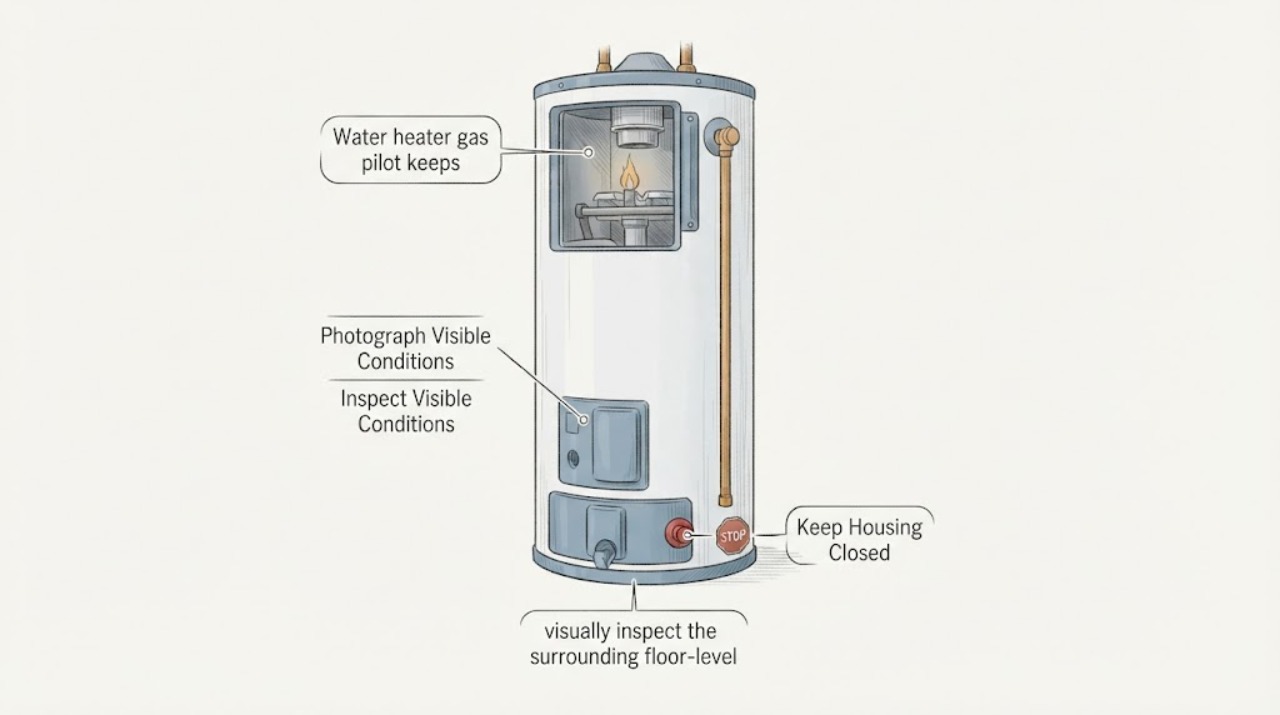
From a safe standing position, photograph or transcribe the water heater's rating plate and any status window or fault indication without removing a cover or access panel.
Expected result: Record the manufacturer, model or serial information if visible, and whether the status indicator is dark, steady, or showing a pattern described on the unit label.
Next step: Give the model information and the exact indicator behavior to the qualified service professional, and leave the heater out of service.
Stop if: Stop immediately if getting the information would require opening a panel, reaching into the burner area, or touching a hot surface.
Why this matters
Why: The heater design and its documented status indication determine which pilot, flame-sensing, or lockout system a technician should evaluate; a dark or abnormal indicator is not proof of a particular failed part.
-
Check 2
Without relighting the pilot or operating the gas control, observe the timing of the last outage from a safe location and compare it with the home's normal hot-water use.
Expected result: Note whether the pilot went out immediately after an ignition attempt, after the burner normally ran, after a door or window was opened, or with no identifiable event; do not create another event to test it.
Next step: Write down the time, whether hot water stopped, and whether the outage has recurred, then provide that record at the service visit.
Stop if: Stop observing and leave the area if any gas odor, unusual whoosh, smoke, soot, headache, dizziness, nausea, or carbon-monoxide alarm occurs.
Why this matters
Why: Timing can help the technician distinguish a flame-sensing or ignition symptom from a possible draft, combustion-air, or operating-condition symptom, but it does not identify a repair by itself.
-
Check 3
From the room entrance and without moving the heater or opening its combustion area, visually inspect the surrounding floor-level area and the visible exterior of the vent or exhaust route.
Expected result: Look only for obvious new blockage, displaced exterior venting, soot or staining, condensation, or stored flammable liquid containers near the appliance; do not touch, clear, probe, or disassemble anything.
Next step: Keep people away from the heater and report the exact visible condition to the service professional. Do not operate the appliance to see whether the symptom repeats.
Stop if: Stop and leave immediately if there is smoke, soot with an active odor, a damaged or disconnected vent, a suspected flammable spill, or a carbon-monoxide alarm.
Why this matters
Why: A visible obstruction, venting change, soot, or flammable-vapor concern can make continued operation unsafe and gives the professional a useful lead; absence of a visible issue does not clear the appliance.
-
Check 4
Observe the heater exterior, floor, and nearby walls from a safe distance without touching the tank, burner door, controls, or piping.
Expected result: Record visible water leakage, corrosion, scorching or discoloration, damaged insulation, unusual moisture, or a recently changed enclosure or storage arrangement.
Next step: Keep the area clear, document the location and extent of the visible sign, and tell the service professional before any visit.
Stop if: Stop approaching the heater if the floor is wet near electrical equipment, the tank or vent appears damaged, there is a burning smell, or the area is unusually hot.
Why this matters
Why: Leakage, heat damage, corrosion, or a changed enclosure can add hazards or change airflow around the appliance; these signs need professional assessment rather than a pilot adjustment.
-
Check 5
Check from outside the appliance area whether anyone has noticed a gas odor or whether a carbon-monoxide alarm has sounded; do not deliberately sniff or test the appliance.
Expected result: If yes, people or pets may be exposed to an immediate hazard; if no, the recurring pilot outage still requires the heater to remain out of service and receive professional diagnosis.
Next step: For yes, leave immediately without operating switches, phones, or appliance controls inside and call emergency services or the gas utility from outside. For no, arrange the high-urgency professional visit and provide the documented observations.
Stop if: Any gas odor, alarm, smoke, or symptoms such as headache, dizziness, nausea, confusion, or shortness of breath means stop, leave for fresh air, and do not re-enter until cleared by responders.
Why this matters
Why: Gas odor or a carbon-monoxide alarm cannot be safely sorted out by homeowner troubleshooting. A no-odor result is not evidence that combustion or venting is safe because carbon monoxide is odorless.
Use your observations
Decision map
Find the observation that best matches what you see, then follow the next safe action.
-
PATH 01Next step
What you see
Gas odor, a carbon-monoxide alarm, smoke, or related illness symptoms are present
Do this next
Leave immediately without operating switches or controls, call emergency services or the gas utility from outside, and do not re-enter or operate the heater until responders or a qualified professional says it is safe.
-
PATH 02Next step
What you see
The pilot repeatedly goes out but there is no odor or alarm
Do this next
Keep the gas water heater out of service, do not relight it again or bypass a safety sensor, and book a qualified gas-appliance or plumbing professional for diagnosis.
-
PATH 03Next step
What you see
A visible venting change, soot, scorching, water leak, or damaged exterior is found
Do this next
Treat the heater as unsafe to operate, keep people away, and tell the professional exactly what was seen; do not clear or repair the vent or burner area yourself.
-
PATH 04Next step
What you see
The status window is dark or shows a code or pattern
Do this next
Record the indication and model information, follow only the shut-down language on the unit label if needed for safety, and provide the record to the service professional rather than attempting repeated resets.
Helpful context
Understand the symptom
A pilot that will not stay lit can be associated with the flame-sensing safety system, a draft or combustion-air problem, ignition components, gas-supply conditions, or the control assembly. A pilot safety device is intended to stop gas flow when the flame is not sensed, so a recurring outage is a reason to leave diagnosis and repair to a qualified professional rather than bypassing that protection. The exact cause depends on the heater design and its label or manual.
The observations below are for documenting the condition without opening the heater, touching hot or energized components, adjusting a gas control, or attempting another ignition cycle. Never deliberately sniff for gas. A gas odor, alarm, smoke, or soot changes this from a service call to an immediate safety response.
Only after diagnosis
Potential parts
- water heater thermocouple
Consider only if a qualified technician confirms that the flame-sensing safety component is the cause after identifying the heater model and design.
Confirm the exact manufacturer, model, gas type, and approved replacement information before ordering; do not bypass or defeat the safety device. - water heater pilot assembly
Consider only if professional diagnosis finds a pilot or ignition assembly fault rather than a venting, airflow, or gas-supply problem.
Pilot assemblies are model- and design-specific; match the heater identification and approved service documentation. - water heater gas control valve
Consider only if a qualified professional confirms a control-valve failure and rules out a safety or combustion condition.
Gas-control replacement requires professional fitment and commissioning for the exact heater and fuel type; never adjust or bypass it.
When checks do not resolve it
Need a professional?
Call a qualified gas-appliance or plumbing professional when the pilot goes out more than once, will not remain lit, or the status indicator reports a fault. Escalate immediately for gas odor, a carbon-monoxide alarm, smoke, soot, suspected flammable vapor, or illness symptoms.
Safety scope: Do not adjust the gas valve, bypass the thermocouple or other safety sensor, open the burner or combustion chamber, relight repeatedly, or operate a heater with warning signs.
Have this ready
- Provide the model and serial information if visible, status indication, outage timing, visible exterior or venting observations, and whether any alarm or odor was noticed.
Common questions
FAQ
Is it safe to keep relighting a pilot that keeps going out?
No. A single extinguished pilot may trigger a built-in gas shutoff, but a recurring outage needs professional diagnosis. Keep the heater out of service and do not repeat ignition attempts, adjust the gas control, or bypass the flame-sensing safety device.
What should I do if I smell gas near the water heater?
Do not operate switches, phones, or appliance controls inside. Leave immediately, move people and pets to fresh air, and call emergency services or the gas utility from outside. Do not return until responders or a qualified professional says it is safe.
Can a homeowner tell whether the thermocouple is bad?
Not reliably through a safe visual check. A technician needs to identify the heater design and assess the flame-sensing and gas-control system. Record the model and the symptom—especially whether the pilot goes out when a control is released—without opening the burner area or bypassing the safety.
What information should I give the water-heater technician?
Give the model or serial information, status-light or fault indication, when the pilot goes out, any visible venting or exterior warning signs, recent changes around the heater, and whether anyone noticed an odor or alarm.
Read the exact guide
Official sources
- How To Relight A Water Heater's Pilot LightA. O. Smith · General manufacturer guidance; the unit label and owner manual take precedence, and this article intentionally limits the reader to observation and escalation.
- Carbon Monoxide Fact SheetU.S. Consumer Product Safety Commission · General residential CO safety; applies to fuel-burning water heaters and emergency response to alarms or symptoms.
- Water Heating Plumbing Terminology 101Rheem Manufacturing Company · Component names are used only to help a homeowner describe observations to a technician; they are not a compatibility or repair determination.
Community feedback
Share a repair observation
Share a plain-text repair observation. Accepted observations are published automatically; this page may take a moment to update.