
On this page
Start here
Quick answer
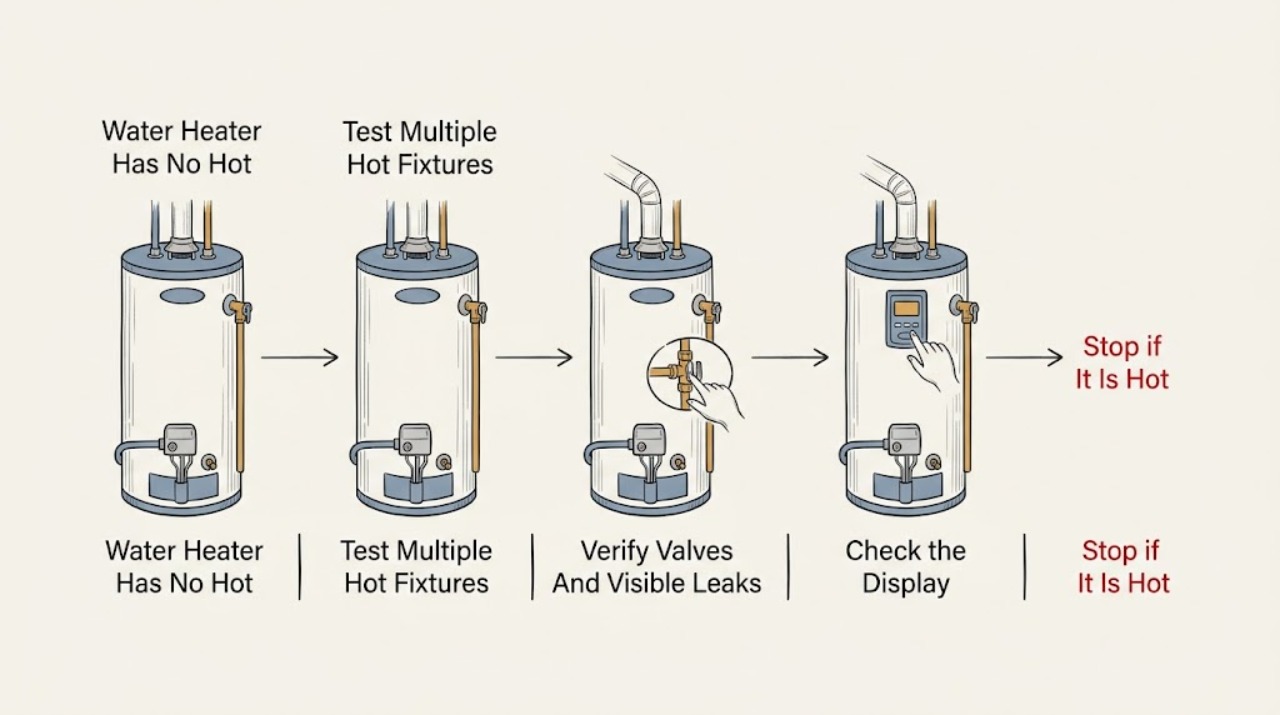
If cold water is available but the water heater supplies no hot water, first test more than one hot fixture and compare the temperature and flow with cold water. If only one tap or shower is cold, the heater may be working and a local mixing valve, cartridge, or plumbing restriction is more likely. If every hot fixture is cold, check only user-accessible items: the water heater's inlet and outlet valves, visible leaks, the user temperature or operating mode, and—without opening covers—the electric disconnect or breaker indication or gas status indication described by the exact manual. A recent heavy draw may need normal recovery, but no recovery, a tripped breaker, a pilot that will not stay lit, a fault indication, a leak, or a relief discharge needs qualified service. Do not open electrical or gas covers, repeatedly reset a breaker or safety control, relight around a gas odor, or raise the temperature beyond the model instructions.
Work through in order
Diagnostic checks
Use only checks that match the exact appliance or system and its official guide.
-
Check 1
At two or more fixtures, briefly test the hot side and compare it with the cold side. Stop if water is scalding, discolored, leaking, or unsafe, and note whether the problem affects every hot fixture or only one outlet.
Expected result: Cold water flows but every hot outlet is cold, only one tap or shower is cold, hot flow is weak, or hot water is briefly warm and then cold.
Next step: For one affected outlet, arrange fixture or plumbing diagnosis without changing the heater. For all outlets, keep testing limited and continue with external heater checks; call service if the result is persistent.
Stop if: Do not run taps for a long period, test a hot outlet with bare hands if temperature is uncertain, or repeatedly cycle the heater to provoke a result.
Why this matters
Why: A whole-house cold result points toward the water heater, its energy source, a hot-side leak, or a system control. One affected outlet points more toward a local cartridge or thermostatic mixing valve. Weak hot flow can be a hot-side restriction, while brief warmth can follow depleted storage or a heating/recovery issue.
-
Check 2
From a dry, safe position, confirm that the water heater's cold inlet and hot outlet isolation valves are in their normal open position and inspect around the tank, connections, relief discharge, and nearby hot-water piping for puddles, drips, or continuous flow.
Expected result: A valve is closed or partly closed, water is pooling at the tank or connection, the relief discharge is dripping, a hot-side pipe or fixture is leaking, or no leak is visible.
Next step: Open only an identified service valve if the manual and installation permit it; do not force a stuck valve. Isolate water or energy from a safe location for a significant leak and arrange prompt plumbing or water-heater service.
Stop if: Do not cap or operate a temperature-and-pressure relief valve, tighten a pressurized fitting, touch hot discharge, or keep using a heater that is leaking from the tank or safety outlet.
Why this matters
Why: A closed valve can stop hot-water delivery despite cold water elsewhere. Pooling or a tank-bottom leak indicates a water-heater or tank fault. Relief discharge can indicate pressure or temperature trouble. A hot-side leak can consume heated water and make the heater appear ineffective; no visible leak does not rule out a concealed one.
-
Check 3
Read the exterior label and identify whether the unit is electric, gas, tankless, or heat-pump, then check only the normal user display, temperature setting, operating mode, indicator light, and any documented fault message. Use the exact manual rather than a generic reset sequence.
Expected result: The unit is in an off, vacation, economy, or standby mode; the temperature setting is changed; a fault/status pattern is shown; the display is blank; or the normal user controls appear correct.
Next step: Restore only a clearly unintended user setting according to the manual and allow the normal heating process to operate. If the display remains blank or a fault returns, keep the unit out of service and call a qualified technician.
Stop if: Do not remove access covers, change wiring, bypass a safety control, or raise the set point beyond the manual's safe user range.
Why this matters
Why: An off mode, low setting, or blank display can explain no hot water without proving a component failure. A fault or abnormal status needs model-specific interpretation. Correct-looking controls shift attention to power/fuel delivery, heating components, a mixing valve, or a plumbing leak.
-
Check 4
Without opening a panel or burner compartment, check the external electrical disconnect or breaker indication for an electric unit, or the external gas supply and status indication for a gas unit, exactly as the owner manual describes. If a breaker has tripped, do not repeatedly reset it; if gas odor is present, leave the area without operating switches.
Expected result: The electrical disconnect is off or the breaker is tripped, the display has no power, the gas status or pilot indication is abnormal, the gas supply is intentionally off, or the external energy indications are normal.
Next step: Restore an accidentally switched-off external control only if the manual allows and the area is dry and safe. For a trip, recurring fault, abnormal gas status, or uncertain fuel condition, leave the unit off and call qualified service.
Stop if: Do not open electrical covers, test live terminals, relight near gas odor, adjust gas piping, or reset a breaker or safety control repeatedly.
Why this matters
Why: No electrical power or an off gas supply can stop heating while cold water remains available. A tripped breaker, recurring power loss, abnormal pilot/status indication, or gas odor can involve an electrical, combustion, or safety fault. Normal external indications do not clear internal heating controls or elements.
-
Check 5
Note whether the no-hot-water report followed unusually heavy use, whether the heater has had time to recover, whether a hot tap or shower is running, and whether water is moving continuously through a hot-side fixture or visible pipe. Compare temperature at several fixtures rather than increasing the heater setting.
Expected result: Hot water returns after normal recovery, the heater runs continuously with little hot water, one fixture dilutes the temperature, a hot tap is leaking, or all fixtures remain cold after recovery.
Next step: Stop the leaking fixture and arrange plumbing service for hot-side loss or a local mixing problem. If all outlets stay cold, proceed to service with the recovery and fixture observations; do not keep increasing temperature.
Stop if: Do not leave a hot tap running as a test, drain or flush the tank, adjust a gas control, or increase temperature in a way the manual does not authorize.
Why this matters
Why: A temporary high demand can deplete storage. Continuous heating with little output suggests a hot-side leak, capacity issue, or heating fault. One fixture can have a failed mixing valve. All fixtures remaining cold after recovery keeps an energy, control, heating-element, burner, or tankless fault possible.
-
Check 6
Record the heater type, model and serial label, all displayed status or fault information, hot and cold fixture results, valve and leak observations, energy-source indication, recent demand, and whether hot water ever returned. Keep the appliance accessible for a qualified technician without opening it.
Expected result: No hot water persists at every fixture, a fault or safety control returns, the breaker trips, the pilot will not stay lit, the tank leaks, the relief outlet discharges, or the cause remains uncertain.
Next step: Keep the heater off when unsafe or leaking and arrange a qualified water-heater or plumbing service visit. Provide the record and photos of visible external conditions from a safe position.
Stop if: Do not open the cabinet, bypass a high-limit or other safety device, perform live electrical or gas tests, cap a relief line, or order a heating component from symptoms alone.
Why this matters
Why: Persistent whole-house loss or a recurring safety symptom requires diagnosis of controls, heating elements, burner or fuel path, mixing, tank, or plumbing. A leaking tank or relief discharge is not a user reset problem, and uncertain symptoms should not be guessed at by replacing parts.
Use your observations
Decision map
Find the observation that best matches what you see, then follow the next safe action.
-
PATH 01Next step
What you see
Cold water is available, most hot fixtures are normal, but one tap or shower remains cold or weak.
Do this next
Keep the heater settings unchanged and arrange fixture or plumbing diagnosis. Check only an obvious local shutoff from a dry position; do not dismantle a pressurized fixture if the source is unclear.
Why this path and its safety boundary
Why it matters: A local cartridge, thermostatic mixing valve, hot-side restriction, or fixture shutoff is more likely than a whole-house water-heater failure.
-
PATH 02Next step
What you see
Every hot fixture became cold after an unusually heavy draw, no leak or fault is visible, and hot water returns after the heater's normal recovery period.
Do this next
Monitor the next normal use. Arrange service if the heater does not recover, runs continuously, or repeatedly supplies less hot water than expected.
Why this path and its safety boundary
Why it matters: Stored hot water was likely depleted by demand rather than the cold supply being absent, though repeated or unusually long recovery should be investigated.
-
PATH 03Next step
What you see
Cold water is present at fixtures, every hot outlet is cold, the user setting is correct, and the external power or gas indication is off, abnormal, or repeatedly trips.
Do this next
Leave the heater off when a breaker trips or gas status is abnormal and call qualified service. Do not open covers, relight repeatedly, or reset a safety device as a repair.
Why this path and its safety boundary
Why it matters: A power, fuel, ignition, control, or safety shutdown is more likely than a fixture-only issue; the correct repair depends on heater type and model.
-
PATH 04Next step
What you see
The heater appears to be heating or running continuously, but little hot water reaches the fixtures, one fixture changes temperature unexpectedly, or a hot-side leak is visible.
Do this next
Stop the leaking fixture or isolate the affected water supply when safe and arrange plumbing service. Do not raise the heater setting to compensate for a leak or mixing fault.
Why this path and its safety boundary
Why it matters: A plumbing leak, failed thermostatic mixing valve, hot-side restriction, or cross-connection may be consuming or diluting hot water while the heater itself still operates.
-
PATH 05Next step
What you see
The tank leaks, water pools at the bottom, hot water or steam discharges from a relief outlet, or water reaches electrical equipment while no hot water is available.
Do this next
Keep people away, isolate water and energy only from a safe location, and obtain urgent qualified plumbing or water-heater service. Do not cap the relief outlet or open the appliance.
Why this path and its safety boundary
Why it matters: A tank, pressure/temperature safety, plumbing, or electrical hazard is present in addition to the heating symptom. Continued operation can cause burns, water damage, or equipment damage.
Helpful context
Understand the symptom
Cold water flow does not prove the heater is heating
A working cold supply only shows that water can enter the plumbing. The heater may have no power or fuel, a user control may be off, a safety control may have stopped heating, or a hot-side leak or mixing valve may be using or diluting the heated water. Testing several fixtures before touching the heater separates a local fixture issue from a whole-house heating issue.
Gas, electric, tankless, and heat-pump units need different checks
There is no universal water-heater reset or temperature setting. An electric tank has electrical disconnects and heating controls; a gas unit has a fuel and ignition path; a tankless or heat-pump unit may display a model-specific status or fault. Check only the external controls and the exact owner manual. Covers, burner compartments, live wiring, heating elements, and safety devices belong to qualified service.
No hot water plus a leak is an urgent service problem
Visible pooling, a leak from the tank bottom, a relief-valve discharge, or a hot-water leak in the home can both damage property and consume the heater's output. Shut off the water or energy source only from a safe, identified control, avoid hot discharge, and arrange qualified plumbing or water-heater service. Do not cap a relief discharge or keep operating a leaking unit.
Safety boundary
Stop conditions
- Stop troubleshooting and arrange qualified service when no hot water persists at all fixtures after normal recovery, a breaker or safety control trips or returns, the gas status or pilot is abnormal, the heater leaks, the relief outlet discharges, water reaches electrics, or the cause is uncertain. Do not open electrical or gas covers, test live wiring, adjust gas piping, repeatedly reset controls, raise the temperature beyond the model instructions, drain or flush the tank as a first response, cap a relief outlet, or order a heating part from symptoms alone. Leave immediately and contact the local gas emergency service if gas odor is present.
Only after diagnosis
Potential parts
- water-heater heating element
Consider this only after a qualified technician confirms an electric heater element has failed and the water-heating path, power, thermostat, and safety controls have been checked.
Element voltage, wattage, length, thread, gasket, and tank design are model-specific; no replacement is justified by no-hot-water symptoms alone. - water-heater thermostat or high-limit control
Consider this only when testing confirms a failed thermostat or high-limit control after power, wiring, and heating elements have been evaluated safely.
Confirm the exact heater type, control arrangement, voltage, and manufacturer fitment; safety controls must not be bypassed or substituted generically. - gas control or ignition component
Consider this only when a qualified gas technician identifies a failed control, pilot, igniter, flame sensor, or related ignition component for the specific heater.
Gas controls and ignition parts require model-specific commissioning and qualified installation; do not select or install one from a status light or pilot symptom alone. - thermostatic mixing valve
Consider this only when temperature checks show that one fixture or the hot-water outlet is being diluted by a failed or misadjusted mixing valve while heated water is available.
Valve location, connection size, temperature range, and system design must be confirmed before selection; a mixing-valve part will not repair a heater that is not producing heat. - water-heater dip tube
Consider this only when a qualified technician confirms a dip-tube or inlet-path fault, especially after a recent installation or connection change, rather than a heating failure.
Dip-tube length, material, inlet arrangement, and tank model must be confirmed; removing water connections can expose stored pressure and is not a routine user check.
When checks do not resolve it
Need a professional?
Call a qualified water-heater technician for persistent no hot water at every fixture, a blank or recurring fault display, a tripped breaker, an ignition or pilot problem, suspected heating-element or thermostat failure, or a heater that runs continuously without producing hot water. Call a plumber for a hot-side leak, local mixing-valve symptom, restricted hot flow, or plumbing cross-connection. Use urgent service for a tank leak, relief discharge, steam, scalding water, gas odor, smoke, or water near electrical equipment.
Have this ready
- Provide the water-heater type, brand and model from the exterior label, age if known, exact status or fault indication, hot and cold results at multiple fixtures, valve positions, visible leaks or relief discharge, energy-source observations, recent demand, and whether hot water ever returned.
Common questions
FAQ
Why do I have cold water but no hot water from the water heater?
Cold supply can remain normal while the heater has no power or fuel, a user mode is off, a safety control has stopped heating, a hot-side leak is consuming output, or a mixing valve is diluting it. Test more than one hot fixture, then check only the external valves and user controls described by the exact manual.
What should I check first when every hot-water fixture is cold?
Confirm the hot-side result at more than one fixture, look for visible leaks, verify the heater's cold inlet and hot outlet valves are in their normal position, identify the heater type, and check the normal external power, gas, display, or status indication. Do not open covers or repeatedly reset controls.
Could a mixing valve make the water heater seem to have no hot water?
Yes. If heated water is available but one shower or tap remains cold or lukewarm, a local thermostatic mixing valve or cartridge may be diluting or restricting hot water. Compare several fixtures before changing the heater setting and arrange plumbing diagnosis for a one-fixture problem.
Can a hot-water leak cause little or no hot water?
Yes. An ongoing leak on the hot side can use the heater's output faster than it can recover, making the heater appear ineffective. Look for continuous flow or visible moisture from a safe position, stop the leaking fixture or isolate water if safe, and call a plumber.
Should I reset the water heater breaker if there is no hot water?
Check the external breaker or disconnect indication, but do not repeatedly reset a tripped breaker. A recurring trip can indicate an electrical or heating fault. Keep the heater off and call qualified service rather than opening the panel or testing live wiring.
What if a gas water heater pilot will not stay lit?
Do not repeatedly relight it or work on the burner, gas control, or vent. Follow only the exact manual's immediate safety instructions; if the pilot or status remains abnormal, keep the unit off and call a qualified technician. If gas odor is present, leave and contact the local gas emergency service from outside.
When should I call a water-heater technician for no hot water?
Call when every hot fixture remains cold after normal recovery and external checks, a fault or safety indication returns, a breaker trips, a pilot or ignition problem persists, the heater runs continuously without hot output, or a heating element, thermostat, burner, sensor, or internal control may be involved. Call a plumber for leaks, mixing-valve symptoms, or hot-side restrictions.
Read the exact guide
Official sources
- What to Do Before Calling a Plumber or Replacing Your Water HeaterRheem Manufacturing Company · Manufacturer guidance on checking open valves, identifying the relevant breaker, documenting leaks and model information, and escalating gas, major damage, or unresolved water-heater problems.
- Residential Gas Water Heater Use and Care GuideA. O. Smith Water Products Company · Official A. O. Smith gas water-heater guide covering no-hot-water causes, hot-side leaks, mixing valves, fuel/ignition behavior, relief discharge, and qualified-service boundaries.
- 7 Signs You Need to Call a PlumberRheem Manufacturing Company · Manufacturer guidance recommending a plumber for no hot water at faucets, pilot problems, leaks, recurring low hot-water output, and service or replacement decisions.
- TROUBLESHOOTINGA. O. Smith Water Products Company · Official A. O. Smith troubleshooting manual listing cold and hot supply valves, power, set points, fuses, and heating elements as model-dependent no-hot-water checks.
Community feedback
Share a repair observation
Share a plain-text repair observation. Accepted observations are published automatically; this page may take a moment to update.