
On this page
Start here
Quick answer
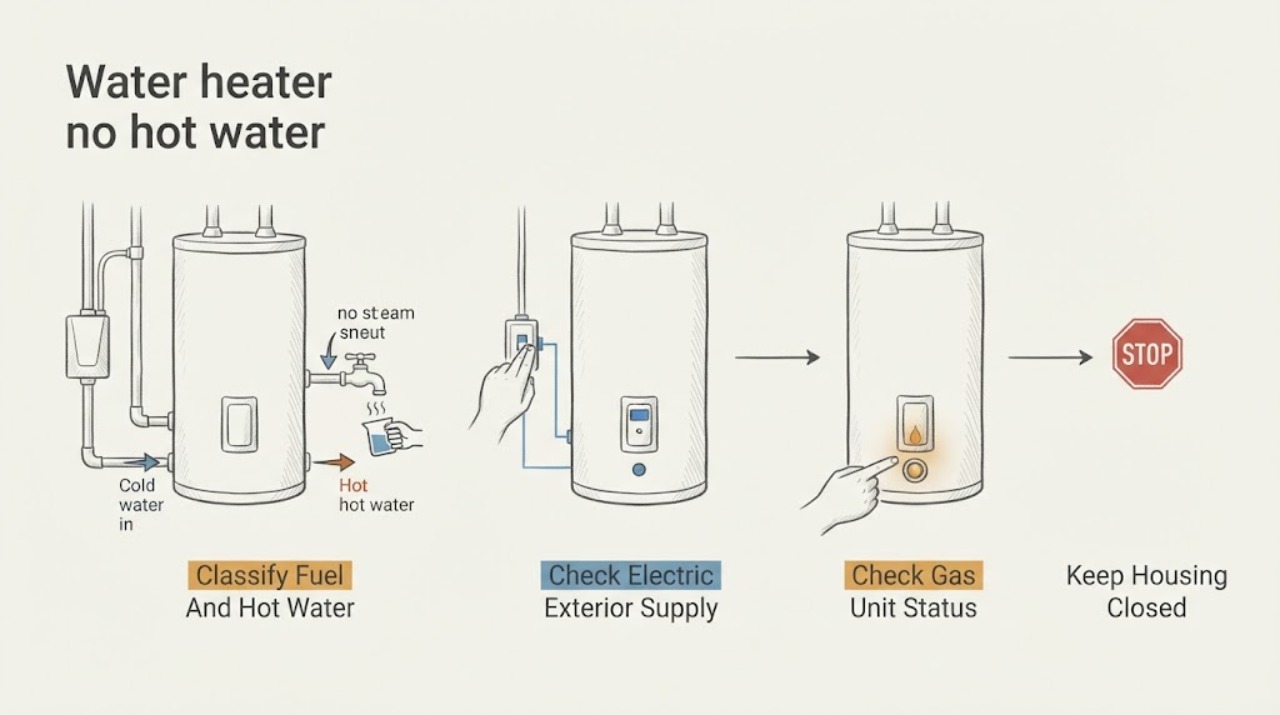
When a water heater has power or gas but produces no hot water, first separate a whole-heater problem from a delivery problem: compare the temperature and flow at more than one hot tap, and note whether the unit is electric, gas-fired, tankless, or a heat-pump model. For an electric unit, check the dedicated breaker or disconnect and any normal front-panel status or vacation setting without removing covers; for a gas unit, observe the control display and burner or pilot only through the intended viewing area, following the model manual. A tripped safety cutoff, failed upper heating element or sensor, burner or ignition fault, low gas pressure, a mixing valve, an open hot-water faucet, or a plumbing leak can all leave the water cold even when an outside supply appears present. Do not open energized covers, measure live circuits, open gas connections, or repeatedly reset a safety device. Stop for gas odor, smoke, soot, a damaged or leaking tank, a carbon-monoxide alarm, or scalding-temperature instability and arrange qualified service.
Before you begin
Safety first
- This article supports ordinary-access observation of fuel type, controls, visible status, fixtures, and leaks. Do not open electrical or gas compartments, perform live measurements, alter safety devices, or dismantle plumbing or venting.
Work through in order
Diagnostic checks
Use only checks that match the exact appliance or system and its official guide.
-
Check 1
From safe access, identify whether the unit is electric, gas-fired, tankless, or a heat-pump model from its exterior label or controls. Run a brief check at two hot-water taps, starting cautiously, and note whether both are cold, one is cold, or water is warm but not fully hot; do not change the temperature setting yet.
Expected result: Every hot tap is cold, only one fixture is affected, the water is lukewarm after heavy use, or hot and cold behavior changes when another fixture runs.
Next step: Record the fuel type, model, affected fixtures, and timing, then use the matching electric or gas check below. Arrange plumbing service when only one fixture is affected, a faucet runs continuously, or the water is being diluted downstream.
Stop if: Stop for scalding or unstable temperature, a leak, water near electrical parts, smoke, combustion odor, or any need to open a wall or appliance cover.
Why this matters
Why: Cold water at every tap points toward the heater or a common supply/control issue. One affected fixture points toward its faucet or branch plumbing. Lukewarm water after high demand may be recovery or capacity, while a fixture that changes with other flow can indicate a mixing or plumbing problem.
-
Check 2
For an electric or heat-pump unit, look at the dedicated breaker or disconnect and the normal exterior control display or indicator. Confirm the breaker is not visibly tripped and that the unit is not in a vacation, disabled, or similar non-heating mode; do not remove an electrical cover or test wires.
Expected result: The breaker is tripped, the display is dark or shows a fault or vacation mode, or the breaker and exterior controls appear normal while all taps remain cold.
Next step: If the manual allows a single ordinary reset, reset the breaker or mode once without opening the heater and observe whether the normal status returns. If it trips again, stays dark, shows a fault, or the water remains cold, leave it out of service and call a qualified electrician or water-heater technician.
Stop if: Do not repeatedly reset a tripping breaker, remove junction-box or element covers, move insulation, use a meter on energized parts, or touch exposed wiring.
Why this matters
Why: A tripped breaker or non-heating mode can explain no heat, but a breaker that trips again signals an electrical fault. Normal exterior status does not rule out an energy cut-off, failed upper element, thermostat, sensor, or mixing-valve problem.
-
Check 3
For a gas-fired unit, first check for gas odor from a safe position, then read only the exterior control or status display and observe the burner or pilot through the manufacturer-provided viewing area. Follow the exact model lighting instructions only if they permit a user relight; do not open a burner door or adjust the gas control.
Expected result: The pilot or burner is absent, will not remain lit, shows an ignition or flame-stability fault, runs normally but the water stays cold, or a gas odor or abnormal flame is present.
Next step: For a gas or combustion warning, do not light or operate the unit; leave and contact the gas utility or emergency service from a safe location. For a heater-only ignition or flame fault, leave the unit off and arrange qualified gas-appliance service.
Stop if: Do not hand-light a sealed assembly, hold a knob down beyond the manual, bypass flame safety, clean an orifice, measure gas pressure, or dismantle venting.
Why this matters
Why: An absent or unstable flame makes ignition, pilot, flame-sensing, gas pressure, control, air, or venting problems more likely. A burner that runs normally shifts attention toward recovery, thermostat/set point, inlet temperature, mixing, or delivery plumbing. A gas odor or abnormal flame is a safety event.
-
Check 4
With the heater and surrounding floor visible, look for a running hot tap, a toilet or appliance drawing hot water, puddles, drips, wet insulation, or signs that water is escaping near the tank or hot outlet. Confirm accessible hot- and cold-water shutoff handles are in their normal fully open position only if they turn freely; do not force a valve or touch a temperature-pressure relief discharge.
Expected result: A hot tap or fixture is continuously drawing water, a leak or pooling is visible, water is hot at the tank but cold at a fixture, or no delivery problem is visible.
Next step: Close only an accessible fixture handle that is already safe to operate, and photograph the leak without touching hot or pressurized discharge. If the leak continues, reaches electrical parts, or the tank is wet at its base, shut off water only if safe and arrange prompt qualified plumbing service.
Stop if: Do not cap or plug a relief discharge, remove a relief valve, open the tank, force shutoffs, or continue using a leaking heater.
Why this matters
Why: An open faucet or plumbing leak can consume the available hot water. Heat at the tank with cold water at one outlet makes a faucet cartridge, thermostatic mixing valve, reversed connection, or branch restriction more likely than a failed heater. Pooling or a bottom-of-tank leak can require urgent service.
-
Check 5
After checking the correct fuel branch, note whether the no-hot-water event followed an unusually large demand, a recent installation or service, a cold-inlet period, or a change in the heater's mode or set point. Use the model manual's normal operating guidance without raising the setting to an unsafe level or repeatedly cycling the unit.
Expected result: Hot water returns after ordinary recovery, remains cold despite normal controls and supply, becomes lukewarm only during demand, or the symptom began after installation or service.
Next step: If hot water returns and remains stable, monitor the pattern and keep the manual with the model record. If no heat persists, returns quickly, or began after service, stop experimenting and give the technician the fuel type, controls, timing, and observations.
Stop if: Do not energize an electric heater that may not be full of water, raise controls to compensate for no heat, remove panels, or repair gas, wiring, elements, or thermostats yourself.
Why this matters
Why: Recovery after an unusual demand or colder inlet can explain a temporary shortage. Persistent no hot water despite normal status makes an element, thermostat, sensor, burner, gas supply, or control fault more likely. A new-installation symptom raises concerns such as incorrect connections, an unfilled electric tank, or setup-specific controls.
Use your observations
Decision map
Find the observation that best matches what you see, then follow the next safe action.
-
PATH 01Safety boundary
What you see
An electric or heat-pump heater has no normal exterior status, the dedicated breaker is tripped, or it trips again after a single manual reset.
Do this next
Leave the breaker off when safe and arrange qualified electrical or water-heater service. Do not remove covers or test energized conductors.
Why this path and its safety boundary
Why it matters: The fault is likely in the supply, disconnect, wiring, controls, or heater rather than hot-water demand. A repeat trip is not a reset problem.
Safety stop: Stop immediately for heat, burning odor, arcing, water at electrical parts, or exposed wiring.
-
PATH 02Safety boundary
What you see
An electric heater appears powered and is not in a non-heating mode, but every hot tap remains cold or the unit reports an energy-cutoff, element, thermostat, or sensor fault.
Do this next
Arrange qualified water-heater or electrical service and provide the model, display state, breaker history, and whether the tank was recently installed or serviced.
Why this path and its safety boundary
Why it matters: A failed upper element, thermostat or sensor, tripped ECO, or internal control issue is more likely than an external breaker problem. These components are behind covers and may remain hazardous.
Safety stop: Do not open access panels, move insulation, reset an inaccessible cutoff, or measure resistance or voltage unless you are the qualified person performing the service.
-
PATH 03Safety boundary
What you see
A gas unit has no pilot or burner, the flame will not stay on, an ignition or flame-stability alert appears, or other gas appliances also lose supply.
Do this next
For gas odor or abnormal combustion, leave the area and contact the gas utility or emergency service from a safe location. Otherwise leave the heater off and request qualified service.
Why this path and its safety boundary
Why it matters: The likely path includes gas supply, ignition, burner or flame sensing, controls, combustion air, or venting. A household-wide gas loss should be handled by the utility; a heater-only fault needs qualified gas-appliance diagnosis.
Safety stop: Do not relight repeatedly, open the gas train, measure pressure, bypass a safety, or disassemble the vent or burner.
-
PATH 04Safety boundary
What you see
The heater's burner or heating cycle appears normal, but one hot tap is cold, a mixing valve is suspected, a hot faucet is running, or water is leaking from the hot-water system.
Do this next
Stop the affected fixture or isolate the leak only through an accessible valve that operates normally, then arrange qualified plumbing diagnosis if the issue persists or water is pooling.
Why this path and its safety boundary
Why it matters: The heat source may be working while a fixture, thermostatic mixing valve, reversed connection, open outlet, or plumbing leak prevents hot water from reaching the user.
Safety stop: Do not remove a mixing valve, cap a relief discharge, open a wall, or continue using a leaking tank.
-
PATH 05Safety boundary
What you see
The heater and controls appear normal, there was an unusually large demand or colder inlet water, and hot water returns after the model's ordinary recovery period.
Do this next
Record the demand pattern and monitor the next normal cycle. Call for service if no-hot-water episodes recur, recovery is abnormal, or the temperature remains unstable.
Why this path and its safety boundary
Why it matters: A temporary recovery or capacity limit is plausible, but recurring shortages, rapid temperature loss, or lukewarm water at normal demand still need diagnosis for sizing, sediment, element, burner, thermostat, or mixing problems.
Safety stop: Do not raise the temperature beyond the manual's safe range or treat a recurring failure as normal recovery.
Helpful context
Understand the symptom
Power or gas is only the first checkpoint
A breaker that is on or a gas valve that is open does not prove that heat is being produced. Electric storage heaters can still have a tripped high-limit cutoff, failed element, thermostat or sensor, while gas units can have ignition, burner, gas-pressure, flame-stability, or venting faults. A tank may also be heating normally while a leaking faucet, thermostatic mixing valve, reversed connection, or other plumbing condition dilutes or diverts the hot water. Use the fuel type and the timing of the symptom to choose the next safe branch rather than opening the appliance.
Protect against electrical, gas, water, and scald hazards
The service manuals distinguish ordinary observation from work behind covers or on gas controls. Keep electrical covers, insulation, burner doors, and gas connections undisturbed unless a qualified person is servicing the exact model. If there is a gas odor, do not light or switch anything in the odor area. If the tank is leaking, water is reaching electrical parts, smoke or soot is visible, a flame is unstable, or a carbon-monoxide alarm sounds, stop using the heater and get the appropriate emergency or qualified help from a safe location.
Safety boundary
Stop conditions
- Do not continue troubleshooting for gas odor, hissing, smoke, soot, flame rollout, unusual combustion odor, a carbon-monoxide alarm, or visible gas-appliance damage; leave the area as appropriate and contact the utility or emergency service from a safe location.
- Do not remove energized electrical covers, move insulation, measure live circuits, or reset a breaker that trips again.
- Do not open gas connections, adjust gas pressure, clean a burner or orifice, bypass a flame or thermal safety, or dismantle venting.
- Do not cap or plug a temperature-pressure relief discharge, remove a relief valve, force a water shutoff, or keep operating a tank with a persistent leak.
- Stop after the safe exterior checks fail to restore heat or the problem returns; arrange qualified plumbing, electrical, or gas-appliance service based on the fuel branch.
Only after diagnosis
Potential parts
- electric heating element
Consider this category only when qualified diagnosis confirms a failed element after the correct power and safety-control checks.
Confirm the exact water-heater model, element type, electrical rating, and manufacturer's approved part; do not energize an unfilled tank. - thermostat, temperature sensor, or energy-cutoff control
Consider this category only when the model's status and qualified testing identify a failed or tripped control rather than a supply, element, burner, or plumbing cause.
Control design and fit are model-specific and may involve energized or gas-safety components; have a qualified technician select the approved replacement. - gas burner or ignition assembly
Consider this category only after a qualified gas-appliance diagnosis identifies a burner, ignition, or flame-sensing failure and rules out supply, venting, and safety conditions.
Match the exact model and fuel configuration with the manufacturer or qualified technician; do not substitute orifices or alter combustion settings. - thermostatic mixing valve
Consider this category only when the heater produces hot water but a fixture remains cold or lukewarm and qualified plumbing diagnosis identifies mixing or crossover at the valve.
Confirm the valve type, connections, temperature-control requirements, and applicable plumbing guidance before ordering or replacing.
When checks do not resolve it
Need a professional?
Arrange qualified service when an electric water heater has persistent no heat, a recurring breaker trip, a dark or faulted control, a suspected ECO, element, thermostat, or sensor problem, or any work behind an electrical cover. Arrange qualified gas-appliance service for an absent or unstable burner or pilot, a status fault, low supply concern, or any combustion or venting issue. Arrange plumbing service for a mixing-valve or fixture problem, reversed connection, or leak. For gas odor, smoke, flame rollout, a carbon-monoxide alarm, or major water damage, leave the area when appropriate and contact the gas utility or emergency service from a safe location.
Safety scope: This article supports ordinary-access observation of fuel type, controls, visible status, fixtures, and leaks. Do not open electrical or gas compartments, perform live measurements, alter safety devices, or dismantle plumbing or venting.
Common questions
FAQ
What should I check first when the water heater has power or gas but no hot water?
First identify the fuel type and determine whether every hot tap is cold or only one fixture is affected. Then check the dedicated electric breaker or exterior mode/status, or the gas unit's exterior status and intended viewing area, without opening covers. A tripped safety, failed element or sensor, burner fault, mixing valve, open faucet, or leak can all produce no hot water even when an outside supply appears present.
Can I reset the water heater myself?
Only use a single reset that the exact model manual presents as an ordinary user control, and do it without opening the appliance. If a breaker trips again, a fault returns, the unit stays dark, or the water remains cold, stop and arrange qualified service. Do not repeatedly reset or bypass a safety cutoff.
Why does one shower stay cold while another tap has hot water?
If hot water is available elsewhere, the heater may be working and the problem may be the shower faucet, thermostatic mixing valve, crossover, reversed connection, or branch plumbing. Check only for a fixture that is visibly running or leaking; do not remove the valve or open the wall.
Is no hot water after heavy use always a failed heater?
Not always. An unusually large demand or colder inlet water can require ordinary recovery, but recurring shortages, rapid temperature loss, or no recovery with normal controls need diagnosis. Do not raise the setting to an unsafe level; record the demand pattern and call for service if the symptom persists.
When is no hot water an emergency?
Gas odor, hissing, smoke, soot, flame rollout, unusual combustion odor, a carbon-monoxide alarm, a major leak, water near electrical parts, or unstable scalding-temperature behavior is a stop-use condition. Leave the area when appropriate and contact the gas utility, emergency service, electrician, or qualified plumber from a safe location.
Read the exact guide
Official sources
- GAS-FIRED WATER HEATERBradford White · Manufacturer owner manual used for gas-odor stop guidance, lighting-label boundaries, sealed-door warnings, and no-hot-water gas safety.
- Installation Instructions and Use & Care GuideA. O. Smith Water Heaters at Lowes · Manufacturer guide used for no-hot-water causes, power and mode checks, ECO and element boundaries, mixing-valve and leak possibilities, and electrical safety.
- Residential Super High Efficiency Water Heater Use & Care ManualRheem Manufacturing Company · Manufacturer manual used for no-hot-water causes including demand, low gas pressure, set point, open faucets, burner stability, air or vent faults, and qualified gas repair boundaries.
- Commercial Electric Energy Saver Medium Duty E32 Series Models Service ManualBradford White · Manufacturer service manual used for the electric no-hot-water decision tree: power, fuses, wiring, elements, thermostats, and ECO.
- What to Do Before Calling a Plumber or Replacing Your Water HeaterRheem Manufacturing Company · Manufacturer guidance used for safe exterior checks, visible leak documentation, model information, and escalation when gas, electrical, or major water risks are involved.
Community feedback
Share a repair observation
Share a plain-text repair observation. Accepted observations are published automatically; this page may take a moment to update.