
On this page
Start here
Quick answer
First determine whether every hot tap is cold or only one fixture, then identify whether the heater is gas, electric, tankless, or a heat-pump unit. Check temperature at more than one faucet, the heater's visible display or status indicator, an obviously labeled water-heater switch or breaker, and the fully open water shutoff without removing covers or changing gas, wiring, temperature, or safety controls. A recent large draw can require recovery, but a whole-house cold condition with no status, a tripped breaker, a repeated lockout, a leak or relief discharge, or a gas or carbon-monoxide warning needs qualified service. Do not assume a cold tap proves a failed heater: a single failed mixing cartridge, a closed valve, a power or fuel interruption, or a heater-side fault can produce the same complaint.
Before you begin
Safety first
- This article supports comparing more than one faucet, reading visible status, checking an obvious user mode or accessible shutoff, checking a clearly labeled breaker or disconnect without opening panels, and recording visible leaks or messages. A qualified professional should diagnose and repair gas, combustion, live electrical, heating elements, thermostats, relief devices, tank interiors, mixing valves, controls, and pressurized or hot piping.
Work through in order
Diagnostic checks
Use only checks that match the exact appliance or system and its official guide.
-
Check 1
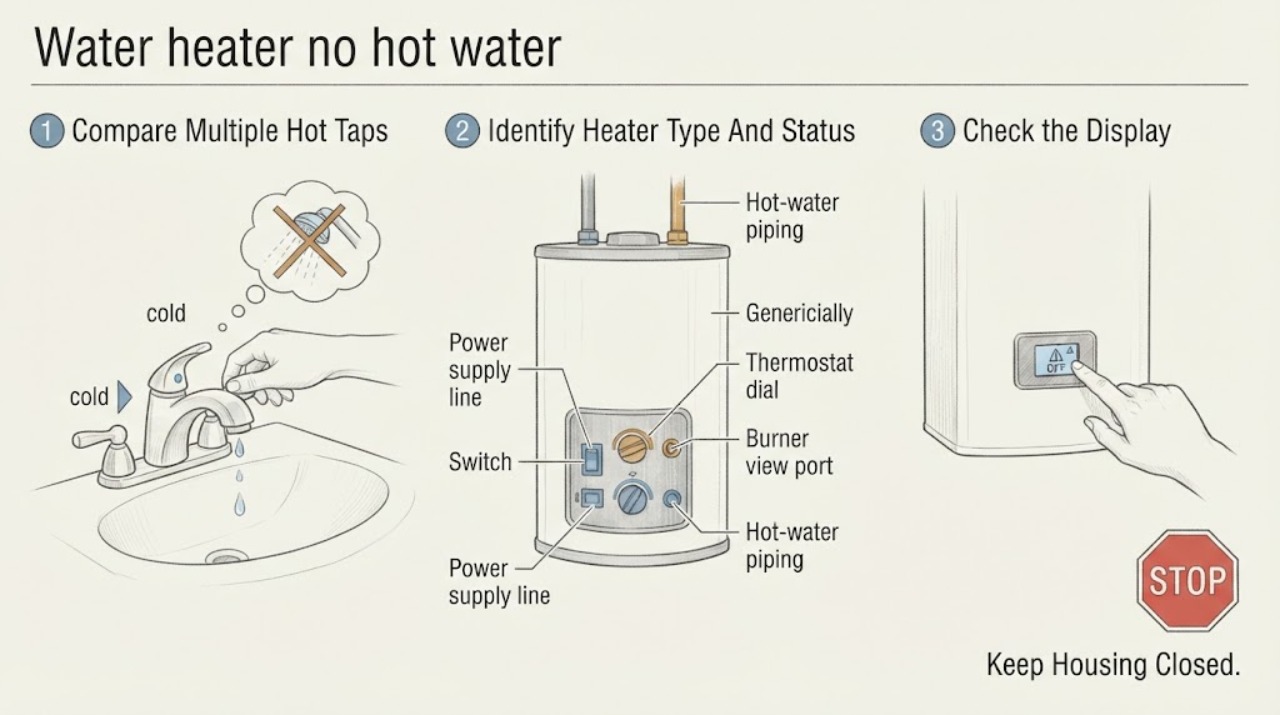
Run the hot side briefly at a bathtub or sink and then at a second fixture, comparing the hot flow with the cold flow; do not disassemble a faucet or shower valve yet.
Expected result: One outlet may stay cold while another produces hot water, all hot outlets may run cold, or hot flow may be weak compared with cold flow.
Next step: If only one fixture is affected, arrange fixture or plumbing diagnosis; if all fixtures are affected, record the pattern and continue to the heater's visible status and supply checks.
Stop if: Stop for scalding water, a leak, water near electrical equipment, unusual odor, smoke, or a carbon-monoxide alarm.
Why this matters
Why: Hot water at another fixture makes a local cartridge, thermostatic mixing valve, or local shutoff more likely. Cold water at every fixture points toward the heater, its supply, a whole-house mixing device, or a hot-side plumbing problem. Weak hot flow with normal cold flow also keeps a hot-side restriction in the differential.
-
Check 2
From a dry, safe position, identify whether the unit is gas, electric, tankless, or heat pump and record the visible display, status light, operating mode, and any error message; photograph the label and screen before attempting a reset.
Expected result: The unit may show normal standby, a heating call, vacation or low-demand mode, an error or lockout, or no display or indicator at all.
Next step: Use only the exact model manual to interpret the displayed state; correct an obvious user mode only if its controls are clearly identified, and leave the cabinet closed if the status is abnormal or unclear.
Stop if: Do not remove access panels, bridge a sensor, bypass a lockout, or keep resetting a code that returns.
Why this matters
Why: The appliance type determines which safe checks and service parts apply. A mode or setpoint intended for absence can explain cold water, while a repeated code or absent status with known power suggests a control, safety, or appliance fault. A display code is evidence for a technician, not proof of a failed component.
-
Check 3
Check only an obviously labeled, accessible water-heater shutoff and, for an electric unit, its clearly identified disconnect or breaker from a dry position; for a gas unit, look at the external control or status indicator without adjusting gas fittings or removing covers.
Expected result: The water valve may be closed or partly closed, the breaker or disconnect may be off, the breaker may have tripped, or the external gas-control/status indication may be normal or abnormal.
Next step: Restore only an obviously switched-off water valve or user control when the exact manual and installation make its purpose clear; if a breaker trips again, the status is abnormal, or the purpose is uncertain, leave it as found and arrange qualified service.
Stop if: Do not repeatedly reset a breaker, test live wiring, relight or adjust a gas appliance without the exact model procedure and safe conditions, or operate a wet, sparking, hot, or damaged control.
Why this matters
Why: A closed water supply or absent electrical supply can prevent normal hot-water delivery. A breaker that trips again or an abnormal gas-control indication signals an electrical, control, fuel, or safety fault rather than a setting to force. A normal external status with cold taps moves the investigation toward heating, mixing, flow, or plumbing faults.
-
Check 4
Record whether the cold-water complaint began after an unusually large draw, whether the heater has had time to recover according to its model manual, and whether the unit appears to run continuously without making hot water; do not raise the temperature setting to compensate.
Expected result: Hot water may return after normal recovery, stay absent despite recovery time, run out quickly, or remain cold while the burner, element, or compressor appears to operate.
Next step: If hot water returns normally, monitor usage and note the event; if it does not recover, runs out unusually fast, or the unit runs continuously, arrange water-heater service and provide the timing and operating pattern.
Stop if: Stop if the unit overheats, vents abnormally, produces smoke or soot, leaks, discharges very hot water, or shows a recurring safety lockout.
Why this matters
Why: Recovery after an exceptional demand makes normal storage depletion more likely. No recovery or rapid loss of hot water makes a heating control, element, burner, heat-pump cycle, sediment, undersized capacity, hot-side leak, or mixing problem more likely. Continuous operation with little hot water is a service clue, not permission to open the heater.
-
Check 5
Without touching hot piping or opening the heater, look for puddles, drips, condensation that persists, a relief-valve discharge, or a whole-house mixing valve; note whether the hot-water pipe or recirculation line is warm only when safe to observe.
Expected result: There may be no visible water, a leak at a connection or valve, water from the tank bottom or relief discharge, or a mixing valve that is affecting all fixtures.
Next step: Document the location with a photo, isolate water or fuel only when the shutoff is clearly identified and safe, and arrange qualified plumbing service for any leak, relief discharge, mixing-valve concern, or uncertain condition.
Stop if: Do not cap a relief pipe, tighten or remove a relief valve, drain a hot tank, handle hot discharge, or place hands near energized or gas components.
Why this matters
Why: A persistent leak can consume heated water and cause apparent no-hot-water symptoms; a tank-bottom leak can indicate tank failure. A relief discharge can indicate excessive temperature or pressure and must not be blocked. A failed whole-house mixing valve can send cool water to every tap even when the heater is hot.
Use your observations
Decision map
Find the observation that best matches what you see, then follow the next safe action.
-
PATH 01Safety boundary
What you see
One hot tap or shower is cold, but another hot fixture produces hot water normally.
Do this next
Use the affected fixture's service instructions or arrange a plumber to inspect its mixing path; do not change the water-heater settings to correct a local fault.
Why this path and its safety boundary
Why it matters: The heater is making hot water; a local faucet cartridge, shower mixing valve, aerator or local shutoff is more likely than a heater-wide failure.
Safety stop: Stop for a scalding condition, a concealed leak, or water near electrical equipment.
-
PATH 02Safety boundary
What you see
All hot taps are cold and the heater has no display, status light, or normal operating indication.
Do this next
Check only a clearly labeled breaker, disconnect, or external control as the exact manual allows; if power is present but the unit remains dark, arrange qualified electrical or water-heater service.
Why this path and its safety boundary
Why it matters: An accessible power interruption, fuel or control issue, safety lockout, or appliance fault is more likely than a fixture problem.
Safety stop: Do not remove panels, test live circuits, adjust gas controls, or repeatedly reset a breaker.
-
PATH 03Safety boundary
What you see
All hot taps are cold, but the heater has normal-looking standby or status indication and no obvious leak.
Do this next
Record the model, operating mode, status pattern, and time since the last hot-water cycle, then arrange model-specific diagnosis if hot water does not return after the manual's normal recovery interval.
Why this path and its safety boundary
Why it matters: A thermostat or heating-element/burner control, user operating mode, sensor, mixing valve, or hot-side plumbing fault remains possible; the status light alone does not confirm heating.
Safety stop: Do not open gas controls or electrical panels, bypass a sensor, or replace a thermostat or element from the symptom alone.
-
PATH 04Safety boundary
What you see
The taps went cold after an unusually large demand and hot water returns after the heater's normal recovery period.
Do this next
Monitor whether the pattern repeats under ordinary use; if it does, have a plumber evaluate capacity, temperature control, sediment, mixing, and hot-side leakage.
Why this path and its safety boundary
Why it matters: The storage or recovery capacity may have been temporarily exceeded rather than the heater failing outright.
Safety stop: Do not raise the setpoint beyond the model instructions; higher temperatures increase scald risk.
-
PATH 05Safety boundary
What you see
Hot water runs out unusually quickly, never recovers, or the heater appears to run continuously while all taps remain cool.
Do this next
Arrange a qualified water-heater assessment and provide the run time, fixture pattern, heater type, status message, and any water-use or leak observations; keep the service panels closed.
Why this path and its safety boundary
Why it matters: A failed heating element, burner or control, sediment or scale, hot-water leak, reversed connection or dip-tube issue, failed mixing valve, or capacity mismatch is more likely than normal recovery.
Safety stop: Do not drain, flush, replace elements, remove a dip tube, or service gas or combustion components as a generic test.
-
PATH 06Safety boundary
What you see
There is a substantial leak, tank-bottom water, very hot relief discharge, gas odor, smoke, soot, exhaust odor, or a carbon-monoxide alarm.
Do this next
For suspected gas or carbon monoxide, leave immediately, get fresh air, and contact emergency or gas authorities from outside. For a safe-to-reach water emergency, isolate the water supply if clearly identified and obtain qualified plumbing service; do not re-use the appliance until cleared.
Why this path and its safety boundary
Why it matters: This is a water, pressure, fuel, or combustion safety event, not a routine no-hot-water diagnosis. Continued operation can cause injury, fire, property damage, or CO exposure.
Safety stop: Do not relight, reset, cap a relief pipe, enter a smoke-filled area, operate electronics near a suspected gas leak, or re-enter after a CO alarm until emergency responders or a qualified professional says it is safe.
Helpful context
Understand the symptom
Confirm that the problem is at the heater
Run the hot side briefly at a tub or sink and compare it with a second fixture; keep the water temperature check cautious because a heater may recover or become unexpectedly hot. If one outlet is cold but another is hot, the faucet cartridge, shower mixing valve, or local shutoff is more likely than the heater. If every hot outlet is cold, continue with the appliance checks below.
Use visible status, not a guess about the failed part
Record whether the heater has a display, indicator light, audible operating cycle, or a current error before resetting anything. Gas models may expose a status light or gas-control setting; electric models may have a dedicated disconnect or breaker; tankless and heat-pump units can show a model-specific code. A status observation narrows the service call, but it does not identify a replacement part.
Separate recovery from a continuous no-heat fault
A storage heater can be cold after several showers, laundry loads, or another unusually large draw. Give it only the recovery interval specified by its own manual and do not raise the temperature setting to force faster heating. If the taps remain cold after the normal recovery window, or the heater runs continuously without restoring hot water, look for a supply, control, leak, or heating fault and arrange service.
Leaks and combustion warnings change the task
Pooled water, a steady drip, hot water from a relief discharge, a gas odor, soot, exhaust odor, smoke, or a carbon-monoxide alarm is not a normal no-hot-water check. Keep clear of hot or energized equipment, use the water or fuel shutoff only when it is clearly identified and safe to reach, and obtain emergency or qualified help as appropriate. Never cap or plug a relief discharge.
Safety boundary
Stop conditions
- Stop immediately for gas odor, a gas-leak sound, smoke, soot, exhaust odor, or a carbon-monoxide alarm. Leave as appropriate, contact emergency or gas authorities from outside, and do not operate the appliance or nearby electronics.
- Stop for a major leak, water from the tank bottom, very hot relief discharge, a wet electrical control, sparking, burning odor, or a damaged vent. Isolate water or fuel only when the shutoff is clearly identified and safe to reach, then obtain qualified service.
- Do not remove access panels, test live wiring, adjust gas pressure, bypass a safety control, cap a temperature-and-pressure relief discharge, or replace a heating element, burner, sensor, or thermostat from the symptom alone.
- Do not raise the temperature beyond the exact model instructions to compensate for cold taps. Hot water can scald, and an unexpected control or mixing-valve fault can make the outlet temperature unsafe.
- Arrange qualified plumbing or water-heater service when all taps stay cold after normal recovery, a breaker trips again, a code or lockout returns, a leak or relief discharge is present, hot water runs out unusually fast, or the diagnosis is uncertain.
Only after diagnosis
Potential parts
- faucet, shower, or whole-house thermostatic mixing valve
Consider this only when another fixture has hot water or a technician confirms that a fixture or whole-house mixing valve is blending cold water into the hot outlet.
Match the valve model, connections, temperature range, flow requirements, and installation instructions; do not change a heater setting to mask a mixing-valve fault. - electric heating element or thermostat/control
Consider this only after qualified testing confirms that an element, thermostat, high-limit control, or related control has failed.
Electrical isolation, tank draining, gasket replacement, and model-specific ratings and procedures matter; do not open the access panel or test live circuits as a homeowner check. - gas control, ignition, burner, or sensor assembly
Consider this only after a qualified technician interprets the exact status or error and confirms the failed assembly.
Gas, combustion, venting, and safety components require exact model compatibility and qualified installation; a status-light pattern does not prove which part failed. - hot-water leak, dip tube, heat trap, or relief-system component
Consider this only when inspection confirms a persistent hot-side leak, reversed connection or dip-tube restriction, or a pressure-and-temperature safety component requiring replacement.
A relief device must never be capped or substituted casually; the technician must verify the model, ratings, plumbing arrangement, pressure, and safe isolation procedure.
When checks do not resolve it
Need a professional?
Arrange qualified water-heater or plumbing service when every hot tap is cold after the model's normal recovery interval, the heater has no normal status despite an apparent power supply, an electric breaker trips again, a gas control or status pattern is abnormal, hot water runs out unusually fast, a whole-house mixing valve or hot-side leak is possible, or a reset does not restore stable operation. For gas odor, a gas-leak sound, smoke, exhaust concern, carbon-monoxide alarm, fire, major leak, or very hot relief discharge, leave or isolate the hazard only if safe and obtain emergency or qualified help before using the heater again.
Safety scope: This article supports comparing more than one faucet, reading visible status, checking an obvious user mode or accessible shutoff, checking a clearly labeled breaker or disconnect without opening panels, and recording visible leaks or messages. A qualified professional should diagnose and repair gas, combustion, live electrical, heating elements, thermostats, relief devices, tank interiors, mixing valves, controls, and pressurized or hot piping.
Common questions
FAQ
Why are all my hot taps cold but the cold water works?
A whole-house cold condition points beyond one faucet. Check the heater's visible status, obvious operating mode, accessible water shutoff, and clearly labeled power control without opening the unit. If normal recovery does not restore hot water, a qualified technician should distinguish a control, heating, mixing, leak, or supply problem.
Could one bad faucet make it seem like the water heater is not working?
Yes. If one fixture is cold while another hot fixture works, a faucet cartridge, shower mixing valve, or local shutoff is more likely than a failed heater. Do not raise the water-heater temperature to compensate for a local mixing fault.
Can I reset the water heater when the taps run cold?
Only use a reset described by the exact model manual and only when there is no leak, gas odor, carbon-monoxide alarm, smoke, exhaust concern, wet electrical equipment, or other unsafe symptom. Record the status first; if the code returns, a breaker trips again, or hot water does not recover, stop resetting and arrange qualified service.
Should I turn the temperature up when there is no hot water?
No. A higher setting can create a scald hazard and will not repair a failed element, burner, control, mixing valve, or leak. Follow the exact model instructions and have a professional diagnose persistent cold taps.
Read the exact guide
Official sources
- Electric Water Heater Troubleshooting ChecklistA. O. Smith / hotwater.com · Opened A. O. Smith electric water-heater manual used for general electric-unit patterns; the exact installed model manual and a qualified person control any reset or repair.
- Carbon Monoxide Fact SheetU.S. Consumer Product Safety Commission · Government safety guidance applies to fuel-burning appliances; it is used for the emergency boundary, not for diagnosing a particular water heater.
- Residential Gas Water Heater Use and Care Guide — TroubleshootingA. O. Smith / hotwater.com · Opened A. O. Smith gas water-heater guide used for general diagnostic patterns; it does not identify the user's heater brand or model, and the installed model manual takes precedence.
- What to Do Before Calling a Plumber or Replacing Your Water HeaterRheem · Opened Rheem homeowner guidance used only for general, low-risk observations; it does not establish a setting, repair, or part for another brand or model.
Community feedback
Share a repair observation
Share a plain-text repair observation. Accepted observations are published automatically; this page may take a moment to update.