
On this page
Start here
Quick answer
When a water heater has no hot water, first determine whether every hot fixture is cold or only one faucet or shower. Check the heater's external water valves and look for leaks, moisture, unusual noises, gas odor, smoke, or electrical warning signs without opening covers or testing live parts. A gas unit may have a pilot or fuel-supply issue, and an electric unit may have a supply, limit, thermostat, or heating-element issue; use the model manual and qualified service for those internal or fuel/electrical checks. If the tank is leaking, a relief outlet is discharging, a breaker repeatedly trips, a pilot will not stay lit, or the problem remains after safe external checks, stop using the heater and arrange qualified plumbing, appliance, gas, or electrical service.
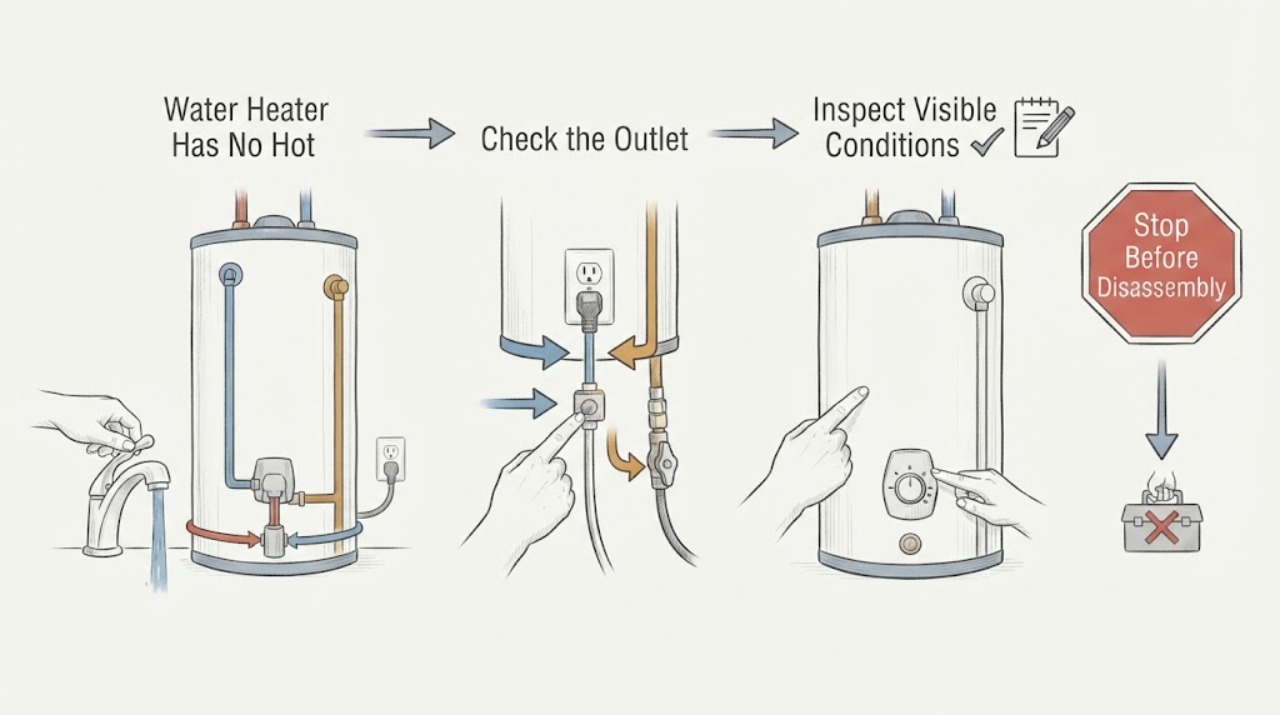
Work through in order
Diagnostic checks
Use only checks that match the exact appliance or system and its official guide.
-
Check 1
Run the hot side briefly at two separate fixtures, then compare one of them with its cold side. Note whether the water is cold everywhere or only at one outlet.
Expected result: One faucet or shower is cold while another hot fixture works, or all tested hot fixtures are cold while cold flow is normal.
Next step: For an isolated fixture, follow that fixture's instructions or arrange fixture service. For a whole-house result, continue with the external heater and safety checks.
Why this matters
Why: An isolated result points toward a faucet, shower control, or thermostatic mixing valve. A whole-house result points toward the heater, its supply, heating controls, or a hot-water plumbing fault.
-
Check 2
Read the nameplate and observe the heater from outside to identify tank or tankless construction, gas or electric energy source, model information, and the position of any clearly labeled external water shutoff. Look for puddles, dripping fittings, rust, or moisture at the base.
Expected result: An external supply valve appears closed, the type or model is unclear, or moisture and pooling are visible around the unit.
Next step: If a valve is clearly closed and there are no warning signs, consult the model manual before changing its position. If the unit is wet, leaking, or unidentified, stop and arrange qualified service rather than opening it.
Why this matters
Why: A closed supply can prevent hot-water delivery. Unclear identity makes a generic reset unsafe, while pooling or a persistent leak may indicate a failing connection, relief valve, or tank.
-
Check 3
For an electric heater, make only a visual check of the household disconnect or breaker indicator from a safe position; for a gas heater, observe only the external status indicator or pilot window if the model provides one. Do not remove covers, touch terminals, relight a pilot without the exact manual, or test energized parts.
Expected result: The supply indicator is off or a breaker is visibly tripped, the gas pilot or status indicator is out or abnormal, or a breaker trips again after a permitted reset.
Next step: Use the exact model manual for a single low-risk reset only when it explicitly permits it and there is no moisture, burning odor, or other warning. If the indicator remains abnormal or the breaker trips again, stop and call an electrician, gas professional, or appliance technician as appropriate.
Why this matters
Why: The heater may not be receiving power or fuel, or a safety control, thermostat, element, pilot, thermopile, or gas control may have failed. A recurring trip or failed pilot is not evidence that a clog is present and needs professional diagnosis.
-
Check 4
Observe the heater while a hot fixture is open, without touching the burner, vent, access panel, or plumbing connections. Note whether the unit makes popping or rumbling sounds, whether a gas unit has an unusual flame or odor, and whether the burner or heater appears to run continuously while little hot water arrives.
Expected result: There is unusual noise, hissing or sizzling near a gas unit, a gas odor, smoke, visible flame abnormality, or apparent continuous heating with little hot water.
Next step: For gas odor, smoke, flame abnormality, hissing or sizzling, leave the area as appropriate and contact the gas utility or qualified emergency service. For suspected leakage or persistent noise, stop using the heater and arrange qualified plumbing or appliance service.
Why this matters
Why: Popping or rumbling can accompany sediment, while hissing or sizzling can indicate water reaching a burner. Continuous operation with little hot water can also accompany a hot-side plumbing leak; these observations require more than a user reset.
-
Check 5
Ask whether the failure began after a plumbing change, a power interruption, a long period of heavy use, or a recent installation. Compare the hot-water temperature at several fixtures and check for a running faucet or visible hot-side leak elsewhere in the home.
Expected result: The problem began immediately after installation or piping work, follows an outage, hot water is used up only during heavy demand, or a faucet or pipe continues to run.
Next step: Do not alter piping or internal controls based on this observation. Correct only an obvious faucet issue if safe; otherwise give the timeline and leak observations to a plumber or appliance technician.
Why this matters
Why: Reversed connections, an unlit or unpowered unit, demand exceeding recovery, or a plumbing leak can look like a dead heater. A leak can continuously draw hot water even while the heater appears to be operating.
-
Check 6
After one model-directed, low-risk external check, retest two hot fixtures and record whether hot water returns, remains cold, or returns briefly and fails again. Record model, energy source, indicator state, leak or noise observations, and any reset attempted.
Expected result: Hot water returns and stays stable, returns only briefly, or remains absent at every fixture.
Next step: Use the heater only when it is dry and stable. If no hot water remains, returns briefly, or any warning sign is present, stop DIY troubleshooting and schedule qualified service with the recorded observations.
Why this matters
Why: A stable recovery supports a supply or control interruption that was safely corrected. A brief recovery or no recovery suggests a failed heating component, thermostat, pilot or gas control, mixing valve, leak, or another internal fault.
Use your observations
Decision map
Find the observation that best matches what you see, then follow the next safe action.
-
PATH 01Safety boundary
What you see
Is only one faucet or shower cold while another hot fixture works?
Do this next
Treat the affected fixture or mixing control as the first suspect and do not reset or open the water heater based on that symptom alone.
Why this path and its safety boundary
Safety stop: If all tested hot fixtures are cold, continue with the heater's external supply, energy-source, and safety checks.
-
PATH 02Safety boundary
What you see
Is an external water valve clearly closed, or is the unit wet around its base or fittings?
Do this next
Follow the model manual for a clearly closed valve only when the area is dry and safe; treat moisture or pooling as a service trigger and do not open the heater.
Why this path and its safety boundary
Safety stop: Continue by identifying gas or electric construction and observing its external indicator without live testing.
-
PATH 03Safety boundary
What you see
Does a safe external energy-source check show a persistent abnormal indicator, an unlit pilot that will not stay lit, or a breaker that trips again?
Do this next
Stop resets and arrange qualified appliance, gas, or electrical service; do not remove covers or test wiring or gas controls.
Why this path and its safety boundary
Safety stop: If the indicators are normal but every fixture remains cold, have a technician evaluate the thermostat, heating elements, gas controls, mixing valve, leak, or other internal cause.
-
PATH 04Safety boundary
What you see
Is there a gas odor, smoke, sparking, abnormal flame, hot relief discharge, active leak, water near electrical equipment, or repeated circuit interruption?
Do this next
Stop using the heater and leave hazardous conditions to the appropriate gas utility, emergency service, electrician, plumber, or appliance technician.
Why this path and its safety boundary
Safety stop: Continue only with external, model-directed observations and schedule service if hot water does not return after the safe check.
Helpful context
Understand the symptom
Separate a heater problem from a fixture problem
No hot water at one shower or faucet does not prove the heater is cold. A failed thermostatic mixing valve or faucet control can reduce hot water at that outlet while hot water remains available elsewhere. If every hot fixture is cold, the heater, its supply, or a whole-house plumbing problem becomes more likely.
Keep power, gas, and hot components closed
Use external observation only. Do not remove an access panel, burner cover, insulation, service cap, or relief valve; do not perform live voltage or gas tests, bypass a safety control, or repeatedly reset a tripping breaker. Water heaters can contain scalding water, combustible gas, pressure, and energized parts.
Only after diagnosis
Potential parts
- heating element or thermostat
Consider a part only after a qualified diagnosis confirms that an electric heater is receiving the correct supply and a specific heating component has failed.
Confirm the exact model, element or control specification, electrical rating, and manufacturer instructions before selecting a replacement. - gas control or pilot component
Consider this category only after qualified gas-appliance diagnosis confirms a failed pilot, thermopile, or gas control rather than an upstream fuel or venting problem.
Gas components require model-specific fit and qualified installation; do not order or install from a no-hot-water symptom alone.
Common questions
FAQ
Why is there no hot water at every faucet?
Common possibilities include a loss of power or fuel, an electric heating or thermostat fault, a gas pilot or control fault, a plumbing leak, or a problem with the heater's hot-water path. Use external checks and the model manual, then arrange qualified service for internal electrical, gas, or plumbing diagnosis.
What if only one shower or faucet has no hot water?
Compare another hot fixture. If hot water works elsewhere, the affected faucet, shower control, or thermostatic mixing valve is more likely than the water heater itself.
Can I reset the breaker or relight the pilot?
Only follow the exact model manual for a permitted low-risk reset or pilot procedure, and never do it around moisture, burning or gas odor, smoke, sparking, or other warning signs. Do not remove covers or perform live electrical or gas tests; a recurring trip or pilot failure needs qualified service.
When is no hot water an emergency?
Treat gas odor, smoke, abnormal flame, sparking, water near electrical equipment, an active leak, a large hot relief discharge, or repeated circuit interruption as a stop condition. Leave the hazardous work to the appropriate gas, electrical, plumbing, or appliance professional.
Read the exact guide
Official sources
- When to Repair or Replace Your Water HeaterA. O. Smith · No-hot-water causes, power and pilot checks, leaks, failed heating elements, and when persistent problems need professional repair.
- Water Heater Repair: Things to ConsiderA. O. Smith · No-hot-water checks, pilot and breaker observations, fixture mixing valves, leaks, sediment noise, blocked valves, and professional repair boundaries.
- What to Do Before Calling a Plumber or Replacing Your Water HeaterRheem Manufacturing Company · External shutoff checks, visual leak inspection, model documentation, and gas, sewage, electrical, and professional-service boundaries.
- Water Heater Maintenance ChecklistA. O. Smith · Leaks, rust or moisture, unusual noises, hot discharge, gas combustion checks, and professional service boundaries.
Community feedback
Share a repair observation
Share a plain-text repair observation. Accepted observations are published automatically; this page may take a moment to update.