
On this page
Start here
Quick answer
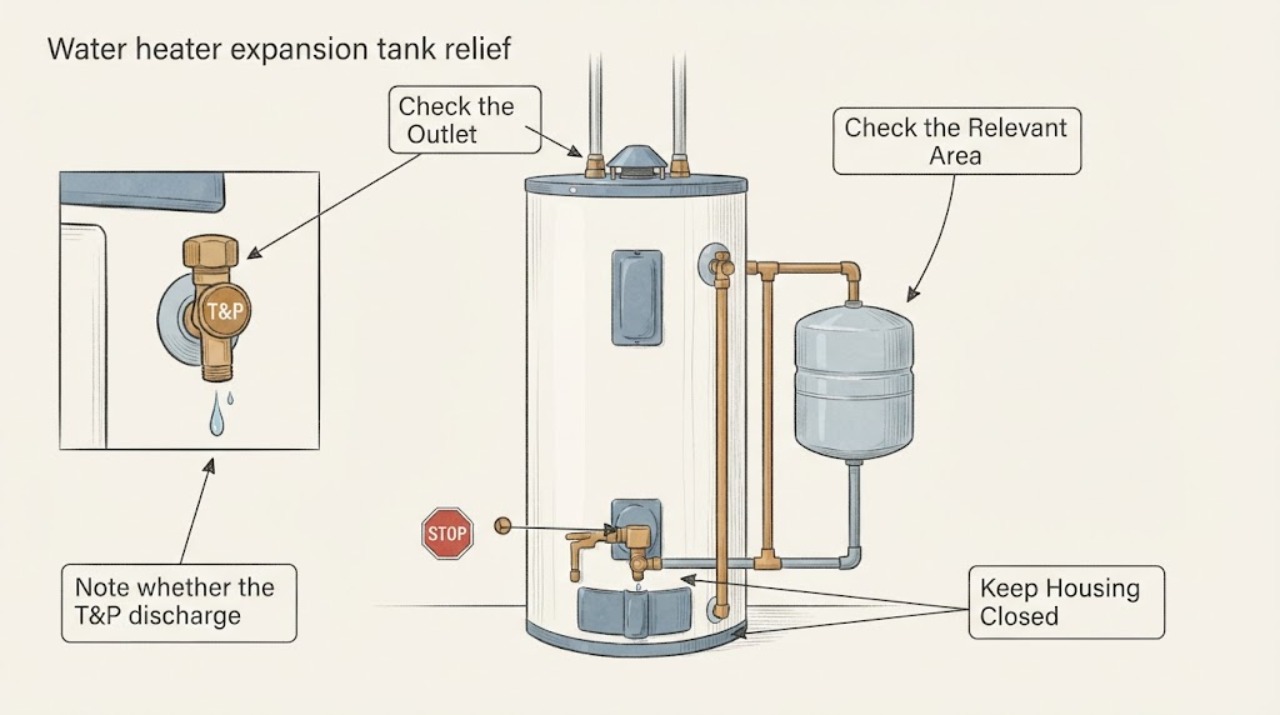
A dripping discharge pipe on an A. O. Smith water heater is not proof that the expansion tank itself is leaking. First identify whether water is coming from the temperature-and-pressure (T&P) relief-valve discharge pipe, a threaded valve connection, the expansion-tank connection, or the tank body. Intermittent drips during recovery commonly indicate high supply pressure or thermal expansion in a closed system; an expansion tank with a failed bladder, incorrect air charge, wrong size, or a loose connection can fail to absorb that pressure. A large discharge of very hot water is an overheating or pressure emergency, not a routine expansion-tank adjustment. Never cap, plug, bypass, or remove the T&P valve. Keep people clear of the discharge, isolate gas or electricity only according to the heater manual or by a qualified professional, and arrange plumbing service for pressure measurement, expansion-tank diagnosis, or valve replacement.
Before you begin
Safety first
- A qualified professional should handle scalding discharge, pressure gauges and PRV adjustment, expansion-tank charge or replacement, T&P valve replacement, gas controls, electrical covers, tank connections, and any leak requiring draining or pressurized disassembly.
Work through in order
Diagnostic checks
Use only checks that match the exact appliance or system and its official guide.
-
Check 1
Keep everyone away from the T&P discharge outlet, do not touch the drip or discharge pipe, and never cap, plug, clamp, or bypass the T&P valve; if a large volume of very hot water is discharging, leave the heater off and get qualified emergency help.
Expected result: The discharge is a small intermittent drip, a steady drip, a large hot discharge, or there is water near electrical parts, a gas smell, or a failed shutoff.
Next step: For a large hot discharge, gas smell, wet electrical area, or uncontrolled water, leave the area safe and arrange qualified service. Otherwise continue by locating the exact first wet point without operating the valve.
Why this matters
Why: A small pattern can be thermal expansion or valve leakage, but a large hot discharge can indicate overheating or dangerous pressure. Wet electricity, gas, and failed isolation controls add immediate hazards.
-
Check 2
Use a dry paper towel or visual inspection to locate the first wet point without touching hot components: the T&P discharge pipe outlet, the threaded valve connection, the expansion-tank connection, nearby inlet/outlet piping, or the tank shell.
Expected result: Only the T&P discharge is wet, the valve threads or tank spud are wet, the expansion-tank fitting or tank body is wet, or another pipe or drain valve is wet.
Next step: Keep the heating appliance and water supply in a safe state and arrange the appropriate plumbing or water-heater service. Do not tighten or remove hot pressurized fittings.
Why this matters
Why: A discharge-only pattern supports valve activation or a valve that is not seating. Threaded, tank-spud, expansion-tank, inlet/outlet, or drain-valve wetness follows a different leak path and is not diagnosed by changing tank air pressure alone.
-
Check 3
Note whether the T&P discharge occurs only during or after hot-water recovery, after no fixture has used water, or continuously regardless of heating; do not create a recovery cycle just to reproduce a hazardous discharge.
Expected result: The drip is intermittent during recovery, follows periods of no water use, is continuous, or is a large hot release.
Next step: Use the pattern to tell the technician what to measure. Do not replace the T&P valve or adjust the thermostat solely from timing; pressure and temperature must be diagnosed safely.
Why this matters
Why: Recovery-related intermittent weeping supports thermal expansion or high pressure in a closed system. Continuous dripping can mean the valve is worn or has debris, while a large hot release raises an overheating or severe-pressure concern.
-
Check 4
Have a qualified person measure incoming water pressure and observe pressure during a safe heater recovery with a properly installed gauge; compare the results with the heater, pressure-reducing-valve, and expansion-tank instructions.
Expected result: Supply pressure is high, pressure rises sharply during recovery, pressure remains controlled, or no gauge can be safely installed.
Next step: Do not adjust the PRV or work on heater connections without plumbing competence. Arrange service to correct pressure, verify a closed-system configuration, and size or diagnose the expansion tank.
Why this matters
Why: High static or rapidly rising heated pressure supports a pressure-reducing-valve or thermal-expansion diagnosis. Controlled pressure makes a worn, debris-affected, incorrectly rated, or otherwise defective T&P valve more plausible if dripping continues.
-
Check 5
With the water supply isolated and pressure relieved by a qualified person following the expansion-tank instructions, check the tank connection for leakage and check the tank air charge only with the appropriate gauge and the exact model procedure; do not pressurize a water-filled tank casually.
Expected result: The tank connection leaks, the air charge does not match incoming pressure, the bladder appears unable to hold charge, the tank is undersized or unsupported, or the tank is dry and correctly charged.
Next step: Have a plumber repair or replace the expansion tank and supporting piping according to code and manufacturer instructions. Never remove the T&P valve or leave the system without a functioning relief device.
Why this matters
Why: A leaking connection, lost pre-charge, failed bladder, wrong size, or poor support can prevent thermal expansion control. A sound, correctly charged tank shifts attention to supply pressure, valve condition, or heater temperature.
-
Check 6
After pressure and expansion control are verified, have a qualified person evaluate whether the T&P valve resets and seals correctly under the valve label and heater manual; do not operate the lever where hot discharge could injure someone or damage property.
Expected result: The valve does not reset, continues to drip with controlled pressure and a correctly charged tank, the threaded connection leaks, the tank spud leaks, or no leak remains.
Next step: Replace a T&P valve only with the exact properly rated and sized component through a qualified person. A leaking tank spud or tank shell generally means water-heater replacement, not expansion-tank adjustment.
Why this matters
Why: A valve that will not reset or still leaks after pressure and expansion causes are corrected may be worn, clogged, incorrectly rated, or damaged. A leaking welded tank spud is not a valve repair.
Use your observations
Decision map
Find the observation that best matches what you see, then follow the next safe action.
-
PATH 01Next step
What you see
A large volume of very hot water discharges from the T&P pipe, the heater overheats, or the thermostat or heating control is suspected.
Do this next
Leave the heater off, isolate gas or electricity only according to the manual and safe access, keep clear of the discharge, and arrange qualified water-heater service immediately. Never block the pipe or valve.
Why this path and its safety boundary
Why it matters: Temperature activation or severe pressure is more likely than ordinary thermal-expansion weeping, with scald and tank-failure risk.
-
PATH 02Next step
What you see
A small intermittent drip comes from the T&P discharge during recovery and pressure rises in a closed plumbing system.
Do this next
Have a plumber verify supply pressure, closed-system devices, PRV operation, and expansion-tank sizing and charge. Do not rely on the T&P valve to control routine expansion.
Why this path and its safety boundary
Why it matters: Thermal expansion and inadequate pressure control are more likely than an immediately failed relief valve.
-
PATH 03Next step
What you see
The expansion tank connection or tank body is wet, or the tank cannot hold the correct air charge after water pressure is relieved.
Do this next
Keep the system safe and have the tank and piping repaired or replaced according to the exact model and local code. Preserve the T&P valve as an active safety device.
Why this path and its safety boundary
Why it matters: The expansion tank or its piping may be leaking, unsupported, incorrectly charged, or internally failed; the T&P drip is a downstream symptom if pressure rises.
-
PATH 04Next step
What you see
Pressure remains controlled and the tank is correctly sized and charged, but the T&P valve continues to drip or will not reset.
Do this next
Have a qualified person install an exact properly rated and sized replacement valve. Do not substitute a higher-rated valve or operate the heater without one.
Why this path and its safety boundary
Why it matters: A worn, clogged, damaged, or incorrectly rated T&P valve is more likely than thermal expansion, although the leak location must still be confirmed.
-
PATH 05Next step
What you see
Water is at a threaded connection, welded tank spud, drain valve, inlet/outlet, or tank shell rather than only at the T&P discharge.
Do this next
Do not tighten hot pressurized fittings. Isolate water and the heating source as safe, then arrange plumbing or water-heater service; a leaking tank spud or shell may require heater replacement.
Why this path and its safety boundary
Why it matters: This is a separate fitting or tank leak; expansion-tank air pressure will not seal a corroded connection or a leaking tank weld.
Helpful context
Understand the symptom
Do not treat every drip as an expansion-tank leak
A drip from the T&P discharge pipe is water being released by a safety valve; it may be caused by thermal expansion or high pressure, while the expansion tank may be undercharged, failed, undersized, or absent. Water at the threaded valve connection is a different leak. Water at the expansion-tank fitting or tank shell is a separate connection or tank failure. Photograph the first wet point without touching the hot discharge.
The pattern matters
Intermittent weeping during or after a heating recovery is consistent with pressure rising in a closed system. A continuous drip after the valve has operated can also mean a worn or debris-affected valve. A large amount of very hot water indicates temperature or severe pressure trouble. The T&P valve has a safety role in both gas and electric heaters, so the heating source changes how power or gas is isolated but does not make it safe to disable the valve.
Check pressure as a measured system condition
A pressure gauge and a heating-cycle observation are the useful diagnostic fork, but installing a gauge on a hot-water heater drain or adjusting a pressure-reducing valve is plumbing work with burn and flooding risks. A. O. Smith describes a closed system whose pressure climbs during recovery and recommends controlling supply pressure and using a correctly sized expansion tank. Do not infer pressure from drip frequency alone.
Expansion tank and T&P valve are different components
The expansion tank is an air-cushioned vessel on the cold-water line; its pre-charge must be checked with the water pressure relieved and matched to incoming pressure according to the tank instructions. The T&P valve is installed on the heater and discharges hot water when temperature or pressure reaches its rating. Replacing one is not automatically a substitute for diagnosing the other.
Gas and electric safety boundaries
For a gas heater, an overheating discharge or gas smell requires the gas control and appliance to be left off and a qualified technician to evaluate it. For an electric heater, keep clear of wet electrical parts and do not remove covers or test energized terminals. Any discharge pipe can contain scalding water, even when the visible drip looks small.
Safety boundary
Stop conditions
- Stop immediately for a large discharge of very hot water, a gas smell, smoke, overheated water, uncontrolled pressure, or water near electrical components; leave the heater off and arrange qualified emergency service.
- Never cap, plug, clamp, bypass, or remove the T&P relief valve or its discharge pipe, and never operate the water heater without a properly rated functioning relief valve.
- Do not manually operate the T&P lever, install a pressure gauge, adjust a pressure-reducing valve, or check expansion-tank air charge unless the hot-water discharge is controlled and a qualified person is following the exact label and manual.
- Do not loosen hot pressurized fittings, the expansion-tank connection, the relief valve, gas controls, electrical covers, or the tank drain valve as a casual leak test.
- Arrange service when the tank shell or welded spud leaks, the expansion tank cannot hold charge, pressure rises during recovery, or the relief valve drips after pressure and expansion causes have been corrected.
Only after diagnosis
Potential parts
- thermal expansion tank
Consider this only when pressure rises during heating in a closed system and the existing tank is missing, leaking, incorrectly sized, or cannot hold the manufacturer-required air charge.
Match system volume, incoming pressure, tank connection, mounting, temperature and pressure ratings, and local plumbing requirements; installation and charge setting should follow the exact tank manual. - pressure-reducing valve
Consider this only when measured incoming pressure is too high or rises beyond the system's safe range and a qualified plumber confirms PRV correction is needed.
Match the home's piping, flow, pressure range, code requirements, and expansion-tank arrangement; do not set pressure from drip frequency alone. - temperature-and-pressure relief valve
Consider this only after pressure and thermal-expansion causes are controlled and a qualified person confirms the valve is worn, clogged, damaged, incorrectly rated, or will not reset.
Match the exact water-heater model, valve temperature and pressure ratings, probe or stem length, discharge connection, and applicable code; never substitute a higher-rated valve.
When checks do not resolve it
Need a professional?
Use a qualified plumber or water-heater technician for any T&P discharge, expansion-tank diagnosis, pressure measurement, PRV work, relief-valve replacement, gas or electrical isolation, tank leak, or recurring hot-water leak.
Safety scope: A qualified professional should handle scalding discharge, pressure gauges and PRV adjustment, expansion-tank charge or replacement, T&P valve replacement, gas controls, electrical covers, tank connections, and any leak requiring draining or pressurized disassembly.
Common questions
FAQ
Does a dripping T&P valve always mean the expansion tank is bad?
No. A. O. Smith says intermittent relief-valve weeping can result from high pressure or thermal expansion in a closed system, while the expansion tank may be undercharged, failed, undersized, or absent. The valve itself or its threaded connection can also leak.
What is the difference between an expansion tank and a T&P relief valve?
The expansion tank absorbs increased water volume during heating using an air cushion on the cold-water line. The T&P valve is an emergency safety device that releases hot water when temperature or pressure reaches its rating; it must not be capped or used as routine expansion control.
Can I adjust the air pressure in an A. O. Smith expansion tank?
Only with the water pressure relieved and the exact tank instructions, gauge, and safety practices. The A. O. Smith manual says the air charge must match incoming pressure; a plumber should handle the check when the heater or connections are hot, pressurized, or unfamiliar.
Why does the relief valve drip mostly after using hot water?
Heating expands the water. In a closed system, pressure can rise during recovery and open the T&P valve briefly. A. O. Smith recommends measuring pressure and using a properly sized expansion tank rather than depending on the relief valve for routine expansion.
When is a dripping relief valve an emergency?
Treat a large discharge of very hot water, overheating, gas smell, uncontrolled pressure, wet electrical parts, a failed shutoff, or a valve that will not reset as an urgent service condition. Never plug the valve or discharge pipe; keep people clear and isolate the heater only as safely directed.
Read the exact guide
Official sources
- Technical Bulletin 51: Puddle on the FloorA. O. Smith · A. O. Smith tank water heaters; leak source depends on fuel type and installation
- A. O. Smith Thermal Expansion Tank ManualA. O. Smith · A. O. Smith expansion-tank models covered by the manual; tank capacity and installation depend on the system
- Technical Bulletin 45: Thermal ExpansionA. O. Smith · Water-heating systems with a closed-system condition; exact pressure controls and expansion-tank sizing depend on the installation
- Technical Bulletin 52: Leaking Temperature and Pressure Relief ValveA. O. Smith · A. O. Smith tank water heaters with a temperature-and-pressure relief valve; exact ratings are model-specific
Community feedback
Share a repair observation
Share a plain-text repair observation. Accepted observations are published automatically; this page may take a moment to update.