
On this page
Start here
Quick answer
A dripping temperature and pressure relief valve is a safety signal, not a nuisance leak to cap. Water may be discharged because a closed water system is building pressure as water heats, because the valve is defective or contaminated, or because temperature or another water-heater condition needs attention. From a safe, dry position, confirm that water is coming from the relief discharge rather than a nearby connection, note whether it is cool, hot, intermittent, or forceful, and check that the discharge outlet is visible and unobstructed without touching it. Do not lift the valve handle, plug or cap the pipe, add a shutoff, or replace the valve yourself. For steam, forceful hot discharge, a bulged or distorted tank, gas odor, smoke, or water near electrical parts, keep clear and obtain emergency help. Otherwise leave the heater undisturbed and arrange qualified plumbing service to assess the valve, system pressure, thermal expansion, temperature control, and discharge installation.
Before you begin
Safety first
- Keep the heater and discharge area undisturbed for hot or forceful water, steam, gas odor, smoke, tank distortion, spreading water, or water near controls. Do not operate the relief valve, cap the pipe, open panels, change settings, or perform pressure tests yourself.
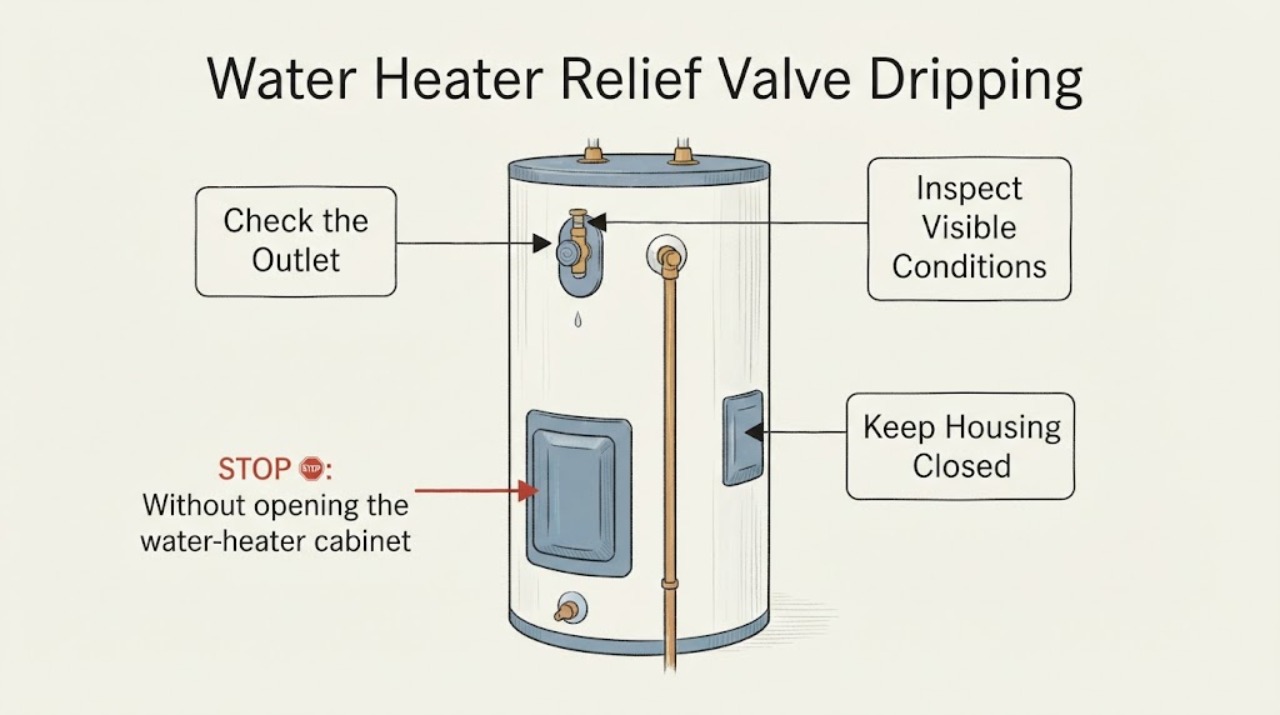
Work through in order
Diagnostic checks
Use only checks that match the exact appliance or system and its official guide.
-
Check 1
From a dry, stable position, identify whether the first wet point is the relief-valve discharge outlet, the valve body, a top water connection, the tank shell, or plumbing above. Follow only visible water and do not touch the valve, discharge pipe, insulation, or tank.
Expected result: Water clearly exits the relief discharge, appears around the valve body, begins at a nearby connection, or the source cannot be distinguished safely.
Next step: Photograph the area from outside the hazard zone and arrange qualified plumbing service. Treat an active stream, hot spray, steam, or water near controls as urgent and keep clear.
Why this matters
Why: A relief discharge suggests a pressure, temperature, valve, or installation branch; a connection leak may be separate, and an uncertain source should not be treated as a valve diagnosis.
-
Check 2
Observe the discharge from a safe distance without lifting the relief-valve handle, loosening the valve, placing a container against the outlet, or changing the pipe. Note whether the water is cool or hot, a slow drip or a stream, and whether it starts during or soon after heating.
Expected result: The drip is intermittent during heating, continues when the heater is not heating, is hot or forceful, or the discharge path is visibly blocked, capped, frozen, or directed toward an unsafe area.
Next step: Do not test or alter the valve or pipe. Keep people away from the outlet and request prompt qualified service; seek emergency help for steam or forceful hot discharge.
Why this matters
Why: Heating-linked discharge is consistent with a pressure or thermal-expansion branch, while continuous discharge can indicate a valve or ongoing condition. Hot, forceful, or obstructed discharge is a heightened safety risk.
-
Check 3
Without opening the water-heater cabinet, note the model and serial information from the rating plate, fuel type, installation type, recent plumbing work, and whether the property has a pressure-reducing valve, backflow preventer, check valve, softener, or unusual meter arrangement. Do not adjust any pressure device.
Expected result: A flow-restricting device or recent plumbing change is present, the system details are unknown, or no such change is known.
Next step: Give the observations and model information to the plumber. Do not choose an expansion tank, change a pressure-reducing valve, or alter a backflow device from a generic recommendation.
Why this matters
Why: A closed system or changed supply arrangement can make thermal expansion pressure appear at the relief valve; unknown system conditions require measurement and model-specific evaluation.
-
Check 4
Look at the tank, nearby floor, pan, and visible piping from outside the hazard area for bulging, distortion, corrosion, a full pan, spreading water, or moisture near gas or electrical controls. Do not enter pooled water or remove access panels.
Expected result: The tank or connections look distorted, the pan is filling, water is reaching a lower level or controls, corrosion is severe, or the area is dry apart from the drip endpoint.
Next step: Keep clear and request urgent plumbing service; use qualified electrical or emergency help when water reaches electrical parts, smoke appears, or the tank is distorted. Do not restart or continue testing the heater.
Why this matters
Why: Distortion can indicate pressure damage, while a filling pan or water near controls raises property, shock, fire, and equipment risks beyond a routine valve drip.
-
Check 5
Check from outside the room for gas odor, smoke, burning odor, hissing, steam, or unusually hot water at a fixture without approaching the heater or operating its controls. Do not relight a burner, remove a cover, or operate a switch in a wet area.
Expected result: Gas odor, smoke, burning odor, hissing, steam, scalding discharge, or water near electrical or burner controls is present.
Next step: Leave immediately for gas odor, avoid flames and switches, and contact the gas utility or emergency services from outside. Otherwise keep clear and obtain emergency plumbing or electrical help; do not restart the heater.
Why this matters
Why: The relief drip is accompanied by a potential fire, explosion, scald, shock, or pressure hazard and is no longer a routine plumbing observation.
-
Check 6
After the area is safe, document whether the drip changes when the heater naturally cycles, when hot-water fixtures are used, or after the cold-water supply is closed by a qualified person. Do not close a valve that is hard to reach or near hot discharge, and do not use a pressure gauge or open a connection yourself.
Expected result: The drip follows heating cycles, changes with water use or an inlet shutoff, remains constant, or no safe timing pattern is available.
Next step: Record the pattern and leave the heater undisturbed while arranging qualified diagnosis of system pressure, expansion control, temperature control, relief valve, discharge routing, and tank condition.
Why this matters
Why: Timing helps a plumber distinguish thermal-expansion pressure, incoming supply, a valve that is not resealing, or a different leak source; it does not prove a valve is safe.
Use your observations
Decision map
Find the observation that best matches what you see, then follow the next safe action.
-
PATH 01Next step
What you see
The relief valve drips only during or shortly after heating, while the discharge is not forceful and the tank and controls show no visible damage.
Do this next
Arrange a plumber to evaluate system pressure, backflow or check devices, and the correctly sized expansion-control arrangement. Do not cap the outlet or install a part from a generic chart.
Why this path and its safety boundary
Why it matters: Thermal expansion in a closed supply system is more likely, although a pressure device, temperature control, or valve problem still must be checked.
-
PATH 02Next step
What you see
The discharge continues when the heater is not heating, the valve body appears wet, or the drip does not change with safe observations.
Do this next
Keep the outlet unobstructed and arrange prompt qualified service. Do not operate the handle, remove the valve, or treat a replacement valve as a confirmed remedy before the cause is evaluated.
Why this path and its safety boundary
Why it matters: A relief valve that is not resealing, contamination at the seat, sustained pressure, or another source may be involved.
-
PATH 03Next step
What you see
The discharge is hot, forceful, steaming, or the outlet is blocked, capped, frozen, trapped, or directed where it can injure someone.
Do this next
Keep everyone away from the outlet and obtain urgent plumbing or emergency help. Do not touch, unblock, cap, redirect, or add a valve to the discharge line.
Why this path and its safety boundary
Why it matters: The safety discharge path or a pressure and temperature condition may be compromised.
-
PATH 04Next step
What you see
A tank is bulged or distorted, the pan is filling, water is spreading, or the leak reaches gas or electrical controls.
Do this next
Keep clear, do not restart the heater, and request urgent qualified service. Leave for gas odor or smoke and contact emergency help from outside; use qualified electrical help for wet electrical equipment.
Why this path and its safety boundary
Why it matters: Pressure damage, tank failure, property damage, fire, or shock risk may be present.
-
PATH 05Next step
What you see
Water starts at a nearby threaded connection or plumbing above the relief valve, while the discharge outlet remains dry.
Do this next
Do not tighten a hot or pressurized fitting. Photograph the highest wet point and arrange plumbing service to identify the source and protect the floor or lower level.
Why this path and its safety boundary
Why it matters: The reported relief drip may be a traveling or separate connection leak rather than relief-valve discharge.
Helpful context
Understand the symptom
First confirm that the relief valve is the source
The discharge pipe may be wet because the valve opened, but water can also run down from a top connection or collect in a pan. Observe from a safe position and follow the water upward only with your eyes. Record the valve location, the discharge endpoint, whether water is hot, and whether the drip occurs during or shortly after a heating cycle. Do not place a container against a hot outlet or touch the valve handle.
Why heating can trigger a relief drip
Water expands as it heats. Bradford White explains that a backflow preventer, check valve, pressure-reducing valve, water softener, or certain meter arrangements can make the supply a closed system, leaving expansion pressure with nowhere to go. A properly selected expansion-control arrangement may be needed, but a relief valve that is already discharging still needs professional diagnosis. Do not infer a pressure setting or select an expansion tank from a generic chart.
The discharge line is part of the safety system
Bradford White installation guidance says the relief discharge must remain unobstructed and must not be plugged, capped, or fitted with a valve between the tank and the relief valve. The outlet must be arranged so discharge can be observed and directed without causing injury or property damage. A drip therefore calls for diagnosis, not concealment; hot discharge can burn and an obstructed path can remove a critical safety function.
Safety boundary
Stop conditions
- Never cap, plug, obstruct, remove, or add a shutoff valve between the temperature and pressure relief valve and its discharge termination. Keep the outlet observable and clear.
- Stop for steam, forceful hot discharge, a bulged or distorted tank, a full or overflowing pan, spreading water, or water near gas or electrical controls. Keep clear and obtain urgent qualified help.
- For gas odor, leave immediately, avoid flames and switches, and contact the gas utility or emergency services from outside. Do not relight or restart the heater.
- Do not lift the relief-valve handle, change pressure settings, install an expansion tank, replace the valve, open a cabinet, or use a pressure gauge as a homeowner diagnostic. Have a qualified plumber determine the cause first.
Only after diagnosis
Potential parts
- temperature and pressure relief valve
Consider this only after qualified diagnosis confirms the valve is leaking or failing to reseal and the underlying pressure or temperature condition has been addressed.
The valve rating, connection, installation location, and discharge requirements depend on the exact heater model and local code. Do not select a substitute by appearance or use a cap as a workaround. - thermal expansion control component
Consider this only when a plumber confirms a closed water system and determines that an expansion-control component is required and correctly sized.
Sizing and installation depend on system pressure, heater characteristics, plumbing arrangement, and local requirements. Do not install one from a generic pressure or tank chart. - pressure-reducing or backflow-control component
Consider this only when qualified diagnosis confirms that the incoming pressure-control or backflow arrangement is causing harmful expansion pressure or is malfunctioning.
The correct device and adjustment depend on the whole plumbing system and local code. A pressure-control change must not disable required backflow protection or the relief path.
When checks do not resolve it
Need a professional?
Request service when water is confirmed at the relief discharge, the valve drips continuously, the drip follows heating, the discharge line is obstructed or unsafe, the system has a backflow or pressure-reducing device, or the tank or pan shows damage.
Safety scope: Keep the heater and discharge area undisturbed for hot or forceful water, steam, gas odor, smoke, tank distortion, spreading water, or water near controls. Do not operate the relief valve, cap the pipe, open panels, change settings, or perform pressure tests yourself.
Common questions
FAQ
Why is my Bradford White relief valve dripping only when the heater runs?
Heating expands water. In a closed supply system created by a backflow or check device, pressure can rise and cause intermittent relief discharge. A plumber must still check system pressure, expansion control, temperature control, and the valve itself. Do not cap or plug the discharge.
Can I put a cap on the dripping relief-valve pipe?
No. The discharge path is a safety function and must remain unobstructed. Do not cap, plug, add a shutoff, or otherwise restrict it. Keep people away from hot discharge and arrange qualified plumbing service to find the cause.
Should I replace the Bradford White relief valve first?
Not as a blind fix. A new valve can still discharge if system pressure or temperature remains high, and a tank or installation problem may be involved. A qualified plumber should confirm the valve and the underlying condition before selecting a part.
Is a dripping relief valve dangerous?
It can be. The water may be hot, and the discharge can indicate excessive pressure, temperature, a failed valve, or a damaged tank. Treat steam, forceful discharge, a bulged tank, spreading water, gas odor, smoke, or water near controls as urgent and keep clear.
Can a water softener or backflow device cause relief-valve dripping?
It can contribute by preventing heated water from expanding back into the supply, creating a closed system. Bradford White lists backflow and pressure-reducing arrangements among conditions that can produce thermal-expansion pressure. Have a plumber evaluate the complete system rather than bypassing a required device.
Read the exact guide
Official sources
- Discharging Temperature and Pressure Relief ValvesBradford White · Bradford White For The Pro bulletin covering residential and commercial units; model and local installation details still govern.
- 238-48384-00_PBradford White · Official Bradford White installation and operation manual; discharge details are model- and code-dependent.
- Draining a Water HeaterBradford White · Bradford White For The Pro bulletin; it contains hot-water and relief-valve procedures that should not be improvised during a leak.
- FAQs - Bradford White For The Pro®Bradford White · Bradford White official FAQ; exact model documentation and local plumbing code govern a specific installation.
- Best Management Practice #7: Faucets and ShowerheadsU.S. Department of Energy · DOE Federal Energy Management Program guidance for facility water-system operations; manufacturer instructions and local code govern a specific home.
- Pressure Damaged Water HeatersBradford White · Bradford White For The Pro bulletin; pressure diagnosis and corrective work require qualified plumbing service.
Community feedback
Share a repair observation
Share a plain-text repair observation. Accepted observations are published automatically; this page may take a moment to update.