
On this page
Start here
Quick answer
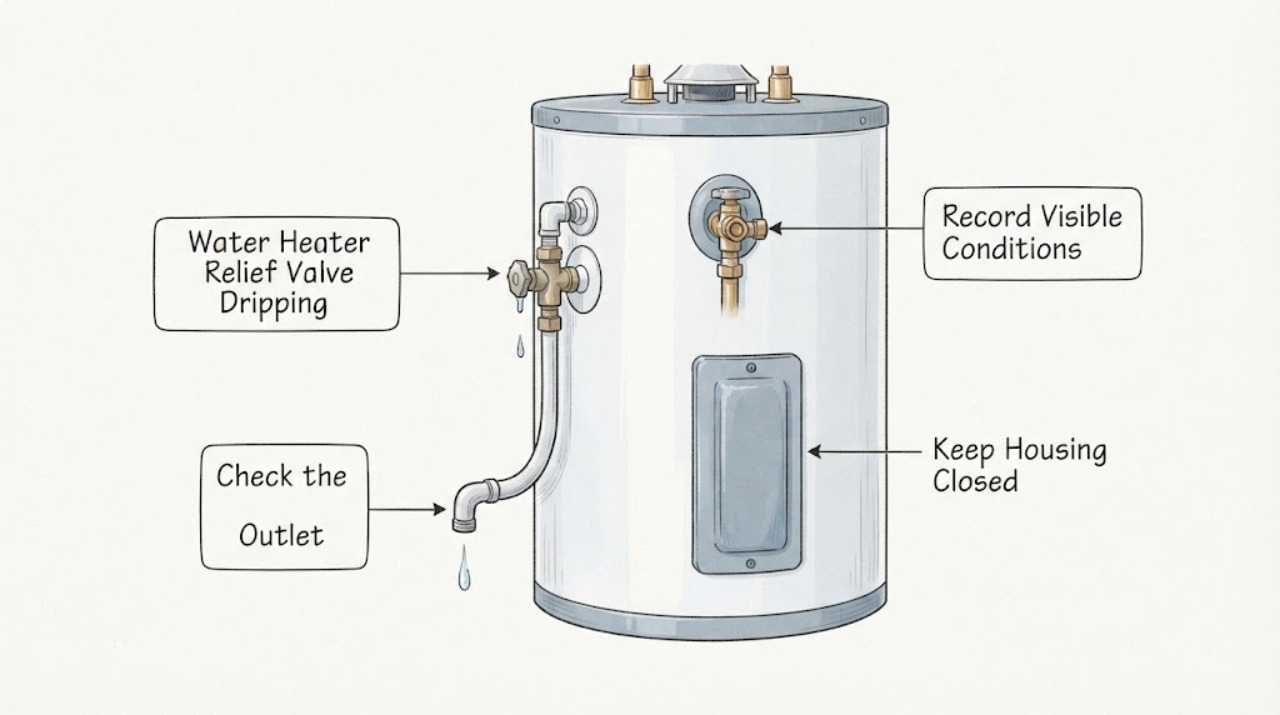
A dripping Rinnai relief valve is a safety signal, not a leak to cap. Rinnai tankless manuals describe a pressure relief valve, while some Rinnai hybrid systems use a temperature and pressure relief valve; the exact model manual controls the diagnosis. From a safe, dry position, confirm that water is actually coming from the relief discharge rather than a nearby connection or condensate drain, and note whether the water is cool, hot, intermittent during heating, or forceful. Do not lift the valve handle, plug or cap the discharge, add a shutoff, combine it with a condensate drain, or replace the valve without diagnosis. For steam, forceful hot discharge, a distorted tank, gas odor, smoke, or water near electrical controls, keep clear and obtain emergency help. Otherwise leave the heater undisturbed and arrange qualified plumbing service to evaluate the valve, system pressure, thermal expansion, temperature controls, discharge routing, and model-specific installation.
Before you begin
Safety first
- Keep the heater and discharge area undisturbed for hot or forceful water, steam, gas odor, smoke, tank distortion, spreading water, or water near controls. Do not operate the relief valve, cap the pipe, open panels, change settings, or perform pressure tests yourself.
Work through in order
Diagnostic checks
Use only checks that match the exact appliance or system and its official guide.
-
Check 1
From a dry, stable position, identify the first wet point without touching the valve, pipe, cabinet, wiring, or condensate tubing. Follow visible water upward with your eyes and determine whether it begins at the relief outlet, valve body, nearby water connection, condensate drain, or another pipe.
Expected result: Water clearly exits the relief discharge, surrounds the valve body, begins at a nearby connection or condensate route, or the source cannot be distinguished safely.
Next step: Photograph the source from outside the hazard area and arrange qualified plumbing service. Treat an active stream, hot spray, steam, or water near controls as urgent and keep clear.
Why this matters
Why: A relief discharge suggests a pressure, temperature, valve, or installation branch; a nearby connection or condensate leak requires a different diagnosis, and an uncertain source should not be assumed to be the valve.
-
Check 2
Observe the relief discharge from a safe distance without lifting its handle, loosening the valve, placing a container against the outlet, or changing the pipe. Note whether the water is cool or hot, a slow drip or a stream, and whether it occurs during or shortly after a heating cycle.
Expected result: The discharge is intermittent during heating, continues when the heater is idle, is hot or forceful, or the line is blocked, capped, frozen, restricted, or directed toward an unsafe area.
Next step: Do not test or alter the relief valve or line. Keep people away from the outlet and request prompt qualified service; seek emergency help for steam or forceful hot discharge.
Why this matters
Why: Heating-linked discharge is consistent with thermal-expansion pressure, while continuous discharge can indicate a valve that is not resealing or another ongoing condition. Hot, forceful, or obstructed discharge is a heightened safety risk.
-
Check 3
Read the Rinnai model and serial information from the rating label without opening the cabinet, and record whether the unit is tankless or a hybrid system, indoor or outdoor, gas or electric, and whether a condensate drain is present. Do not use a generic valve procedure or alter controls.
Expected result: The exact manual identifies a pressure relief valve, a combination temperature and pressure relief valve, a condensate path, or a model-specific isolation arrangement; or the unit type remains unknown.
Next step: Give the model, serial information, and installation type to the plumber and use only the matching manual. If the model cannot be identified, arrange service rather than experimenting with the valve.
Why this matters
Why: Rinnai relief components and discharge arrangements vary by product family. A wrong procedure can create a restriction, cross-connection, scald risk, or operating fault.
-
Check 4
Without opening the cabinet, look at the visible cold-water supply, hot-water piping, isolation valves, pressure-control or backflow devices, condensate drain, floor, and nearby wall for leaks, corrosion, freezing, standing water, or recent plumbing changes. Do not close or adjust a valve that is near hot discharge or difficult to reach.
Expected result: A backflow or pressure-reducing device, recent plumbing change, frozen or blocked line, condensate issue, severe corrosion, or spreading water is present, or the surroundings look dry and unchanged.
Next step: Keep the relief path open and arrange qualified diagnosis of the complete installation. Stop for spreading water, freezing damage, or water near electrical controls and obtain urgent help.
Why this matters
Why: A closed system or altered plumbing can contribute to thermal-expansion discharge; freezing, condensate, corrosion, and connection leaks can mimic or worsen a relief-valve problem.
-
Check 5
Look from outside the room for gas odor, smoke, burning odor, hissing, steam, unusually hot water, a distorted tank section on a hybrid unit, or water reaching wiring and controls. Do not relight a burner, remove an access panel, or operate a switch in a wet area.
Expected result: Gas odor, smoke, burning odor, hissing, steam, scalding discharge, tank distortion, or water near electrical or burner controls is present.
Next step: Leave immediately for gas odor, avoid flames and switches, and contact the gas utility or emergency services from outside. Otherwise keep clear and obtain emergency plumbing or electrical help; do not restart the heater.
Why this matters
Why: The relief drip is accompanied by a potential fire, explosion, scald, shock, or pressure-damage hazard and is no longer a routine valve observation.
-
Check 6
After the area is safe, document whether the drip changes when the unit heats, when hot-water fixtures are used, or after a qualified person isolates the water heater. Do not use a pressure gauge, manually operate the relief handle, open a drain, or remove a connection yourself.
Expected result: The drip follows heating cycles, changes with water use or isolation, remains constant, or no safe timing pattern is available.
Next step: Record the pattern and leave the heater undisturbed while arranging qualified evaluation of pressure, expansion control, temperature control, relief valve, discharge routing, condensate separation, and equipment condition.
Why this matters
Why: Timing helps a plumber distinguish thermal-expansion pressure, an incoming supply condition, a valve that will not reseal, or another leak source; it does not prove the valve is safe.
Use your observations
Decision map
Find the observation that best matches what you see, then follow the next safe action.
-
PATH 01Next step
What you see
A Rinnai relief valve drips only during or shortly after heating, while the discharge is not forceful and the unit has no visible damage.
Do this next
Arrange a plumber to assess supply pressure, backflow or check devices, and the correctly sized expansion-control arrangement. Do not cap the outlet or bypass required protection.
Why this path and its safety boundary
Why it matters: Thermal expansion in a closed water supply system is more likely, although pressure control, temperature control, and valve condition still need confirmation.
-
PATH 02Next step
What you see
The relief valve continues to discharge while the unit is idle, the valve body is wet, or the drip has no safe timing pattern.
Do this next
Keep the relief line unobstructed and arrange prompt qualified service. Do not operate the handle, remove the valve, or assume replacing it alone will correct the cause.
Why this path and its safety boundary
Why it matters: A valve that is not resealing, contamination, sustained pressure, or another plumbing source may be involved.
-
PATH 03Next step
What you see
The discharge is hot, forceful, steaming, or the line is blocked, capped, frozen, restricted, or directed where it can injure someone.
Do this next
Keep everyone away from the outlet and obtain urgent plumbing or emergency help. Do not touch, unblock, cap, redirect, or add a valve to the line.
Why this path and its safety boundary
Why it matters: A temperature or pressure condition or a compromised safety discharge path may be present.
-
PATH 04Next step
What you see
The water starts at a nearby connection or condensate drain while the relief outlet remains dry.
Do this next
Do not tighten a hot or pressurized fitting or combine drains. Photograph the highest wet point and arrange plumbing service to identify the source.
Why this path and its safety boundary
Why it matters: The reported relief drip may actually be a traveling or separate connection or condensate leak.
-
PATH 05Next step
What you see
A hybrid tank section is distorted, water is spreading, or water reaches wiring, gas controls, or the floor below.
Do this next
Keep clear and do not restart the unit. Request urgent qualified service; leave for gas odor or smoke and contact emergency help from outside.
Why this path and its safety boundary
Why it matters: Pressure damage, equipment failure, property damage, fire, or shock risk may be present.
Helpful context
Understand the symptom
Rinnai relief valves are not identical across product families
A Rinnai tankless installation may use a pressure relief valve, while a Rinnai hybrid system may include a combination temperature and pressure relief valve. The valve location, discharge route, isolation arrangement, and model safety instructions therefore matter. Find the model and serial information from the unit label, then use that exact manual for service details. Do not copy a tankless procedure onto a hybrid system or the reverse.
A heating-cycle drip often points to expansion pressure
Water expands as it heats. Rinnai explains that a closed supply system can make a pressure relief valve discharge periodically; backflow prevention or other devices can prevent expansion from moving back into the supply. The correction may involve professional evaluation of pressure and expansion control, but a relief valve that is already discharging still needs its own inspection. Do not bypass required backflow protection or choose an expansion component from a generic chart.
The discharge line must stay open and observable
Rinnai manuals prohibit plugging the relief valve, restricting its line, placing another shutoff between the valve and heater, or combining relief discharge with a condensate drain. The line should drain safely and visibly. A cap can conceal the symptom while removing a safety path, and water from the outlet may be hot enough to burn.
Safety boundary
Stop conditions
- Never cap, plug, obstruct, remove, or add a shutoff valve between the Rinnai relief valve and its discharge termination. Do not combine the relief line with a condensate drain.
- Stop for steam, forceful hot discharge, a distorted tank, spreading water, freezing damage, or water near electrical or gas controls. Keep clear and obtain urgent qualified help.
- For gas odor, leave immediately, avoid flames and switches, and contact the gas utility or emergency services from outside. Do not relight or restart the heater.
- Do not manually operate the relief handle, change pressure settings, install an expansion tank, replace the valve, open the cabinet, or use a pressure gauge as a homeowner diagnostic. Have a qualified plumber determine the cause first.
Only after diagnosis
Potential parts
- Rinnai pressure relief valve
Consider this only after qualified diagnosis confirms that the pressure relief valve is leaking or not resealing and the underlying pressure or installation condition has been addressed.
Valve rating, connection, placement, and discharge requirements depend on the exact Rinnai model and local code. Do not select a substitute by appearance or cap the existing valve. - Rinnai temperature and pressure relief valve
Consider this only for a Rinnai product family that uses a combination valve and only after qualified diagnosis confirms the valve is the source.
Tankless and hybrid Rinnai systems can use different relief arrangements. Confirm the exact model manual, rating, connection, and discharge requirements before selecting a component. - thermal expansion control component
Consider this only when a plumber confirms a closed water supply system and determines that expansion control is required and correctly sized.
Sizing and installation depend on system pressure, water-heater type, plumbing arrangement, and local requirements. Do not install one from a generic chart or bypass backflow protection.
When checks do not resolve it
Need a professional?
Request service when water is confirmed at the relief discharge, the valve drips continuously, the drip follows heating, the discharge line is obstructed or unsafe, the system has pressure-control devices, or the tank, pan, floor, or controls show damage.
Safety scope: Keep the heater and discharge area undisturbed for hot or forceful water, steam, gas odor, smoke, tank distortion, spreading water, or water near controls. Do not operate the relief valve, cap the pipe, open panels, change settings, or perform pressure tests yourself.
Common questions
FAQ
Why is my Rinnai relief valve dripping only when the heater runs?
Heating expands water. In a closed supply system created by a backflow or check device, pressure can rise and cause periodic discharge. A plumber must still check system pressure, expansion control, the model-specific valve, and temperature operation. Do not cap or plug the discharge.
Can I put a cap on the Rinnai relief-valve pipe?
No. Rinnai requires the relief path to remain unobstructed. Do not cap, plug, add a shutoff, install a restriction, or combine it with a condensate drain. Keep people away from hot discharge and arrange qualified service.
Should I replace the Rinnai relief valve first?
Not as a blind fix. A new valve can still discharge if system pressure or temperature remains high, and the valve arrangement differs between Rinnai product families. Have a qualified plumber confirm the cause and exact model component before replacement.
Is a dripping Rinnai relief valve dangerous?
It can be. The water may be hot, and the discharge can indicate excessive pressure, temperature, a valve problem, or an installation fault. Treat steam, forceful discharge, tank distortion, spreading water, gas odor, smoke, or water near controls as urgent and keep clear.
Can I open the Rinnai relief valve to test it?
Do not manually operate it as a response to an active drip unless the exact manual and a qualified person direct the procedure. Rinnai warns that the released water can be scalding and under pressure. Keep the outlet open and observable and arrange qualified service instead of testing a hot or leaking valve.
Read the exact guide
Official sources
- Best Management Practice #7: Faucets and ShowerheadsU.S. Department of Energy · DOE Federal Energy Management Program guidance for facility water systems; manufacturer instructions and local code govern a specific home.
- Rinnai Tankless Water Heater Installation and Operation ManualRinnai · Official Rinnai tankless installation and operation manual; details vary by model and local code.
- Rinnai Residential Hybrid System Installation and Operation ManualRinnai · Official Rinnai residential hybrid-system manual; tank and valve details must be matched to the exact model.
- RU130eNRinnai · Rinnai product page; the displayed product is one model and its documentation should not be generalized to every Rinnai water heater.
Community feedback
Share a repair observation
Share a plain-text repair observation. Accepted observations are published automatically; this page may take a moment to update.