
On this page
Start here
Quick answer
A dripping A. O. Smith water-heater temperature-and-pressure (T&P) relief valve is a safety symptom, not a fitting to cap. First determine whether water is coming from the end of the discharge pipe, the valve threads, the welded tank connection, or another nearby joint, and whether the drip happens only while the heater is recovering or continues at rest. Intermittent dribbling can reflect thermal expansion in a closed plumbing system or excessive supply pressure; a large discharge of very hot water can indicate a thermostat or overheating problem. Keep the discharge path open and unobstructed, avoid touching hot water, and arrange qualified service for pressure/expansion diagnosis or valve replacement. If there is a large hot discharge, unusually hot water, gas odor, smoke, water near electrical parts, or a tank leak, stop using the heater and isolate it only from a known-safe control while obtaining urgent help.
Before you begin
Safety first
- This article supports cool, ordinary-access observation and documentation only. Qualified service handles pressure measurement, thermal-expansion diagnosis, valve sizing and replacement, gas/electrical controls, tank leaks, and correction of discharge piping.
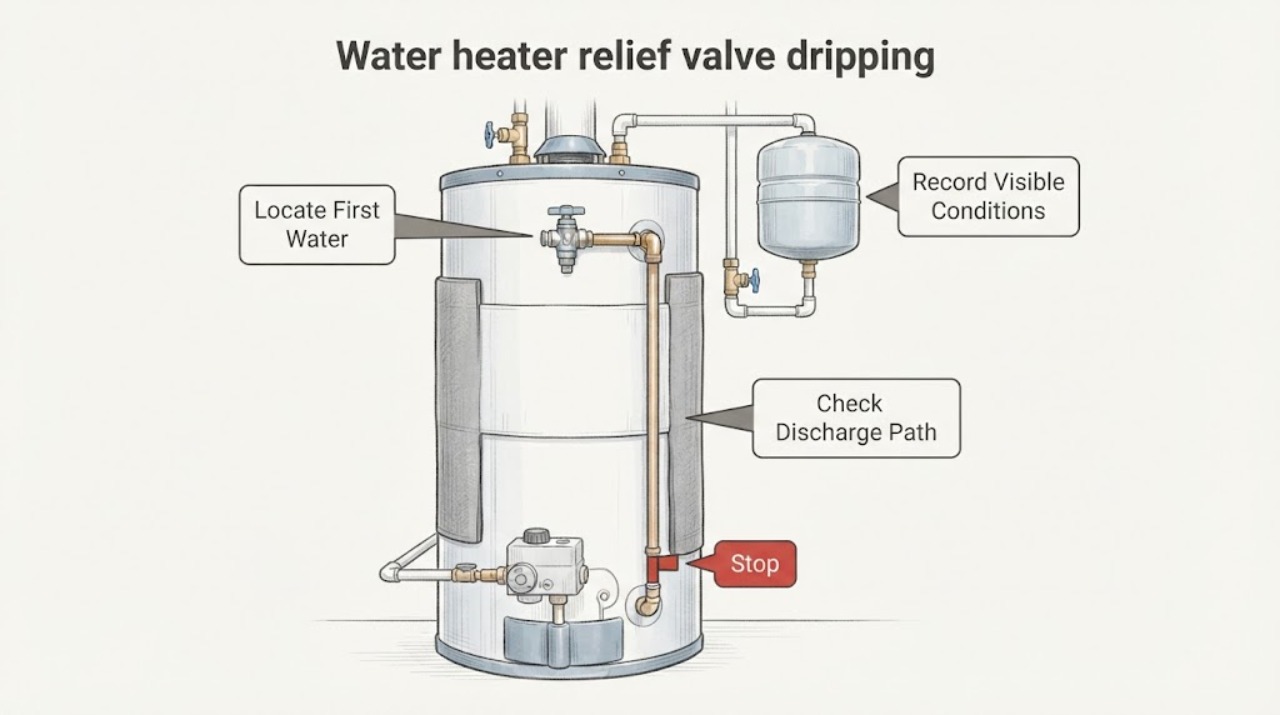
Work through in order
Diagnostic checks
Use only checks that match the exact appliance or system and its official guide.
-
Check 1
From a cool, dry, well-lit position, trace the outside of the A. O. Smith heater and identify the first place a fresh drop appears; do not touch the discharge water or remove the discharge pipe.
Expected result: Record whether water appears at the discharge-pipe outlet, directly around the T&P valve body or threads, at the welded tank opening, at the drain valve, or at an inlet/outlet connection.
Next step: Photograph the source and use the matching branch below; arrange service rather than tightening or disassembling a pressurized relief assembly.
Stop if: Stop if the surface is hot, the leak is fast, water reaches electrical parts, the tank shell is wet, or the source cannot be identified safely.
Why this matters
Why: Water at the discharge outlet supports a relief event or a valve that is not reseating. Water at threads points toward a connection seal; water at the welded tank spud or tank shell points toward a non-repairable tank leak. A nearby puddle can also come from another fitting or condensation.
-
Check 2
Visually follow the T&P discharge pipe to its termination and check only for obvious kinks, caps, plugs, blocked openings, or an end that is not routed to a safe discharge location; do not alter it.
Expected result: Record an open, intact pipe; an obstructed or capped pipe; a missing, loose, damaged, or incorrectly terminated pipe; or a pipe that is actively discharging hot water.
Next step: Keep people away from the outlet and obtain qualified service for any obstruction, damaged pipe, or active discharge; do not try to cap it or redirect it by improvisation.
Stop if: Do not bend, shorten, cap, plug, reduce, clamp, remove, or test the pipe with your hand.
Why this matters
Why: An unobstructed pipe preserves the relief function. Any obstruction can prevent pressure or hot water from escaping safely and makes this an urgent service issue. An active discharge confirms that the valve is releasing water but does not establish whether pressure, temperature, or valve failure caused it.
-
Check 3
Without changing the thermostat or repeatedly operating controls, note whether the drip starts during a hot-water recovery, occurs only after a long draw, continues while no hot water is being used, or becomes a stream.
Expected result: Record occasional drops tied to heating, slow continuous weeping, a repeated drip after each recovery, or a rapid/large discharge of very hot water.
Next step: Provide the timing and amount to a qualified plumber; treat a large hot discharge or unusual temperature as urgent and leave the heater in the safest available off state.
Stop if: Do not place hands, a cup, or a container under hot discharge, force the lever, or keep the heater running to reproduce a hazardous release.
Why this matters
Why: Heating-linked intermittent dribbling is compatible with thermal expansion or pressure relief. Continuous or recurring weeping makes sustained pressure, an improperly seated or worn valve, or another fault more likely. A large hot discharge points to a temperature-release event and possible thermostat malfunction, not merely a dirty valve seat.
-
Check 4
Read only the external A. O. Smith control, display, status label, and model manual from a safe position; note any high-temperature, safety, or service indication without opening panels or adjusting gas or electrical components.
Expected result: Record normal controls, an overheating indication, unusually hot water at a safely usable fixture, a repeated safety trip, an error or service message, or no visible indication.
Next step: Stop using the heater and arrange qualified service for overheating, a safety trip, a service code, or unusually hot water; do not reset repeatedly or raise the temperature setting.
Stop if: Do not remove access covers, test live wiring, adjust a gas control, bypass a high-temperature limit, or touch hot plumbing.
Why this matters
Why: The T&P valve may open when temperature or pressure is substantially above normal, and A. O. Smith describes a high-temperature cutoff as a safety feature. An overheating indication or unusually hot water changes the diagnosis from routine pressure investigation to a safety/control fault.
-
Check 5
Inspect the drain pan and nearby external piping from a safe position, using dry tissue on a cool accessible surface only if it cannot contact hot water or wiring; do not open insulation or the tank.
Expected result: Record a dry pan with water only at the discharge outlet, water at the drain valve or supply connections, condensation after a long draw, corrosion or wetness at the tank shell, or water near electrical components.
Next step: Document the location and arrange service for any connection, tank, or electrical-area leak; do not seal a tank shell or tighten a hot pressurized connection.
Stop if: Stop for a wet electrical area, expanding corrosion, a fast leak, steam, smoke, or unsafe access.
Why this matters
Why: A dry pan with outlet discharge keeps the relief path as the leading issue. Water at another fitting or condensation can mimic a T&P leak. Wetness at the tank shell or welded opening suggests tank replacement, while water near electrical parts is an immediate safety boundary.
-
Check 6
Collect the model/rating label, heater type, recent plumbing work, presence of a pressure-reducing valve or expansion tank, and whether the home has a closed water system; do not adjust or charge any device.
Expected result: Record recent installation or valve work, a newly added check or pressure-reducing valve, an expansion tank that is absent or of unknown condition, prior pressure complaints, or no relevant history.
Next step: Give this history and the drip timing to a plumber so they can verify system pressure, expansion control, valve rating, and the correct repair sequence.
Stop if: Do not turn adjustment screws, change pressure settings, inflate an expansion tank, replace a pressure valve, or remove the T&P valve as an experiment.
Why this matters
Why: A closed system, supply pressure above the valve rating, or a changed pressure-control arrangement can produce thermal-expansion relief. An absent or unverified expansion tank does not prove it is the only cause, and unknown valve sizing or pressure must be checked professionally.
Use your observations
Decision map
Find the observation that best matches what you see, then follow the next safe action.
-
PATH 01Safety boundary
What you see
Water is coming from the discharge-pipe outlet, the pipe is open, and the drip is intermittent or tied to the heater recovering.
Do this next
Arrange qualified plumbing assessment of incoming pressure, expansion control, valve rating, and valve condition; do not replace the valve before the cause is checked.
Why this path and its safety boundary
Why it matters: Thermal expansion in a closed system or pressure reaching the valve setting is more likely than a leak at a threaded joint, but the valve and system pressure still need confirmation.
Safety stop: Stop immediately for a stream, very hot discharge, scalding risk, or an obstructed pipe.
-
PATH 02Safety boundary
What you see
The discharge outlet weeps even when the heater is not recovering, or the drip returns after every attempted normal cycle.
Do this next
Leave the discharge path open and have a qualified person verify pressure, expansion control, valve selection, and whether the T&P valve should be replaced.
Why this path and its safety boundary
Why it matters: Sustained high pressure, debris or wear at the valve seat, an incorrectly selected valve, or a valve that needs replacement is more likely than a one-time expansion event.
Safety stop: Do not plug the pipe, remove the valve, repeatedly lift the lever, or keep operating a valve that is releasing hot water.
-
PATH 03Safety boundary
What you see
A large amount of very hot water is discharged, water is unusually hot, or a high-temperature/safety indication appears.
Do this next
Keep people away, stop using the heater, isolate it only using a known-safe external control if appropriate, and obtain urgent qualified service.
Why this path and its safety boundary
Why it matters: A temperature-control or thermostat fault is a serious possibility; this is not ordinary thermal-expansion troubleshooting.
Safety stop: Do not reset a safety control repeatedly, touch the discharge, open panels, or relight a gas appliance during a hazardous event.
-
PATH 04Safety boundary
What you see
Water begins at the threaded relief-valve connection rather than at the discharge outlet, with no evidence of a hot relief event.
Do this next
Arrange service to identify the correct valve and reseal procedure; protect the area from water damage without tightening the hot pressurized connection yourself.
Why this path and its safety boundary
Why it matters: The connection seal or valve installation is more likely than pressure activation, although a professional should still confirm the valve and tank condition.
Safety stop: Do not loosen or unscrew the relief valve, use improvised sealant, or treat a connection leak as permission to cap the discharge path.
-
PATH 05Safety boundary
What you see
Water comes from the welded tank opening or tank shell, corrosion is expanding, or the pan fills despite a dry discharge outlet.
Do this next
Stop using the heater, isolate water and energy only from known-safe controls, and arrange qualified replacement assessment before water damage worsens.
Why this path and its safety boundary
Why it matters: A tank leak is more likely than a replaceable relief-valve or connection issue; A. O. Smith identifies a leaking welded spud or confirmed tank leak as non-repairable at that point.
Safety stop: Do not patch the tank, open insulation, drain hot water casually, or continue operating a tank with structural leakage.
-
PATH 06Safety boundary
What you see
The T&P discharge pipe is capped, plugged, crushed, reduced, missing, or routed so that discharge cannot safely escape.
Do this next
Keep clear of the heater and obtain qualified service to restore the correct discharge arrangement and diagnose the relief event.
Why this path and its safety boundary
Why it matters: The safety discharge function is compromised regardless of why the valve is dripping, creating an urgent installation and pressure-safety issue.
Safety stop: Do not remove the valve, operate the heater to test the obstruction, or improvise a larger or shorter pipe.
-
PATH 07Safety boundary
What you see
The T&P outlet is dry, but water is found at the drain valve, inlet/outlet piping, condensation path, gas connection, electric-element gasket area, or another fitting.
Do this next
Arrange plumbing or appliance service for the identified fitting and keep the relief-valve path unchanged while documenting the source.
Why this path and its safety boundary
Why it matters: The puddle is not established as a relief-valve drip; the next diagnosis depends on heater type and the exact connection involved.
Safety stop: Stop for gas odor, water near electrical parts, a fast leak, steam, smoke, or an unsafe hot surface.
Helpful context
Understand the symptom
Confirm that the drip is from the relief-valve path
The T&P valve is normally connected to a discharge pipe that ends in a visible, safe location. Water at that pipe end is a different diagnostic path from water at the threaded valve connection, the welded tank opening, the drain valve, or an inlet/outlet fitting. Dry the surrounding exterior only from a cool, safe position, then observe where a new drop first appears without removing the pipe or touching the discharge water. A nearby puddle by itself does not identify the source.
The timing and amount change the likely cause
A few drops that occur during heating or recovery and then stop can be consistent with pressure relief from thermal expansion, especially in a closed plumbing system. Dripping that continues when the heater is not recovering makes sustained pressure, a contaminated or worn valve seat, or a valve that needs replacement more likely. A rapid or large release of very hot water is an overheating or thermostat warning, not a routine leak check.
Do not defeat the safety discharge
The discharge pipe must remain open, correctly routed, and unobstructed. Never cap, plug, reduce, clamp, or remove the T&P valve to stop the drip. Pressure readings, expansion-tank charge, valve sizing, and replacement require model- and installation-specific judgment; a qualified plumber should handle those decisions, especially when the valve has opened or the cause is not obvious.
Safety boundary
Stop conditions
- Never plug, cap, block, clamp, reduce, remove, or otherwise obstruct the T&P relief valve or its discharge pipe.
- Do not touch or collect water from the discharge path; it may be hot enough to scald.
- Do not open electrical panels, adjust gas controls, bypass a high-temperature limit, change pressure settings, charge an expansion tank, or unscrew the relief valve as a homeowner test.
- Stop using the heater for a large hot discharge, unusual water temperature, fast leak, tank-shell leak, water near electrical parts, gas odor, smoke, steam, or repeated safety trip.
- If the leak source or safe isolation control is unclear, keep people away and obtain qualified plumbing or appliance service rather than continuing tests.
Only after diagnosis
Potential parts
- A. O. Smith-compatible temperature and pressure relief valve
Consider this category only after a qualified person confirms the valve itself is leaking or not reseating after pressure, thermal-expansion, temperature, and valve-selection causes are assessed.
Match the exact heater model, tank working-pressure requirement, temperature/pressure ratings, connection, probe length, and manufacturer's instructions; never substitute a higher-rated or generic valve by guesswork. - thermal expansion tank
Consider this category only when the plumbing system is closed and a qualified pressure assessment confirms thermal expansion is contributing to relief-valve activation.
Sizing, connection, pre-charge, and installation depend on the actual system and local requirements; do not inflate or install one without qualified guidance. - pressure-reducing valve
Consider this category only when measured incoming pressure exceeds the applicable valve or system rating and a qualified plumber confirms pressure reduction is required.
Confirm the home's pressure-control layout, valve ratings, expansion strategy, flow needs, and local plumbing requirements before ordering or adjusting. - water-heater tank or complete replacement unit
Consider replacement only when the welded tank opening or tank shell is confirmed to leak or the unit has a structural condition that cannot be repaired safely.
A qualified installer must match fuel or power, capacity, venting or electrical requirements, dimensions, relief protection, and applicable installation rules.
When checks do not resolve it
Need a professional?
Arrange qualified plumbing service for any drip from the discharge outlet, any continuous or recurring weep, a missing or obstructed discharge pipe, an unknown or changed pressure-control arrangement, a leak at the valve threads or tank, or a valve that needs testing or replacement. Seek urgent help for a stream or large release of very hot water, unusually hot water, a tank leak, gas odor, smoke, steam, water near electrical components, or a repeated safety trip. Provide the model label, heater type, exact first-wet location, discharge-pipe condition, drip timing and amount, control/status indications, recent plumbing work, and whether an expansion tank or pressure-reducing device is present.
Safety scope: This article supports cool, ordinary-access observation and documentation only. Qualified service handles pressure measurement, thermal-expansion diagnosis, valve sizing and replacement, gas/electrical controls, tank leaks, and correction of discharge piping.
Common questions
FAQ
Why is my A. O. Smith water heater relief valve dripping?
A drip from the discharge pipe can result from thermal expansion in a closed system, high supply pressure, or a valve that is contaminated, worn, incorrectly selected, or not reseating. First locate the exact source and record whether it is intermittent during heating or continuous; do not cap the pipe.
Is a small drip from the T&P discharge pipe safe to ignore?
No. Intermittent dribbling may be a pressure or thermal-expansion symptom, and A. O. Smith treats a leaking T&P valve as a possible unsafe condition. Keep the discharge path open and arrange qualified diagnosis, especially if the drip is recurring.
Can I cap the relief-valve discharge pipe to stop the leak?
No. Never plug, cap, block, reduce, or remove the T&P valve or its discharge pipe. The opening is part of the heater's safety protection, and a qualified person must correct the cause and any pipe defect.
What if the relief valve releases a lot of very hot water?
Treat that as urgent. A. O. Smith identifies a large sporadic hot discharge as a possible thermostat or temperature-release problem. Keep people away, stop using the heater, avoid the water and controls, and obtain qualified service.
Should I replace the relief valve before checking water pressure?
Not automatically. High pressure or thermal expansion can make a sound valve open, so the pressure-control and expansion conditions should be assessed before selecting a replacement. If the valve still drips after those conditions are correct, a qualified person can confirm the exact replacement.
What if water is leaking at the tank connection instead of the discharge pipe?
A threaded valve connection may need a model-appropriate reseal, but a leak at the welded tank opening or tank shell can mean the tank is not repairable. Do not loosen a hot pressurized valve yourself; document the first-wet location and arrange qualified service.
Read the exact guide
Official sources
- Water Heater Maintenance GuideA. O. Smith · Official A. O. Smith general maintenance guidance; the valve label and exact owner's manual control a particular installation.
- Technical Bulletins - Bulletin #52 Leaking Temperature and Pressure Relief ValveA. O. Smith · Official A. O. Smith technical bulletin; exact valve ratings and repair procedures remain model- and installation-specific.
- Safety Features in Tank Water HeatersA. O. Smith · Official A. O. Smith tank water-heater safety overview; it does not replace the model manual or professional diagnosis.
- Technical Bulletins - Bulletin #51 Puddle On The FloorA. O. Smith · Official A. O. Smith diagnostic bulletin for distinguishing a water-heater puddle source; exact repairs depend on heater type and model.
- Voltex Hybrid Electric Heat Pump Water Heater Use and Care GuideA. O. Smith · Official A. O. Smith model manual for the Voltex hybrid electric family; its safety warning is relevant to the T&P function, while model-specific procedures control the installed heater.
Community feedback
Share a repair observation
Share a plain-text repair observation. Accepted observations are published automatically; this page may take a moment to update.