
On this page
Start here
Quick answer
A dripping water-heater relief valve is a safety signal, not a leak to cap or ignore. First identify whether water is coming from the temperature-and-pressure (T&P) discharge pipe, the valve's threaded connection, the expansion tank connection, or another drain or pan. A small recurring discharge during a heating cycle can be caused by thermal expansion in a closed plumbing system, an absent, incorrectly sized, or incorrectly charged expansion tank, or a tank with a failed bladder. A continuous or large flow of hot water can indicate an unsafe temperature or pressure condition. Keep the discharge path open, do not lift the relief-valve lever as a casual test, and do not open the heater or adjust the expansion tank unless the exact manufacturer instructions and a qualified professional make that procedure appropriate. Arrange qualified plumbing service for any continuing discharge, abnormal pressure, leak, or suspected expansion-tank or relief-valve fault.
Before you begin
Safety first
- The homeowner scope is limited to safe visual observation, reading accessible controls or gauges, and recording timing and location. Do not cap or plug the T&P line, lift the relief-valve lever as a test, open the heater, adjust the relief valve or pressure regulator, pressurize or disconnect the expansion tank, or work near hot water, gas, or electrical components.
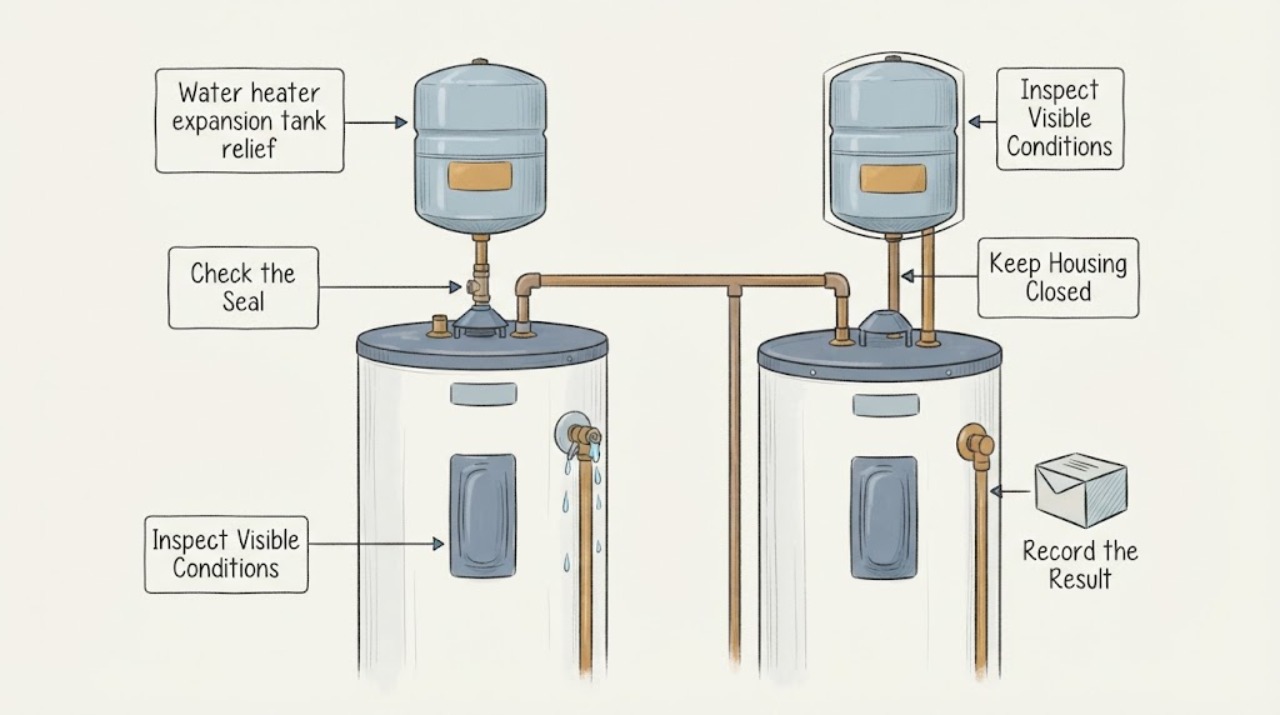
Work through in order
Diagnostic checks
Use only checks that match the exact appliance or system and its official guide.
-
Check 1
From a cool, dry, safe position, identify the first wet point: the open end of the T&P discharge pipe, the relief-valve body or threaded connection, the expansion-tank threaded fitting or shell, or a nearby drain, pipe joint, or pan. Do not touch hot water or remove insulation and do not place anything over the discharge opening.
Expected result: Water exits only from the discharge pipe, appears around a threaded connection, wets the expansion tank or its fitting, or comes from another nearby component.
Next step: Photograph the source and timing for the plumber. Keep the relief path open and arrange qualified service for any confirmed discharge or connection leak.
Stop if: Stop immediately for hot water, a rapid flow, water near electrical parts, a bulging or badly corroded tank, or any need to remove the heater cover or insulation.
Why this matters
Why: Discharge from the pipe points toward a relief event or valve that is not reseating; a connection leak points toward sealing or installation; another wet point may not be the relief valve at all.
-
Check 2
Observe when the drip occurs without operating the relief-valve lever: only while the heater recovers or shortly after hot-water use, at random times, or continuously. Note whether the water is cool, warm, or too hot to approach safely, and whether the amount is a few drops or a sustained flow.
Expected result: The discharge is small and repeats with heating, is continuous between cycles, or is a large or very hot discharge.
Next step: Record the pattern and keep clear of the outlet. Arrange qualified service; treat a large or very hot discharge as urgent and follow the appliance manual's safe shutdown guidance only if it can be done without approaching hot water or opening the unit.
Stop if: Do not repeatedly reset the heater, change its temperature control beyond normal user instructions, or attempt to force the relief valve closed.
Why this matters
Why: A small heating-cycle pattern is consistent with thermal-expansion pressure; continuous discharge can indicate debris, a worn valve, or ongoing pressure; a large hot discharge raises concern about excessive temperature or pressure.
-
Check 3
Read any accessible house-water pressure gauge or the appliance's user-facing pressure indication, if installed, and compare it with the range specified in the water-heater and pressure-regulator manuals. Look for a pressure-reducing valve, backflow preventer, or check valve on the incoming cold-water line without adjusting it.
Expected result: Pressure is above the applicable manual range, rises during heating, changes sharply, or no gauge is available and the discharge recurs during recovery.
Next step: Give the pressure readings and the presence of backflow or pressure-reduction equipment to a qualified plumber. Do not guess a pressure setting or adjust the regulator or relief valve from the symptom alone.
Stop if: Stop for a leaking pressure device, rapidly rising pressure, damaged pipework, or any instruction that requires disconnecting plumbing or opening the water heater.
Why this matters
Why: High or rising pressure supports a thermal-expansion or pressure-regulation investigation; a closed system can need a correctly selected expansion tank, while the absence of a gauge means pressure cannot be safely inferred from the drip alone.
-
Check 4
Inspect the expansion tank only from the outside for a loose or wet connection, corrosion, physical damage, missing support, or water reaching its air-valve end. Do not press the air valve, remove the tank, disconnect its fitting, or try to add or release air while the plumbing is pressurized or the water is hot.
Expected result: The tank connection leaks, the tank is damaged or unsupported, water appears at the air-valve end, or the tank looks intact but the T&P valve still drips.
Next step: Keep the heater and tank undisturbed and have a qualified plumber verify the tank size, air charge, isolation arrangement, and bladder condition before any adjustment or replacement.
Stop if: Stop for active leakage, corrosion, movement, a hot surface, or any need to depressurize, drain, or remove the expansion tank.
Why this matters
Why: A connection leak may be plumbing-related; water at the air valve can indicate a failed internal bladder; an intact-looking tank can still be wrongly sized or charged and needs installation-specific testing.
-
Check 5
Visually follow the T&P discharge line from the valve to its termination. Confirm only that it is present, unobstructed, directed to a safe observable location, and not capped or plugged; do not disassemble or test the valve yourself.
Expected result: The line is open and visible, terminates unsafely, is kinked or blocked, is capped or plugged, or is missing.
Next step: Keep people away from the outlet and arrange prompt qualified plumbing service. If the line is blocked or capped, do not operate the heater until a professional has assessed the safety device and discharge path.
Stop if: Never cap, plug, clamp, reroute, or remove the discharge line, and never lift the relief-valve lever as a casual diagnostic step.
Why this matters
Why: An open, observable line allows a dangerous discharge to be noticed; a blocked, capped, missing, or unsafe line removes a critical safety path and needs immediate correction by a qualified professional.
Use your observations
Decision map
Find the observation that best matches what you see, then follow the next safe action.
-
PATH 01Safety boundary
What you see
A few drops come from the T&P discharge pipe only during or shortly after a heating cycle, especially where a backflow or check device makes the plumbing closed.
Do this next
Treat thermal expansion as a leading possibility and have a qualified plumber verify incoming pressure, the closed-system arrangement, and whether the expansion tank is properly selected and charged.
Why this path and its safety boundary
Safety stop: Do not solve the symptom by capping the discharge or guessing an expansion-tank pressure.
-
PATH 02Safety boundary
What you see
An expansion tank is installed, but the T&P discharge continues during recovery or the tank connection or air-valve end is wet.
Do this next
Have a qualified plumber check the tank's size, air charge, isolation, bladder, and plumbing connections before deciding whether the tank or another pressure-control component needs replacement.
Why this path and its safety boundary
Safety stop: Do not pressurize, drain, disconnect, or replace the tank based only on its appearance or the drip pattern.
-
PATH 03Safety boundary
What you see
The relief valve discharges continuously, releases a large amount, or produces water that is dangerously hot, or the heater appears to be overheating.
Do this next
Keep clear, follow the exact appliance manual's safe shutdown direction if accessible without approaching the discharge or opening the unit, and contact qualified plumbing service promptly for an unsafe temperature or pressure assessment.
Why this path and its safety boundary
Safety stop: Do not relight, repeatedly reset, bypass, restrain, or replace the relief device as a first response.
-
PATH 04Safety boundary
What you see
Water is at the relief-valve threaded connection or the expansion-tank fitting rather than exiting the discharge pipe.
Do this next
Keep the area clear and have a qualified plumber inspect the connection, tank port, valve body, and surrounding corrosion; a connection leak is not diagnosed by changing the expansion-tank air charge.
Why this path and its safety boundary
Safety stop: Do not tighten, unthread, reseal, or remove a pressurized or hot component yourself.
-
PATH 05Safety boundary
What you see
The T&P discharge line is capped, plugged, kinked, missing, or routed where hot water could injure someone or damage the building.
Do this next
Treat the installation as an immediate safety defect and arrange qualified service before operating the water heater normally.
Why this path and its safety boundary
Safety stop: Do not alter the line yourself or operate the relief valve to see whether it clears.
-
PATH 06Safety boundary
What you see
No discharge comes from the T&P outlet, but a drain pan, nearby pipe, or another fitting is wet.
Do this next
Have the actual leak source identified by a plumber; keep water away from electrical components and do not assume the expansion tank or relief valve is the cause.
Why this path and its safety boundary
Safety stop: Stop if water is accumulating, reaching wiring, or coming from the heater tank itself.
Helpful context
Understand the symptom
Confirm which part is actually dripping
A drop at the end of the discharge pipe is a different clue from water around the valve's threaded tank connection, the expansion-tank fitting, or the drain pan. Dry the outside surfaces only if they are cool and accessible, then observe from a safe position during normal use. Do not touch a hot discharge or remove insulation to trace it. The source location changes whether the likely issue is thermal expansion, a connection leak, a relief valve that is not reseating, or a different plumbing leak.
Why an expansion tank can be involved
Heating water increases its volume. If a check valve, backflow preventer, or pressure-reducing arrangement makes the house plumbing a closed system, that extra volume has nowhere to go and pressure can rise. An expansion tank provides a place for the expansion; its size, air charge, connection, and internal bladder must suit the installation. A tank being present does not by itself prove that it is correctly charged or functioning.
Treat the relief valve as a safety boundary
The T&P valve protects against excessive temperature and pressure by discharging water. Normal operation should not leave water discharging from it, and the discharge line must remain correctly routed to a safe, observable termination. Do not cap, plug, clamp, or otherwise restrict it. A large hot discharge, repeated discharge, visible leak, or suspected overheating needs prompt qualified attention rather than a guessed valve or tank adjustment.
Only after diagnosis
Potential parts
- potable-water thermal expansion tank
Consider this category only after a qualified plumber confirms a closed system, thermal-expansion pressure, and the tank's required size and connection.
Match potable-water approval, capacity, connection, working-pressure rating, mounting, incoming pressure, and local installation requirements; an available tank is not automatically compatible. - water-heater temperature-and-pressure relief valve
Consider this category only when a qualified professional confirms that the valve is defective or incorrectly installed after temperature, pressure, discharge path, and thermal expansion causes are assessed.
The replacement must match the water heater's exact approved temperature, pressure, connection, and discharge requirements; never substitute by thread size or symptom alone. - water pressure-reducing or backflow-control component
Consider this category only when measured pressure and the home's incoming-water arrangement show a regulation or backflow problem that a qualified plumber confirms.
Selection depends on incoming pressure, flow, pipe connection, backflow requirements, potable-water approval, and local code; it is not a generic fix for a dripping relief valve.
When checks do not resolve it
Need a professional?
Escalate for any continuing or large discharge, hot water from the relief line, visible leak or corrosion, abnormal pressure, wet expansion-tank connection, blocked discharge line, or a need to test, adjust, drain, or replace a relief or expansion component.
Safety scope: The homeowner scope is limited to safe visual observation, reading accessible controls or gauges, and recording timing and location. Do not cap or plug the T&P line, lift the relief-valve lever as a test, open the heater, adjust the relief valve or pressure regulator, pressurize or disconnect the expansion tank, or work near hot water, gas, or electrical components.
Have this ready
- Provide the water-heater make and model if available, the exact first wet point, drip timing and amount, whether the water is hot, pressure readings if safely visible, presence of a backflow or pressure-reducing device, expansion-tank details, discharge-line condition, recent plumbing work, and photos taken from a safe position.
Common questions
FAQ
Why does a water-heater relief valve drip only while the heater is heating?
A small recurring discharge during recovery is consistent with thermal expansion, especially when a backflow or check device makes the plumbing a closed system. Have a qualified plumber verify pressure and whether the expansion tank is correctly sized and functioning; do not cap the discharge line.
Does an expansion tank stop a dripping relief valve?
It can absorb heated-water expansion in a closed potable-water system, but the tank must suit the installation and be correctly connected and charged. A tank that is present may still be wrong for the system or have a failed bladder, so a plumber should verify it before replacement or adjustment.
Can I cap or plug the water-heater relief-valve pipe?
No. The T&P valve and its discharge path are safety devices. Keep the line open and safely routed; capping, plugging, clamping, or removing it can defeat the protection against excessive temperature or pressure.
What if the relief valve releases a lot of very hot water?
Keep clear and treat it as an urgent temperature or pressure concern. Follow the appliance manual's safe shutdown direction only if it can be done without approaching the discharge or opening the unit, and contact qualified service rather than restraining or replacing the relief device yourself.
How can I tell whether the expansion tank or relief valve is leaking?
From a safe position, identify the first wet point and note whether water exits the T&P discharge pipe, appears at a threaded connection, wets the expansion tank, or comes from another nearby pipe or pan. Do not press the expansion tank air valve, lift the relief lever as a test, or disconnect a hot or pressurized part; provide photos and timing to a plumber.
Read the exact guide
Official sources
- Discharging Temperature and Pressure Relief ValvesBradford White · Bradford White professional bulletin for residential and commercial water heaters; the installed system and local code control the remedy.
- Water Heater SafetyState Water Heaters · State tank-water-heater safety guidance; exact operating instructions depend on the installed water heater and local requirements.
- DETA-30Watts · Watts product information illustrating the function of potable-water expansion tanks; it does not establish compatibility for an unspecified water heater.
- Temperature and Pressure (T&P) Relief ValvesWatts · Watts technical guidance for water-heater T&P valves; exact valve ratings and local installation rules vary by appliance and jurisdiction.
Community feedback
Share a repair observation
Share a plain-text repair observation. Accepted observations are published automatically; this page may take a moment to update.