
On this page
Start here
Quick answer
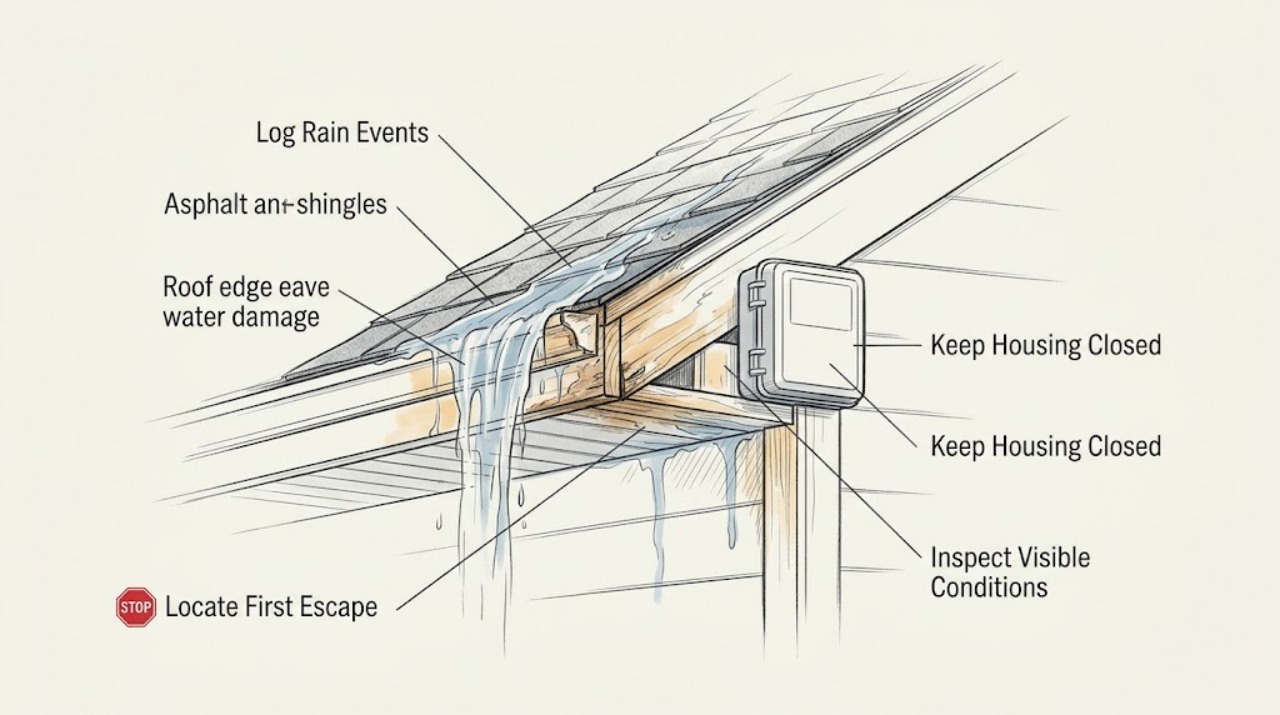
Repeated overflow at a roof edge can damage the fascia, soffit, siding, wall, or interior even when the gutter looks intact between storms. For each safe rain event, record when overflow begins, whether it starts at a valley or upper-roof discharge, the gutter lip or seam, the downspout connection, or the roof edge itself, and where the water lands. From the ground and inside ordinary living areas, look for recurring wet or stained fascia and soffit, swollen trim, damp walls or ceilings, musty odor, and water tracking below the eave. A weak outlet suggests clog or discharge trouble; a clear outlet with a repeated valley or roof-edge origin needs coordinated gutter and roof assessment. Do not climb, walk the roof, run a hose, probe a downspout, or work during a storm. Arrange prompt roofing or gutter service when damage is present or water reaches the interior.
Before you begin
Safety first
- Do not use ladders, climb the roof, hose-test, pressure-wash, probe downspouts, open a ceiling or wall, or work during lightning, high wind, hail, flooding, or unstable conditions.
Work through in order
Diagnostic checks
Use only checks that match the exact appliance or system and its official guide.
-
Check 1
For each safe rain event, record the date, whether rain was light, sustained, or intense, how long it had been raining when overflow began, wind direction, and whether the same roof edge was affected after the rain stopped.
Expected result: Overflow may begin only during intense bursts, after sustained rain, or in every rain. Repeated wetting at the same edge can cause damage even when each event appears brief.
Next step: Keep the timeline and safe photographs for the roofing or gutter professional; do not wait outdoors during lightning, high wind, hail, or flooding.
Stop if: Stop observing for lightning, high wind, hail, falling debris, slippery or undermined ground, or any unsafe position below the roof edge.
Why this matters
Why: A multi-event timeline distinguishes a recurring drainage path from a one-time storm event and shows whether the damage threshold changes with rainfall intensity.
-
Check 2
From stable ground, identify the first visible escape point during each event: a roof valley or upper-roof discharge, gutter lip or middle of a run, seam or end cap, gutter-to-downspout connection, or the roof edge behind the gutter.
Expected result: The same point may spill every time, several points may spill together, or the origin may move as rain intensifies. Water below a valley can arrive faster than water along the rest of the run.
Next step: Take wide and close photographs from ground level and mark the roof plane above the point; do not reach, scrape, lift, or remove any gutter or roof material.
Stop if: Stop if the view requires a ladder, roof access, standing under unstable material, or entry onto flooded or eroded ground.
Why this matters
Why: The first escape point narrows whether to inspect the gutter, downspout, valley, roof edge, or connected flashing. A stain below the eave does not prove that the roof edge is the original source.
-
Check 3
From the ground, look for recurring wetness, streaks, swelling, peeling finish, soft-looking trim, gaps, corrosion, or movement at the fascia, soffit, eave edge, gutter attachment, and nearby siding.
Expected result: Damage may be limited to the gutter face, may follow the fascia or soffit, or may extend along the wall and below the eave. A dry exterior between storms does not rule out trapped moisture or repeated wetting.
Next step: Photograph the damaged eave and note whether the damage aligns with the overflow origin; keep people clear of loose trim and request prompt professional inspection when material is soft or shifting.
Stop if: Stop for loose or falling material, structural movement, exposed wiring, active flooding, or any need for elevated access.
Why this matters
Why: The pattern shows whether the roof-edge assembly is being repeatedly wetted and may need roofing, carpentry, siding, or drainage assessment together. Do not paint or seal over a stain before the water path is understood.
-
Check 4
At ground level, observe the downspout outlet during and after rain and note whether discharge is strong, weak, absent, backing up, or landing against the roof edge, wall, foundation, or lower roof.
Expected result: A weak or absent outlet while the gutter spills supports a clog, disconnected route, or below-grade restriction. Strong discharge with overflow above can shift attention to incoming roof flow, outlet spacing, valley concentration, or gutter capacity.
Next step: Photograph the outlet and where the water lands and ask the professional to inspect the full downspout route; do not probe, hose, or pressure-flush it.
Stop if: Stop if water approaches electrical equipment, enters the building, undermines soil, creates deep pooling, or may be contaminated.
Why this matters
Why: Downspout discharge helps separate a drainage restriction from roof-edge or gutter overload, while repeated discharge against the building can create additional eave and foundation damage.
-
Check 5
From safe interior living areas, look for ceiling or wall stains, bubbling paint, damp trim, peeling finish, musty odor, or water appearing below the affected eave after the same rain events; do not enter the attic or open a ceiling.
Expected result: Interior impact may occur directly below the eave, at a wall corner, around a window or upper roof junction, or not at all. A delayed stain or odor can appear after the exterior has dried.
Next step: Photograph the interior impact, move belongings only from safe dry areas, and request prompt service when water is entering or the area remains damp.
Stop if: Stop and keep clear for a sagging ceiling, wet electrical fixture, active leak near electricity, mold-like contamination, or structural movement.
Why this matters
Why: Interior evidence raises urgency and may require coordinated roof-edge, roofing, wall, and moisture assessment. Water location inside does not always match the entry point above.
-
Check 6
Using only ground-level views, trace the visible roof planes, valleys, dormers, upper roofs, and roof-edge sections that drain toward the damaged eave and note any recent roof addition or gutter alteration.
Expected result: A valley or upper roof can concentrate flow into a short gutter section; a changed addition can redirect water to an edge that was previously adequate. No visible roof defect does not rule out concealed flashing or underlayment damage.
Next step: Sketch the visible drainage path and include it in the service request; do not climb to inspect a valley, flashing, shingle, or roof-edge attachment.
Stop if: Do not climb, walk the roof, lean over an edge, lift roofing, or handle flashing or valley material.
Why this matters
Why: A concentrated catchment or changed roof path may require more than gutter cleaning, while a roof-edge leak can require roofing repair even if downspout flow is normal.
-
Check 7
Prepare a handoff containing the event timeline, first overflow point, gutter and downspout behavior, roof valleys and catchment, fascia and soffit condition, interior impact, recent work, and all safe photographs.
Expected result: A stable gutter overflow with dry interior may start with drainage inspection; recurring wet fascia or soffit, strong outlet flow, or interior stains can require roofing and building-envelope assessment together.
Next step: Arrange qualified roofing or gutter service and ask for the source, safe temporary water-control plan, repair scope, and whether interior moisture assessment is needed.
Stop if: Do not perform ladder, roof, hose, downspout-probing, electrical, structural, or interior opening work as a DIY confirmation.
Why this matters
Why: The handoff lets the professional distinguish gutter maintenance, downspout discharge, roof-edge or flashing failure, valley concentration, and capacity or layout issues before covering damage or replacing sections.
Use your observations
Decision map
Find the observation that best matches what you see, then follow the next safe action.
-
PATH 01Next step
What you see
The same gutter lip, seam, end cap, or outlet spills repeatedly, while the fascia, soffit, and interior remain dry and intact.
Do this next
Request ground-safe gutter inspection and repair before another storm; do not reach or climb to clear it.
Why this path and its safety boundary
Why it matters: A local gutter, joint, slope, clog, or downspout issue is more likely than established roof-edge water damage.
-
PATH 02Next step
What you see
Overflow begins below a valley, upper roof, dormer, or roof-edge transition and repeats with the same catchment.
Do this next
Request coordinated roofing and gutter assessment of the valley, roof edge, receiving run, outlet, and lower-roof protection.
Why this path and its safety boundary
Why it matters: Concentrated flow or a roof-edge or flashing path may be overwhelming or bypassing the receiving gutter.
-
PATH 03Next step
What you see
The fascia or soffit is repeatedly wet, stained, swollen, soft-looking, loose, or separating below the overflow.
Do this next
Arrange prompt roofing and eave inspection and keep people clear of loose material; include the event timeline and photos.
Why this path and its safety boundary
Why it matters: The roof-edge assembly may have repeated water exposure or concealed damage and should not be sealed or painted over.
-
PATH 04Next step
What you see
The gutter spills while the downspout outlet is weak, dry, backing up, or disconnected.
Do this next
Have the full downspout route professionally inspected; do not probe, hose, or pressure-flush it.
Why this path and its safety boundary
Why it matters: A clog or discharge failure can be causing the overflow and may be directing water into the roof edge or foundation.
-
PATH 05Next step
What you see
Water stains, dampness, bubbling finish, musty odor, or active leaking appears inside after the recurring overflow.
Do this next
Keep clear of sagging ceilings and wet electrical fixtures, move belongings only from safe dry areas, and request urgent roofing and moisture assessment.
Why this path and its safety boundary
Why it matters: The drainage event has a building-envelope or interior moisture consequence and should be addressed promptly.
-
PATH 06Next step
What you see
The edge stays dry in lighter rain but repeatedly overflows during intense events from a broad roof area or concentrated valley, with a strong outlet.
Do this next
Ask for a site-specific capacity and layout review instead of repeated cleaning or a guessed section replacement.
Why this path and its safety boundary
Why it matters: The receiving gutter, outlet spacing, downspout route, or roof drainage layout may not handle the catchment under the recurring storm condition.
-
PATH 07Next step
What you see
Confirming the gutter, valley, roof edge, attachment, or concealed moisture would require a ladder, roof access, a hose test, or opening a wall or ceiling.
Do this next
Stop and arrange qualified roofing or gutter service with the repeat-event timeline and ground-level and interior photographs.
Why this path and its safety boundary
Why it matters: The remaining question is beyond safe observation and is not permission for a risky confirmation test.
Helpful context
Understand the symptom
Track the repeated water path
Repeated eave damage is diagnosed by the relationship between rain event, first overflow point, and the wet or stained material below it. Record whether the edge overflows in light rain, after sustained rain, or only during intense bursts. Then identify a valley or upper-roof discharge, gutter lip, seam, end cap, downspout connection, or roof-edge origin from the ground.
Separate drainage from roof-edge damage
Observe the downspout outlet and the fascia, soffit, siding, lower roof, and foundation from safe positions. A weak outlet can indicate a restriction; strong discharge with a repeated valley or broad catchment may point to layout or capacity; recurring wet fascia or interior staining can require roofing and building-envelope work even when the gutter looks clear. GAF notes that clogged gutters can redirect water under roofing and that heavy rainfall commonly exposes roof leaks, so the first visible stain is not necessarily the entry point.
Protect the interior and stay off the roof
Do not climb, walk the roof, hose-test, pressure-wash, probe a downspout, open a ceiling, or work during lightning, high wind, hail, or flooding. Photograph exterior eave damage and safe interior signs, move belongings only from dry areas, and call promptly when water is entering or trim is soft, loose, or shifting.
Safety boundary
Stop conditions
- Do not use a ladder, climb or walk on the roof, lean over an edge, or stand below unstable trim or roof material.
- Do not hose-test, pressure-wash, probe a downspout, remove gutter or roof fasteners, or open a wall or ceiling as a user test.
- Stop for lightning, high wind, hail, slippery or undermined ground, falling debris, active flooding, wet electrical equipment, or a sagging ceiling.
- Keep people clear of contaminated water and damaged or loose material and arrange qualified roofing, gutter, or moisture service.
When checks do not resolve it
Need a professional?
Arrange prompt roofing or gutter service when overflow repeats, fascia or soffit becomes wet or damaged, water reaches a lower roof or foundation, or any stain, dampness, odor, or active leak appears inside.
Safety scope: Do not use ladders, climb the roof, hose-test, pressure-wash, probe downspouts, open a ceiling or wall, or work during lightning, high wind, hail, flooding, or unstable conditions.
Common questions
FAQ
Why can repeated gutter overflow damage the roof edge?
Water can repeatedly wet the fascia, soffit, siding, wall, and roof edge, and may track behind materials even when the gutter dries between storms. The first escape point and the material below it should be documented across events.
How do I tell whether water starts at the gutter or roof edge?
From the ground, watch whether the first escape is over the gutter lip, at a seam or downspout connection, below a valley or upper roof, or behind the roof edge. A stain below the eave alone cannot prove the entry point; ask for coordinated gutter and roofing assessment.
What does a weak downspout outlet mean?
A weak or absent outlet while the gutter spills supports a clog, disconnected route, or discharge restriction. Do not probe or hose it; have the full downspout route and discharge professionally inspected.
When does fascia or soffit damage require prompt service?
Arrange prompt service for recurring wetness, stains, swelling, soft-looking or loose trim, water entering the wall or interior, or damage below a valley or roof transition. Keep people away from loose material and wet electrical fixtures.
Can a clear gutter still be part of a capacity problem?
Yes. If a strong outlet is present but a broad roof area or concentrated valley repeatedly overflows only during intense rain, the receiving run, outlet spacing, downspout route, or roof drainage layout may be inadequate. A professional should review the catchment rather than guess a replacement.
Should I climb up or run a hose to find the leak?
No. Do not climb, walk the roof, hose-test, pressure-wash, probe a downspout, or open a ceiling or wall. Use safe ground-level and interior observations and arrange qualified roofing or gutter service.
Read the exact guide
Official sources
- How to Identify and repair roof leaksGAF · The opened GAF manufacturer page identifies clogged gutters as a cause that can redirect water beneath roofing, describes water stains, damp attic, mold, and dripping as leak signs, and recommends professional roof evaluation.
Community feedback
Share a repair observation
Share a plain-text repair observation. Accepted observations are published automatically; this page may take a moment to update.