
On this page
Start here
Quick answer
Granules in a gutter do not by themselves prove that a roof has reached end of life: a new roof can shed some loose granules, and a storm or foot traffic can remove them locally. The stronger end-of-life pattern is widespread or growing bald areas that expose the shingle surface, combined with brittleness, curling, cracking, missing shingles, leaks, or a roof near the end of its expected service period. Inspect from the ground, attic, and safe accessible areas; do not walk a steep, wet, fragile, or deteriorating roof. Arrange a qualified roof inspection when granule loss is widespread, exposes the shingle mat or asphalt, follows a storm, or appears with leaks or structural signs. Loose granules cannot be restored permanently by brushing them back or applying a cosmetic coating.
Before you begin
Safety first
- The homeowner scope is limited to ground-level or stable-access visual observations, safe attic observations from supported areas, photos, records, and protecting contents from below. Do not climb a steep, wet, fragile, or deteriorating roof, walk near skylights or edges, sweep or pressure-wash shingles, probe decking, nail a tarp through shingles, apply cosmetic granules, or disturb wet electrical equipment.
Work through in order
Diagnostic checks
Use only checks that match the exact appliance or system and its official guide.
-
Check 1
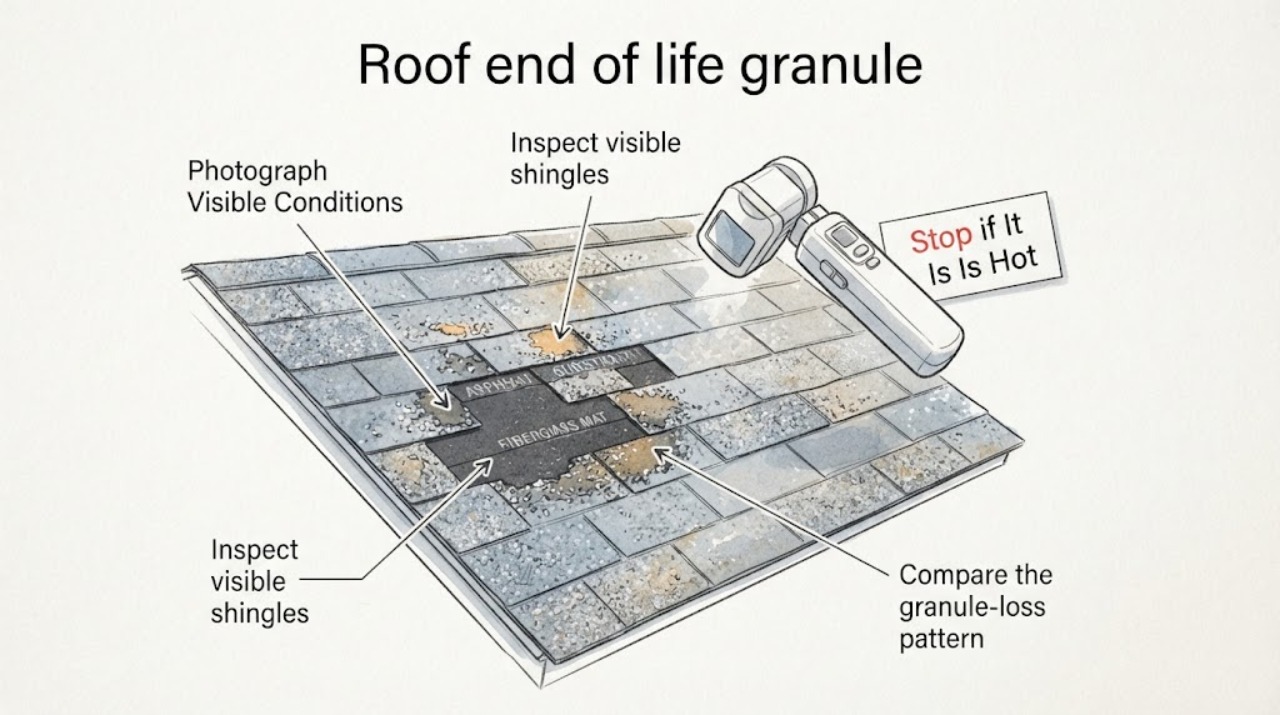
From the ground or another stable location, photograph and map the roof planes where granules are visible in gutters or at downspouts. Use binoculars or optical zoom to compare the visible shingle surface across slopes; do not climb onto the roof to collect a sample.
Expected result: Granule deposits are light and limited to a new installation, concentrated below one small area, or accompanied by broad bald patches and exposed shingle surface across one or more planes.
Next step: Record the roof installation or replacement date if known, the affected planes, and whether the pattern is growing. Arrange a roof inspection for broad loss or exposed surface rather than attempting to brush granules back.
Stop if: Stop if the only way to see the area is to climb a steep, wet, fragile, or deteriorating roof, cross a skylight, or work near overhead utility lines.
Why this matters
Why: Limited early or localized loss does not establish end of life. Widespread loss or exposed surface means the protective coating is compromised and the remaining life needs professional assessment.
-
Check 2
Inspect visible shingles from the ground for curling or cupping edges, cracks, missing or lifted pieces, exposed fiberglass mat or asphalt, brittle-looking surfaces, and failed or damaged flashing around chimneys, skylights, valleys, and roof edges.
Expected result: Granule loss occurs with several other aging signs across a plane; it is limited to a few intact shingles; or the roof shows a missing section, exposed underlayment, open seam, damaged flashing, or sagging.
Next step: Arrange a qualified inspection and provide photos showing the defect pattern. Treat a missing section, open flashing, active leak, or sag as a priority; do not nail, seal, or walk on the surface as a temporary diagnosis.
Stop if: Do not pull shingles, probe the roof, lift flashing, apply cement, or enter a roof area that looks soft, sagging, cracked open, or unsupported.
Why this matters
Why: Multiple age-related defects make a patch-only plan less predictable. A few isolated intact shingles may be repairable, while exposed underlayment, open details, or sagging can allow water entry or indicate a structural concern regardless of granule count.
-
Check 3
Compare the granule-loss pattern with recent weather, maintenance, and roof work. Note whether it appeared after hail, high wind, falling debris, gutter work, chimney work, or anyone walking on the shingles, and whether the roof was recently installed.
Expected result: Loss is concentrated in impact-like spots, follows a work path, began after a storm, is uniform over much of a relatively new roof, or has accumulated gradually on an older roof.
Next step: Save dated photos, storm or work records, and installation documents if available. Ask the inspector to distinguish aging, storm, mechanical, installation, or product-related causes before selecting a repair scope.
Stop if: Do not scrub, sweep, pressure-wash, or walk the shingles to test adhesion; do not add loose granules or use asphalt cement as a permanent restoration.
Why this matters
Why: A storm or mechanical pattern can represent localized or latent damage and should not be mistaken for ordinary aging. Uniform early loss may require manufacturer or installer review. Gradual widespread loss on an older roof is more consistent with weathering and approaching replacement, but an inspection still determines scope.
-
Check 4
From inside the attic or upper-floor rooms, look only from a safe standing point for water stains, damp insulation, daylight, mold or mildew, rusted fasteners, or a musty odor below the affected roof plane. Check after rain if conditions allow, without touching wet electrical equipment.
Expected result: There is active dripping, dampness, staining that is spreading, daylight through the roof assembly, mold, or no interior evidence of leakage.
Next step: For active leakage, protect contents without climbing onto the roof and arrange prompt roof service; document the location and weather. For no interior signs, continue the exterior condition assessment and schedule an inspection if surface loss is widespread.
Stop if: Stop if the attic floor is not clearly supported, insulation or decking is wet or soft, there is mold requiring specialized handling, or water is near electrical equipment.
Why this matters
Why: Interior evidence confirms that water is reaching the building or that a leak investigation is needed, but a dry ceiling does not prove the roof is watertight. Granule loss can precede an obvious interior stain.
-
Check 5
Gather the roof's approximate age, shingle type if known, replacement and repair history, prior leaks, storm dates, and photos from several seasons. Compare the roof condition with the exact product documentation rather than treating a published life range or warranty term as a guarantee.
Expected result: The roof is older with recurring repairs and broad surface wear; it is younger with a localized defect; or its age and material cannot be confirmed.
Next step: Give the history and photos to a qualified roofer for a written condition assessment that states whether localized repair, a plane-level repair, or replacement is appropriate and why.
Stop if: Do not promise a remaining service life, approve a full replacement, or reject a repair based only on age, a warranty number, gutter granules, or one visual spot.
Why this matters
Why: Age is one decision factor, but GAF also identifies damage extent and repair history as relevant. A younger roof with uniform or storm-related loss may need a warranty or installation review; an older roof with broad defects may have little predictable life even without an obvious interior leak.
Use your observations
Decision map
Find the observation that best matches what you see, then follow the next safe action.
-
PATH 01Safety boundary
What you see
The roof is recently installed, granules are mostly in gutters, shingles look fully covered from a safe vantage point, and there are no leaks or other visible defects.
Do this next
Document the condition and ask the installer or inspector to confirm that the amount and pattern are consistent with the installation; monitor gutters and the visible surface over time.
Why this path and its safety boundary
Safety stop: Escalate if bald patches, exposed mat or asphalt, cracking, missing shingles, leaks, or rapidly increasing deposits appear.
-
PATH 02Safety boundary
What you see
Granule loss is widespread or increasing on an older asphalt-shingle roof and appears with bald areas, curling, cracking, brittleness, or repeated repairs.
Do this next
Arrange a comprehensive roof inspection to determine whether the roof has reached the end of predictable service and whether replacement or a limited repair is defensible.
Why this path and its safety boundary
Safety stop: Do not walk the roof, rely on a cosmetic granule application, or delay action because the ceiling is still dry.
-
PATH 03Safety boundary
What you see
Loss is concentrated in round or irregular impact-like areas after hail, high wind, falling debris, or another storm, with otherwise sound surrounding shingles.
Do this next
Document the date and visible pattern and arrange a professional storm-damage assessment that checks surrounding shingles and flashings, not just the most obvious spots.
Why this path and its safety boundary
Safety stop: Do not scrub the roof, walk it to count spots, nail a tarp through intact shingles, or treat loose granules with asphalt cement as a permanent repair.
-
PATH 04Safety boundary
What you see
Granule loss follows a ladder, walkway, chimney, gutter, or other work path, while the rest of the roof has little loss.
Do this next
Have a qualified roofer inspect the mechanically affected shingles and surrounding seal bonds; localized replacement may be possible if the underlayment and adjacent materials are sound.
Why this path and its safety boundary
Safety stop: Do not create more test damage by walking on the roof or attempt to reseal brittle shingles without a professional assessment.
-
PATH 05Safety boundary
What you see
Granule loss occurs with an active leak, exposed underlayment or decking, sagging, open flashing, missing shingles, or water damage inside.
Do this next
Arrange prompt roofing service and protect the interior from below where safe; the inspection should assess both the roof covering and the supporting assembly.
Why this path and its safety boundary
Safety stop: Do not climb onto the roof, enter a soft or wet attic area, use an improvised roof patch, or disturb electrical equipment near water.
-
PATH 06Safety boundary
What you see
The roof is relatively young but loss is uniform across many shingles or planes, or the loss appeared soon after installation without a storm explanation.
Do this next
Request a documented inspection by a qualified roofer and preserve installation, product, and maintenance records so the cause can be evaluated as installation, handling, or product-related rather than assumed to be normal aging.
Why this path and its safety boundary
Safety stop: Do not accept a cosmetic granule treatment or assume the warranty outcome without documenting the surface pattern and obtaining the exact product guidance.
Helpful context
Understand the symptom
Granules are a protective surface, not a cosmetic finish
Mineral granules cover asphalt shingles and help protect the surface from weather and sunlight. Some loose granules can appear after installation or ordinary weathering, so gutter material must be compared with the actual shingle surface. When broad areas are visibly bald or the underlying surface is exposed, the shingle has lost protection and its remaining life is less predictable. A roof's age and overall condition matter more than a single handful of granules.
Find the pattern before assuming end of life
Localized round or irregular patches after hail, a work path from foot traffic, or loss concentrated on one area can point to an event or installation problem rather than uniform aging. Granule loss across many slopes, with curling, cracking, brittleness, exposed mat, or repeated leaks, is more consistent with a roof that needs a comprehensive condition assessment. Do not diagnose the cause from gutter granules alone, and do not use a repair decision rule based only on a warranty label or calendar age.
Keep the inspection below the fall hazard
From the ground, use binoculars or a camera with a zoom lens to look for bare patches, missing or curled shingles, exposed underlayment, and damaged flashing. From inside, look for daylight, damp insulation, staining, mold, or a musty area in the attic, but do not step on suspect decking. OSHA notes that roofing surfaces can be steep, slippery, and deteriorating and that roof work requires planned fall protection; roof access and repairs belong to a trained professional with appropriate equipment.
Only after diagnosis
Potential parts
- matching asphalt shingles
Consider individual shingle replacement only after a qualified inspection finds a localized, repairable defect and confirms that the surrounding shingles, underlayment, flashing, and seal bonds are sound.
Match the exact shingle profile, dimensions, exposure, color, installation method, and roof-plane condition; a visually similar shingle may not integrate or seal correctly. - roof flashing or seal detail
Consider this category only when inspection identifies a damaged or failed flashing detail as the local source of water entry, rather than using sealant to conceal widespread shingle wear.
The repair depends on the roof intersection, existing materials, drainage, and installation details; flashing work should be designed and installed by a qualified roofer. - underlayment or roof-deck repair material
Consider this category only if the roofer finds exposed, wet, deteriorated, or structurally unsound material beneath the shingle surface during a repair or replacement.
Selection depends on the roof assembly, local requirements, moisture condition, and extent of removal; granule loss alone does not identify an underlayment or deck part.
When checks do not resolve it
Need a professional?
Escalate for broad bald areas, exposed mat or asphalt, missing or curled shingles, storm or mechanical damage, repeated leaks, active water entry, sagging, damaged flashing, or a roof whose age and repair history suggest little predictable remaining life.
Safety scope: The homeowner scope is limited to ground-level or stable-access visual observations, safe attic observations from supported areas, photos, records, and protecting contents from below. Do not climb a steep, wet, fragile, or deteriorating roof, walk near skylights or edges, sweep or pressure-wash shingles, probe decking, nail a tarp through shingles, apply cosmetic granules, or disturb wet electrical equipment.
Have this ready
- Provide the approximate installation date, shingle type and product records if known, photos from the ground and attic, gutter-granule pattern, affected roof planes, recent storm or roof work, prior repairs and leaks, and whether the interior has stains, dampness, mold, or daylight.
Common questions
FAQ
Do granules in the gutter mean the roof needs replacement?
Not necessarily. Some loose material can occur after installation or ordinary weathering. Concern rises when deposits are increasing and the shingles show broad bald areas, exposed surface, curling, cracking, brittleness, missing material, leaks, or repeated repairs. Have the roof assessed from a safe vantage point before deciding.
What does widespread granule loss do to asphalt shingles?
It removes part of the protective surface, leaving the asphalt or shingle mat more exposed to weather and sunlight and making remaining life less predictable. Granule loss alone does not identify the exact cause, so the pattern and other roof defects need inspection.
Can I put loose granules back on the roof?
No. Adding loose granules with asphalt cement is not a permanent repair for damaged shingles. A qualified roofer should determine whether the affected shingle, roof plane, flashing, or entire roof system needs repair or replacement.
How can I inspect for granule loss without climbing the roof?
Use ground-level photos or binoculars to compare roof planes and look at gutters and downspouts. From a safe standing point inside, look for stains, dampness, mold, daylight, or damaged decking. Do not walk a steep, wet, brittle, or deteriorating roof; roof access requires appropriate fall protection and training.
When is granule loss a sign that the roof is at end of life?
It is more concerning when loss is widespread or growing on an older roof and appears with bald areas, curling, cracks, brittleness, recurring repairs, or leaks. A professional inspection should combine age, damage extent, repair history, roof-plane condition, and interior evidence rather than relying on gutter granules or age alone.
Read the exact guide
Official sources
- Understanding Residential Roof Repairs: How Do I Know if my Roof Needs to be Replaced?GAF · GAF homeowner guidance; material life, repairability, and inspection findings vary by roof system, climate, installation, and condition.
- TAB-R-126 Replacement Of Storm Damaged ShinglesGAF Technical Services · GAF technical bulletin focused on GAF shingles and storm damage; it is used here for the general mechanism and repair boundary, not to infer a particular roof product or warranty outcome.
- Roof Inspection, Tarping, and RepairOccupational Safety and Health Administration · OSHA guidance addresses trained workers and construction or recovery work; it supports the safety boundary that homeowners should not access hazardous roof surfaces without appropriate training and protection.
Community feedback
Share a repair observation
Share a plain-text repair observation. Accepted observations are published automatically; this page may take a moment to update.