
On this page
Start here
Quick answer
A roof with widespread missing, cracked, curled, brittle, or granule-shedding covering, recurring leaks, sagging, or decay is not a good candidate for patch-by-patch guessing. Start from the ground and from safe interior areas: document the roof age and repair history, photograph each damaged slope, check the attic and ceilings for moisture or structural signs, and keep people away from sagging or unsound areas. GAF identifies extensive damage, recurring or widespread leaks, severe storm damage, sagging, and end-of-life shingle condition as reasons to consult a roofing professional about replacement. Do not climb a questionable roof, walk on wet or deteriorated sheathing, remove shingles, or attempt a DIY tarp or structural repair. A qualified roofer or structural professional should determine whether the roof needs localized repair, a full replacement, deck or framing work, or urgent temporary protection.
Before you begin
Safety first
- This article supports ground-level and safe interior observation, documentation, keeping people clear, and protecting belongings from interior drips. It does not authorize roof or ladder work, attic entry into unsafe areas, shingle or deck removal, structural shoring, tarp installation, roof-anchor work, or material selection as a substitute for professional assessment.
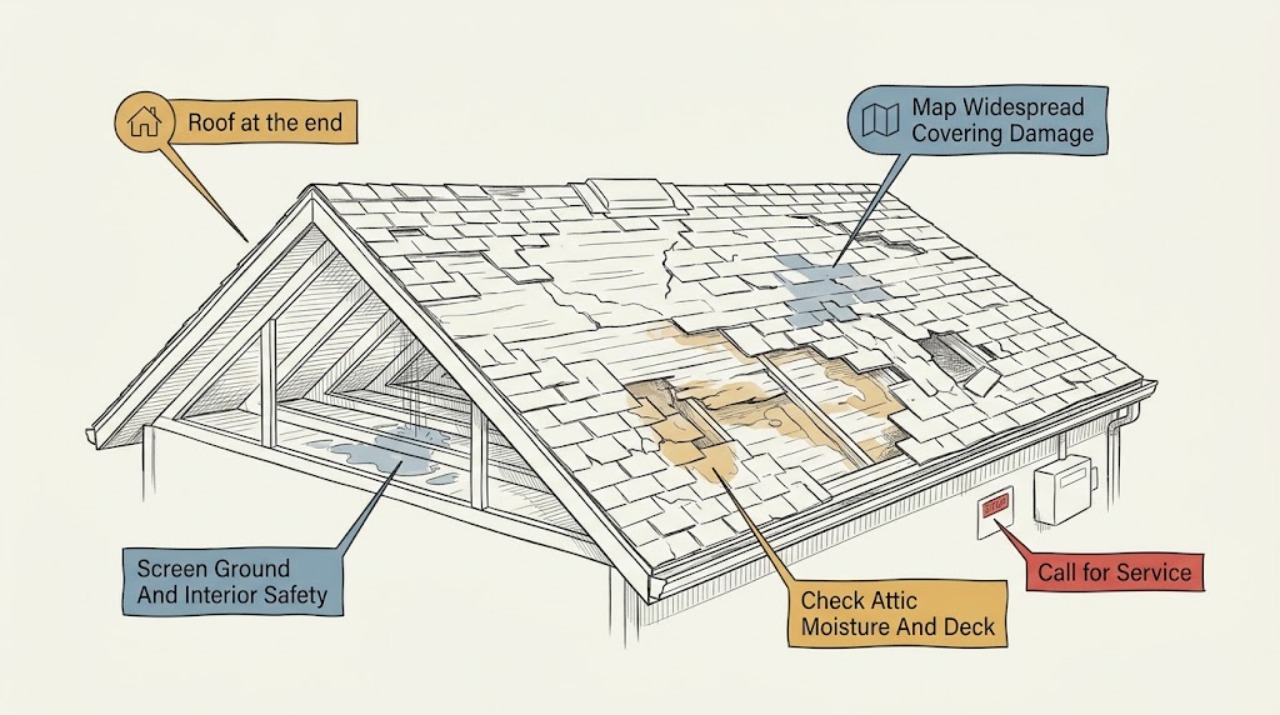
Work through in order
Diagnostic checks
Use only checks that match the exact appliance or system and its official guide.
-
Check 1
From the ground or another stable location, look at the roofline, eaves, gutters, and visible slopes; inside, look only from safe floors or an accessible attic area for daylight, active dripping, ceiling stains, wet insulation, sagging, or visibly compromised wood. Keep people and pets away from areas below loose material or a sagging roof.
Expected result: Record no apparent structural change, broad surface damage, an active interior leak, a sagging roofline or ceiling, daylight through the roof deck, wet or rotted wood, or a roof area that looks unsafe to approach.
Next step: Use the safety branch that matches the strongest observation. Photograph conditions from a safe position and arrange a roofer or structural professional; leave an affected room or area if falling material or structural movement is possible.
Stop if: Do not climb, enter a visibly compromised attic, step on soft decking, touch hanging material, or stand below a sagging or actively shedding roof section.
Why this matters
Why: A sagging roofline or ceiling, daylight through decking, wet insulation, or rotting wood raises concern beyond replaceable surface covering and may require urgent structural and water-entry assessment. Broad surface damage without interior or structural signs still warrants a professional replacement evaluation when the pattern is widespread.
-
Check 2
Using ground-level photos or binoculars, map damage by roof slope and note missing, buckled, curled, cracked, brittle, torn, or visibly bare shingle areas; look on the ground and in gutters for abnormal granule accumulation. Check visible flashing, roof penetrations, and open seams without touching them.
Expected result: Record whether damage is isolated to one location, repeated across several slopes, concentrated around penetrations or edges, or widespread across most of the visible roof; record granule loss and recurring leak locations separately.
Next step: Give the slope map and photos to a qualified roofer and ask for a written assessment that distinguishes surface repair, concealed-layer repair, and replacement. Do not remove shingles or rely on an estimate based only on a quick visual from the ground.
Stop if: Do not climb onto the roof, walk on loose or brittle covering, pull out nails, probe open seams, or apply sealant as a substitute for inspection.
Why this matters
Why: A small isolated defect on an otherwise sound covering may be a repair discussion, but repeated or widespread covering failure, severe storm damage, excessive granule loss, or recurring leaks makes a full replacement assessment more likely. Damage concentrated at a flashing or penetration may still require concealed underlayment or deck inspection before a repair scope is chosen.
-
Check 3
From a safe attic access point, inspect only visible surfaces for water stains, dark spots, mold or mildew, wet insulation, warped or rotted wood, daylight, or sagging sheathing. Check ceilings and upper walls below the roof for stains or peeling paint, and note whether signs follow rain or persist in dry weather.
Expected result: Record dry and sound-looking surfaces, isolated moisture near a penetration, multiple wet areas, persistent dampness or mold, soft or warped sheathing, or a ceiling/attic area that cannot be safely accessed.
Next step: Photograph and date the findings, protect belongings from active drips without climbing or opening the roof, and arrange a roofing inspection that includes underlayment, flashing, decking, and attic moisture causes. Treat unsafe or contaminated areas as professional-only access.
Stop if: Do not step between attic framing, touch mold or saturated insulation without appropriate protection, cut the deck, disturb electrical wiring, or enter an attic with structural movement or unsafe heat or air quality.
Why this matters
Why: Multiple wet areas, warped or rotting wood, wet insulation, or persistent dampness can indicate water intrusion or ventilation problems affecting the roof assembly, not just one visible shingle. A ceiling stain can appear away from the entry point, so its location alone does not identify the failed flashing or slope.
-
Check 4
Collect the roof installation or inspection record if available, previous repair invoices, leak dates, material type, and recent wind, hail, ice, or heavy-rain events. Match the history to the slope map and interior observations rather than treating age as the only measure of end of life.
Expected result: Record a known or estimated installation date, repeated repairs in the same areas, a recent severe-weather event, changes in leak frequency, or no reliable age record.
Next step: Give the timeline and records to the roofer and, when storm damage is involved, document conditions before cleanup or disposal. Ask the professional to state what evidence supports repair, partial replacement, full replacement, or structural referral.
Stop if: Do not sign off on a roof's safety, remove evidence, or approve a structural repair scope from age or insurance paperwork alone.
Why this matters
Why: An older roof with extensive or recurring damage is a stronger replacement candidate than an older roof with one isolated, well-defined defect. A recent storm may have added localized damage to an already aging roof, while widespread age-related deterioration can make repeated patches short-lived; the material and concealed layers still require professional assessment.
-
Check 5
Arrange a qualified roofing inspection when damage spans multiple slopes, leaks recur, the roofline or deck sags, materials are at the end of their useful life, or the inspection would require roof access. Provide photos, the damage map, age and repair history, attic findings, and any storm date.
Expected result: The professional assessment should identify the condition of the covering, flashing, underlayment, deck, framing, drainage, and attic moisture or ventilation, and state whether repair, partial replacement, full replacement, or structural evaluation is appropriate.
Next step: Obtain a written scope that identifies damaged layers, temporary water protection, required permits or inspections, disposal, ventilation and flashing details, and post-work verification. Keep the roof off limits until the professional confirms safe access.
Stop if: Do not climb, tarp, reroof, shore, cut, or alter the roof structure yourself; do not allow work to begin without a site-specific fall and structural-safety plan.
Why this matters
Why: Widespread covering failure plus recurring leaks or concealed moisture makes replacement and hidden-material work more likely than a single patch. A sound deck with localized defects may support repair, while sagging, rot, or unstable framing changes the job to structural and safety planning.
Use your observations
Decision map
Find the observation that best matches what you see, then follow the next safe action.
-
PATH 01Safety boundary
What you see
Ground-level inspection shows missing, curled, cracked, brittle, or granule-shedding covering across several slopes, but no visible sagging, daylight, active leak, or wet attic material.
Do this next
Arrange a qualified roofing inspection and request a written repair-versus-replacement scope that includes flashing, underlayment, decking, ventilation, and drainage.
Why this path and its safety boundary
Why it matters: The roof covering may be broadly at the end of its useful life even if the deck and framing appear stable. A replacement assessment is more appropriate than selecting isolated patches by appearance.
Safety stop: Do not climb to confirm the surface, walk on brittle shingles, or assume hidden layers are sound because the attic is currently dry.
-
PATH 02Safety boundary
What you see
Leaks recur in several places or after ordinary rain, with wet insulation, stains, mold or mildew, warped wood, or multiple dark areas in the attic.
Do this next
Protect belongings and document the moisture from safe interior locations, then arrange a roofing and moisture assessment promptly; include an attic or structural referral if wood is warped, soft, or rotted.
Why this path and its safety boundary
Why it matters: Water intrusion may involve more than one roof slope or penetration and may have affected underlayment, decking, insulation, or framing. A ceiling stain is not a reliable map of the entry point.
Safety stop: Do not enter an unsafe attic, remove wet insulation, cut the deck, or seal a ceiling stain without finding and correcting the roof assembly problem.
-
PATH 03Safety boundary
What you see
The roofline, ceiling, deck, or framing sags, appears soft or rotted, shows new movement, or has daylight through damaged sheathing.
Do this next
Keep people and pets out from below and away from the affected area, avoid roof and attic access, and arrange urgent roofing and structural evaluation. Use only professional temporary protection if the building is exposed to weather.
Why this path and its safety boundary
Why it matters: The roof may have lost structural integrity in addition to weatherproofing. Walking or storing materials on it can increase collapse and fall risk.
Safety stop: Do not climb, probe, shore, cut, tarp, or load the roof yourself; leave an area if material is falling or movement is worsening.
-
PATH 04Safety boundary
What you see
A wind, hail, ice, or heavy-rain event is followed by missing or torn covering, exposed areas, damaged flashing, new leaks, or widespread granule loss on an already aging roof.
Do this next
Photograph conditions from the ground and safe interior locations before cleanup, prevent further interior damage without climbing, and ask a qualified roofer to assess the full assembly and temporary weather protection.
Why this path and its safety boundary
Why it matters: The event may have caused new damage across an already weathered assembly. A roof that was near end of life may need broader replacement or concealed-layer evaluation rather than a storm patch alone.
Safety stop: Do not climb after a storm, remove damaged materials, use a ladder against unstable eaves, or allow unprotected openings to be approached by occupants.
-
PATH 05Safety boundary
What you see
The roof shows aging or damage and the attic also has persistent dampness, mold, wet insulation, or inadequate-looking ventilation, even when a single active leak is not obvious.
Do this next
Ask the roofer or building-performance professional to assess roof weatherproofing, air sealing, insulation, ventilation, and wood condition as one moisture path; prioritize active water entry and unsafe materials.
Why this path and its safety boundary
Why it matters: Moisture may be entering through roof defects, flashing, or indoor air leakage and may be accelerating deterioration of insulation, sheathing, and framing. Ventilation changes alone do not repair a failed roof covering.
Safety stop: Do not block or add vents, vent household exhaust into the attic, disturb moldy material, or replace shingles without addressing the moisture source and safety conditions.
Helpful context
Understand the symptom
Widespread damage changes the repair question
A single loose shingle or isolated flashing defect may be repairable on a sound roof, but a broad pattern of missing, curled, brittle, cracked, or granule-shed covering means the weathering layer may be failing across more than one location. Recurring leaks, sagging, or visible decay can also involve underlayment, decking, or framing. Roof age is useful context, not a stand-alone verdict: material, installation, weather, and maintenance affect service life.
Inspect without creating a fall or collapse hazard
Begin from the ground with binoculars or a camera and from safe attic and ceiling locations. Do not climb onto a roof that appears unsound, wet, steep, damaged, or unfamiliar, and do not step on questionable attic framing or sheathing. OSHA notes that roof repair workers face increased risk when roof integrity is uncertain and that structural integrity and fall protection must be evaluated before work begins.
Replacement planning should include the layers below the shingles
A replacement assessment should account for the roof covering, flashing and penetrations, underlayment, deck condition, drainage, and attic moisture and ventilation. DOE notes that moisture can warp or damage a roof, wet insulation, and wood, while GAF describes roof installation as including inspection, hidden deck repairs, underlayment, flashing, and ventilation details. Let a qualified roofer determine the scope instead of selecting materials or a patch area from a street view.
Safety boundary
Stop conditions
- Do not climb or work on a roof that is wet, steep, damaged, brittle, sagging, structurally uncertain, or near unprotected openings, skylights, electrical lines, or severe weather.
- Do not enter a questionable attic, walk on soft sheathing, probe rot, remove wet insulation, shore framing, cut the deck, or install a roof anchor or fall-protection system yourself.
- Do not patch widespread failure by guessing at shingles, flashing, underlayment, sealant, or decking; the concealed layers and drainage need a qualified roof assessment.
- Keep occupants away from falling debris, active structural movement, and rooms below a sagging or leaking roof; use professional temporary weather protection for exposed areas.
- Arrange qualified roofing service when damage is widespread, leaks recur, the roof is at the end of its useful life, or the inspection would require roof access. Add structural or emergency help for collapse, severe sagging, smoke, or unsafe conditions.
Only after diagnosis
Potential parts
- roof underlayment or water-resistant membrane
Consider this category only if a qualified roofer finds failed or missing underlayment during a repair or replacement assessment.
The roof slope, covering, climate, code requirements, penetrations, and manufacturer's installation instructions must be confirmed before selection. - roof decking or sheathing
Consider this category only where an inspection confirms that moisture, rot, impact, or structural deterioration has damaged the supporting deck.
Thickness, span, fastening, framing, load path, and code compliance must be determined by the qualified roofer or structural professional; do not cut or replace deck material yourself. - roof flashing and penetration weatherproofing
Consider this category only when the inspection traces water entry or deterioration to flashing, valleys, edges, or roof penetrations.
The flashing design must match the roof material, slope, penetration, drainage, and local installation requirements; a bead of sealant is not a universal substitute.
When checks do not resolve it
Need a professional?
Arrange a qualified roofing inspection when missing, curled, cracked, brittle, or granule-shedding covering spans several slopes, leaks recur, the roof is at the end of its useful life, or attic and ceiling evidence suggests concealed moisture. Request urgent roofing and structural evaluation for sagging, soft or rotted decking, daylight through damaged sheathing, active interior water, or storm damage that makes access unsafe. Do not climb a questionable roof or attempt a DIY tarp, structural repair, or replacement.
Safety scope: This article supports ground-level and safe interior observation, documentation, keeping people clear, and protecting belongings from interior drips. It does not authorize roof or ladder work, attic entry into unsafe areas, shingle or deck removal, structural shoring, tarp installation, roof-anchor work, or material selection as a substitute for professional assessment.
Common questions
FAQ
Does widespread shingle damage mean the whole roof must be replaced?
Not automatically, but it changes the decision from a simple patch to a full roof-system assessment. Widespread covering failure, recurring leaks, severe storm damage, sagging, or end-of-life shingles are reasons to ask a qualified roofer whether replacement is safer and more durable than repeated repairs. The deck, underlayment, flashing, drainage, and attic condition still determine the scope.
Can I inspect an aging damaged roof by climbing up with a ladder?
Use ground-level viewing or a qualified inspector instead when the roof is wet, steep, brittle, sagging, structurally uncertain, or affected by a storm. OSHA notes that uncertain roof integrity increases repair hazards and requires structural and fall-protection planning before work; a ladder does not make a damaged roof safe.
What attic signs suggest the damage is more than shingles?
Wet insulation, water stains, mold or mildew, dark spots, daylight, warped or rotted wood, sagging sheathing, and recurring moisture suggest that underlayment, flashing, decking, framing, ventilation, or air-sealing conditions may be involved. Photograph from a safe location and have the roof assembly assessed rather than cutting or probing it.
What can I do before a roofer arrives if the roof is leaking?
Keep people and belongings away from the affected area, catch or redirect interior drips only from a safe floor, document the damage, and arrange professional temporary weather protection. Do not climb onto the roof, install a tarp, remove shingles, or use sealant as a substitute for a safe inspection.
Should roof replacement include the attic and ventilation?
The replacement assessment should consider the complete assembly, including deck, underlayment, flashing, drainage, insulation, air sealing, and ventilation. DOE explains that moisture and poor ventilation can damage insulation and wood, while GAF describes underlayment, flashing, and ventilation as part of a roof installation scope.
Read the exact guide
Official sources
- How to Identify Roof Damage and What to Look ForGAF · GAF homeowner roof-damage guidance; it does not replace a professional roof or structural inspection and does not authorize climbing a damaged roof.
- Guide to Durable AtticsU.S. Department of Energy, Energy Efficiency and Renewable Energy · DOE residential attic moisture guidance; it is a general building-science guide and does not replace a roof-specific or structural inspection.
- Reducing Falls During Residential Construction: Roof RepairU.S. Department of Labor, Occupational Safety and Health Administration · OSHA safety guidance for workers and employers; homeowners should not treat construction fall-protection equipment as authorization to climb or repair an unsafe roof.
- Residential Roofing FAQsGAF · GAF manufacturer homeowner guidance; material life and repair or replacement decisions remain dependent on the installed roof, local conditions, and professional inspection.
Community feedback
Share a repair observation
Share a plain-text repair observation. Accepted observations are published automatically; this page may take a moment to update.