
On this page
Start here
Quick answer
A musty attic odor with condensation usually means moisture is reaching cold roof materials faster than the assembly can dry. First determine whether the moisture is widespread condensation or a localized roof leak, then check for indoor exhaust discharged into the attic, blocked soffit or ridge airflow, and high indoor humidity. Drying or deodorizing the attic without correcting the moisture path will not solve the problem.
Before you begin
Safety first
- A professional should assess roof access, structural damage, extensive mold, hidden moisture, and any change to the roof or attic assembly.
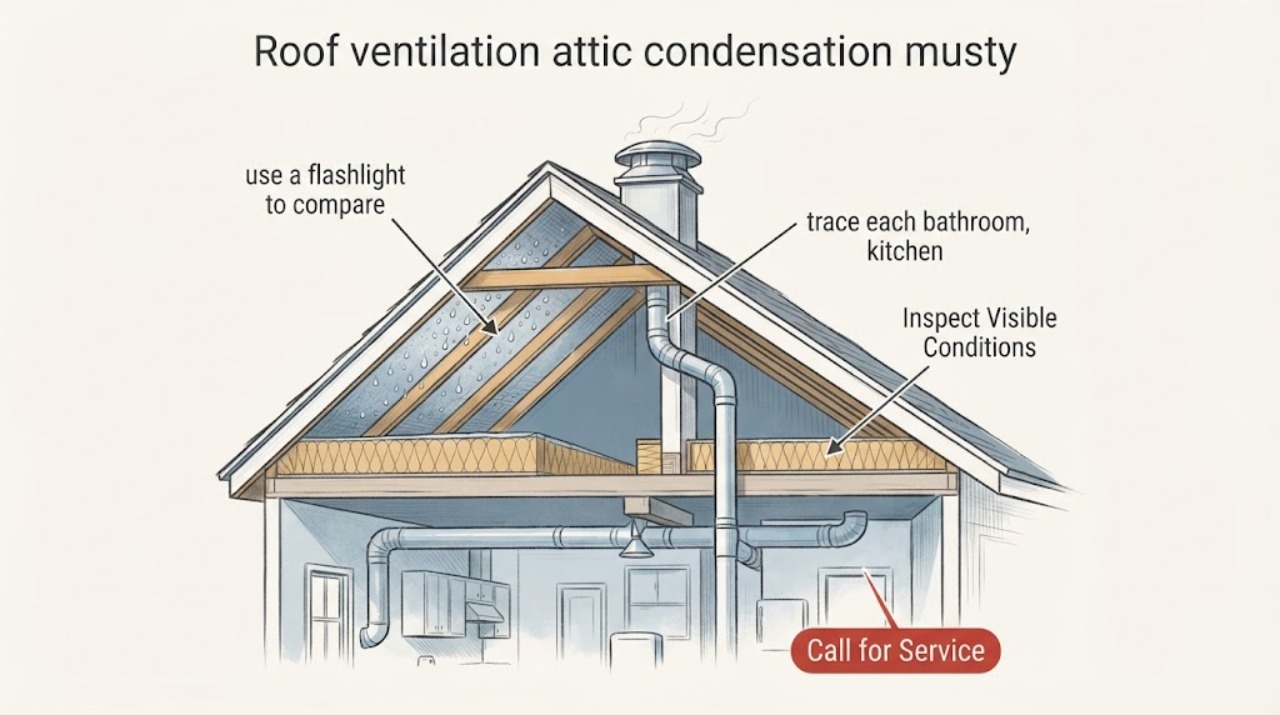
Work through in order
Diagnostic checks
Use only checks that match the exact appliance or system and its official guide.
-
Check 1
From the attic access or another safe viewpoint, use a flashlight to compare the roof deck, rafters, fasteners, and insulation across several visible areas. Do not step on ceiling drywall or loose insulation.
Expected result: Condensation or frost appears broadly across many bays, or the dampness is limited to one penetration, eave, or roof section.
Next step: Record the locations and timing, then use the weather and exhaust checks below to separate condensation from bulk water. Stop and arrange an inspection if framing is soft, insulation is saturated, or the area cannot be reached safely.
Why this matters
Why: Broad dampness is more consistent with a moisture and drying problem; one concentrated wet or stained area makes a roof leak, flashing issue, or local airflow obstruction more likely.
-
Check 2
From a safe attic viewpoint, trace each bathroom, kitchen, and clothes-dryer exhaust duct as far as visible, and check the exterior termination from ground level when possible. Do not climb onto the roof for this check.
Expected result: A duct ends in the attic, is disconnected or crushed, or its outside termination is blocked; alternatively, every visible duct reaches outdoors and is intact.
Next step: Do not keep using an exhaust fan that discharges into the attic; have the duct routed and terminated outdoors by a qualified professional. If the routes are intact, continue with the ventilation and humidity checks.
Why this matters
Why: An attic termination or failed duct can add warm, wet air directly where condensation and musty odor develop. A clear outdoor route makes that particular source less likely, but does not rule out other moisture paths.
-
Check 3
Inspect visible soffit intakes, rafter spaces, and ridge or other high vents without moving across the attic. Look for insulation blocking the eaves, missing air channels, debris, or a path that is closed at one end.
Expected result: The intake is blocked or there is no continuous low-to-high air path; or the intake, rafter channels, and exhaust openings appear clear.
Next step: Do not add a fan or cut new openings as a first response. Have a roofing or building-performance professional verify the assembly, baffles, insulation clearances, and climate-appropriate intake and exhaust balance before changing it.
Why this matters
Why: A blocked or incomplete path can leave humid attic air at cold roof surfaces and reduce drying. A clear path makes a major ventilation obstruction less likely, although air leakage from the home or a roof leak can still create moisture.
-
Check 4
Measure relative humidity in the living space with a humidity meter, and note whether the odor or visible moisture changes after showers, cooking, laundry, or prolonged cold weather.
Expected result: Indoor humidity stays at or above 60 percent, or condensation increases after moisture-producing activities; or humidity is lower and the attic remains wet independently of those activities.
Next step: Vent moisture-producing rooms outdoors, use a dehumidifier when appropriate, and arrange an air-sealing or moisture assessment if the level stays high. Do not use humidity reduction as a substitute for repairing a leak or wet insulation.
Why this matters
Why: Sustained high humidity or activity-linked changes support an indoor moisture and air-leakage contribution. Persistent wetness despite lower indoor humidity raises the priority of checking for a roof leak, duct defect, or hidden moisture.
-
Check 5
Compare the damp pattern with weather: inspect the same visible areas after rain and during a cold spell, and look for water marks near flashing, chimneys, roof penetrations, valleys, or the eaves.
Expected result: A localized mark becomes wet after rain, or broad droplets and frost appear during cold weather without a rain correlation.
Next step: For a rain-correlated area, arrange a qualified roof and flashing inspection before repairing interior finishes. For broad cold-weather condensation, prioritize indoor air sealing, exhaust routing, humidity control, and a review of the ventilation assembly.
Why this matters
Why: Rain-correlated localized wetness points toward bulk water entry; broad cold-weather droplets without a rain pattern are more consistent with condensation. Both conditions can coexist.
Use your observations
Decision map
Find the observation that best matches what you see, then follow the next safe action.
-
PATH 01Next step
What you see
Condensation or frost is widespread during cold weather, indoor humidity is high or rises after showers and cooking, and no single rain-wet location stands out.
Do this next
Correct indoor exhaust routing and ceiling-plane air leaks, control humidity, and have the intake, baffles, and exhaust path reviewed before adding or changing vents.
Why this path and its safety boundary
Why it matters: Warm, moist indoor air entering a cold attic is more likely than one isolated roof defect. The odor may persist because insulation or roof materials have stayed damp.
-
PATH 02Next step
What you see
One roof section, penetration, or eave is stained or wet after rain, while the rest of the attic is comparatively dry.
Do this next
Arrange a qualified roof inspection and protect interior finishes from further water. Do not walk the roof or apply a sealant based only on an attic view.
Why this path and its safety boundary
Why it matters: Localized bulk water entry is more likely than a ventilation-wide problem; flashing, shingles, gutters, or an opening around a penetration need inspection.
-
PATH 03Next step
What you see
The roof deck is not visibly wet, but the musty odor is strongest near an HVAC return or supply path, or visible growth is near an air intake.
Do this next
Do not disturb suspected hidden growth. If the HVAC system may be contaminated, stop operating it until an experienced professional assesses the system and moisture source.
Why this path and its safety boundary
Why it matters: Hidden moisture or contamination in roof materials, nearby cavities, or ductwork becomes more plausible than a simple odor trapped in the attic.
-
PATH 04Next step
What you see
Wet insulation, visible mold, or a moldy odor remains after the moisture source is addressed, especially when the affected area is extensive or anyone has health concerns.
Do this next
Stop DIY cleanup and use an experienced mold or water-damage professional. EPA guidance uses about 10 square feet as a point at which a larger problem should be referred for professional guidance.
Why this path and its safety boundary
Why it matters: Drying and source correction have not yet established a clean, dry assembly. Porous insulation may not be recoverable by surface cleaning alone.
Helpful context
Understand the symptom
Why the odor and condensation often appear together
A musty smell is a clue that damp materials or biological growth may be present, not proof that a roof vent itself is defective. In a cold season, warm indoor air leaking through ceiling penetrations can condense on a cold roof deck, nails, or framing. Moisture can also come from rain entering at flashing or from a bathroom, kitchen, or dryer duct that ends in the attic. The correct repair depends on which pattern you find.
Start from a safe viewpoint
Use the attic access opening and a flashlight. Do not step on ceiling drywall, move across loose insulation, or work on the roof as part of these checks. If the space is tight, wet, visibly moldy, or difficult to enter safely, document what can be seen from the opening and arrange an inspection.
What a lasting repair usually involves
The moisture source has to be controlled before odor treatment is useful. Depending on the evidence, that may mean correcting a roof or flashing defect, routing every moisture-producing exhaust to the outdoors, restoring a clear intake-and-exhaust path, sealing air leaks at the ceiling plane, or correcting indoor humidity. Roof and attic assemblies vary by climate and construction, so a qualified roofing or building-performance professional should design changes that alter the assembly.
Safety boundary
Stop conditions
- Stop and arrange professional help if the attic cannot be entered without stepping on ceiling drywall or unstable surfaces, or if roof work would require climbing.
- Stop and arrange a qualified roof or building-performance inspection when framing is soft, insulation is saturated, water enters during rain, or the moisture source is not clear.
- Do not disturb widespread or hidden mold. Use an experienced remediation professional for extensive growth, contaminated water, suspected HVAC contamination, or health concerns.
When checks do not resolve it
Need a professional?
Safety scope: A professional should assess roof access, structural damage, extensive mold, hidden moisture, and any change to the roof or attic assembly.
Common questions
FAQ
Can better attic ventilation alone remove a musty odor?
Usually not. Ventilation may support drying, but the odor returns if rain enters, an exhaust duct adds moisture, air leaks from the home, or wet porous materials remain. Find and correct the moisture path first.
How can I tell attic condensation from a roof leak?
A broad pattern of droplets or frost during cold weather points more toward condensation, especially with high indoor humidity. A single stained or wet area that follows rain points more toward bulk water entry. A professional inspection may be needed when both patterns overlap.
Should I paint over attic mold or use a deodorizer?
No. Fix the moisture problem and dry the materials first; painting over moldy surfaces can fail, and deodorizing does not remove the cause. Extensive, hidden, contaminated, or health-sensitive mold should be assessed by an experienced professional.
Is an attic fan the first fix for condensation?
Not necessarily. Adding a fan without correcting indoor air leakage, exhaust routing, roof leaks, or the intended intake and exhaust design can leave the main moisture source unchanged. Have the assembly reviewed before adding or changing mechanical ventilation.
Read the exact guide
Official sources
- A Brief Guide to Mold, Moisture and Your HomeU.S. Environmental Protection Agency · Musty attic odor, visible or hidden mold, wet insulation, and moisture remediation
- Mold Cleanup in Your HomeU.S. Environmental Protection Agency · Attic mold or musty odor after condensation or water intrusion
- Guide to Home VentilationU.S. Department of Energy · Residential attic condensation caused by warm moist air and ventilation paths
- Addressing Indoor Environmental Concerns During RemodelingU.S. Environmental Protection Agency · Residential roof and attic moisture paths where climate and assembly affect the remedy
- Consumer Guide to Durable AtticsU.S. Department of Energy · Residential attics with condensation, moisture intrusion, or musty odor
- What are the main ways to control moisture in your home?U.S. Environmental Protection Agency · Indoor moisture contributing to attic condensation and musty odor
Community feedback
Share a repair observation
Share a plain-text repair observation. Accepted observations are published automatically; this page may take a moment to update.