
On this page
Start here
Quick answer
Condensation near a soffit vent can result from a blocked intake path, warm moist air leaking from the home, an exhaust duct terminating in the attic, or a roof leak. From a safe ground-level or normal standing position, document where and when the moisture appears and look for visible soffit blockage or damage; do not enter the attic, climb onto the roof, use a ladder, remove a soffit, or disturb insulation. If moisture is active, the ceiling is damaged, or the cause is not clear after these observations, arrange a roofing or home-performance inspection.
Before you begin
Safety first
- Do not enter the attic, climb onto the roof, use a ladder to reach the soffit, remove soffit panels or insulation, cut the ceiling, disconnect or reroute ducts, handle suspected mold or wildlife, or add a powered attic fan as a test.
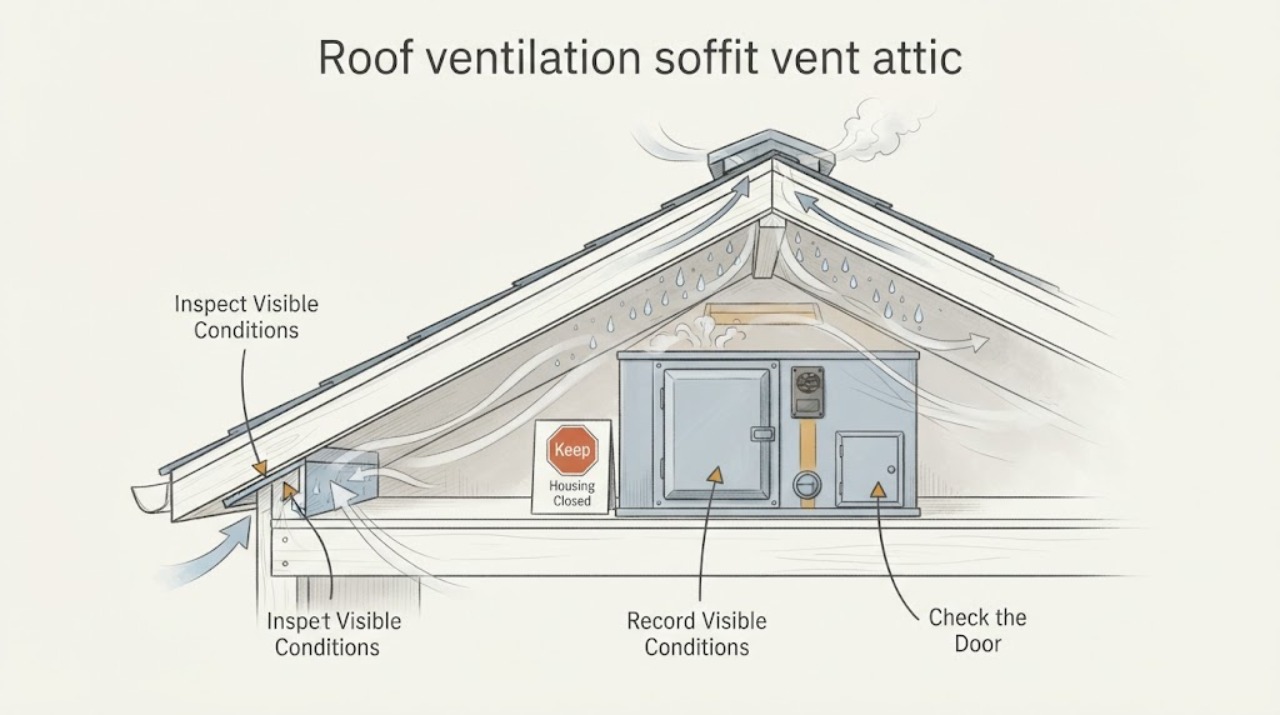
Work through in order
Diagnostic checks
Use only checks that match the exact appliance or system and its official guide.
-
Check 1
From inside the home at a normal standing position, and from the ground outside if visible, record exactly where the moisture is seen and when it appears. Note whether it is frost, droplets, a stain, peeling paint, or a damp-looking area; note recent rain, a cold snap, and whether it is limited to one eave or repeats along several eaves.
Expected result: Moisture that appears only after rain and stays near one roof area differs from frost or droplets that recur on several cold eaves.
Next step: Photograph the location from a safe position and continue to the exterior soffit and indoor-moisture checks below. Give the timing and weather pattern to the professional if an inspection is needed.
Stop if: Stop observing and arrange prompt professional help for active dripping, a growing ceiling stain, sagging drywall, or water near a light, outlet, or other electrical equipment.
Why this matters
Why: A rain-linked, localized pattern keeps a roof or flashing leak in the differential; a cold-weather, repeated-eave pattern is more consistent with condensation or a ventilation/air-leakage condition, but neither observation proves the cause.
-
Check 2
Without a ladder, roof access, or removing any trim, view the soffit/eave intake from the ground or another ordinary standing position. Look for a continuous row of vent openings, visible paint or debris across the openings, nesting, a missing or bent screen, or a section that is visibly covered.
Expected result: The openings may look clear, partly blocked, fully covered, or physically damaged; some vents will not be visible from the ground.
Next step: Photograph the exterior view and describe which eave section is affected. Do not scrape, drill, pry, remove the screen, or push material into the opening; request an inspection if the intake cannot be judged safely.
Stop if: Stop if the only view requires a ladder, roof access, reaching over an edge, or handling wildlife, damaged material, or loose debris.
Why this matters
Why: Visible blockage or damage can restrict the low intake path, but clearing or repairing it may require access and should be scoped by a roofing professional. A clear-looking screen does not rule out a blocked rafter channel or an unbalanced exhaust path.
-
Check 3
Use a hygrometer in an occupied room near the affected ceiling area for several readings, and record whether bathroom use, cooking, laundry, a humidifier, or many occupants coincide with the condensation. Keep the instrument in the living space; do not take it into the attic.
Expected result: Indoor readings may rise during moisture-producing activities, remain broadly steady, or show no obvious timing relationship to the soffit symptom.
Next step: Keep a short log with date, weather, room reading, and symptom location. Continue ordinary use of required exhaust fans, but do not add an attic fan or alter ductwork as a test.
Stop if: Stop and seek professional advice if indoor air becomes unusually damp, odors or visible growth spread, or any electrical equipment is wet.
Why this matters
Why: A repeated indoor-moisture correlation supports checking air sealing and exhaust routing as part of the professional diagnosis; no obvious correlation leaves ventilation balance and roof leakage unresolved. A hygrometer reading alone cannot identify the source.
-
Check 4
From normal indoor and ground-level positions, identify the visible grille and, if safely observable, the exterior termination for each bathroom fan, kitchen exhaust, and clothes dryer. Check the appliance or home records for the intended route; do not enter the attic, disconnect a duct, or open a ceiling.
Expected result: A termination may be visibly outdoors and moving air, may be absent or blocked from the safe viewpoint, or may be unknown because the route is concealed.
Next step: Record each appliance, the visible termination location, and whether moisture or lint is present. Ask a qualified roofing, insulation, or HVAC professional to verify concealed routing.
Stop if: Stop if checking the route would require opening a ceiling, entering the attic, moving insulation, handling a hot duct, or working near wiring.
Why this matters
Why: An exhaust route that appears to terminate in an attic or cannot be confirmed is a professional air-sealing/duct-routing issue, not a soffit-screen cleaning task. A confirmed outdoor termination does not rule out other moisture sources.
-
Check 5
Inspect the ceiling, upper wall, and trim below the affected eave from ordinary room access. Look for a new or enlarging stain, bubbling paint, soft drywall, musty odor, or discoloration, and compare it with the weather and condensation log.
Expected result: The interior surface may be dry and unchanged, show a stable old mark, or show fresh/worsening damage.
Next step: Photograph the area with a scale such as a ruler only if it is already at hand and safe, and keep furnishings and electronics away from active drips. Arrange a professional assessment for any recurring or changing sign.
Stop if: Stop using the affected room area and escalate promptly if drywall sags, water reaches electrical equipment, or a ceiling surface begins to fail.
Why this matters
Why: Fresh damage or a rain-linked change raises the priority of a roof-leak inspection; a dry stable surface does not make recurring attic condensation safe to ignore.
-
Check 6
Assemble the observation log, safe photos, roof and insulation work history, approximate roof age if known, vent types visible from the ground, exhaust-appliance list, and hygrometer readings before requesting an inspection.
Expected result: The record will usually show a localized rain pattern, a repeated cold-weather pattern, an apparent intake obstruction, an indoor-moisture correlation, or an unresolved combination.
Next step: Request a roofing or home-performance inspection and ask the provider to document the cause before any vent, insulation, or air-sealing change is proposed.
Stop if: Do not proceed with a DIY repair when the diagnosis requires attic entry, roof access, removal of soffit or insulation, cutting, or concealed duct changes.
Why this matters
Why: This pattern helps the professional choose between checking roof water entry, soffit-to-ridge airflow and baffles, ceiling-plane air leakage, and exhaust routing; it does not substitute for inspecting concealed assemblies.
Use your observations
Decision map
Find the observation that best matches what you see, then follow the next safe action.
-
PATH 01Safety boundary
What you see
The safe exterior view shows the soffit intake is visibly blocked or damaged.
Do this next
Leave the opening and surrounding material undisturbed and request a roofing inspection.
Why this path and its safety boundary
Why it matters: The low intake path may be restricted, but the correct repair still depends on the roof assembly, exhaust path, and local requirements.
Safety stop: No ladder, roof access, prying, scraping, or wildlife handling.
-
PATH 02Safety boundary
What you see
Frost or droplets recur at several eaves during cold weather and indoor moisture readings or activities rise at the same time.
Do this next
Keep the log and request a home-performance or insulation/roofing assessment.
Why this path and its safety boundary
Why it matters: The combination points toward moisture transport and ventilation/air-sealing interactions rather than a screen-only repair.
Safety stop: Do not enter the attic or add a powered attic fan as a diagnostic experiment.
-
PATH 03Safety boundary
What you see
A single area changes after rain or wind-driven weather, or the interior stain is new or enlarging.
Do this next
Treat the pattern as a possible roof water-entry issue and arrange a prompt roofing inspection.
Why this path and its safety boundary
Why it matters: Ventilation improvements alone will not correct a roof leak and can delay protection of the roof deck or ceiling.
Safety stop: Escalate immediately for active water, ceiling sag, or water near electrical equipment.
-
PATH 04Safety boundary
What you see
A bathroom, kitchen, or dryer exhaust route cannot be confirmed as terminating outdoors from safe observation.
Do this next
Have a qualified professional verify the duct route and termination without DIY disassembly.
Why this path and its safety boundary
Why it matters: Moist exhaust entering a concealed roof space can mimic or worsen soffit-related condensation.
Safety stop: Do not open a ceiling, move insulation, disconnect ductwork, or enter the attic to trace it.
-
PATH 05Safety boundary
What you see
The soffit cannot be judged from the ground or another ordinary standing position.
Do this next
Record that the intake is unverified and use the interior timing and damage checks instead.
Why this path and its safety boundary
Why it matters: An inaccessible view is not evidence that the vent is clear or blocked.
Safety stop: Do not use a ladder or climb onto the roof to obtain a closer view.
-
PATH 06Safety boundary
What you see
Condensation returns after a documented professional repair or after the soffit appears clear.
Do this next
Return to the timing, weather, indoor-moisture, and exhaust-routing log rather than repeating an unverified vent change.
Why this path and its safety boundary
Why it matters: Recurrence suggests the original cause may be incomplete, or that a separate leak, air leak, exhaust route, or assembly defect remains.
Safety stop: Stop DIY troubleshooting if moisture is active, damage is worsening, or the next check would require concealed-space access.
Helpful context
Understand the symptom
A soffit vent is an intake, not a complete ventilation system by itself. A vented attic normally needs a clear low intake path and a suitable high exhaust path. ENERGY STAR explains that insulation or other material should not cover soffit vents and that insulation baffles can preserve the air channel at the eaves.
Condensation is a symptom rather than proof that the soffit screen is the only fault. Cold roof surfaces can collect moisture when warm indoor air reaches them; roof leaks and bathroom, kitchen, or dryer exhaust terminating in the attic can create similar staining or dampness. The checks below are observation-only so a professional receives useful information without exposing you to roof or attic hazards.
Only after diagnosis
Potential parts
- attic moisture meter
Consider only as a supplemental documentation tool if a professional asks for readings from an accessible, safe surface; it cannot identify a roof leak or replace an inspection.
Confirm the meter's intended material range and follow its instructions; do not use it as a reason to enter an attic or open a ceiling. - hygrometer
Useful only when the symptom log shows a possible relationship between occupied-space moisture and recurring cold-weather condensation.
Use it in a normal living area and compare trends; a reading is not a diagnosis and no model-specific compatibility is implied. - ventilation screen
Consider only if a roofing professional confirms the existing soffit intake screen is damaged and the replacement matches the roof assembly.
Verify dimensions, intake design, weather exposure, and compatibility with the existing soffit and ventilation system before ordering.
When checks do not resolve it
Need a professional?
Call a roofing professional for active or rain-linked moisture, new or worsening ceiling damage, a blocked or damaged soffit intake, or recurring condensation. Include an insulation or home-performance professional when indoor air leakage or insulation-edge airflow is suspected, and an HVAC professional when an exhaust route is uncertain.
Safety scope: Do not enter the attic, climb onto the roof, use a ladder to reach the soffit, remove soffit panels or insulation, cut the ceiling, disconnect or reroute ducts, handle suspected mold or wildlife, or add a powered attic fan as a test.
Have this ready
- Provide the safe photos, exact eave/room location, weather and season, frost-versus-droplet description, timing log, indoor hygrometer trends, visible soffit condition, appliance exhaust observations, and any roof or insulation work history. State that no attic entry or roof access was performed.
Common questions
FAQ
Does a soffit vent by itself fix attic condensation?
No. It is the low intake part of a system. A professional may also need to assess the high exhaust path, air leakage from the home, insulation-edge airflow, exhaust ducts, and roof leakage.
Can I clean the soffit vent from a ladder?
Not within this observation-only guidance. Do not use a ladder or roof access to reach it; photograph what is visible from the ground or ask a roofing professional to inspect and repair it.
Is frost near the eaves proof that the soffit is blocked?
No. Frost can reflect cold-surface condensation, indoor moisture leakage, insufficient or unbalanced airflow, or another roof-space condition. Record the pattern and have the concealed assembly assessed.
Should I add an attic fan to stop condensation?
Do not add one as a test. If intake is blocked or the ceiling air barrier leaks, a powered fan can change pressure and draw conditioned air from the home. Diagnose the whole ventilation and air-sealing system first.
What should I tell the roofing professional?
Share safe photos, the exact location, frost or droplets, weather and timing, indoor hygrometer trends, visible soffit condition, exhaust-appliance observations, and roof or insulation history. Mention that you did not enter the attic or access the roof.
Read the exact guide
Official sources
- Attic Air Sealing ProjectENERGY STAR · General screening guidance; damp insulation, moisture damage, exhaust discharging into the attic, limited access, and little ventilation are reasons to hire a professional.
- Soffit Vents: Undereave Intake VentsGAF · General manufacturer explanation of soffit intake and balanced attic ventilation; it is not a model-specific installation instruction.
- About Attic VentilationENERGY STAR · General guidance for vented residential attics; use local code and professional assessment for the specific roof assembly.
Community feedback
Share a repair observation
Share a plain-text repair observation. Accepted observations are published automatically; this page may take a moment to update.