
On this page
Start here
Quick answer
Wet attic insulation is a symptom, not proof that the roof needs more vents. First determine whether the moisture is localized after rain, concentrated near the eaves or roof penetrations, or spread across the underside of the roof deck after cold or humid weather. Rain or ice-dam water suggests a roof, flashing, or drainage path; moisture from bathrooms, kitchens, dryers, or ceiling penetrations suggests warm humid air entering the attic; and blocked soffit intake or missing rafter channels can prevent a vented roof from drying. From safe access, photograph the wet areas and check visible ventilation and exhaust paths without disturbing insulation. Keep people out of an unsafe or contaminated area, fix the moisture source before adding insulation, and use a qualified roofing or building-performance professional when the roof, wiring, combustion vent, mold, or concealed air path is involved.
Before you begin
Safety first
- This article covers ordinary safe visual observation and documentation only. Do not walk on fragile attic or roof surfaces, disturb insulation or growth, handle energized or combustion equipment, alter vents, or open concealed building assemblies.
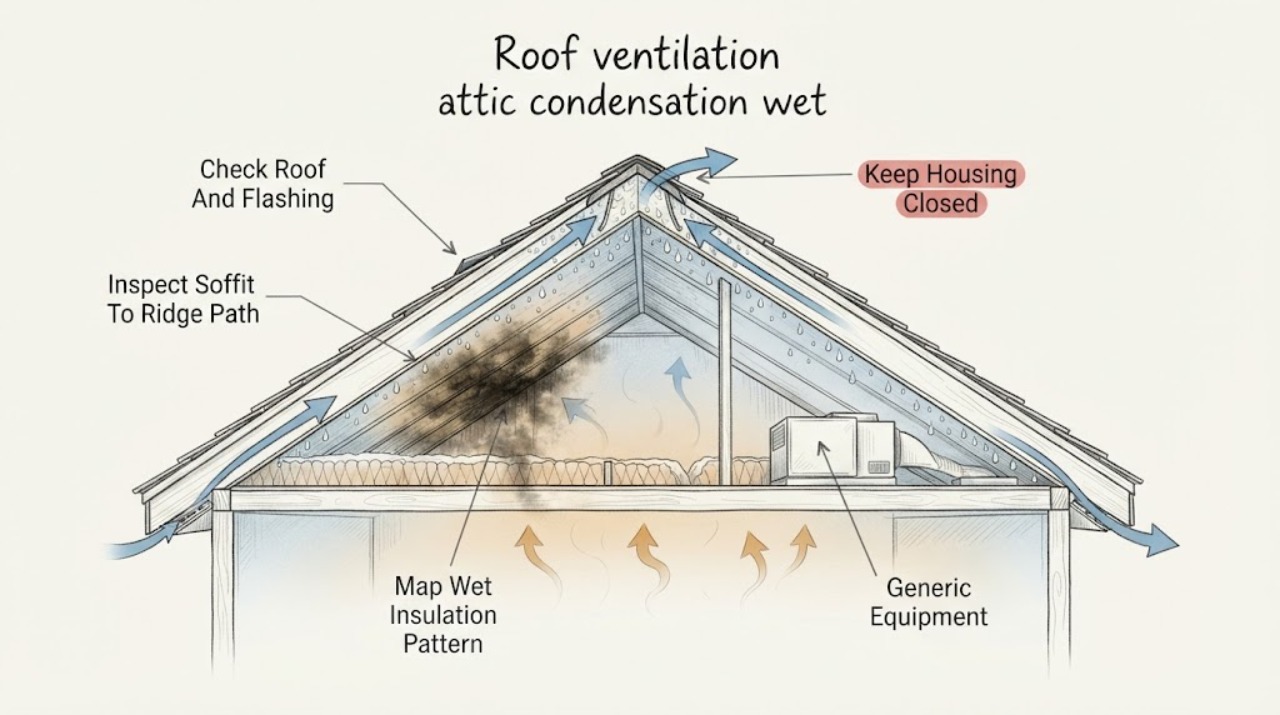
Work through in order
Diagnostic checks
Use only checks that match the exact appliance or system and its official guide.
-
Check 1
From a stable attic access point and without walking on ceiling drywall or joists that are not intended as a walkway, photograph the wet insulation, roof deck, rafters, eaves, and nearby penetrations; do not rake, lift, or compress the insulation to search underneath.
Expected result: Map whether wetness is localized at an eave, roof penetration, wall line, or duct, spread along the underside of the roof deck, concentrated around ceiling penetrations, or present across a broad area; note the weather and when it was first seen.
Next step: Keep the map and photos for a roofing or building-performance assessment, then use the roof, ventilation, and moisture-source checks to narrow the path without disturbing the insulation.
Stop if: Stop if the attic floor is unsafe, the insulation is heavily saturated, mold is widespread, the wood feels soft, wiring is exposed, or access requires a ladder or roof walking that you cannot do safely.
Why this matters
Why: A localized stain after rain is more suggestive of liquid water entry. A broad underside pattern after cold or humid conditions can fit condensation or air leakage. A patch near a duct or pipe may be surface condensation, and a patch near a ceiling penetration can indicate moist indoor air; the pattern does not identify the source by itself.
-
Check 2
From the ground or another ordinary safe viewing position, inspect the roof surface, eaves, gutters, valleys, and visible flashing around chimneys, vents, skylights, and other penetrations; do not climb onto the roof or remove shingles or flashing.
Expected result: Record missing or damaged roofing, displaced flashing, overflowing or blocked gutters, staining below a penetration, warped eave materials, or an attic wet spot that appeared after rain or snow; also record when no exterior defect is visible.
Next step: Arrange a qualified roofing inspection when the wet area follows precipitation or a roof feature; keep the photos and avoid sealing or coating the suspected path before it is traced.
Stop if: Do not climb a wet, icy, steep, or damaged roof, enter a roof cavity through a fragile surface, or remove roofing materials as a diagnostic test.
Why this matters
Why: A weather-linked wet spot or visible roof and flashing defect makes liquid water entry more likely than ventilation-only condensation. No visible defect does not rule out a concealed leak, wind-driven rain, or an ice-dam path.
-
Check 3
From the attic access, visually trace the intended intake-to-exhaust path: look for visible soffit openings, rafter vents or baffles at the eaves, a clear channel above insulation, and a ridge or gable exhaust opening; do not pull insulation out of the eaves.
Expected result: Record clear or blocked soffit openings, missing or collapsed baffles, insulation packed against the roof deck, blocked ridge or gable openings, or a roof design where the intended ventilation route is not apparent.
Next step: Photograph the obstruction and ask a qualified roofing or insulation professional to restore a continuous, code-appropriate ventilation path and protect the eaves before insulation is replaced.
Stop if: Do not cover soffit vents, staple or cut a baffle, move saturated insulation, or enter a narrow rafter bay without a safe work platform and appropriate assessment.
Why this matters
Why: Blocked eave intake or a broken channel can keep a vented roofline from moving air and drying. A visible exhaust opening without a clear intake path is not a complete ventilation diagnosis, and adding an attic fan can worsen house-to-attic air draw when the ceiling is leaky.
-
Check 4
From safe accessible positions, trace bathroom, kitchen, and laundry exhaust ducts and the ceiling plane for a duct that ends in the attic, disconnected duct joints, gaps around plumbing or wiring, the attic hatch, recessed fixtures, and dirty insulation that marks air movement; do not handle hot flues or disturb unknown insulation.
Expected result: Record an exhaust duct that terminates outdoors or in the attic, a disconnected or crushed duct, visible warm-air staining or dirty insulation at a ceiling penetration, an unsealed hatch or chase, or no accessible moisture source.
Next step: Have a qualified contractor correct an attic-terminated exhaust or inaccessible air leak and confirm the exhaust terminates outdoors; do not simply add roof vents while the moisture source remains.
Stop if: Stop around combustion flues, electrical fixtures, vermiculite or other suspect insulation, inaccessible duct runs, or any opening that requires removing a ceiling or wall finish.
Why this matters
Why: Venting moist household air into the attic or leaking through the ceiling can load the attic with vapor and produce condensation. Dirty insulation can indicate airflow through it. Absence of a visible source means concealed leakage, a roof path, or a climate-specific condensation mechanism remains possible.
-
Check 5
Note the season, recent heating or cooling operation, indoor humidity symptoms, and whether wetness is on or immediately around an air-conditioning duct, refrigerant line, or other cold surface in the attic; inspect only from ordinary safe access.
Expected result: Record wetness that appears during cold weather on the roof deck, during hot humid weather around cold ducts or pipes, after showers or cooking, or only after rain; note whether the duct insulation is complete and dry on its outer surface.
Next step: Give the timing and surface map to the appropriate roofing, insulation, or HVAC professional; do not wrap, compress, or tape over wet duct insulation without identifying the condensation or leak source.
Stop if: Do not handle refrigerant lines, electrical equipment, combustion appliances, or wet insulation near energized equipment; stop when the cause cannot be separated safely.
Why this matters
Why: Cold-weather roof-deck wetness can fit warm indoor air reaching a cold surface. Hot-humid wetness around a cold duct can fit surface condensation or inadequate duct insulation and sealing. Rain-linked wetness still requires roof investigation, and indoor humidity symptoms can coexist with a roof leak.
-
Check 6
Without pulling the insulation apart, photograph visible roof sheathing, rafters, trusses, and ceiling-side materials for mold-like growth, discoloration, warping, rot, or dampness, and record whether the wet material is fiberglass, cellulose, spray foam, or unknown.
Expected result: Record dry and sound wood, localized staining, soft or warped wood, widespread visible growth, insulation that is saturated or compressed, or unknown loose-fill material that may contain a hazardous substance.
Next step: Keep the area undisturbed and arrange a qualified moisture or building professional for sampling, drying, remediation, and insulation decisions; document the source investigation separately from the material cleanup.
Stop if: Do not disturb vermiculite or other suspect insulation, brush or vacuum visible growth, enclose wet materials, or remove insulation near wiring, flues, or roof edges.
Why this matters
Why: A localized, recently damp area may need source correction and a professional drying decision. Soft wood, widespread growth, persistently saturated insulation, or unknown material can involve structural, health, or hazardous-material concerns beyond a ventilation adjustment.
Use your observations
Decision map
Find the observation that best matches what you see, then follow the next safe action.
-
PATH 01Safety boundary
What you see
A wet patch is localized near a roof penetration, valley, eave, flashing, or wall line and appears or grows after rain or snow, while the ventilation path may be clear.
Do this next
Arrange a qualified roofing inspection to trace and repair the exterior water path before replacing insulation; protect the interior without covering the evidence.
Why this path and its safety boundary
Why it matters: Liquid water entry, wind-driven rain, flashing failure, gutter overflow, or an ice-dam path is more likely than ventilation-only condensation. A clear vent path will not stop a roof leak.
Safety stop: Do not climb the roof, remove shingles or flashing, or seal over a suspected leak from the attic side.
-
PATH 02Safety boundary
What you see
Wetness is broad along the underside of the roof deck or rafters after cold weather, with no clear rain-linked entry, and the ceiling plane or attic ventilation path shows gaps or blocked eave intake.
Do this next
Have a qualified professional inspect ceiling penetrations, attic hatch, baffles, soffit intake, and ridge or gable exhaust, then correct the moisture path and only afterward decide whether insulation must be dried or replaced.
Why this path and its safety boundary
Why it matters: Warm, moist indoor air may be reaching cold roof surfaces, and blocked or incomplete ventilation may be limiting drying. This pattern can involve both air sealing and ventilation rather than one vent component.
Safety stop: Do not add insulation over wet material or cover soffit vents, and do not seal around hot flues or recessed fixtures without the correct safety method.
-
PATH 03Safety boundary
What you see
Wet or dirty insulation clusters near a bathroom, kitchen, laundry duct, attic hatch, plumbing or wiring penetration, dropped soffit, or kneewall, and the exhaust path or ceiling air barrier is incomplete.
Do this next
Correct the exhaust termination and air-sealing details with a qualified contractor; keep the affected insulation and roof materials open for a drying and damage assessment.
Why this path and its safety boundary
Why it matters: Moist air is likely entering the attic from the home or being discharged there. More roof ventilation alone may not remove the moisture load and can draw additional conditioned air through leaks.
Safety stop: Do not disturb suspect insulation or work around combustion vents, electrical fixtures, or concealed chases to reach a leak.
-
PATH 04Safety boundary
What you see
Wetness is concentrated on a cold supply duct, refrigerant line, or nearby surface during hot humid weather, while the roof deck is dry and no rain-linked stain is present.
Do this next
Arrange HVAC or building-envelope assessment of duct insulation, air leakage, condensate drainage, and attic humidity; do not compress wet insulation around the duct or tape over an unknown leak.
Why this path and its safety boundary
Why it matters: Surface condensation or a duct insulation and air-sealing problem is more likely than a roof leak. Outdoor humidity and cold HVAC surfaces can create moisture in an attic even when roof ventilation is functioning.
Safety stop: Do not handle refrigerant lines, condensate equipment, or energized HVAC parts, and stop if water is near electrical equipment.
-
PATH 05Safety boundary
What you see
Insulation remains saturated, the roof deck or framing is soft or warped, visible growth is widespread, the source cannot be located, or the material is unknown and potentially hazardous.
Do this next
Keep people out of the affected area and arrange qualified moisture, roofing, and remediation assessment; ask the professional to coordinate any hazardous-material testing before disturbance.
Why this path and its safety boundary
Why it matters: The problem may include structural damage, microbial contamination, a concealed leak, or hazardous-material exposure. Vent adjustment or new insulation is not a sufficient diagnosis.
Safety stop: Do not brush, vacuum, cut, bag, or remove the insulation or roof materials yourself, and do not enclose the area while it is wet.
Helpful context
Understand the symptom
Condensation and roof leaks leave different clues
Condensation forms when moist air reaches a surface cold enough to collect water. In a cold attic, warm indoor air leaking through the ceiling can condense on the underside of the roof deck; in a hot, humid attic, outdoor moisture or a cold duct can create a different pattern. A roof leak usually follows a roof penetration, flashing, shingle, or eave path and may appear after precipitation. Wet insulation can hide either path, so its location and timing matter more than the fact that it is wet.
A vented attic needs both air sealing and a continuous air path
In a vented attic, air sealing at the ceiling limits warm, moist household air entering from below, while a clear soffit-to-ridge or soffit-to-gable path allows outdoor air to move through the roofline. Insulation stuffed into the eaves can block this intake; missing or collapsed rafter vents can leave insulation against the roof deck. An attic fan is not a substitute for a sealed ceiling and clear passive intake, and adding an exhaust fan can pull conditioned air from the home when the intake path is blocked.
Drying the insulation is not the first repair
Replacing or adding insulation before the water or vapor path is found can hide the evidence and allow the new material to become wet. Water-damaged insulation, roof sheathing, and wood need an assessment of how long they have been damp and whether mold or structural damage is present. A professional should handle work near combustion flues, electrical fixtures, suspected hazardous insulation, roof edges, and any concealed moisture path.
Safety boundary
Stop conditions
- Do not walk on unsupported attic surfaces, climb onto a wet or steep roof, or work near an open edge without appropriate professional safety controls.
- Do not cover soffit vents, pull saturated insulation from eaves, add insulation over wet material, or install an attic fan as a substitute for finding the moisture path.
- Do not disturb vermiculite or unknown loose-fill insulation, visible growth, wet materials near energized equipment, combustion flues, or concealed wiring.
- Stop when the roof deck or framing is soft, warped, widely stained, or persistently wet, or when water is entering the living space; arrange qualified roofing and moisture assessment.
- Do not seal roof, ceiling, duct, or exhaust paths with an unverified material or block a drainage route before the source and safety requirements are known.
Only after diagnosis
Potential parts
- rafter vent or insulation baffle
Consider this category only when a professional confirms a vented roof assembly has blocked or missing eave channels and the existing soffit-to-exhaust path is intended to be restored.
Confirm the roof assembly, rafter spacing, soffit and ridge or gable configuration, local requirements, and installation method; do not use a baffle to conceal wet insulation or a roof leak. - attic air-sealing material
Consider this category only after a qualified inspection identifies accessible ceiling-plane leakage and selects a method that is safe around the specific penetration, fixture, flue, or chase.
Confirm the substrate, temperature, fire and combustion clearances, local requirements, and product instructions; do not seal a hot flue, electrical fixture, or drainage path with a generic material. - replacement attic insulation
Consider this category only after the roof, vapor, exhaust, and ventilation source is corrected and a professional determines that the existing insulation cannot be dried or has lost required performance.
Confirm the climate, roof assembly, insulation type, air and vapor control, eave clearance, fire clearances, and moisture condition before selecting or installing replacement material. - duct insulation and air-sealing wrap
Consider this category only when wetness is confirmed on or around a cold duct and HVAC or building-envelope assessment finds incomplete insulation, air leakage, or a related condensate problem.
Confirm the duct material, insulation system, vapor control, condensate drainage, equipment access, and applicable installation requirements; do not compress wet insulation around a leaking duct.
When checks do not resolve it
Need a professional?
Arrange qualified roofing or building-performance service when wet insulation follows rain or snow, the roof deck or framing is stained or soft, a roof penetration or flashing may leak, the soffit-to-ridge path is blocked or unclear, an exhaust duct ends in the attic, or the ceiling plane requires sealing around flues, wiring, or recessed fixtures. Use HVAC service when wetness is concentrated on cold ducts or condensate equipment. Seek prompt moisture and remediation assessment for widespread visible growth, saturated insulation, mold concerns, or unknown insulation that may be hazardous.
Safety scope: This article covers ordinary safe visual observation and documentation only. Do not walk on fragile attic or roof surfaces, disturb insulation or growth, handle energized or combustion equipment, alter vents, or open concealed building assemblies.
Common questions
FAQ
Does wet attic insulation always mean the attic needs more vents?
No. Wet insulation can come from a roof or flashing leak, exhaust air discharged into the attic, warm indoor air leaking through the ceiling, blocked soffit intake, or condensation around a cold duct. Map the wet pattern and timing before changing ventilation or insulation.
How can I tell attic condensation from a roof leak?
A patch that follows rain or snow and clusters near a roof penetration, flashing, valley, eave, or wall line makes liquid entry more likely. Broad wetness on the underside of the roof deck after cold weather, especially with ceiling air leaks or blocked intake, makes condensation more plausible. The patterns can coexist, so a professional may need to trace the source.
Can I add insulation over wet insulation?
Do not cover wet material before the moisture source and material condition are assessed. New insulation can hide the evidence and remain wet if a roof leak, air leak, exhaust path, or blocked ventilation problem continues.
What should I do if a bathroom or dryer duct ends in the attic?
Treat it as a moisture-source problem, not just a ventilation problem. Keep the attic access safe, document the duct route, and arrange qualified work to correct the exhaust termination and assess any wet insulation, roof deck, or wood damage.
Can an attic fan solve condensation?
Not by itself. ENERGY STAR warns that when soffit intake is blocked and the ceiling is not well sealed, an attic fan can draw conditioned air from the home into the attic. Find and control the moisture source and restore the intended intake-to-exhaust path before considering any fan strategy.
When should wet attic insulation be handled by a professional?
Arrange professional assessment for roof or flashing leaks, saturated or widespread insulation, soft or warped wood, visible growth, unknown loose-fill material, work near flues or wiring, unsafe access, or any ventilation or air-sealing change that requires opening the building assembly.
Read the exact guide
Official sources
- Air Sealing Existing AtticsU.S. Department of Energy Building Science Education · DOE building-science guidance for sealing penetrations between conditioned space and an existing vented attic before insulating.
- Remodeling Your Home and Indoor Air QualityU.S. Environmental Protection Agency · EPA residential remodeling guidance for attic and ceiling air sealing, moisture control, and ventilation considerations.
- About Attic VentilationENERGY STAR · ENERGY STAR guidance for residential vented attics, insulation clearances, soffit intake, and continuous eave-to-ridge or gable airflow.
- Guide to Durable AtticsU.S. Department of Energy, Energy Efficiency and Renewable Energy · Department of Energy residential attic guidance for distinguishing roof water, household moisture, ventilation problems, and wet-insulation damage.
- Sealing Air Leaks: AtticENERGY STAR · ENERGY STAR guidance for identifying attic air movement at ceiling junctions, dropped soffits, kneewalls, and insulation.
- Moisture Control, Part of Indoor Air Quality Design Tools for SchoolsU.S. Environmental Protection Agency · EPA building-envelope moisture guidance; school-building examples are used only for general moisture-path, insulation-performance, and safety principles that also apply to attic assemblies.
Community feedback
Share a repair observation
Share a plain-text repair observation. Accepted observations are published automatically; this page may take a moment to update.