
On this page
Start here
Quick answer
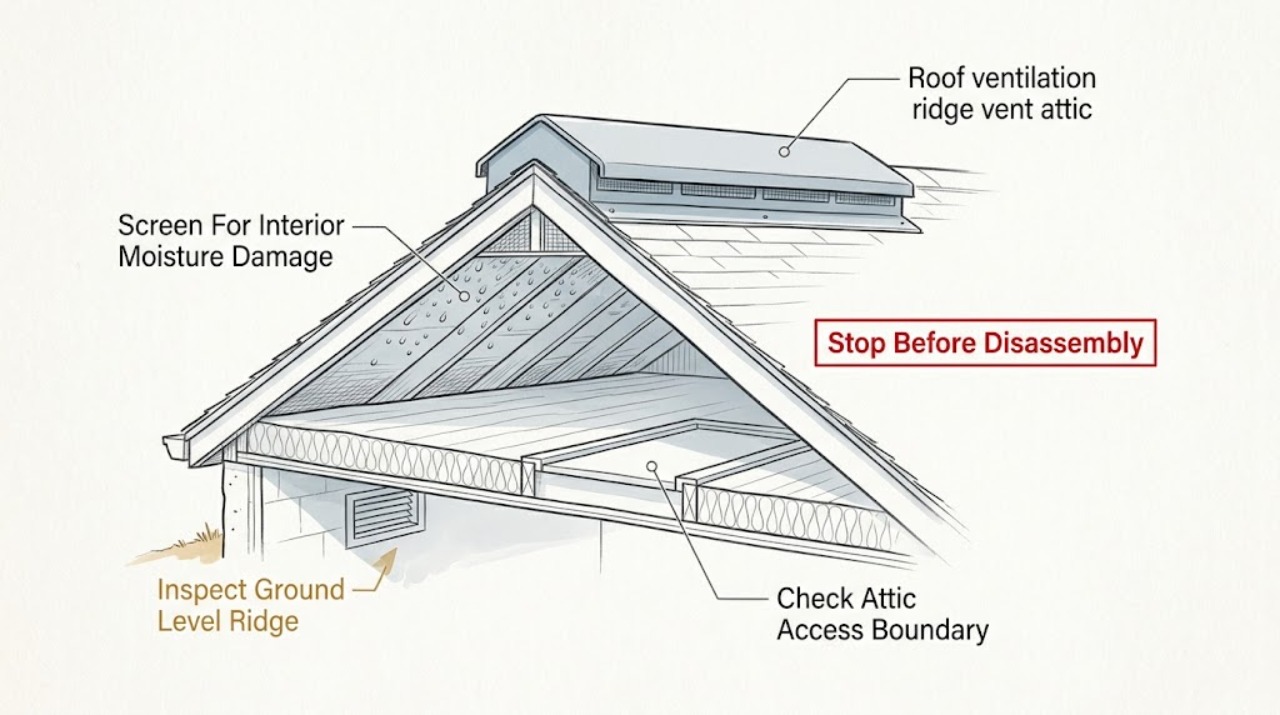
Attic condensation around a ridge-vented roof usually means moisture is entering faster than the attic assembly can remove it, or the intake and exhaust path is blocked or unbalanced; it can also be a roof leak rather than condensation. From inside the living space and from ground level only, note ceiling or upper-wall dampness, staining, musty odor, blocked or damaged soffit areas, visible ridge-line damage, and whether kitchen, bathroom, or dryer exhaust appears to terminate outdoors. Review indoor humidity and any accessible monitoring history, but do not open an unsafe attic hatch, walk on insulation or ceiling drywall, climb to the roof, inspect the ridge vent by contact, move insulation, or alter ducting or vents. Call a roofing or home-performance professional for wet insulation, mold, roof or soffit damage, persistent condensation, or any uncertainty about the ridge vent and intake path.
Work through in order
Diagnostic checks
Use only checks that match the exact appliance or system and its official guide.
-
Check 1
From the living space, inspect the ceiling and upper walls below the attic without opening the attic hatch. Look for droplets, damp or bubbled paint, brown staining, peeling finish, mold-like growth, or a musty odor, and note the room, weather, and whether the sign changes after cooking, bathing, or cold nights.
Expected result: The interior may be dry, show surface condensation only, show recurring stains or dampness, or show mold-like growth or a sagging ceiling.
Next step: Photograph the area with a room reference and record timing. Keep the area dry and call a roofing or home-performance professional for recurring moisture, mold-like growth, staining, or any structural concern; do not pierce, open, or press the ceiling.
Stop if: Stop for a sagging ceiling, active dripping, wet electrical fixture, spreading stain, mold-like growth with health sensitivity, or any need to enter the attic to continue.
Why this matters
Why: Surface condensation can reflect indoor humidity and a cold ceiling; recurring staining or dampness can indicate roof or flashing leakage, attic moisture, or both. A sagging or visibly wet ceiling is a damage and safety concern rather than a ventilation adjustment.
-
Check 2
Look at the attic access panel, trim, and the surrounding ceiling from the floor without opening the panel. Confirm whether the panel is dry and intact and whether accessing the attic would require a ladder, stepping onto insulation or drywall, crawling, or working around wiring or stored items.
Expected result: The access area may be dry and safely observable, show staining or dampness, or lead to an attic that is difficult or unsafe to enter.
Next step: Leave the panel closed and report its condition to a qualified professional. Do not place a board, body weight, tool, or moisture meter into the opening; use only visible evidence from the room side.
Stop if: Stop for any need to use a ladder, enter the attic, step on insulation or ceiling drywall, disturb suspected asbestos or vermiculite, or reach near wiring.
Why this matters
Why: A difficult or contaminated attic is not a suitable DIY inspection area. Moisture at the access can indicate air leakage from the living space, but it does not prove the ridge vent is the cause.
-
Check 3
From stable ground, view the eaves, soffits, fascia, roofline, ridge caps, and any visible vent openings with a camera or binoculars. Look for blocked soffit openings, damaged or missing ridge-cap material, sagging or warped fascia, nests, leaves, ice buildup, or an opening that appears covered; do not climb, use a ladder, or touch the roof or vent.
Expected result: The ground view may show clear-looking intake areas, blocked or covered soffits, damaged ridge-line material, debris or nesting, or too little detail to judge.
Next step: Save wide and zoomed photographs and identify the roof side and approximate location. Ask a roofer to inspect the ridge vent, intake path, flashing, and roof covering; do not remove debris from the roofline or alter soffit or ridge components.
Stop if: Stop for loose roofing material, falling debris, ice, active nest or wildlife, unstable ground, overhead utility hazards, or any need for a ladder or roof access.
Why this matters
Why: A ridge exhaust path cannot work as intended when intake is blocked, and damaged roof materials can admit water independently of ventilation. A ground view cannot establish vent sizing, continuity, baffle condition, or the condition beneath the roof covering.
-
Check 4
From inside the home and from ground-level exterior locations, identify whether kitchen, bathroom, or clothes-dryer exhaust appears to discharge outdoors rather than into the attic. Note visible indoor steam, unusually humid rooms, a closed bathroom door during showering, or an exterior termination with no clear airflow; do not open ductwork, enter the attic, or redirect a vent yourself.
Expected result: Exhaust may clearly terminate outdoors, have an uncertain route, show moisture at an interior grille, or appear to discharge near the roofline or another unverified location.
Next step: Photograph accessible grilles and exterior terminations and tell the professional which rooms and appliances are involved. Do not disconnect, cut, seal, or reroute ducting as a test.
Stop if: Stop for a concealed duct, hot appliance exhaust, gas or combustion appliance concern, mold-like growth, or any need to open a ceiling, wall, duct, or attic.
Why this matters
Why: Warm, moist air entering an attic can create condensation even when the ridge vent is intact. An uncertain or incorrect exhaust route needs professional correction and should not be treated as proof that the ridge vent itself is defective.
-
Check 5
Use a room hygrometer if you already have one and record indoor humidity, room temperature if available, outdoor weather, and when condensation appears. Also record the roof age if known, recent reroofing or insulation work, and whether the ridge vent or soffits were changed; do not place a meter in the attic or use readings to justify roof access.
Expected result: Condensation may correlate with humid indoor conditions, cold weather, rain or snow, a recent roof change, or no clear pattern; attic measurements may be unavailable.
Next step: Send the notes, photos, and any monitoring readings to a roofer or home-performance contractor and request an inspection of ventilation balance, air leakage, insulation, roof covering, and moisture sources. Do not buy a vent part solely from a room reading.
Stop if: Stop if measurement would require attic entry, roof access, electrical contact, disturbing insulation, or any invasive opening.
Why this matters
Why: Timing helps a professional distinguish indoor vapor and seasonal surface condensation from bulk water intrusion or ventilation defects. A room reading cannot diagnose ridge-vent airflow or hidden roof moisture by itself.
Use your observations
Decision map
Find the observation that best matches what you see, then follow the next safe action.
-
PATH 01Next step
What you see
The ceiling is dripping or sagging, staining is spreading, or water is near a light or other electrical fixture.
Do this next
Keep people away from the area and arrange prompt roofing and electrical assessment as appropriate. Do not open the attic, touch a wet fixture, or attempt a roof patch.
-
PATH 02Next step
What you see
A ground-level view shows damaged ridge caps, warped fascia or soffits, covered intake openings, loose material, or another roofline defect.
Do this next
Treat the issue as a professional roof and ventilation inspection. Provide photos and do not climb, remove material, or alter the ridge or soffit components.
-
PATH 03Next step
What you see
Condensation appears mainly after bathing, cooking, drying clothes, or during a cold period while no bulk-water damage is visible.
Do this next
Have a home-performance professional assess exhaust routing, air sealing, insulation, and ventilation balance. Do not vent into the attic, open ducting, or block soffits as a workaround.
-
PATH 04Next step
What you see
The source cannot be distinguished without opening an attic hatch, walking on insulation, or accessing the roof.
Do this next
Leave the attic and roof untouched and schedule a qualified inspection. Tell the provider that the visible evidence is limited to the ceiling, hatch exterior, and ground-level roofline.
-
PATH 05Next step
What you see
Condensation or moisture odor persists, but no roofline damage is visible from the ground and no clear indoor source is found.
Do this next
Request a professional ventilation and moisture assessment rather than replacing the ridge vent by guesswork. Include dates, weather, humidity notes, room locations, and photos.
Helpful context
Understand the symptom
Condensation is a moisture-path problem, not automatically a ridge-vent failure
A ridge vent is an exhaust path at the roof peak; it is expected to work with intake ventilation near the eaves or soffits. ENERGY STAR explains that outdoor air entering through clear soffit paths and leaving through ridge or gable vents helps move moisture out, while air sealing and insulation limit warm, moist air entering from below. The Department of Energy also lists roof leaks, indoor vapor, and inadequate ventilation as different ways attic moisture can appear. A damp surface near a ridge vent therefore needs source and airflow diagnosis before any vent replacement is considered.
Keep the attic and roof out of the homeowner check
The visible signs can be documented without entering the attic or accessing the roof. Wet insulation, mold or mildew, rotted wood, damaged soffits, or a failed roof assembly can involve falls, sharp roofing materials, hidden electrical wiring, and structural damage. DOE guidance recommends qualified inspection for attic moisture, while the user-safe boundary here is the ceiling, attic hatch exterior, and ground-level roofline only.
Safety boundary
Stop conditions
- Do not climb, use a ladder, walk on the roof, touch the ridge vent, remove ridge caps, alter soffits, or perform roofing or ventilation installation.
- Do not enter an attic, step on insulation or ceiling drywall, move insulation, probe hidden areas, or use a moisture meter beyond a safe room-side surface.
- Do not cut, disconnect, reroute, or seal exhaust ducting or plumbing, and do not block or open vents as a test.
- Stop for active leaks, sagging or wet ceilings, mold-like growth, suspected asbestos or vermiculite, electrical contact, falling debris, wildlife, or any uncertainty; call a qualified roofer or home-performance professional.
Only after diagnosis
Potential parts
- attic-moisture-meter
Consider this category only if a qualified inspector confirms a safe, appropriate measurement location and explains how the reading will inform the moisture assessment; a room reading cannot diagnose hidden attic moisture.
Use only according to the device and professional instructions, without attic entry, roof access, electrical contact, or probing insulation, wiring, or structural members. - hygrometer
Consider this category for room-side trend documentation when condensation timing is unclear; it is an observation aid, not proof that the ridge vent or roof is at fault.
Place in a safe living-space location and interpret readings with weather, room use, and professional assessment; do not use it to justify roof or attic access. - ventilation-screen
Consider this category only after a roofer confirms that a damaged or missing screen is the cause and identifies the exact roof system, vent, and intake design.
Roof ventilation components are system- and climate-dependent; do not install, remove, or alter a screen, ridge vent, soffit, or roof covering without qualified roof access and manufacturer instructions.
When checks do not resolve it
Need a professional?
Call a roofer or home-performance professional for persistent attic condensation, wet insulation or wood, mold-like growth, recurring ceiling stains, blocked or damaged soffit or ridge areas, an uncertain exhaust route, difficult attic access, or any need to inspect the roof, ridge vent, baffles, insulation, or ducts. Provide ground-level roofline photos, room-side ceiling and hatch photos, condensation timing, weather, humidity notes, roof or insulation history, and visible exhaust observations. Keep the attic and roof untouched while waiting.
Common questions
FAQ
Does attic condensation mean the ridge vent is broken?
Not necessarily. Condensation can involve blocked soffit intake, warm moist air leaking from below, insulation or air-sealing gaps, or a roof leak. A ridge vent works as part of a balanced system, so have the whole moisture and airflow path assessed.
Can I inspect or clear a ridge vent myself?
Not within this safe check. Do not climb, use a ladder, walk on the roof, touch the ridge vent, remove ridge caps, or improvise a tool. Photograph the roofline from the ground and call a qualified roofer.
Can I open the attic hatch to look for condensation?
Keep the hatch closed if access is difficult, requires a ladder, or could expose you to insulation, wiring, mold, or unstable footing. Room-side signs and the hatch exterior can be documented; a professional should inspect the attic when needed.
Could a bathroom or dryer vent cause attic condensation?
Yes. Warm, moisture-laden exhaust entering an attic can contribute to condensation even when a ridge vent is present. Look only at accessible room grilles and exterior terminations, then have a professional verify the route without opening or rerouting ductwork yourself.
What should I tell the roofing or home-performance professional?
Provide room-side photos, ground-level roofline photos, condensation timing, weather, humidity notes if available, roof or insulation history, and any safe observations about soffits, ridge caps, and exhaust terminations. State clearly if the attic and roof were not accessed.
Read the exact guide
Official sources
- About Attic VentilationENERGY STAR · Supports the relationship between clear intake, ridge exhaust, air sealing, and attic moisture; it does not authorize roof or attic access for this user.
- Consumer Guide to Durable AtticsU.S. Department of Energy · Supports distinguishing roof leaks, indoor vapor, and ventilation problems and escalating wet or damaged attic conditions; it does not authorize attic entry in this article.
- Ridge VentsGAF · Supports the role of a ridge vent as part of a balanced roof-ventilation system; it is not a model-specific installation or repair instruction for the reader's roof.
- Attic Air Sealing ProjectENERGY STAR · Supports stopping and hiring a professional for difficult or hazardous attic conditions; the article intentionally restricts the reader to room-side and ground-level observations.
Community feedback
Share a repair observation
Share a plain-text repair observation. Accepted observations are published automatically; this page may take a moment to update.