
On this page
Start here
Quick answer
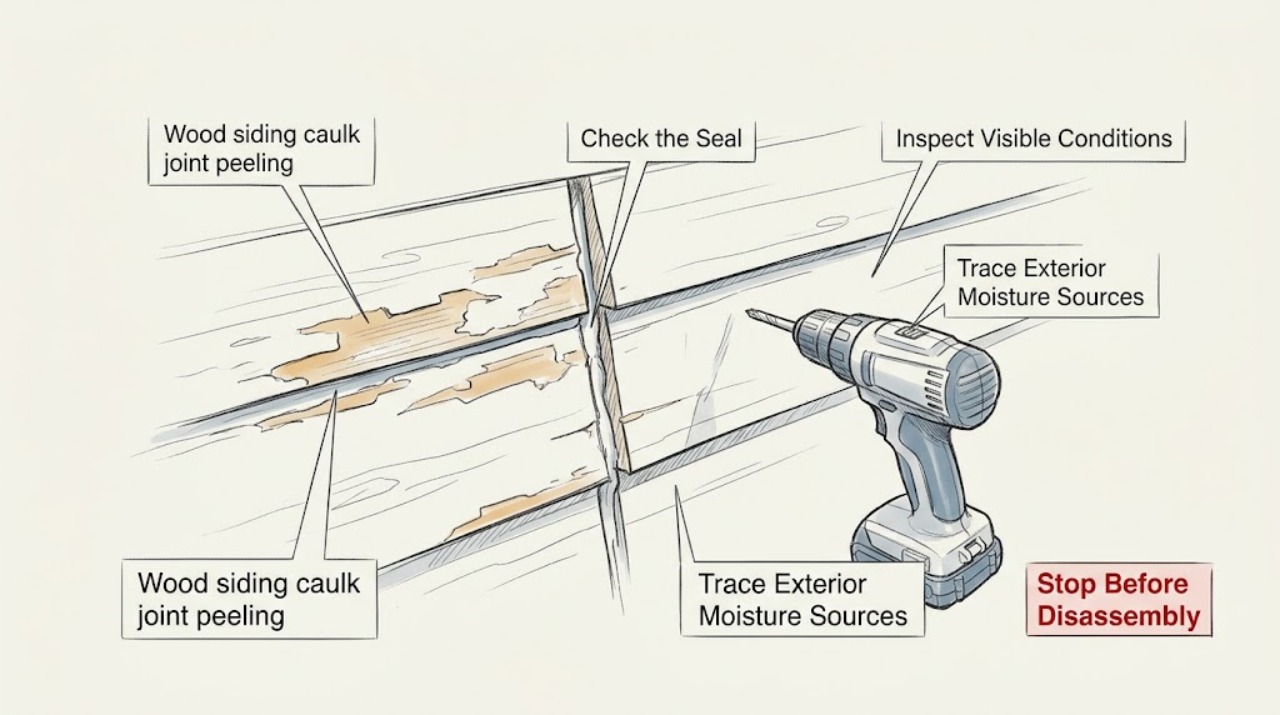
Peeling paint at a wood-siding caulk joint usually means the joint, paint bond, wood condition, or moisture path needs to be assessed before anything is recoated. From safe ground-level or interior viewpoints, document whether the joint is cracked or open, whether the wood is swollen or soft-looking, and whether rain, a roof or window detail, a gutter, sprinkler, or indoor moisture could be reaching the area. Do not paint over damp or loose material, disturb unknown older paint, climb to inspect, or remove caulk and siding until the cause and substrate are evaluated. A siding professional can then decide whether the work is localized caulk and paint maintenance, wood repair, flashing or drainage correction, or broader wall-envelope service.
Work through in order
Diagnostic checks
Use only checks that match the exact appliance or system and its official guide.
-
Check 1
From a safe ground-level or interior viewpoint, photograph the entire siding elevation and close views of the caulk joint. Map whether peeling is centered on the bead, extends onto one or both siding boards, follows a corner or opening, or repeats at other joints; do not scrape, pick, or pull loose paint.
Expected result: Peeling is confined to a small edge, follows the caulk line, spreads across a board, clusters around a window or door, or appears in several elevations or joints.
Next step: Record the locations, weather-facing direction if known, and dates of photographs, then give the pattern to a siding professional before selecting caulk, filler, primer, or paint.
Stop if: Stop if loose flakes are falling, the siding shifts, the wall surface is unstable, or the area can only be inspected from a ladder, roof, or exterior ledge.
Why this matters
Why: A bead-centered failure suggests a joint adhesion or movement question, while broad or repeated peeling makes moisture, preparation, substrate, exposure, or a larger envelope condition more plausible. Pattern alone does not prove the source.
-
Check 2
Look at the joint from a stable position without touching it. Note whether the caulk is continuous, split, shrunk, pulled away from one side, brittle, missing, discolored, or covering a gap that appears to be moving; do not cut out the bead or probe the joint.
Expected result: The bead looks intact, has a hairline surface crack, has a visible separation from wood, has a missing section, or the gap is too deep or irregular to interpret safely.
Next step: Photograph both sides of the joint and ask the provider to assess joint movement, wood moisture or decay, flashing, backing, and the appropriate exterior sealant system.
Stop if: Stop if the joint exposes soft or missing wood, an open wall cavity, sharp fasteners, active water, or material that would need force or elevated access to inspect.
Why this matters
Why: Surface cracking may be a coating issue, while separation or missing bead can allow water into the joint. A large, irregular, or moving gap may require wood, trim, flashing, or backing work before caulk; filling it blindly can trap or redirect moisture.
-
Check 3
From the ground and accessible interior rooms, look for nearby roof edges, gutters and downspouts, window or door trim, flashing, sprinklers, hose outlets, vegetation, grade, stains, or dampness that could wet the siding joint. Compare the condition after ordinary rain without spraying the wall or moving exterior components.
Expected result: No moisture source is visible, water reaches the joint during rain, staining or dampness appears below or beside an opening, runoff or sprinklers wet the wall, or the source remains unknown.
Next step: Map the suspected source and timing, photograph gutters, downspouts, openings, and interior signs, and request a siding or building-envelope assessment before repainting.
Stop if: Stop if water is actively entering, the wall is soft or swollen, electrical equipment is wet, or tracing the source would require roof, ladder, excavation, or concealed-wall work.
Why this matters
Why: Water reaching the joint can cause paint failure and wood movement even when the bead itself looks like the visible defect. PNNL lists flashing and rain or splashback pathways among possible moisture causes, and EPA describes rainwater, surface water, plumbing water, and vapor as distinct moisture sources that need different responses.
-
Check 4
From a stable position, visually compare the exposed or painted wood at the joint with nearby siding for swelling, cupping, splitting, dark staining, rot-like softness, insect holes, missing finish, or siding movement. Do not puncture, scrape, sand, remove boards, or press hard on questionable wood.
Expected result: The wood appears hard and dimensionally stable, has surface discoloration only, is swollen or cupped, has a soft-looking or crumbling area, or cannot be assessed without disturbing the coating.
Next step: Keep water and impact away from the area, provide photographs and the location to the siding professional, and ask whether wood repair, siding replacement, flashing correction, or moisture remediation is needed before coating work.
Stop if: Stop if wood is unstable, a cavity or fastener is exposed, mold-like growth is present, or assessment would require removing siding or creating paint debris.
Why this matters
Why: Sound-looking wood supports a possible localized preparation and joint-maintenance scope only after moisture is ruled out. Swelling, cupping, soft areas, or crumbling indicate that repainting or caulking alone may conceal damaged siding or wall materials; the repair extent requires professional assessment.
-
Check 5
Collect paint or caulk labels, approximate coating age, prior repairs, siding material and exposure history, and photos from safe positions. Note whether the coating predates current records or could be an older unknown paint; do not remove a sample, create dust, or plan a full-area coating based on appearance alone.
Expected result: The coating and caulk are identified, only a recent repair is documented, the paint age is unknown, or the joint is on an upper story or otherwise inaccessible.
Next step: Give the records, photos, moisture pattern, and access limits to the provider and ask for a cause-and-extent evaluation before ordering materials or disturbing the paint.
Stop if: Stop and request professional service if access requires ladder work, the coating may be lead-containing, the wall is deteriorated, or safe containment cannot be maintained.
Why this matters
Why: Known products and a sound, dry substrate can support a professional localized maintenance plan. Unknown older coating, repeated failed repairs, or inaccessible joints increase the need for a qualified assessment and appropriate containment or access plan.
Use your observations
Decision map
Find the observation that best matches what you see, then follow the next safe action.
-
PATH 01Next step
What you see
Peeling is concentrated on a cracked, shrunken, or separated caulk bead while surrounding wood appears stable and dry.
Do this next
Request a localized joint assessment and compatible caulk and paint plan after the joint movement, backing, and substrate are checked. Do not simply coat over the failed bead.
-
PATH 02Next step
What you see
Rain, gutter discharge, flashing, window or door trim, sprinklers, or indoor dampness appears to wet the joint or adjacent wood.
Do this next
Have the moisture source and wall detail assessed and corrected before recoating. Peeling paint is a symptom until the water path is understood.
-
PATH 03Next step
What you see
The siding is swollen, cupped, split, soft-looking, crumbling, stained through, or moving at the joint.
Do this next
Request a siding and wall-envelope evaluation for damaged wood, flashing, drainage, and repair extent. Keep water and people away from the area and do not fill or paint it as a concealment.
-
PATH 04Next step
What you see
Peeling repeats at multiple joints, elevations, openings, or broad siding areas.
Do this next
Treat the condition as a moisture, exposure, preparation, or coating-system investigation rather than a single caulk repair. Provide dated photos and request a professional assessment before broad paint work.
-
PATH 05Next step
What you see
Paint age or composition is unknown, the home is older, or loose flakes and dust are present.
Do this next
Keep the area undisturbed and arrange an appropriate professional assessment before any paint preparation. Do not create dust or chips or use an uncontained removal method.
-
PATH 06Next step
What you see
The joint is accessible without elevated work, the wood appears sound and dry, and peeling is limited with no active moisture clue.
Do this next
Ask a siding or painting professional to confirm that localized joint preparation, compatible caulk, primer, and exterior paint are appropriate for the actual materials and exposure.
Helpful context
Understand the symptom
A peeling caulk joint is a moisture and movement clue
Wood siding changes dimension as its moisture changes, and a joint can open, shrink, or move while the paint film is trying to bridge it. Peeling may also reflect water entering from a roof, window, door, gutter, flashing, sprinkler, or the wall interior. PNNL explains that bubbling, blistering, or peeling paint can indicate moisture damage in the wall beneath, while EPA guidance treats peeling paint and stained finishes as symptoms that warrant finding the moisture source.
Check the joint before choosing a caulk
A caulk bead that is split, pulled away, brittle, or missing is a different problem from paint peeling on intact wood beside a sound joint. The visible bead does not show whether the joint has the right backing, movement, flashing, or dry substrate. Photograph the condition and leave product selection and surface preparation to the siding or painting professional when the joint is deep, moving, wet, or difficult to access.
Keep older paint and elevated work undisturbed
Peeling paint should be treated as deteriorated material. HUD visual-assessment guidance notes that peeling can be caused by moisture or poor preparation and may affect small or large areas. If the paint age is unknown or the home may contain older coatings, do not create dust or chips while investigating; keep occupants away from loose flakes and arrange appropriate professional assessment.
Only after diagnosis
Potential parts
- exterior-wood-filler
Consider only if a professional confirms that the defect is a small, localized void in sound, dry wood rather than rot, movement, an open wall detail, or an active moisture path.
Confirm the wood species, exposure, depth, paint system, and manufacturer's preparation requirements; filler is not a substitute for replacing deteriorated wood or correcting water entry. - exterior-caulk
Consider only after the joint is confirmed sound, dry, appropriately sized, and free of unresolved flashing or drainage problems, with a product selected for the actual siding materials and movement.
Verify adhesion, movement capability, paintability, joint depth, backing, and manufacturer instructions; generic caulk may fail or trap moisture in an unsuitable joint. - siding-paint
Consider only after moisture, loose coating, substrate distress, and joint failure are addressed and the existing coating is suitable for the selected exterior paint system.
Confirm coating history, substrate dryness, preparation limits, exposure, and any older-paint safety requirements with a qualified professional before ordering.
When checks do not resolve it
Need a professional?
Call a qualified siding or building-envelope professional when peeling repeats, the caulk joint is open or moving, wood is swollen, soft, split, or crumbling, water enters around the joint, flashing or gutters may be involved, paint age is unknown, or safe access requires a ladder or exterior work. Arrange prompt assessment for active leakage, structural deterioration, suspected mold, or falling material.
Have this ready
- Provide wide and close photos, joint and peeling pattern, dates and weather context, nearby roof, gutter, window, door, sprinkler, and vegetation observations, interior dampness or staining, siding and coating history, paint or caulk labels, and access limitations.
Common questions
FAQ
Can I caulk over peeling paint at a wood-siding joint?
Do not cover it by assumption. First determine whether the joint is open or moving, the wood is sound and dry, and water or flashing is contributing. New caulk or paint over loose coating or damp wood can fail again and conceal damage.
What does peeling paint around a siding joint usually mean?
It can reflect failed caulk adhesion, wood movement, poor preparation, rain or splashback, flashing or gutter leakage, indoor moisture, or deterioration behind the paint. The pattern and moisture history help narrow the scope, but the visible peeling does not prove one cause.
Should I sand old peeling paint before repainting wood siding?
Not as a first troubleshooting step, especially when the coating age or composition is unknown. Keep loose material undisturbed and ask a qualified professional to assess the moisture cause, substrate, and appropriate containment and preparation method.
When should peeling paint at a caulk joint receive professional service?
Arrange service when the joint is open or moving, peeling repeats, wood is swollen or soft, water enters, trim or flashing is deteriorated, the paint may be old or lead-containing, or the area requires ladder or exterior access.
Read the exact guide
Official sources
- Moisture Control Guidance for Building Design, Construction and MaintenanceU.S. Environmental Protection Agency · Used to frame peeling paint and stained finishes as moisture symptoms and to distinguish possible rain, surface, plumbing, and vapor sources; it is guidance, not a diagnosis of this siding joint.
- Visual Assessment Training: Identify Types of DeteriorationU.S. Department of Housing and Urban Development · Used for the conservative boundary around peeling or unknown older paint; it does not establish a lead-paint determination or a siding repair method.
- Look for Missing Window and Door FlashingU.S. Department of Energy Building America Solution Center · Used for general moisture-path and peeling-paint assessment around wood siding and openings; it is not a site-specific siding repair specification.
Community feedback
Share a repair observation
Share a plain-text repair observation. Accepted observations are published automatically; this page may take a moment to update.