
On this page
Start here
Quick answer
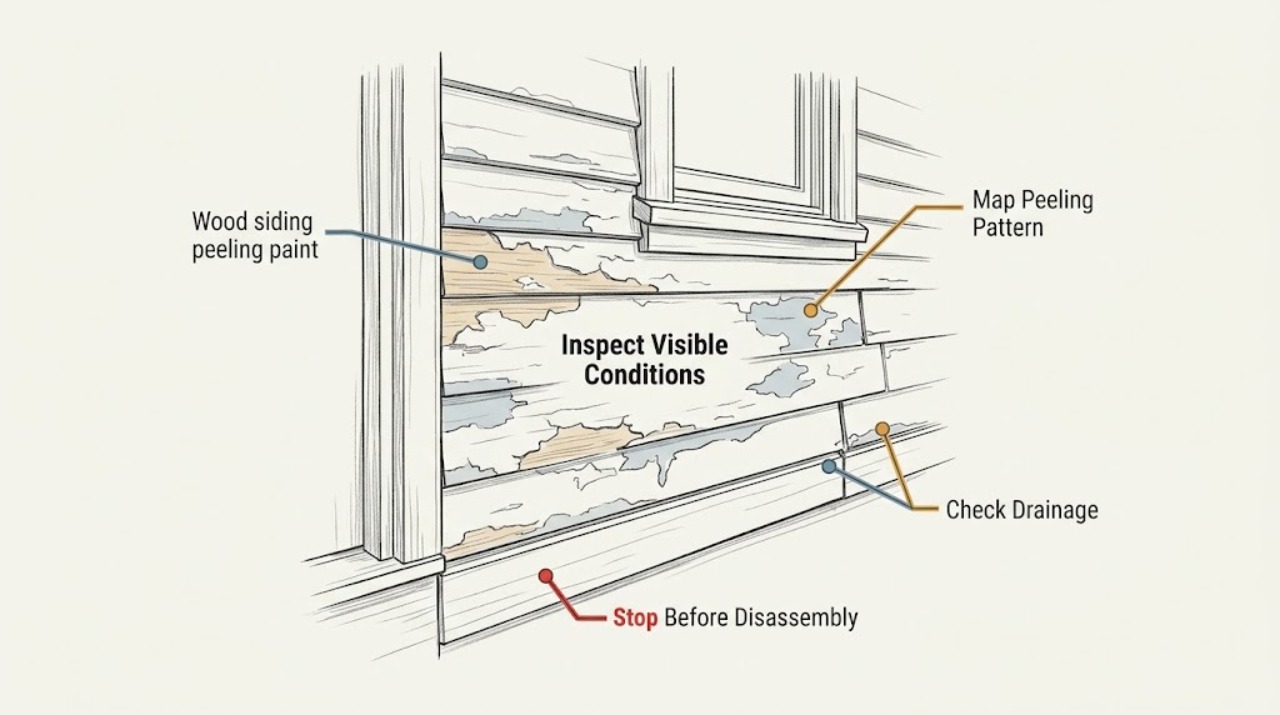
Start with a ground-level or window view and document the pattern before disturbing the coating. Peeling concentrated below windows, at joints, near trim, under eaves, or beside downspouts makes moisture or drainage a priority; sun-facing or broad, age-related peeling may also involve exposure or prior preparation. Note whether bare wood, soft-looking areas, gaps, staining, or buckled boards are visible. Do not climb, scrape, sand, pressure-wash, remove siding, cut wood, or disturb an older coating; request qualified siding or paint service when the cause is uncertain or the wood appears damaged.
Work through in order
Diagnostic checks
Use only checks that match the exact appliance or system and its official guide.
-
Check 1
From the ground, porch, or a room-side window, map where the paint peels, blisters, cracks, or flakes. Compare the lower and upper boards, corners, trim, joints, and areas below windows without climbing, leaning outside, touching the coating, or removing siding.
Expected result: Peeling is localized below an opening or joint, follows a broad horizontal band, is concentrated on one elevation, or is widespread across several elevations.
Next step: Photograph the whole elevation and close views from a safe position, then give the pattern and locations to a siding or exterior-paint professional.
Stop if: Stop if the only view requires a ladder, exterior window access, contact with loose flakes, or approaching an unstable surface.
Why this matters
Why: A localized band keeps water entry, joint, trim, or drainage conditions in focus. A sun-facing or widespread pattern can add exposure, age, and prior preparation to the service assessment; the pattern does not prove a single cause.
-
Check 2
From a dry ground or window position, observe staining, damp-looking areas, runoff marks, blocked or overflowing gutters, downspouts that discharge near the wall, and peeling that changes after rain. Do not pressure-wash, hose-test, open wall layers, scrape, or touch the coating.
Expected result: There is no visible moisture context, a mark or wet pattern is near a joint or opening, runoff reaches the siding, or the pattern is unchanged across weather conditions.
Next step: Record recent rain, snow, gutter or downspout behavior, and the exact wall locations for the professional; request prompt service if water is entering near an opening.
Stop if: Stop if observing would require roof access, ladder work, moving a gutter, disturbing paint, or approaching wet electrical equipment or an unstable surface.
Why this matters
Why: A moisture or runoff pattern makes source control part of the repair scope. A stable dry appearance does not rule out concealed moisture, while widespread weather-independent peeling keeps age and coating history in consideration.
-
Check 3
Use photographs or a room-side view to note exposed wood, dark staining, swelling, cupping, open joints, missing trim, holes, or boards that appear uneven. Do not press, probe, lift, cut, or remove a board to test its condition.
Expected result: The wood appears covered and flat, has visible bare areas, shows swelling or cupping, has open joints or missing trim, or its condition cannot be determined from a safe view.
Next step: Provide close and wide photos and ask the professional to assess whether the boards, trim, joints, and drainage details need repair before coating work.
Stop if: Stop if boards are loose, falling, sharp, visibly rotten, or accessible only by climbing, pulling, or disturbing the paint.
Why this matters
Why: Bare wood or distorted boards increase the chance that the job includes substrate or water-entry assessment rather than repainting alone. An intact-looking surface may still need preparation and moisture review before a coating is selected.
-
Check 4
Compare the affected area with a shaded elevation, a sheltered trim section, and any dated photos or maintenance records. Note the building age, prior repainting, direction of the wall, and whether peeling follows sun, wind, weather, or a previous repair boundary; do not scrape or sand to identify coating layers.
Expected result: Peeling is limited to a high-exposure face, follows a previous repair boundary, appears in an older multi-layer area, or has no clear age or exposure pattern.
Next step: Share the wall orientation, maintenance history, dated photos, and visible repair boundaries with the siding or paint professional.
Stop if: Stop if records cannot be checked without disturbing the surface, if loose paint is shedding, or if the area can only be reached from a ladder or exterior opening.
Why this matters
Why: Exposure and coating history can change the preparation and product assessment. An unclear history is a reason for a professional coating and substrate review, not a reason to disturb the surface to find out.
-
Check 5
Confirm that the peeling pattern, moisture context, visible wood condition, exposure, age, and access limits are documented without climbing, scraping, sanding, pressure washing, removal, cutting, or coating disturbance.
Expected result: The condition is documented from safe ground or window views, or important areas remain inaccessible or uncertain.
Next step: Request qualified siding or exterior-paint service and provide the photos, wall locations, weather pattern, age or maintenance history, and safety concerns.
Stop if: Stop and seek professional help for broad deterioration, bare or soft-looking wood, water entry, loose boards, suspected older coatings, or any inaccessible area.
Why this matters
Why: A clear record supports a professional decision about moisture control, board or trim repair, surface preparation, and compatible coating. An incomplete or unsafe record means the inspection should be escalated rather than extended by DIY disturbance.
Use your observations
Decision map
Find the observation that best matches what you see, then follow the next safe action.
-
PATH 01Next step
What you see
Peeling follows an opening, joint, trim, lower edge, gutter, downspout, or visible runoff mark.
Do this next
Request siding and moisture-source assessment before choosing a filler, caulk, or paint. Do not seal over an unresolved water path.
-
PATH 02Next step
What you see
Bare wood, swelling, cupping, open joints, missing trim, or apparent substrate damage is visible.
Do this next
Request professional board, trim, and drainage evaluation; repainting alone may not address the condition. Do not probe, pull, cut, or remove the boards.
-
PATH 03Next step
What you see
Peeling is broad on a sun or weather-exposed elevation, follows an old repair boundary, or involves an older coating history.
Do this next
Provide the exposure and maintenance history to a qualified exterior-paint professional and ask for a safe preparation and coating assessment.
-
PATH 04Next step
What you see
Peeling is localized, the siding appears flat and intact from a safe view, and no moisture path is visible.
Do this next
Request a planned siding or paint evaluation. Keep parts and coating choices conditional until surface preparation and compatibility are confirmed.
-
PATH 05Next step
What you see
The wall can only be inspected with a ladder, exterior access, scraping, sanding, removal, or other disturbance.
Do this next
Stop and arrange qualified service. Do not extend the inspection into a fall or coating-exposure hazard.
Helpful context
Understand the symptom
Peeling paint is a symptom, not a complete diagnosis
Exterior wood paint can separate when moisture reaches the wood or when the coating and surface preparation are no longer compatible. The location and pattern matter: a narrow band below an opening is a different observation from widespread exposure-related peeling. Correcting the moisture path is part of a durable repair, but the visible surface alone does not identify the hidden condition.
Use ground and window views
Look from the ground, a porch, or a window without leaning outside. Compare shaded and sun-exposed elevations, the area below gutters and downspouts, window and door trim, and the lower edge of the siding. Photograph before any work. A qualified professional can inspect inaccessible or concealed areas without turning a coating problem into a fall or exposure hazard.
Treat unknown older coatings cautiously
Peeling, chalking, cracking, or flaking paint is deteriorated surface material. The age of the building and the coating history may change the safe work method, but appearance alone does not establish what a coating contains. Do not disturb the paint while investigating; ask an appropriately qualified professional about the work boundary.
Only after diagnosis
Potential parts
- exterior wood filler
Consider this category only if a professional confirms a small, stable surface defect and the wood is sound, dry, and suitable for that repair.
Confirm the siding species, exposure, substrate condition, and coating system before selecting a filler; filler will not correct active moisture or board movement. - exterior caulk
Consider this category only after a professional confirms that the joint is an appropriate, sound, dry sealing location and that drainage paths must remain open.
Confirm joint movement, surface condition, paint compatibility, and drainage details; do not seal over a concealed water path or deteriorated wood. - siding paint
Consider this category only after moisture, substrate condition, prior coating, and safe preparation have been assessed by a qualified professional.
Confirm the wood species, existing coating, exposure, preparation method, and manufacturer compatibility before choosing a coating; appearance alone is not enough.
When checks do not resolve it
Need a professional?
Call qualified siding or exterior-paint service when peeling is widespread, wood appears bare or distorted, water enters near an opening, boards or trim are loose, the cause is uncertain, the wall is inaccessible from the ground or a window, or the coating may require a specialized safe-work method.
Have this ready
- Provide wide and close photos taken from ground or room-side positions, affected elevations, moisture and runoff observations, rain or season timing, sun and wind exposure, building age, prior coating history, repair boundaries, bare-wood or board observations, and access limits.
Common questions
FAQ
Why is the paint peeling only below a window?
That pattern can be consistent with a localized moisture or drainage path, a joint or trim condition, or a previous repair boundary. Photograph the area and have the water path and siding condition assessed before recoating.
Can I scrape and repaint wood siding myself?
This article does not recommend scraping, sanding, pressure washing, or disturbing the coating as a homeowner test. Ask a qualified professional to assess moisture, substrate, coating history, and the appropriate preparation method.
Does peeling paint prove the siding is rotten?
No. Peeling can have several causes, including moisture, exposure, age, and prior preparation. Bare, swollen, cupped, or open-jointed boards deserve professional inspection, but surface appearance alone does not establish hidden wood damage.
Should I assume an older home's peeling exterior paint contains lead?
Do not make a contents claim from appearance or age alone. Avoid disturbing the coating and ask an appropriately qualified professional about the building's history and safe work method before any preparation or repainting.
Read the exact guide
Official sources
- Lead Abatement, Inspection and Risk AssessmentU.S. Environmental Protection Agency · Supports cautious observation of peeling, chipping, chalking, or cracking paint and professional escalation; the article makes no claim about the coating's contents.
- Moisture Control Guidance for Building Design, Construction and MaintenanceU.S. Environmental Protection Agency · Supports the article's distinction between peeling paint and possible moisture sources; it does not provide a siding-specific repair prescription.
Community feedback
Share a repair observation
Share a plain-text repair observation. Accepted observations are published automatically; this page may take a moment to update.