
On this page
Start here
Quick answer
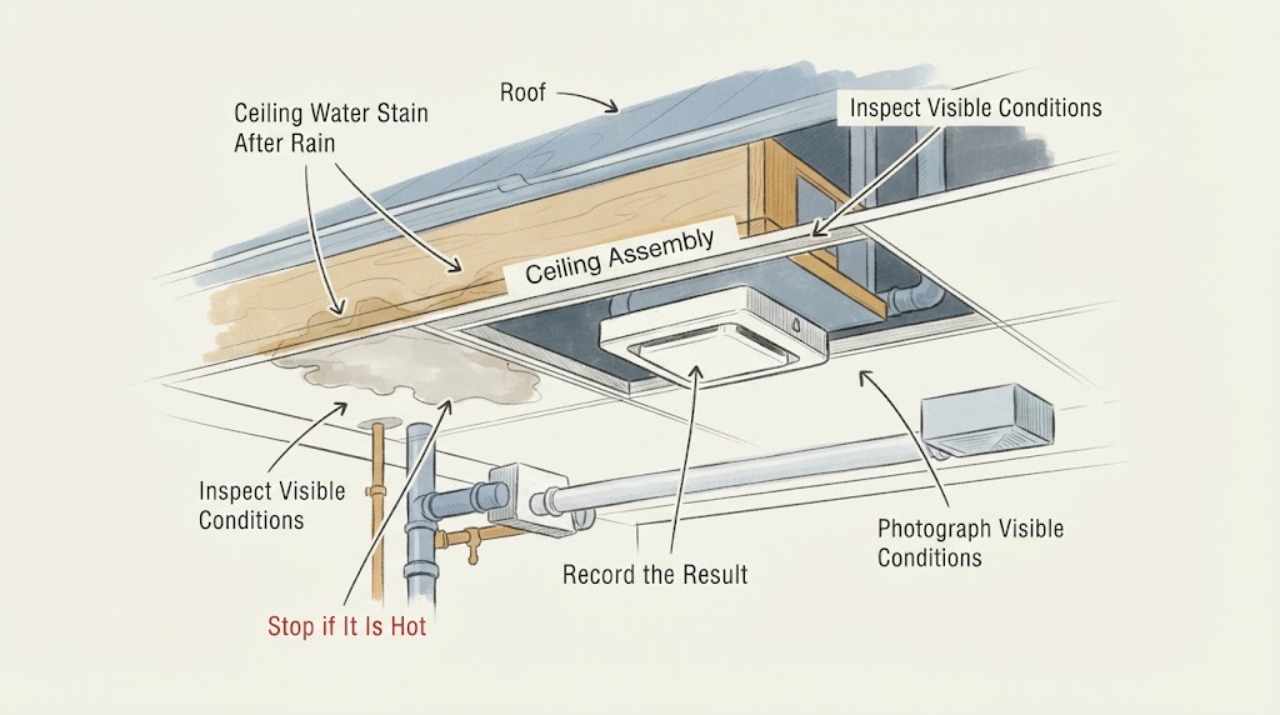
A ceiling stain that appears or grows after rain is evidence of moisture entry, but the stain is not necessarily directly below the roof defect. Water can travel along roof components, framing, ducts or pipes before appearing indoors, and a plumbing or condensation problem can coincide with wet weather. First keep clear of a sagging or actively dripping ceiling and treat wet light fixtures or wiring as an electrical hazard. Photograph and measure the stain, note whether it follows rain or a plumbing use, and make only safe, ground-level or accessible-interior observations. Do not climb onto a wet roof, cut into the ceiling, disturb saturated insulation, or paint over an active stain. Arrange qualified roof, plumbing, electrical or water-damage assessment when the source is uncertain, the ceiling is wet or deformed, or the stain returns.
Work through in order
Diagnostic checks
Use only checks that match the exact appliance or system and its official guide.
-
Check 1
From a dry floor, look at the ceiling without pressing, poking, drilling or standing beneath a visibly sagging section. Note active drops, bubbling or peeling finish, cracking, bulging, loose material, the approximate stain size and whether any light, fan, smoke alarm or other electrical equipment is in or near the wet area.
Expected result: The stain is dry and flat, or the ceiling is wet, expanding, sagging, cracked, shedding material or dripping near electrical equipment.
Next step: Keep people and belongings clear, place a container under a safe drip if it can be done without touching the ceiling, and arrange appropriate qualified help. If electrical equipment or wiring is wet, do not operate it; have a qualified electrician isolate or assess it safely.
Stop if: Stop immediately for sagging or falling material, a large or rapidly expanding bulge, sparks, burning odor, standing water, a wet light or fan, or any need to enter water or touch a damaged fitting.
Why this matters
Why: A dry flat mark may be an old repaired leak, while active moisture or deformation means the ceiling and hidden materials may still be taking on water. Water near electrical equipment adds shock and fire risk and should not be investigated by touching the fitting.
-
Check 2
Photograph the stain before wiping or painting, mark its visible edge with the date, and measure it from two fixed room features such as walls or a doorway. Record when it appeared, whether it grew during or after rain, and whether showers, toilets, sinks, HVAC operation or other water use happened before the change.
Expected result: The mark appears only after rain, follows a particular plumbing use, changes during HVAC operation, or returns during both rain and unrelated water use.
Next step: Give the dated record to the roofer, plumber or building professional and use it to decide which system to inspect first. Do not run a deliberate water test over the roof or ceiling while the interior is wet.
Stop if: Stop if the stain spreads quickly, water reaches an electrical fitting, the ceiling deforms, or tracing would require opening the ceiling or climbing an unsafe ladder or roof.
Why this matters
Why: Rain-only recurrence makes roof or exterior drainage more likely; a repeat after a particular fixture use keeps plumbing in consideration; HVAC timing keeps condensation or a drain issue possible. Mixed timing means the first assumption is unreliable and the source needs tracing.
-
Check 3
If there is a dry, stable and safely accessible attic or upper area, inspect only from a sound walking surface with a flashlight. Look for damp insulation, a wet roof deck, drip trails on framing, wet ducts or pipes, and roof penetrations near the measured stain; do not step on ceiling drywall, move saturated insulation, or enter a confined or unstable space.
Expected result: Moisture or a drip trail is visible on the roof assembly or framing, only plumbing or HVAC components are wet, or no source is visible above the stain.
Next step: Photograph the accessible evidence and arrange the corresponding qualified professional. Leave concealed areas unopened; a professional can trace moisture without turning a small stain into a larger ceiling opening or unsafe attic entry.
Stop if: Stop for soft flooring, exposed wiring, active dripping, mold-like growth, poor ventilation, heat, a low or confined roof space, or any need to walk on ceiling material or disturb insulation.
Why this matters
Why: A roof-deck or framing trail supports an exterior-envelope investigation, but the entry point may be upslope or laterally displaced. Wet pipes or ducts shift attention toward plumbing or condensation. No visible source does not rule out a concealed path or a roof leak hidden by insulation.
-
Check 4
From the ground or another safe location, use sight or binoculars to look for obvious roof or drainage changes near the room: displaced or damaged covering, failed-looking flashing or penetrations, debris at gutters, overflowing downspouts, or water directed toward the wall. Do not climb onto the roof or wet ladder to confirm a suspected defect.
Expected result: An exterior defect or overflow is visible, the roof looks unchanged, or the defect cannot be seen from a safe position.
Next step: Send the exterior photos with the interior measurements to a qualified roofing professional. If gutters or downspouts are dangerously blocked or damaged, do not climb to clear them during wet conditions; arrange safe service.
Stop if: Stop for lightning, wind, ice, wet surfaces, unstable ladders, overhead lines, a steep roof, or any request to walk the roof or apply a patch from an unsafe position.
Why this matters
Why: A visible defect or drainage overflow gives a roofer useful direction but does not prove it is the only entry path. An unchanged view does not clear the roof because defects can be concealed, intermittent or above the visible line.
-
Check 5
After the leak source is addressed or the area has stopped receiving water, check the affected finish only without disturbing it: note whether the stain is still wet, whether a musty odor or visible growth develops, and whether the ceiling or wallboard dries in comparison with an unaffected nearby area. Use a moisture meter only as an aid and follow its instructions; do not treat one reading as proof that hidden materials are safe.
Expected result: The material dries and remains flat, stays damp, develops a musty odor or visible growth, or the stain returns after the next rain.
Next step: Keep the area ventilated only when doing so is safe and arrange water-damage or building-material assessment for persistent dampness, growth or damaged wallboard. Have the roof or plumbing source rechecked when the stain returns; do not seal or paint over active moisture.
Stop if: Stop cleaning or disturbing the area if contaminated water, extensive growth, damaged ceiling material, a musty enclosed space or health symptoms are present; use qualified remediation guidance.
Why this matters
Why: Drying and a stable surface support later repair evaluation. Persistent dampness or growth indicates unresolved infiltration or a remediation need. A returning stain proves the moisture problem is not finished even if the first mark was painted.
Use your observations
Decision map
Find the observation that best matches what you see, then follow the next safe action.
-
PATH 01Next step
What you see
The stain is flat and dry, appears only after rain, and there is no active drip or electrical involvement.
Do this next
Document and measure it, then arrange a qualified roof or exterior-envelope inspection. Do not assume the roof defect is directly above the room, and do not paint until the source and dryness are confirmed.
-
PATH 02Next step
What you see
The mark changes after a shower, toilet, sink or HVAC event, or it appears during rain and unrelated water use.
Do this next
Treat the timing as inconclusive or plumbing/HVAC-related and arrange the corresponding professional inspection. Stop using the suspected fixture if doing so is safe and do not open the ceiling to follow the wet path.
-
PATH 03Next step
What you see
The ceiling is sagging, rapidly expanding, actively dripping, or wet near a light, fan, outlet or wiring.
Do this next
Clear the area and arrange safe electrical and building assessment. Do not touch the ceiling or fitting, stand in water to reach a panel, or restore power to wet equipment until a qualified electrician has inspected it.
-
PATH 04Next step
What you see
The visible roof and attic checks do not locate the source, or the stain returns after an apparent repair.
Do this next
Keep the dated photos and measurements and request professional moisture tracing of the roof assembly, plumbing, HVAC and ceiling materials. A hidden travel path or unresolved source is more likely than a stain that needs another coat of paint.
Helpful context
Understand the symptom
Rain is an important timing clue, not proof that the roof directly above the stain is leaking. A roof penetration, flashing or drainage issue can let water enter elsewhere and travel along framing before it reaches the ceiling. Plumbing, HVAC condensation or an earlier unrepaired leak can produce a similar mark, so record the weather and other water use before choosing a repair.
Make the first assessment from a dry, stable floor. Active dripping, bubbling paint, a sagging section, loose ceiling material or water near a light, fan, outlet or wiring changes the situation from cosmetic staining to a safety and damage-control problem. Never stand in water to reach a service panel, and do not restore power to wet electrical equipment until it has been inspected by a qualified electrician.
Once the source is corrected, drying and material decisions still matter. A dry stain may be cleanable only after the source is eliminated and the material is shown to be dry; wet wallboard or ceiling tile may need professional evaluation or replacement. Painting over a stain before the leak is fixed can hide a recurring problem rather than solve it.
Safety boundary
Stop conditions
- Stop and clear the area for a sagging, bulging or falling ceiling, rapid water entry, standing water, sparks, burning odor or water near electrical equipment.
- Do not enter standing water to reach a service panel, use electric tools in a wet area, or restore power to water-damaged equipment before qualified inspection.
- Do not climb a wet or steep roof, use an unstable ladder, cut open the ceiling, disturb saturated insulation or perform a deliberate hose test while the source is uncertain.
When checks do not resolve it
Need a professional?
Arrange a qualified roofing professional when a stain appears after rain, returns after a roof repair, or is accompanied by exterior drainage or penetration concerns., Arrange a plumber or HVAC professional when the timing follows a fixture, pipe, drain, duct or condensation event rather than rain alone., Use a qualified electrician for wet electrical equipment, wiring, outlets, lights, fans, repeated breaker operation or any need to isolate power where water is present., Use qualified water-damage or building-material help for persistent dampness, musty odor, visible growth, contaminated water, damaged wallboard, or a ceiling that is soft, bulging or unstable.
Common questions
FAQ
Why does a ceiling stain show up after rain if the roof above looks dry?
Water can enter at a roof penetration, flashing or drainage defect and travel along framing or other building components before appearing indoors. A dry roof surface or a stain that is not directly below the entry point does not rule out a roof leak, so use dated measurements and a professional inspection rather than guessing from the stain alone.
Should I paint over a ceiling water stain after rain?
Not while the source is active or the material is damp. First correct the moisture source and confirm the ceiling material is dry and sound. If the stain returns, the infiltration problem remains and needs tracing rather than another coat of paint.
Can I cut open the ceiling to find the leak?
Do not cut into a wet or sagging ceiling as a first check. Hidden wiring, plumbing, insulation and unstable material can make the opening hazardous. Document the location and have a qualified professional trace the moisture and decide whether an opening is necessary.
What if water is near a ceiling light or fan?
Treat the fitting and nearby wiring as potentially wet electrical equipment. Do not touch it, stand in water to reach a panel, or restore power after it has been exposed to water. Clear the area and have a qualified electrician isolate and inspect it safely.
When should a ceiling water stain be treated as urgent?
Clear the area and seek prompt qualified help for active dripping, rapid spread, a sagging or bulging ceiling, wet electrical equipment, standing water, persistent dampness, visible growth, contaminated water or a stain that returns after an apparent repair.
Read the exact guide
Official sources
- Guidance on Moisture Infiltration after 48 HoursNational Institutes of Health, Office of Research Facilities · NIH building-moisture guidance on wet and dry wallboard or ceiling materials, moisture meters, drying, mold remediation and contaminated water
- What to Do to Protect Yourself From Electrical HazardsCenters for Disease Control and Prevention · CDC guidance on wet electrical circuits and equipment, standing water, safe power isolation and qualified electrician inspection
- Roof and Waterproofing MaintenanceU.S. Department of Housing and Urban Development · HUD guidebook guidance on inspecting interior water stains, measuring locations, tracing roof and waterproofing leaks and avoiding assumptions about the entry point
Community feedback
Share a repair observation
Share a plain-text repair observation. Accepted observations are published automatically; this page may take a moment to update.