
On this page
Start here
Quick answer
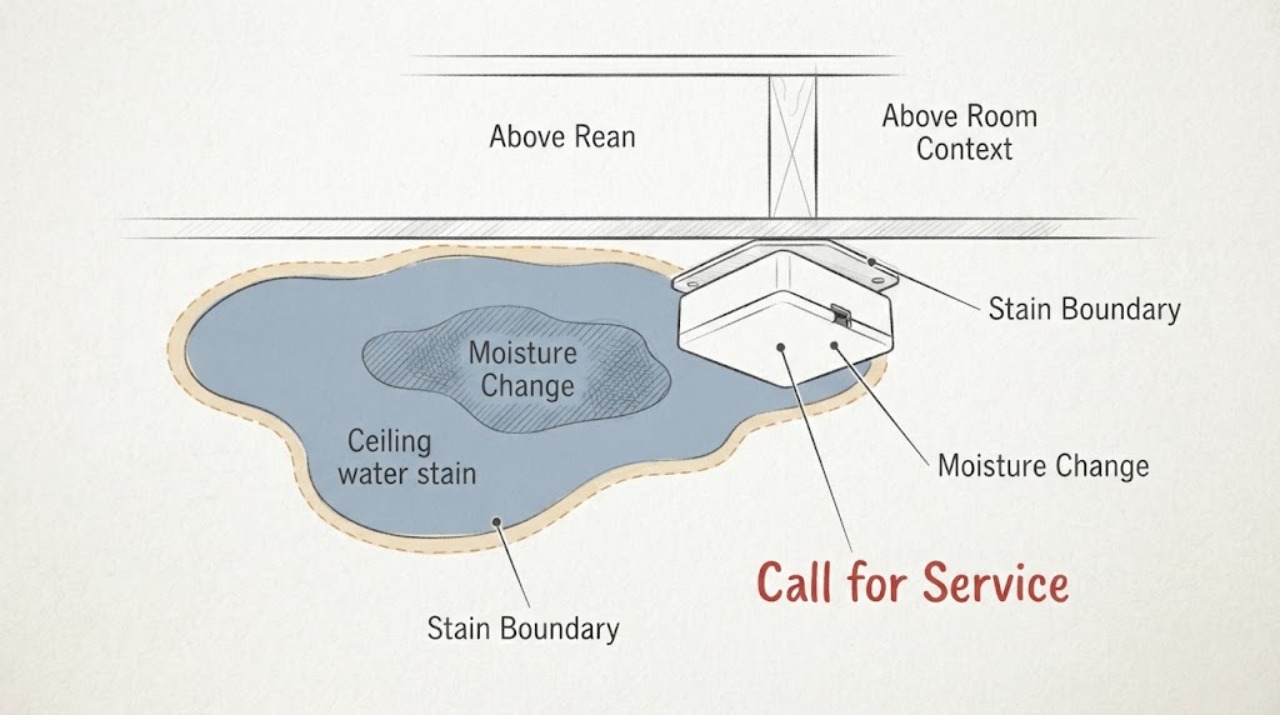
A ceiling water stain means moisture has reached the ceiling or an adjacent building layer, but the visible mark may be older than the leak or may be below a roof, plumbing, HVAC, or bathroom source. From a safe, dry position, document the stain's size and edge, whether it changes after rain or plumbing use, and whether the ceiling is sagging or near electricity. Do not touch, puncture, open, or scrape the ceiling, and do not touch wet electrical equipment or suspected mold. Isolate the area and arrange qualified water-damage or building service; treat dripping, expanding, bulging, damp electrical areas, or a sagging ceiling as urgent.
Work through in order
Diagnostic checks
Use only checks that match the exact appliance or system and its official guide.
-
Check 1
From a safe, dry position, visually document the ceiling stain without touching it, pressing on it, puncturing it, scraping it, or moving a light fixture or ceiling panel.
Expected result: Record the room, approximate location, shape, edge sharpness, discoloration, peeling finish, damp appearance, and whether the edge is stable or visibly expanding.
Next step: Take an overall photo from floor level and request water-damage or building assessment; do not create an opening to inspect above the ceiling.
Stop if: Stop immediately for a bulge, sag, falling material, active dripping, cracking, or any need to stand below an unstable area or use a ladder.
Why this matters
Why: A stable, dry mark may be older damage, while a damp or expanding edge supports an active-moisture concern; neither finding identifies the source by itself.
-
Check 2
Observe the stain from a safe location at separate ordinary times, noting whether its color, edge, dampness, or odor changes after rain, plumbing use, bathing, or HVAC operation; do not run a deliberate water test.
Expected result: Record whether change follows rainfall, a sink or bathroom event, appliance use, condensation, or no identifiable event, and whether the room smells musty.
Next step: Keep the timeline and provide it to the qualified service provider; do not operate fixtures or equipment solely to reproduce the leak.
Stop if: Stop and isolate the area for active dripping, rapidly changing dampness, musty odor with visible growth, or water near electrical equipment.
Why this matters
Why: A repeatable connection can help a professional prioritize roof, plumbing, bathroom, appliance, or HVAC investigation, but timing alone cannot prove the source.
-
Check 3
From safe rooms and ordinary floor-level sight lines, note what is above or near the stained area, such as a bathroom, plumbing fixture, roof edge, attic space, HVAC equipment, or another room; do not enter the attic or open a wall or ceiling.
Expected result: Record the likely neighboring source, any separate stain or damp spot, and whether the ceiling location aligns with a fixture, roof area, vent, pipe chase, or HVAC path.
Next step: Give the room map and photos to the appropriate water-damage, plumbing, roofing, or HVAC professional for coordinated source tracing.
Stop if: Stop if determining the source would require attic entry, roof access, moving wet materials, opening a surface, or contacting a pipe, fixture, or electrical component.
Why this matters
Why: The location can narrow the professional inspection route, but water may travel and a neighboring fixture is not automatically the cause.
-
Check 4
From a dry, safe position, note whether the stain is near a light, fan, outlet, smoke alarm, HVAC register, or other electrical equipment and whether the ceiling appears bowed, sagging, cracked, or loose.
Expected result: Separate a dry cosmetic-looking mark from dripping water, a bulge, loose material, discoloration around electrical equipment, smoke, sparking, or a burning odor.
Next step: Keep everyone out of the area and contact qualified building, water-damage, and electrical help as appropriate; do not touch or remove the nearby equipment.
Stop if: Stop immediately for sagging or bulging, falling material, exposed wiring, sparking, smoke, burning odor, or water contacting energized equipment.
Why this matters
Why: Structural movement or water near electricity can turn a routine inspection into an immediate life-safety issue and should not be investigated by touch.
-
Check 5
Visually check from safe floor-level positions whether staining or dampness extends to adjacent walls, trim, flooring, furnishings, or rooms, and record any occupant health concern without touching suspected mold.
Expected result: Note spreading discoloration, wet flooring, peeling or soft-looking finishes, musty odor, visible mold-like growth, or symptoms that improve away from the room.
Next step: Isolate the affected area, avoid disturbing material, and arrange qualified water-damage or mold-related service; seek medical advice for health concerns.
Stop if: Stop for widespread wetness, visible growth, sewage or contaminated water, breathing difficulty, a vulnerable occupant, or any need to clean or demolish material.
Why this matters
Why: Spread or a health concern suggests a larger moisture or indoor-air scope; visible mold color does not establish species or risk, and professional assessment may be needed.
Use your observations
Decision map
Find the observation that best matches what you see, then follow the next safe action.
-
PATH 01Next step
What you see
The stain is dry, stable, and has no odor, active moisture, electrical proximity, or structural change.
Do this next
Document it and schedule a non-invasive professional assessment before painting or covering it; continue watching for change from a safe position.
-
PATH 02Next step
What you see
The stain grows or becomes damp after rain, plumbing use, bathing, appliance use, or HVAC operation.
Do this next
Treat it as an active leak and request prompt water-source inspection; do not reproduce the event or open the ceiling.
-
PATH 03Next step
What you see
The stain is near a light, fan, outlet, smoke alarm, HVAC equipment, or other electrical component.
Do this next
Keep clear and obtain qualified electrical and water-damage assistance; do not touch, remove, or test the equipment.
-
PATH 04Next step
What you see
The ceiling is bulging, sagging, cracked, dripping, or shedding material.
Do this next
Isolate the area immediately and seek urgent building or water-damage service; do not stand below it, puncture it, or attempt temporary support.
-
PATH 05Next step
What you see
Visible mold-like growth, musty odor, widespread wetness, contaminated water, or occupant health concerns are present.
Do this next
Do not clean, scrape, sample, or demolish the area; keep occupants away and obtain qualified water-damage or mold-remediation guidance.
Helpful context
Understand the symptom
A stain identifies a moisture concern, not its source
Water can travel above a ceiling before appearing as a ring, discoloration, peeling finish, or damp patch. Possible sources include a roof or flashing issue, a plumbing or bathroom leak, condensation, or an HVAC drain problem. A dry-looking stain can still represent a past event, while a growing edge suggests active moisture. The safe homeowner task is visual documentation and escalation, not opening the ceiling to follow the path.
Protect people before investigating
Keep people, pets, and belongings away from the area when the ceiling is damp, bulging, dripping, or shedding material. Do not touch the ceiling, push a bulge, pierce drywall, remove a light fixture, handle mold-like growth, or use a ladder. If water is near an outlet, light, fan, or other electrical equipment, do not touch the equipment; use qualified electrical and water-damage help.
What to give the professional
Share the room, stain location, approximate extent, first noticed date, recent rain or plumbing/HVAC activity, odor, visible moisture, and any nearby electrical or structural concern. Photos from a stable, dry position are useful. Renters should report the condition promptly to the property owner or manager as well as arranging the appropriate service path.
Only after diagnosis
Potential parts
- moisture-meter
Only consider a moisture meter as a supplemental observation aid if a professional confirms it is appropriate; a reading does not locate a hidden leak or replace inspection.
Confirm the meter's intended material range and use it only from a safe, dry position without probing or opening the ceiling. - water-leak-alarm
Only consider an alarm for supplemental monitoring after the area is safe; it cannot repair a ceiling leak or make a bulging ceiling safe.
Place it only on a dry, stable, accessible surface away from electrical hazards and without using it to justify a deliberate water test. - drop-cloth
Only consider a cover for dry, uncontaminated belongings if it can be placed without standing under an unstable ceiling or touching wet material; it is not a ceiling repair.
Keep covers away from electrical equipment, active dripping, mold-like material, and walkways, and follow the professional's protection plan.
When checks do not resolve it
Need a professional?
Call qualified water-damage or building service for any expanding, damp, recurring, or unexplained ceiling stain. Escalate immediately for dripping, bulging, sagging, active spread, water near electricity, structural movement, visible mold-like growth, contaminated water, or occupant health concerns.
Have this ready
- Share the room and stain location, approximate extent, photos from floor level, moisture changes after weather or fixture use, likely source above, nearby electrical equipment, odor or mold-like appearance, and any structural or occupant concern.
Common questions
FAQ
Does a ceiling water stain mean the roof is leaking?
Not necessarily. A plumbing, bathroom, HVAC, condensation, or roof-edge source can produce a similar mark, and water can travel above the ceiling. Record timing and location and have the source traced professionally.
Should I poke a ceiling stain to see if it is wet?
No. Do not puncture, press, or open the ceiling. A hidden cavity may contain water, mold, wiring, or weakened material. Observe from a safe position and arrange qualified assessment.
Can I paint over a dry ceiling stain?
Wait until the moisture source and any hidden damage have been assessed and corrected. Covering a stain can hide an active leak or moisture problem and does not address mold or weakened material.
When is a ceiling water stain an emergency?
Treat it as urgent when the ceiling drips, expands, bulges, sags, cracks, sheds material, or is wet near electrical equipment. Isolate the area and seek qualified building, water-damage, and electrical help as appropriate.
Read the exact guide
Official sources
- A Brief Guide to Mold, Moisture and Your HomeU.S. Environmental Protection Agency · Official homeowner guidance used to distinguish a stain from an unresolved moisture problem and to avoid painting or caulking over affected surfaces.
- Mold Course Chapter 9: PreventionU.S. Environmental Protection Agency · Official EPA mold-prevention guidance used to explain why ceiling stains require moisture-source investigation and safe professional escalation.
- Mold, Testing, and RemediationNational Institute for Occupational Safety and Health, CDC · Official occupational-health guidance used for the no-disturbance boundary and for escalating visible mold or damp building materials.
Community feedback
Share a repair observation
Share a plain-text repair observation. Accepted observations are published automatically; this page may take a moment to update.