
On this page
Start here
Quick answer
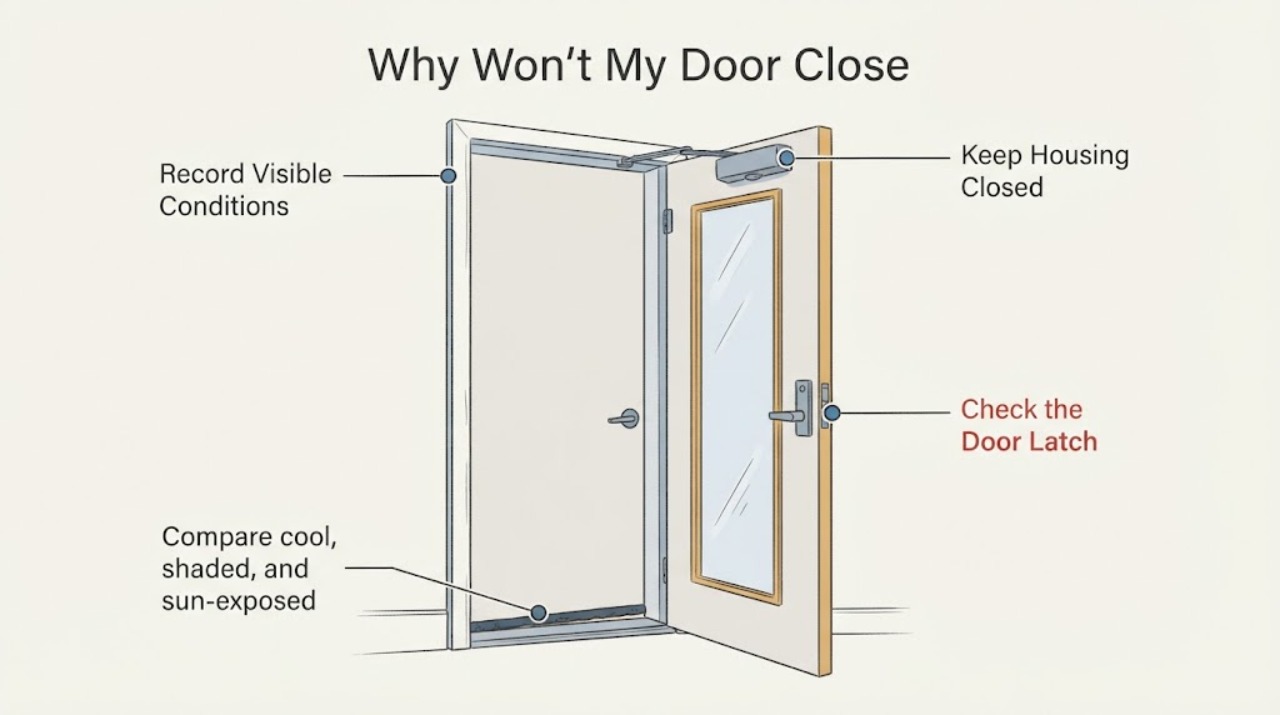
If a door will not close mainly in the morning or daytime, use the time pattern as a clue rather than forcing the latch. Direct sun and the temperature difference between the two sides of an exterior door can temporarily bow the door or bind the lock; a shifted frame, swollen material, worn hinge, roller, closer, weatherstrip, or track can create a similar symptom. Compare the door when it is cool and when the sun is on it, note exactly where it rubs, and inspect the visible sill, track, frame, and latch path. Use only the exact manufacturer's small adjustment for an identified door model. Do not force a glass panel, lift a heavy door, drill or loosen fittings, or keep operating it if the glass is damaged or the frame is unstable; arrange qualified window-and-door service.
Work through in order
Diagnostic checks
Use only checks that match the exact appliance or system and its official guide.
-
Record the morning/daytime pattern without forcing the door
Keep the door in a safe, supported position and record the time, weather, sun direction, and indoor/outdoor temperature difference as practical. Identify whether the door is sliding or hinged and whether it stops before the frame, rubs at one corner, reaches the frame but misses the latch, or swings unpredictably. Keep children and pets away from an opening that cannot be secured.
Expected result: The door fails only when a particular face is in direct sun or when the temperature changes, fails at all times, or has a crack, loose fitting, sagging panel, bent frame, or other visible damage.
Next step: If the door or glass is damaged or unstable, stop using it and arrange qualified service. Otherwise compare operation during a cooler or shaded period and continue with the visible-path inspection.
Why this matters
Why: A repeatable sun or temperature relationship supports a thermal-movement branch, while an all-day failure points more toward a persistent alignment or installation issue. Damaged glass, fittings, or frame stability is a safety boundary regardless of timing.
-
Compare cool, shaded, and sun-exposed operation
Without pushing harder than normal, make one slow closing attempt when the door is cool or shaded and another when the morning/daytime condition is present. Observe whether the gap, rub point, latch alignment, or handle resistance changes with the temperature or sunlight. Do not cool glass or a frame with a hose, and do not alter the strike or latch during this comparison.
Expected result: The door closes normally when cooler or shaded but binds in the morning/daytime condition, or it fails in both conditions at the same point.
Next step: If the issue follows sun or temperature, reduce direct exposure where practical and have the door inspected for proper clearances; do not make a permanent strike or latch change from one hot-period observation. If it fails regardless of conditions, inspect the closing path and plan for service if the next checks do not resolve it.
Why this matters
Why: A reversible sun/temperature relationship is consistent with thermal movement, while the same failure in all conditions suggests a fixed frame, hinge, roller, track, closer, or latch problem. The comparison does not prove which material or part is moving.
-
Inspect the sill, track, frame, and latch path
With the panel supported by its normal hardware, inspect the visible sill or track, weatherstrip, latch receiver, and the gap around the frame for grit, stones, debris, displaced seals, or an object leaning against the door. Note whether the top-to-bottom gap is even on a sliding panel and whether the latch reaches its receiver on a hinged panel. Remove only a loose, harmless obstruction that is safely reachable.
Expected result: An obstruction is present, the sliding-panel gap is tapered, the weatherstrip or sill binds, the latch misses the receiver, or the visible path is clear.
Next step: Remove the safe obstruction and make one slow close attempt. If the gap remains uneven, the latch still misses, or the panel rubs, continue only with a confirmed model-specific adjustment or arrange service.
Why this matters
Why: A clear obstruction can explain a time-specific hard close, but a tapered reveal indicates panel alignment and a missed latch indicates hardware alignment. A clear path with persistent binding leaves frame, roller, hinge, closer, or glass-fitting faults to identify by the exact product instructions.
-
Use the correct model-specific alignment branch
For an identified sliding patio door, follow the manufacturer's instructions for a roller adjustment only when the reveal shows misalignment; make small changes and check movement after each one. For an identified hinged or storm door, check the manufacturer's guidance for closer position, hinge/frame alignment, bottom expander, and strike engagement. Do not use a sliding-door adjustment on a hinged glass door or vice versa.
Expected result: A documented small adjustment restores a uniform gap and smooth closing, or the door still binds, the frame is warped, the hinge/closer is damaged, or the product identity cannot be confirmed.
Next step: If the approved adjustment works, close and latch once slowly during the morning/daytime condition. If it does not work, if hardware is damaged, or if the model instructions are unavailable, stop and arrange qualified window-and-door service.
Why this matters
Why: Andersen says an unequal reveal indicates that a gliding panel needs adjustment and separates roller alignment from latch-receiver alignment. Pella lists closer, expander, hinge, frame, and strike conditions separately. Persistent or unknown conditions are not safe guesses for a homeowner.
-
Make one controlled close and set the service boundary
After a safe obstruction removal or confirmed model-specific adjustment, make one controlled close with hands clear of the edges. Confirm that the panel reaches the frame without scraping, the latch engages without extra force, and the glass and fittings remain stable. Do not keep cycling the door to reproduce a time-specific bind.
Expected result: The door closes and latches in the morning/daytime condition, it closes but will not latch, it still rubs or binds, or the panel/fitting shifts or makes a sharp impact.
Next step: If it fails, secure the opening and arrange qualified service. Provide the door type, full manufacturer/model identity, sun and temperature pattern, rub point, gap observations, latch state, glass condition, and checks completed.
Why this matters
Why: A successful close confirms only that the immediate condition changed. A repeat failure after one controlled attempt points to a persistent frame, hardware, or thermal-clearance issue; shifting glass or a sharp impact is an immediate stop condition.
Use your observations
Decision map
Find the observation that best matches what you see, then follow the next safe action.
-
PATH 01Next step
What you see
The door fails only when direct sun or a particular morning/daytime temperature difference is present and works normally when cooler or shaded.
Do this next
Treat thermal movement as a diagnostic possibility, reduce direct exposure where practical, and have clearances and frame alignment inspected. Do not permanently move the strike, latch, or weatherstrip based only on the hot-period symptom.
-
PATH 02Next step
What you see
The door fails at the same point in all conditions, including cool or shaded periods.
Do this next
Look for a fixed obstruction, unequal reveal, worn roller, binding hinge, closer, strike, or frame alignment problem, then arrange qualified service if one safe external check does not resolve it.
-
PATH 03Next step
What you see
The visible sill, track, latch path, weatherstrip, or frame has a harmless loose obstruction that is safely reachable.
Do this next
Remove only the obstruction without forcing the panel, then make one slow close attempt. If the door still binds or will not latch, stop and arrange service.
-
PATH 04Safety boundary
What you see
The glass is cracked or chipped, a fitting is loose, the panel is sagging or unstable, or the frame or hinge is bent or warped.
Do this next
Keep people clear, do not operate or lift the door, and arrange qualified window-and-door or glass service. Do not remove a heavy panel or attempt structural alignment.
Why this path and its safety boundary
Safety stop: True
-
PATH 05Safety boundary
What you see
The door still rubs, binds, misses the latch, or cannot be secured after one safe path check and an approved model-specific adjustment.
Do this next
Stop troubleshooting and arrange qualified service. Give the technician the time-of-day pattern, sunlight and temperature observations, failure location, door identity, glass condition, and adjustments already attempted.
Why this path and its safety boundary
Safety stop: True
Helpful context
Understand the symptom
Morning and daytime timing changes the diagnosis
A time-specific failure is valuable evidence. Note whether the problem follows direct sun on the door, a large indoor/outdoor temperature difference, overnight moisture, or a predictable part of the day. Allegion's thermal-bow guidance describes sun-driven movement and says a door that binds only under that exposure should not be permanently corrected by randomly moving the strike or latch. A door that fails in every condition needs an alignment or installation assessment instead.
First distinguish rubbing from a latch failure
A panel that stops before the frame is rubbing or obstructed; a panel that reaches the frame but will not latch has a different decision path. Look for an unequal gap, a mark at one corner, a latch that misses the receiver, or a closer that stops short. Do not increase force to overcome a seasonal bind, especially on a door with a glass panel.
Use manufacturer adjustments only for a known product
Andersen's gliding-door instructions use the panel reveal to decide whether rollers need adjustment and distinguish latch-receiver work from roller alignment. Pella's storm-door troubleshooting separates closer position, expander position, binding hinges, frame alignment, and strike alignment. These are examples of different hardware systems, not interchangeable instructions for an unidentified door.
Glass and heavy fittings are not a DIY force test
A door can be heavy even when it looks simple. Andersen warns that doors and windows require safe lifting techniques, and its storm-door guide notes that hardware can become hot in sunlight. Keep hands clear of the closing edge, do not remove a panel alone, and stop when glass, hinges, fasteners, or the opening look damaged or unstable.
Only after diagnosis
Potential parts
- sliding-door roller or track hardware
Consider this only when a confirmed sliding-door model has an uneven reveal or persistent rough movement after the visible path is clear and qualified diagnosis identifies the roller or track.
Confirm the complete door manufacturer and model and approved fit information; panel removal and roller replacement require qualified handling of the heavy glass assembly. - hinge or door-closer hardware
Consider this only when a qualified inspection confirms that the hinge, closer, or its mounting position causes the morning/daytime closing failure after the frame and path are checked.
Glass-door fittings are model- and weight-specific; verify the manufacturer's service information and use qualified installation. - latch, strike, or receiver hardware
Consider latch or receiver hardware only when the intact door reaches the frame with correct alignment but still misses or fails to engage, and the exact hardware is identified.
Confirm the full door identity and approved hardware compatibility; do not alter a structural glass fitting to compensate for thermal movement or an unknown frame problem.
When checks do not resolve it
Need a professional?
Call qualified window-and-door or glass service for recurring time-of-day binding, a warped or out-of-square opening, damaged glass or fittings, a failed roller or track, a hinge or closer problem, or a latch that will not engage after safe checks.
Common questions
FAQ
Why does my door only refuse to close in the morning or daytime?
A repeatable relationship with sunlight or a temperature difference can indicate temporary thermal movement that makes the frame or latch bind. Compare cool/shaded and sun-exposed operation without forcing the door; if it fails at all times, look for a fixed alignment, hardware, or installation issue.
Should I move the strike plate to make a sun-affected door close?
Do not make a permanent strike or latch change from one hot-period symptom. Allegion describes field strike, latch, or weatherstrip changes as an inadequate response to thermal bow; have the opening and clearances assessed instead.
What can I check on a sliding glass door that binds during the day?
Check the visible track and sill for a safe obstruction and compare the panel's top-to-bottom reveal. An uneven reveal can indicate a model-specific roller adjustment, but the exact door instructions must be confirmed before changing anything.
When should I stop troubleshooting a glass door that won't close?
Stop for cracked or loose glass, a sagging or unstable panel, a bent frame or fitting, hard binding, or a door that still will not latch after one safe external check and an approved adjustment. Keep people clear and arrange qualified window-and-door or glass service.
Read the exact guide
Official sources
- TROUBLE SHOOTING GUIDEPella Corporation · Pella troubleshooting table for a door that does not open or close properly and for a handle that does not latch correctly.
- Storm Door Installation GuideAndersen Windows & Doors · Manufacturer safety and installation guidance that doors can be heavy, hardware can become hot in sunlight, and safe lifting and protective equipment are required.
- What is thermal bow?Allegion · Manufacturer hardware guidance on sun- and temperature-differential-related thermal bow, latch binding, time-of-day symptoms, and why field strike/latch changes are not a reliable permanent fix.
- Gliding Patio Door Hardware Adjustment and Replacement GuideAndersen Windows & Doors · Manufacturer guidance for an unequal top-to-bottom reveal, gliding-panel adjustment, lock alignment, and the panel-removal boundary for roller replacement.
- Patio Door AdjustmentsAndersen Windows & Doors · Manufacturer maintenance and adjustment guidance for identified Andersen patio-door panels, rollers, reveals, and latch receivers.
Community feedback
Share a repair observation
Share a plain-text repair observation. Accepted observations are published automatically; this page may take a moment to update.