
On this page
Start here
Quick answer
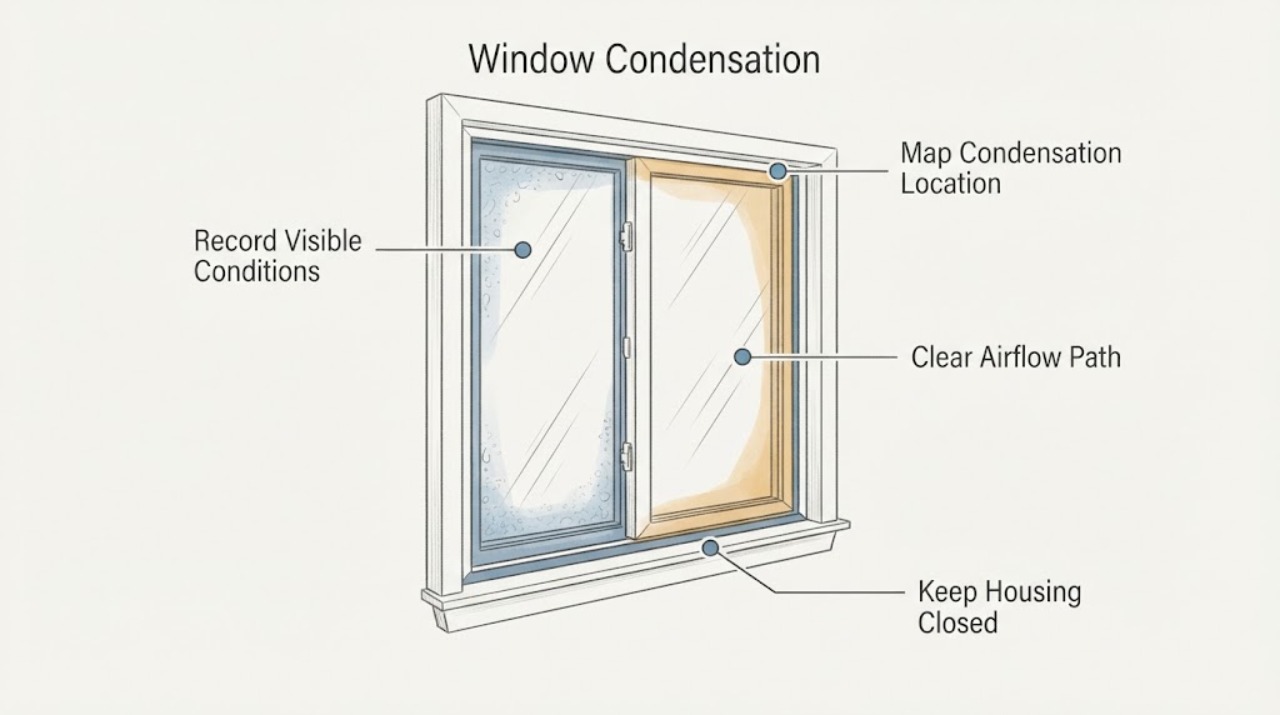
First identify where the water is: on the room-side glass, on the outdoor glass, or between sealed panes. Room-side condensation usually means humid indoor air has reached a glass surface colder than its dew point, so record indoor humidity, improve exhaust from cooking, bathing, and laundry, keep air moving over the glass, and avoid blocking the window with tight coverings. Outdoor condensation can occur when indoor cooling makes the exterior glass cold in warm humid weather. Moisture or fog trapped between insulating-glass panes points to a failed glass seal and cannot be solved by wiping the room-side surface. Water at the frame, sill, or wall, peeling finishes, mold, a draft, cracked glass, or recurring between-pane fog needs a window professional; do not drill the glass, remove glazing, or seal over a drainage path.
Before you begin
Safety first
- This article covers observation, drying visible surfaces, humidity notes, and ordinary ventilation changes only. Do not remove glazing, drill glass, alter frame drainage, open wall cavities, or seal over an active leak.
Work through in order
Diagnostic checks
Use only checks that match the exact appliance or system and its official guide.
-
Check 1
When the window is safe to approach, identify whether droplets or haze are on the room-side glass, on the outdoor surface, between panes, at the sash or frame edge, on the sill, or on the adjacent wall; wipe only the accessible room-side surface.
Expected result: Record the exact surface, whether the moisture wipes away, whether it returns, whether one or many windows are affected, and whether staining or soft materials surround the opening.
Next step: Use the location to choose the humidity, airflow, or seal checks below. Stop and arrange window service for between-pane fog, water entering the wall, visible mold, damaged glass, or a sill that stays wet.
Stop if: Do not remove glazing beads, drill the glass, pry the sash, or cover a sill or weep path to hide the moisture.
Why this matters
Why: Room-side or outdoor surface moisture follows air humidity and surface-temperature conditions. Moisture trapped between panes points to the insulating-glass seal. Water at the frame, sill, or wall points to a perimeter, drainage, flashing, or installation issue.
-
Check 2
Use a room hygrometer to record indoor humidity and note whether condensation coincides with cooking, bathing, laundry, a humidifier, drying clothes indoors, many occupants, or closed ventilation fans.
Expected result: Record the humidity trend when the glass is dry and when it is wet, the room activity, whether other cold surfaces also collect water, and whether the issue is seasonal.
Next step: Vent cooking, bathing, and laundry outdoors as the building allows, use the existing ventilation controls, and reduce or adjust any humidifier according to its instructions. Recheck the same window without changing the glass or seal.
Stop if: Do not use an unvented fuel-burning appliance to dry the room, overheat the glass, or rely on a humidity reading to dismiss water entering the frame or wall.
Why this matters
Why: High or rising indoor moisture with room-side droplets supports a humid-air and cold-surface cause. Condensation on one window only, normal room humidity, or moisture between panes weakens that explanation and shifts attention to the window assembly or local cold bridge.
-
Check 3
Check whether blinds, curtains, furniture, or a radiator arrangement blocks warm room air from reaching the affected glass, and confirm kitchen, bath, and laundry exhaust fans discharge outdoors rather than into an attic or crawlspace.
Expected result: Record clear airflow, a tight covering or furniture obstruction, a fan that is missing or ineffective, or moisture that persists despite airflow and ventilation.
Next step: Open or reposition coverings and use correctly vented exhaust fans during moisture-producing activities, then compare the same glass surface. Have a professional assess the window when the frame leaks, the fan route is inaccessible, or water remains.
Stop if: Do not block exterior vents, tape over window drainage openings, install an unapproved interior liner, or dismantle a fan or window frame to improve airflow.
Why this matters
Why: Poor air circulation can keep the glass colder and allow room-side condensation to form. A fan that does not exhaust outdoors leaves moisture in the house. Persistence after airflow changes points to humidity level, thermal performance, frame leakage, or a failed seal.
-
Check 4
From inside and outside where safely reachable, inspect the frame, sash or gasket, corners, sill, and visible sealant for cracks, gaps, brittleness, movement, staining, or a draft; check that the window closes and locks normally.
Expected result: Record an intact dry perimeter, a local draft or gap, failed sealant, water staining, a loose frame, a window that will not close or lock, or an area that cannot be inspected without removing trim.
Next step: Document the defect and follow the exact manufacturer's maintenance guidance for a minor accessible sealant or gasket issue; arrange qualified service for a loose frame, failed lock, water entry, rotten material, or any repair requiring trim removal.
Stop if: Do not seal over weep holes or drainage paths, pack the frame with unapproved foam, remove trim containing lead paint without appropriate controls, or force a window that will not close.
Why this matters
Why: A draft, failed perimeter seal, loose frame, or water staining can admit cold air or liquid water and may create condensation or hidden wall damage. A dry intact perimeter makes room humidity, surface temperature, and between-pane seal checks more important.
-
Check 5
Look through the glass at an angle in changing light to determine whether haze or droplets remain inside the sealed space between panes rather than on either wipeable surface.
Expected result: Record a clear sealed space, persistent fog or droplets between panes, edge-only haze, or cracked or damaged glass.
Next step: Keep the window in normal use only if it is secure and undamaged, and arrange a window professional to assess the insulated glass unit or sash and any applicable product coverage. Stop for cracked, loose, or sharp glass.
Stop if: Do not drill a drain hole, pry apart insulating glass, inject a desiccant, remove glazing, or order glass by appearance alone.
Why this matters
Why: Persistent moisture between panes is consistent with an insulating-glass seal failure; wiping, room ventilation, or adding exterior caulk will not dry that sealed space. Cracked or damaged glass adds an immediate breakage and injury concern.
-
Check 6
After documenting the location, humidity, ventilation, airflow, and frame observations, compare the same window during a similar weather or room-use period without adding sealant or changing the glazing.
Expected result: Record reduced room-side droplets, unchanged surface condensation, recurring between-pane fog, water at the sill or wall, mold or finish damage, or a window that becomes difficult to operate.
Next step: Continue the successful humidity and airflow measures while protecting the sill, or arrange qualified window service with photos, humidity notes, weather, and the exact location and recurrence pattern.
Stop if: Do not keep adding caulk, cover wet materials, or postpone service when water is reaching the wall, finishes, insulation, or electrical components.
Why this matters
Why: A reduction after moisture and airflow changes supports room humidity as a contributor. Persistent between-pane moisture, frame water, damage, or operation failure indicates a glass, seal, installation, or structural issue requiring professional assessment.
Use your observations
Decision map
Find the observation that best matches what you see, then follow the next safe action.
-
PATH 01Safety boundary
What you see
Droplets are on the room-side glass, occur during cold weather or moisture-producing activities, and the sealed space between panes is clear.
Do this next
Vent cooking, bathing, and laundry outdoors, manage humidifier use, and allow air to circulate over the glass; monitor the same window and sill for recurrence.
Why this path and its safety boundary
Why it matters: Humid indoor air contacting a cold surface is the leading explanation; the window may be functioning normally while room moisture is too high for the surface conditions.
Safety stop: Arrange service if water reaches the wall or frame, the glass is damaged, mold appears, or condensation continues despite reasonable humidity and airflow changes.
-
PATH 02Safety boundary
What you see
Moisture is on the outdoor glass surface during warm, humid weather while the indoor side and frame remain dry.
Do this next
Observe whether the moisture clears as outdoor conditions change, keep exterior drainage clear, and call service only if moisture moves between panes or enters the frame or wall.
Why this path and its safety boundary
Why it matters: Indoor cooling can leave the exterior glass below the outdoor dew point; outdoor surface condensation does not by itself prove a failed window seal.
Safety stop: Do not scratch the outdoor glass, apply an unapproved coating, or seal exterior drainage openings to remove temporary dew.
-
PATH 03Safety boundary
What you see
Haze or droplets persist between sealed panes and cannot be wiped from either accessible glass surface.
Do this next
Arrange a window professional to identify the insulating-glass unit or sash and determine a compatible repair or replacement path.
Why this path and its safety boundary
Why it matters: Moisture has entered the insulating-glass space, consistent with a failed glass seal rather than ordinary room humidity.
Safety stop: Do not drill the pane, separate the glass, inject materials, or cover the fog with film as a supposed repair.
-
PATH 04Safety boundary
What you see
Water appears at the frame, sash edge, sill, or adjacent wall, or sealant and finishes are stained, cracked, soft, or moldy.
Do this next
Protect nearby finishes, document the path during and after rain, and arrange qualified window or building-envelope service to trace the entry before resealing.
Why this path and its safety boundary
Why it matters: This may be a perimeter seal, flashing, drainage, installation, or structural moisture problem rather than surface condensation.
Safety stop: Do not caulk over weep paths, seal the bottom drainage edge, remove trim blindly, or leave persistent wet wall materials untreated.
-
PATH 05Safety boundary
What you see
Room-side droplets are concentrated at the glass edge or a covered corner, while humidity is not obviously high and the frame is dry.
Do this next
Open coverings, restore airflow, document indoor humidity and weather, and request a window assessment if the pattern persists or the frame is poorly insulated.
Why this path and its safety boundary
Why it matters: A colder edge, restricted room airflow, thermal bridge, or frame and glass design may be lowering the local surface temperature.
Safety stop: Do not add interior foam, remove glazing, or alter the frame or glass coatings without product-specific guidance.
-
PATH 06Safety boundary
What you see
The glass is cracked or loose, the sash will not close or lock, or condensation is accompanied by a draft, movement, or damaged gasket.
Do this next
Stop handling damaged glass, secure the area without putting pressure on the pane, and arrange qualified glazing or window service.
Why this path and its safety boundary
Why it matters: The window has a safety, security, or weather-resistance defect that ordinary humidity control cannot correct.
Safety stop: Do not tape, drill, pry, or force the sash and do not rely on a temporary film as structural or weather protection.
Helpful context
Understand the symptom
The location of the water changes the diagnosis
Water on the room side of one or more panes is usually a humidity and surface-temperature problem, especially during cold weather. Water on the exterior can occur when indoor cooling leaves the outside glass below the outdoor dew point. Haze or droplets sealed between panes are different: they indicate moisture inside the insulating-glass space and should not be treated as ordinary room humidity. Water at the frame, sill, or wall suggests an installation, sealant, flashing, or drainage problem.
Reduce room-side moisture without creating a hidden leak
Use a hygrometer to compare the room's humidity when condensation appears, and note recent cooking, bathing, laundry, humidifier, or ventilation changes. ENERGY STAR recommends managing humidity and exhausting kitchen, bath, and laundry moisture outdoors. Open or reposition coverings so air can circulate over the glass, but do not tape over weep paths or exterior joints.
Check the glass, frame, and seal separately
Dry the visible surface and watch where moisture returns. Inspect the gasket, sash or frame edges, corners, sill, and exterior sealant for gaps, brittleness, movement, or staining. A cold edge with room-side droplets can be consistent with humidity; moisture that reappears between panes, a failed gasket, or water entering the wall needs a product-specific assessment rather than more caulk on the interior surface.
Do not turn condensation into a glass or mold hazard
Wipe standing water from the room-side sill and protect nearby finishes while the cause is being assessed. Do not use a drill, razor, solvent, heat gun, or improvised spacer on the glass or seal. If wood, drywall, insulation, or finishes stay wet, if mold is visible, or if the window no longer closes and seals, arrange qualified service to trace the moisture path and assess the glass or frame.
Safety boundary
Stop conditions
- Stop and arrange service for cracked or loose glass, a window that will not close or lock, a loose frame, water entering the wall, visible mold, or wet electrical components.
- Do not drill or separate sealed panes, inject desiccant, pry glazing, use a heat gun, or apply solvent or abrasive to glass or gaskets.
- Do not caulk over sill drainage, weep holes, flashing edges, or an active leak before the moisture path is understood.
- Do not block the glass with tight coverings or furniture when airflow is needed, and do not vent cooking, bathing, laundry, or a dryer into an attic or crawlspace.
- Arrange qualified window service when between-pane fog persists, humidity and airflow changes do not reduce room-side condensation, or repair would require trim, glazing, frame, or wall access.
Only after diagnosis
Potential parts
- insulating glass unit
Consider this category only when persistent moisture between panes confirms or strongly indicates a failed sealed glass unit and the exact opening can be measured.
Confirm the window model, dimensions, glazing construction, spacer, coating, safety requirements, and installation method with a qualified professional; do not order by visible appearance alone. - window gasket or weatherstrip
Consider this category only when inspection confirms a deteriorated or displaced gasket is causing a draft, perimeter condensation, or water entry and the product permits replacement.
Match the exact window system, profile, material, and location; do not add a thicker gasket that prevents the sash from closing or blocks drainage. - compatible exterior sealant
Consider this category only after the moisture path is identified as a failed accessible perimeter seal rather than between-pane failure, blocked drainage, or concealed wall leakage.
Use the manufacturer's approved product and application boundary; preserve expansion joints, weep paths, flashing, and drainage. - humidity-control or ventilation component
Consider this category only when room-side condensation tracks high indoor moisture and ordinary use of existing exhaust and airflow does not adequately manage it.
Select equipment for the room, climate, electrical supply, and outdoor exhaust route with qualified advice; do not vent moisture into an attic or crawlspace.
When checks do not resolve it
Need a professional?
Arrange qualified window or glazing service for persistent moisture between panes, water at the frame, sill, or wall, mold or finish damage, cracked or loose glass, a window that will not close or lock, a failed gasket or frame, or condensation that continues after reasonable humidity and airflow changes. A professional should also assess any suspected flashing, drainage, insulation, structural, or insulated-glass-unit problem before sealant or replacement work.
Safety scope: This article covers observation, drying visible surfaces, humidity notes, and ordinary ventilation changes only. Do not remove glazing, drill glass, alter frame drainage, open wall cavities, or seal over an active leak.
Common questions
FAQ
Why is there condensation on the inside of my window?
Warm humid indoor air can condense on glass that is colder than its dew point, especially in cold weather. Record humidity, vent cooking and bathing outdoors, and allow air to circulate over the glass. Water at the frame or wall needs a separate leak assessment.
What does condensation between window panes mean?
Persistent haze or droplets between sealed panes are consistent with moisture inside the insulating-glass space and a failed glass seal. Wiping the room-side surface will not fix it; arrange a qualified window assessment for the glass unit or sash.
Can curtains cause window condensation?
Tight coverings can restrict warm room air from reaching the glass and make a cold surface more likely to collect room-side moisture. Open or reposition coverings to allow airflow, while keeping window drainage paths clear.
Is condensation on the outside of a window a leak?
Not necessarily. On a warm humid day, indoor cooling can leave the exterior glass below the outdoor dew point. It becomes a service concern when moisture moves into the frame or wall, appears between panes, or is accompanied by damage.
When should I call a window professional for condensation?
Call when moisture is between panes, water reaches the frame, sill, or wall, mold or finish damage appears, glass or gaskets are damaged, the window will not close or lock, or reasonable humidity and airflow changes do not reduce room-side condensation.
Read the exact guide
Official sources
- Residential Windows, Doors, & SkylightsENERGY STAR · Official ENERGY STAR guidance for residential windows, doors, and skylights; exact product instructions and local building conditions control a particular opening.
- Winterize Windows to Keep the Cold at BayPella · Official Pella winterization guidance; use the exact window system's manual before replacing seals or applying sealant.
- The Cost of a Bad InstallationPella · Official Pella professional installation guidance; it is general installation context and not a substitute for a particular window's manual.
Community feedback
Share a repair observation
Share a plain-text repair observation. Accepted observations are published automatically; this page may take a moment to update.