
On this page
Start here
Quick answer
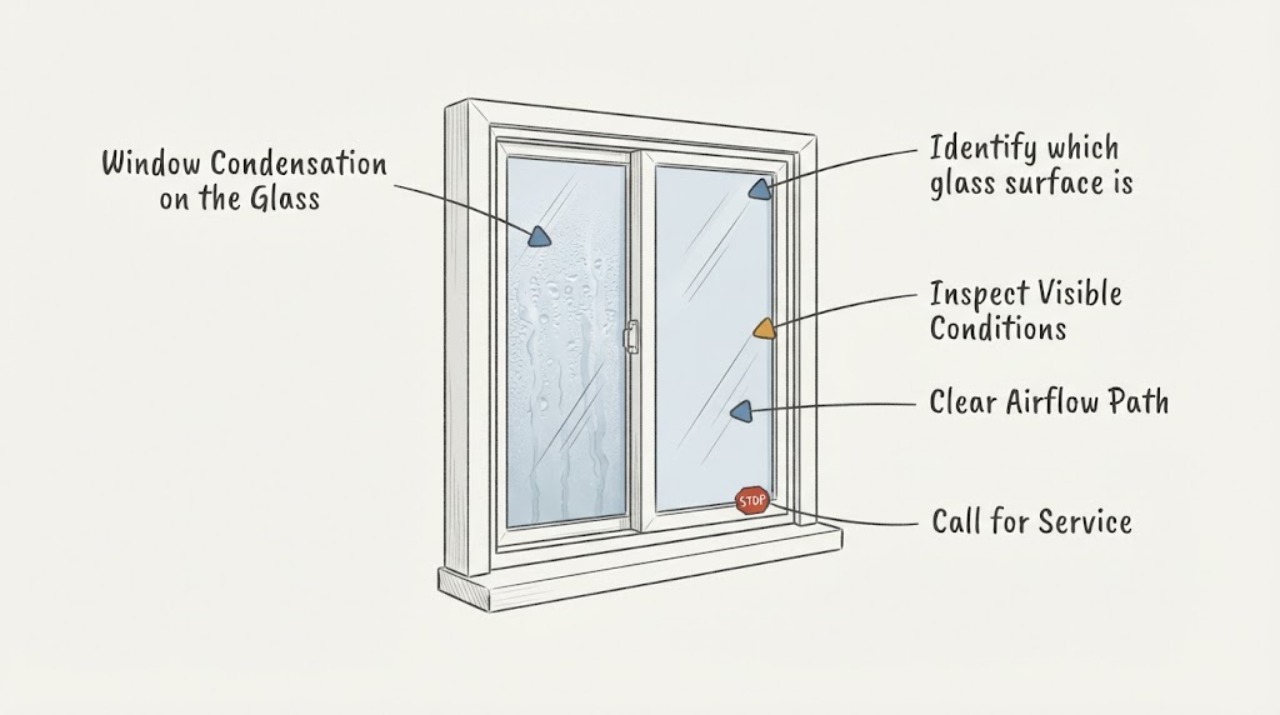
Start by locating the water: on the room-side glass, on the exterior glass, or between sealed panes. Surface condensation usually forms when humid air meets cooler glass; the risk increases with indoor moisture, cold weather, low air movement, or coverings that trap cool air at the pane. Reduce moisture at its source, use the home's existing ventilation as appropriate, and leave blinds or curtains open enough for air to reach the glass. If moisture is visibly trapped between double- or triple-pane glass, it is a different condition: a failed insulated-glass seal is likely and the glass unit normally needs professional replacement. Wipe standing water to protect the sill, but stop and arrange window or building-envelope service if the frame or wall is wet, the glass is cracked, condensation returns despite controlled humidity and airflow, or you cannot safely distinguish condensation from a leak.
Work through in order
Diagnostic checks
Use only checks that match the exact appliance or system and its official guide.
-
Identify which glass surface is wet
With clean, dry hands, look at the condensation from both sides of the window and gently wipe the accessible room-facing surface with a soft cloth. Note whether the water is on the room side, on the exterior, or appears cloudy or wet between sealed panes. Do not press hard on the glass or attempt to separate the panes.
Expected result: The water wipes from the room side, appears only outside, or remains trapped between panes after both accessible surfaces are dry.
Next step: Use the room-humidity and airflow checks for interior surface water, monitor exterior condensation as a weather pattern, and arrange glazing service for moisture trapped between panes.
Stop if: Stop if the glass is cracked, loose, sharp at an edge, or under visible pressure; keep people away and arrange qualified glass service.
Why this matters
Why: Surface location separates a humidity or weather condition from a likely insulating-glass seal failure. Wiping cannot remove moisture inside a sealed unit, so persistent between-pane fog is not solved by cleaning the room.
-
Look for a repeatable indoor moisture pattern
Record when the condensation appears and what was happening nearby: cold weather, a shower, cooking, laundry, sleeping, humidifier use, or many people in the room. If available, read the room's humidity with a hygrometer and compare a room with condensation to one without it; do not set a humidifier solely from one window reading.
Expected result: Condensation follows a moisture-generating activity or cold spell, appears in several rooms, or is isolated to one window despite similar room conditions.
Next step: Reduce the nearby moisture source and use appropriate ventilation, then monitor the same window and adjacent surfaces. If only one unit persists after normal humidity control, inspect its airflow, seal, and surrounding envelope.
Stop if: Do not deliberately raise or lower humidity to an extreme, disable required ventilation, or operate an unvented combustion appliance as a condensation test.
Why this matters
Why: A whole-room or activity-linked pattern supports indoor humidity and air exchange as the driver. One isolated pane can also reflect its size, orientation, colder edge, local airflow, or a window-specific thermal or sealing condition; the pattern does not prove a failed window by itself.
-
Remove airflow obstructions at the pane
Open interior blinds or curtains enough for room air to reach the glass, and move only lightweight furniture or decor that blocks the sill or a nearby heat register. Check that a radiator or supply vent is not covered. Do not move heavy furniture, modify a register, or block an exit window.
Expected result: The glass is behind tightly closed coverings, a sill or nearby object blocks air, a heat register is covered, or the pane has a clear air path.
Next step: Leave the window area open to normal room circulation and observe whether the pane dries. If the sill, wall, or one glass edge remains wet, check the frame and installation boundary rather than adding sealant blindly.
Stop if: Do not cover heating or ventilation equipment, force a stuck shade against the glass, or make changes that obstruct an emergency egress window.
Why this matters
Why: Still air near a cold pane lets the glass remain cooler and allows moisture to collect. Milgard specifically identifies allowing air movement between shades and the window as one way to reduce interior condensation; persistent water with clear airflow needs a broader assessment.
-
Use existing ventilation at the moisture source
During showering, cooking, or laundry, run the existing bathroom or kitchen exhaust as its instructions allow and keep the room's air path open. If the home has an HRV or ERV, check its normal operating status and maintenance instructions; do not redesign or increase the system beyond its controls without professional advice.
Expected result: Condensation decreases after the moisture source is exhausted, remains unchanged throughout the home, or increases after a ventilation change.
Next step: Continue source control within the existing system's instructions and monitor. Ask a qualified ventilation or building professional to assess persistent whole-home humidity, an HRV/ERV fault, or any proposed retrofit.
Stop if: Stop a ventilation change if it causes backdrafting concerns, combustion odor, unusual appliance behavior, or unsafe house depressurization; obtain qualified help.
Why this matters
Why: A decrease after source control supports excess indoor moisture or inadequate air exchange. No change suggests the pane may be unusually cold, locally blocked, or affected by a sealed-unit or building-envelope issue. Ventilation systems have climate and combustion-safety tradeoffs, so a change that worsens comfort or creates drafts needs review.
-
Check for moisture trapped between sealed panes
From a safe standing position, inspect the space between double- or triple-pane glass for a persistent fog, droplets, or milky band that does not wipe away from either accessible surface. Photograph the pattern and note whether it changes with outdoor temperature. Do not drill, puncture, pry, or inject anything into the glass unit.
Expected result: The between-pane haze remains, only surface water is present, or the glass unit shows a crack, edge damage, or a broken spacer or seal.
Next step: Provide the photos, window location, pane count, and any manufacturer or installer information to a qualified glazier or window service for an insulated-glass-unit assessment.
Stop if: Do not attempt a do-it-yourself sealed-unit repair, remove glazing beads, or handle cracked or loose glass without qualified glass safety procedures.
Why this matters
Why: Pella identifies moisture entering the space between insulating panes after seal failure and says the window or insulated glass unit typically needs replacement. A persistent haze therefore changes the remedy from humidity control to glazing evaluation.
-
Separate condensation from a frame or wall leak
After drying the sill, inspect the lower frame, corners, trim, and nearby wall for staining, swelling, peeling finish, mold-like growth, or water that appears after rain rather than after indoor moisture events. Check the exterior visually from ground level for obvious damaged sealant or a blocked drainage path; do not climb or dismantle the window.
Expected result: Water is limited to glass droplets, the sill or wall is also wet, damage follows rain, or the frame appears sound and dry after the pane dries.
Next step: Document the timing and affected materials. Arrange window or building-envelope service for rain-linked water, wall damage, recurring sill wetness, or any exterior work above safe reach.
Stop if: Do not climb ladders, remove exterior trim, scrape suspected hazardous growth, or seal over an active leak before its path is diagnosed.
Why this matters
Why: Glass droplets can be condensation, but wet trim or rain-linked staining may indicate drainage, flashing, sealant, or building-envelope leakage. Surface condensation that dries without material damage has a different service path from water entering the assembly.
-
Set the professional-service boundary
Keep a short record of room humidity readings if available, weather, moisture activities, pane location, whether the water is inside/outside/between panes, airflow and covering changes, and any frame or wall damage. Use that record when requesting service; do not make live thermal or structural tests on the window.
Expected result: The condensation stops with ordinary moisture and airflow control, recurs on one pane, is trapped between panes, or has caused damage around the opening.
Next step: Continue normal moisture control when the glass dries and no materials are damaged. Otherwise arrange qualified window, glazing, or building-envelope service with the record and photos.
Stop if: Stop and seek urgent help for cracked or loose glass, falling components, water reaching electrical equipment, structural movement, or rapidly spreading wall damage.
Why this matters
Why: A repeatable improvement from source and airflow control supports a moisture-management issue. Recurrence in one unit, failed sealed glass, or damage to the frame or wall points to glazing or building-envelope diagnosis beyond a cloth, fan, or household setting.
Use your observations
Decision map
Find the observation that best matches what you see, then follow the next safe action.
-
PATH 01Next step
What you see
Water wipes from the room-facing glass and appears after cooking, showering, laundry, or a cold-weather change.
Do this next
Control moisture at its source, use existing ventilation as directed, and keep air moving across the pane; monitor the sill for damage.
Why this path and its safety boundary
Why it matters: Indoor humidity and the temperature of the glass are the leading explanation.
-
PATH 02Next step
What you see
Condensation appears only on the exterior during a cool night or changing weather and the room side stays dry.
Do this next
Observe whether it clears as outdoor conditions change; seek service only if there is cracked glass, frame damage, or another separate leak symptom.
Why this path and its safety boundary
Why it matters: Exterior dew-like condensation can be a weather and glass-temperature condition rather than a failed window.
-
PATH 03Next step
What you see
Fog or droplets remain between sealed panes after both accessible surfaces are dry.
Do this next
Photograph the pattern and arrange a qualified glazing assessment; do not drill or pry the sealed unit.
Why this path and its safety boundary
Why it matters: An insulating-glass-unit seal failure is possible.
-
PATH 04Next step
What you see
Condensation is concentrated behind closed blinds, curtains, furniture, or a blocked heat register.
Do this next
Restore safe airflow around the pane and monitor before considering replacement or sealant.
Why this path and its safety boundary
Why it matters: Restricted air movement may be keeping the glass colder and allowing moisture to collect.
-
PATH 05Next step
What you see
Condensation occurs throughout the home or follows high-moisture activities and improves when existing ventilation is used.
Do this next
Continue source control within the ventilation system's instructions and consult a qualified ventilation professional for persistent humidity or proposed system changes.
Why this path and its safety boundary
Why it matters: The broader indoor humidity or air-exchange condition is contributing.
-
PATH 06Next step
What you see
The sill, frame, trim, or adjacent wall is wet, stained, swollen, or affected after rain rather than only after indoor moisture events.
Do this next
Document the timing and arrange qualified window or building-envelope service; do not cover the active path with unverified sealant.
Why this path and its safety boundary
Why it matters: A window, drainage, flashing, sealant, or building-envelope leak must be considered.
Helpful context
Understand the symptom
Where the moisture sits changes the diagnosis
Water on the room-facing glass is usually a room humidity and glass-temperature interaction. Water on the outside can be dew-like condensation under the weather conditions described by window manufacturers. A cloudy film or droplets that cannot be wiped from the space between sealed panes points to an insulating-glass-unit seal problem, not simply a steamy room.
Control moisture without trapping air at the glass
Cooking, showering, laundry, humidifiers, plants, and occupants can add moisture indoors. Use existing kitchen or bathroom exhaust and any installed ventilation system according to its instructions, and avoid closing curtains or blinds tightly against a wet pane. Ventilation changes can affect comfort, energy use, and combustion appliances, so major system modifications should be handled by a qualified professional.
Safety boundary
Stop conditions
- Do not drill, puncture, pry, or inject material into a sealed glass unit, and do not remove glazing beads or exterior trim as a condensation test.
- Stop for cracked, loose, sharp, or falling glass; keep people away and arrange qualified glass service.
- Do not climb, make unsafe exterior repairs, seal over an active leak, or scrape suspected hazardous growth without appropriate professional controls.
- Stop a ventilation change if it causes combustion odor, appliance backdrafting concerns, unsafe depressurization, or other indoor-air safety symptoms.
Only after diagnosis
Potential parts
- insulated glass unit
Consider this category only when a qualified glazing assessment confirms moisture between sealed panes or another failed insulated unit condition.
Confirm the exact opening dimensions, pane configuration, frame system, and safety requirements with the glazing professional before ordering. - window weatherstripping or perimeter seal
Consider this category only when inspection identifies a failed operable-sash seal or perimeter air path rather than ordinary room-side humidity.
Match the window system and profile through the manufacturer or professional; do not use an unverified seal to conceal a drainage or structural leak.
When checks do not resolve it
Need a professional?
Arrange qualified glazing service when moisture remains between sealed panes, the glass unit is cracked or loose, or condensation returns on one unit despite ordinary humidity and airflow control. Arrange window or building-envelope service when the sill, frame, trim, or wall is wet or damaged, water follows rain, or the window has a suspected drainage or installation fault. Consult a qualified ventilation professional for persistent whole-home humidity or changes to an HRV, ERV, exhaust, or combustion-air arrangement.
Common questions
FAQ
Is condensation on the inside of a window always a failed window?
No. Room-side droplets commonly reflect humid indoor air meeting cooler glass, especially when air exchange is low or airflow is blocked. Moisture trapped between sealed panes is the pattern that points toward an insulating-glass seal problem.
Why is condensation only on one window?
A single pane may be colder because of its size, orientation, local airflow, coverings, edge condition, or exposure. Compare the room conditions and airflow before assuming the glass has failed; persistent between-pane fog or frame damage needs service.
What should I do about condensation between double-pane windows?
If the moisture cannot be wiped from either accessible surface, photograph it and arrange a qualified glazing assessment. A failed sealed unit typically requires replacement of the insulated glass unit or window, not drilling or household sealant.
Will opening curtains help window condensation?
It can help when coverings trap still air against the glass. Leave safe clearance for room air to reach the pane, keep heat and ventilation equipment unobstructed, and address the indoor moisture source as well.
When is window condensation actually a leak?
Water on the glass after a humid activity can be condensation, but wet or stained trim, a swollen sill, wall damage, or water that follows rain suggests a window or building-envelope leak. Document the timing and arrange qualified service rather than sealing over the symptom.
Read the exact guide
Official sources
- Frequently Asked Questions About WindowsPella · Residential dual- and triple-pane windows where condensation location must be distinguished
- About CondensationMilgard · Residential windows with condensation on the glass or between panes; general glazing behavior is applicable beyond a specific model
- Ventilation and the indoor environmentHealth Canada · Homes where window condensation may reflect whole-home humidity or inadequate air exchange
- Purchasing Energy-Efficient Residential Windows, Doors, and SkylightsU.S. Department of Energy · Residential window glass and framing when considering persistent condensation and performance differences
Community feedback
Share a repair observation
Share a plain-text repair observation. Accepted observations are published automatically; this page may take a moment to update.