
On this page
Start here
Quick answer
Do not hold a breaker on, repeatedly reset it, open the panel cover, test live wiring, bypass the breaker, or replace it yourself. From outside the closed panel, note the breaker's visible position and label, what lost power, and whether there are smoke, burning odor, buzzing, sparking, heat, discoloration, or shock signs at accessible devices. If any emergency warning is present, leave the area and contact emergency services or the utility as appropriate; otherwise leave the affected circuit undisturbed and call a qualified electrician.
Work through in order
Diagnostic checks
Use only checks that match the exact appliance or system and its official guide.
-
Observe the visible breaker position and label
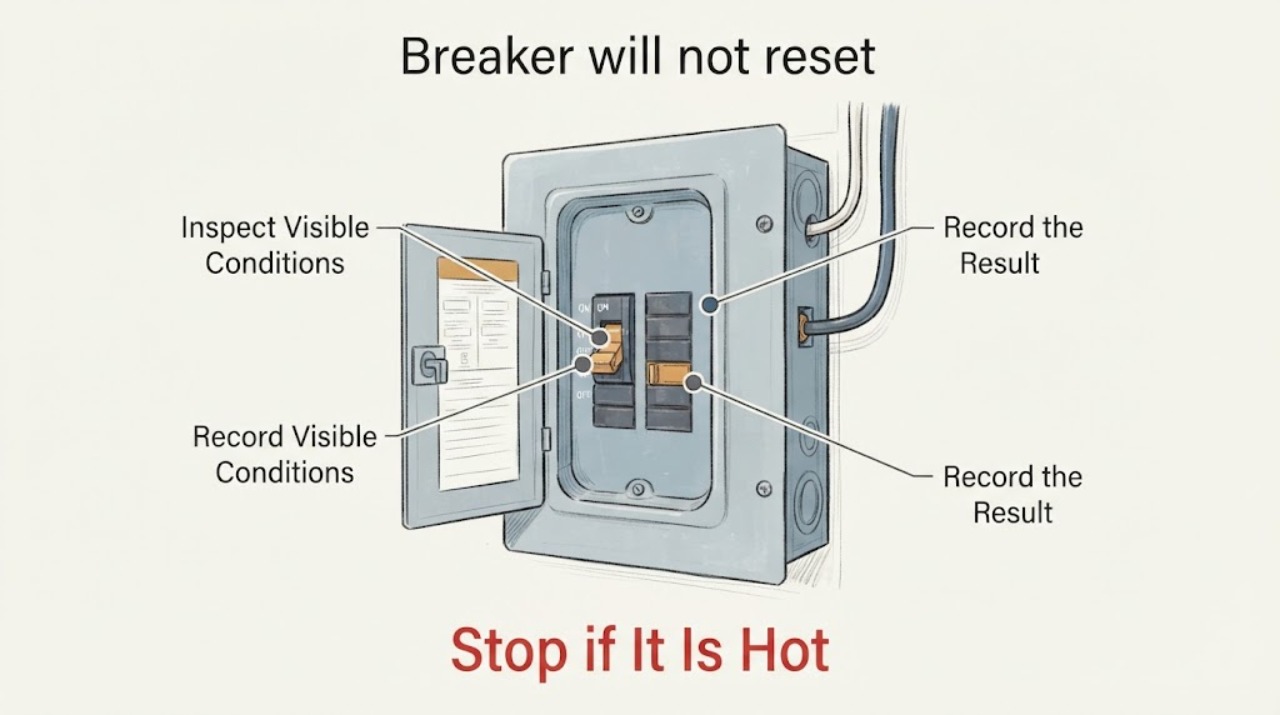
From outside the closed panel, read any already-visible circuit label and note whether the affected handle appears ON, OFF, or between positions; do not open the cover, touch the handle, or attempt another reset.
Expected result: The handle may appear fully off, sit in an intermediate trip position, have an unclear label, or show no obvious change while a circuit remains without power.
Next step: Photograph or transcribe only the visible label and leave the breaker undisturbed. Give the position and label to a qualified electrician.
Stop if: Stop if reading the information would require opening the panel, removing a cover, touching the breaker, or reaching near exposed electrical parts.
Why this matters
Why: Different breaker designs show a trip in different positions, and a label may identify the affected branch without proving the cause. An unclear position or label is a reason for professional identification, not repeated manipulation.
-
Record which loads and rooms lost power
Using normal room observations only, note which lights, receptacles, or appliances are without power and what was operating when the breaker stopped resetting; do not plug, unplug, switch, or deliberately test devices to reproduce the fault.
Expected result: One appliance or room may be associated, several loads on one branch may be off, or the affected area may be unclear.
Next step: Leave associated appliances and the affected circuit unused and provide the load list to the electrician. Do not move loads to another outlet as a test.
Stop if: Stop if any device is hot, wet, smoking, sparking, damaged, or giving a shock/tingle; leave it alone and escalate urgently.
Why this matters
Why: A single appliance association can point the electrician toward an appliance fault, while several loads or an unexplained outage can indicate a branch-circuit, wiring, or breaker issue. Context alone cannot establish that an appliance is safe.
-
Look for external electrical warning signs without touching
From a safe position, look at accessible outlets, switches, plugs, cords, and the outside of the closed panel for smoke, flame, arcing, burning odor, sizzling or buzzing, discoloration, or unusual heat; do not touch any device to confirm temperature.
Expected result: There may be no visible warning sign, or there may be one or more signs of overheating, arcing, fire, or shock risk.
Next step: For smoke, flame, active arcing, or a strong burning odor, leave the area and contact emergency services or the utility when safe. For heat, buzzing, discoloration, or shock signs without fire, keep clear and request urgent electrical service.
Stop if: Stop immediately and leave the area if smoke, flame, active arcing, strong burning odor, worsening heat, or a shock hazard appears.
Why this matters
Why: Smoke, flame, active arcing, strong burning odor, hot/discolored devices, or a shock/tingle can indicate an urgent hazard. The absence of a sign does not make a breaker-safe to force on.
-
Document timing without another reset attempt
Write down when the breaker first tripped, whether it followed a particular appliance, moisture event, storm, power interruption, or recent electrical work, and whether anyone already tried one reset; do not attempt a further reset or hold the breaker on.
Expected result: The event may follow a recognizable load or water event, happen immediately when power is restored, recur without a known trigger, or have an uncertain history.
Next step: Give the complete timeline to a qualified electrician and keep the circuit undisturbed. If moisture or recent work is involved, mention it before any service begins.
Stop if: Stop any further troubleshooting if the only way to clarify timing would be another reset, a live test, panel access, or deliberate operation of a suspect load.
Why this matters
Why: Timing helps a professional assess overload, appliance, environmental, wiring, or breaker possibilities, but it cannot safely distinguish them without inspection.
Use your observations
Decision map
Find the observation that best matches what you see, then follow the next safe action.
-
PATH 01Next step
What you see
Smoke, flame, active arcing, or a strong burning odor is present.
Do this next
Leave the area, keep others away, and contact emergency services or the utility when safe. Do not touch the panel or continue troubleshooting.
-
PATH 02Next step
What you see
An accessible device is hot, discolored, buzzing, sparking, or gives a shock or tingle.
Do this next
Do not touch or use the device; keep clear and request urgent qualified electrical service. Escalate to emergency services if conditions worsen.
-
PATH 03Next step
What you see
The failure followed one appliance, tool, water event, or recognizable load.
Do this next
Leave the suspected load and affected circuit unused, do not retest it, and give the timing and load information to the electrician.
-
PATH 04Next step
What you see
The breaker remains off or trips immediately after an earlier attempt, with no emergency sign visible.
Do this next
Do not attempt another reset, hold it on, or open the panel. Arrange a qualified electrician to identify the fault.
-
PATH 05Next step
What you see
The position, affected loads, or timing is unclear and the circuit remains without power.
Do this next
Leave everything undisturbed and request electrical service; uncertainty is not a reason to perform live testing or repeated resets.
Helpful context
Understand the symptom
A breaker that will not reset is a stop signal
A breaker can trip to an intermediate position or remain off after a fault. The visible position and the affected loads provide useful information, but they do not identify whether the cause is an overload, appliance defect, wiring fault, or breaker problem. A qualified electrician should assess the cause before the circuit is returned to service.
Stay outside the panel
Look only at the closed panel door, already-visible labels, and accessible room devices. Do not remove the service-panel cover, touch conductors, probe outlets, hold the breaker on, or create another test event. Keep the affected circuit and associated appliances unused until professional assessment.
Record what the electrician needs
Write down the breaker label, what lost power, what appliances were running, when the trip occurred, whether it stayed off or returned to an intermediate position, and any external warning signs. This lets the electrician start with context without asking you to perform electrical work.
Only after diagnosis
Potential parts
- circuit breaker replacement
Consider a replacement only after a qualified electrician diagnoses the breaker itself and rules out a load, appliance, wiring, or panel compatibility issue.
The electrician must match the exact panel system, breaker family, rating, and installation requirements; do not substitute a larger or unverified breaker. - breaker panel cover screw
A cover fastener is relevant only if a qualified electrician identifies a missing or damaged enclosure fastener during a professional panel inspection; it is not a reset or troubleshooting part.
The professional must match the enclosure and approved fastener specification; never remove or refit a panel cover as a homeowner diagnostic step.
When checks do not resolve it
Need a professional?
Call promptly for any non-resetting breaker. Treat smoke, flame, active arcing, strong burning odor, hot/discolored devices, or shock/tingle as urgent or emergency hazards and leave the area when safe.
Common questions
FAQ
Why will a breaker not reset?
A persistent fault, overload, appliance defect, wiring problem, or breaker problem may be involved. The visible position and affected-load history help a qualified electrician, but do not justify repeated resets or panel access.
Should I hold the breaker on?
No. Do not hold it on or keep resetting it. Leave the affected circuit undisturbed and call a qualified electrician.
Can I open the electrical panel to see why the breaker is stuck?
No. Do not remove the panel cover, touch wiring, or perform live tests. A qualified electrician should inspect and repair the panel or branch circuit.
When is a non-resetting breaker an emergency?
Smoke, flame, active arcing, strong burning odor, worsening heat, or a shock/tingle at an accessible device requires leaving the area and contacting emergency services or the utility when safe.
Read the exact guide
Official sources
- CPSC Guide to Home Wiring HazardsU.S. Consumer Product Safety Commission · Breaker that will not reset or trips again after an earlier attempt
- Commission Closes Investigation Of FPE Circuit Breakers And Provides Safety Information For ConsumersU.S. Consumer Product Safety Commission · Breaker that cannot be safely returned to service
Community feedback
Share a repair observation
Share a plain-text repair observation. Accepted observations are published automatically; this page may take a moment to update.