
On this page
Start here
Quick answer
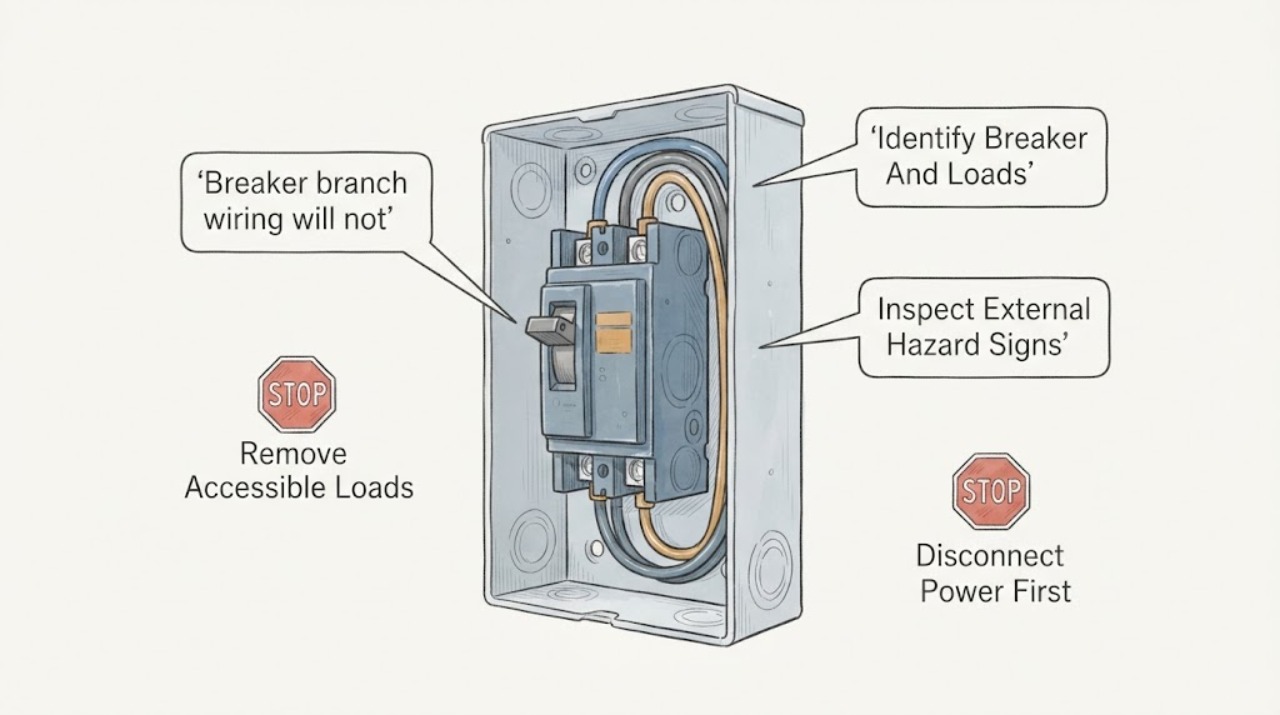
A GE breaker that will not reset is protecting the branch circuit until an overload, short, ground fault, damaged appliance, wiring problem, or breaker fault is cleared. First switch off or unplug accessible loads, identify whether the handle is fully off or in a trip position, and make one deliberate reset by moving it fully off and then on. If it will not latch, trips again immediately, or will reset only with a particular load connected, leave the circuit off and arrange qualified electrical diagnosis. A recent installation, burning smell, warmth, buzzing, scorch marks, moisture, sparks, or damaged insulation is a stop condition. Do not remove the panel deadfront, touch branch conductors, change the breaker rating, tighten terminals, or keep forcing the reset.
Before you begin
Safety first
- This article covers identification from outside the panel, unplugging accessible loads, visual and audible observations, and one external handle reset when no hazard is present. It does not authorize opening the panel, electrical testing, wiring changes, breaker replacement, protective-device bypass, or work on energized equipment.
Work through in order
Diagnostic checks
Use only checks that match the exact appliance or system and its official guide.
-
Check 1
From outside the panel, match the GE breaker to its directory and list the outlets, lights, appliances, and any recent work on that branch; do not remove the panel cover or rely on an uncertain label.
Expected result: The branch is clear, several loads share it, a large appliance is connected, the breaker is paired, or the directory is missing or wrong.
Next step: Record the breaker label, affected locations, connected loads, and recent installation history. If the circuit cannot be identified confidently, leave the breaker off and request qualified service.
Stop if: Do not open the enclosure, probe the panel, move conductors, or remove a breaker to trace the branch.
Why this matters
Why: Shared or high-demand loads can produce an overload. A paired handle may be a two-pole device with a partial trip that is easy to miss. An unknown branch map makes isolation unsafe and raises the need for an electrician.
-
Check 2
Without touching electrical parts, look and listen around accessible outlets, switches, cords, appliances, and the panel exterior for warmth, discoloration, melted plastic, buzzing, crackling, sparks, smoke, burning odor, moisture, or damaged insulation.
Expected result: There is no visible or audible warning, or one of the listed heat, odor, sound, moisture, or damage signs is present.
Next step: For any warning sign, keep people away, stop using the affected equipment, and arrange prompt electrical service; use the main disconnect or emergency help only when directed by a qualified professional or emergency responder.
Stop if: Do not touch a hot or wet device, handle a sparking outlet, spray or dry the panel, or continue reset attempts after a warning sign.
Why this matters
Why: A warning sign can indicate arcing, overheating, a wet fault, or damaged equipment rather than a harmless nuisance trip. No visible sign does not clear concealed branch wiring or a failed breaker.
-
Check 3
Turn off and unplug only accessible cord-and-plug loads on the affected branch, including portable heat-producing equipment; do not disconnect hardwired equipment or pull a built-in appliance out to reach its wiring.
Expected result: The breaker can be isolated from portable loads, a specific appliance cannot be unplugged, or the branch remains loaded by fixed equipment.
Next step: Leave suspect equipment disconnected and identify it for the electrician. Do not reconnect loads one by one if the breaker will not latch or if any warning sign was found.
Stop if: Do not cut a cord, remove an appliance junction cover, open an outlet, or disconnect a hardwired load as an isolation test.
Why this matters
Why: If removing a known portable load prevents a repeat trip, that load or its cord becomes more likely. A hardwired or inaccessible load remains a possible fault and needs a qualified person to isolate it.
-
Check 4
With accessible loads off and no hazard sign present, use the handle only: move the GE breaker firmly to OFF, then once to ON; if it is a paired breaker, follow its handle arrangement and the GE instructions without opening the panel.
Expected result: The handle latches and power returns, the handle will not stay on, or it trips immediately when power is restored.
Next step: If it resets, keep suspect loads off and monitor only without reconnecting questionable equipment. If it will not latch or trips again, leave it off and arrange qualified electrician diagnosis.
Stop if: Do not force the handle, hold it in ON, repeatedly cycle it, or reset after smoke, odor, heat, moisture, sparks, or a returned fault.
Why this matters
Why: A successful reset after load removal supports an overload or connected-load fault, but does not prove the branch is safe under normal use. Failure to latch or an immediate trip points toward persistent fault current, branch wiring, a hardwired load, or the breaker.
-
Check 5
If the breaker held after the single reset, record whether the trip occurred at appliance startup, when several loads ran together, after rain or moisture exposure, after recent wiring work, or with no load change; do not deliberately recreate the trip.
Expected result: The fault tracks one appliance, several simultaneous loads, wet conditions, recent installation, or no identifiable trigger.
Next step: Keep the suspect load disconnected, document the timing and affected locations, and give those details to a qualified electrician. A hardwired appliance fault should be handled by the appropriate appliance technician after the circuit is made safe.
Stop if: Do not reconnect a suspect appliance to see whether it trips again, bypass protective devices, or change the branch wiring or breaker size.
Why this matters
Why: One appliance or cord makes an equipment fault more likely; simultaneous use makes overload more likely; moisture or recent work raises ground-fault or miswiring concern; an unexplained trip keeps branch wiring and breaker failure in the differential.
-
Check 6
Read the external markings for AFCI, GFCI, or a combination device and note whether the no-reset symptom began after a renovation, new appliance, storm, leak, or repeated prior trips; do not press a test function while a hazard is present.
Expected result: The breaker has arc- or ground-fault protection, the symptom followed moisture or altered wiring, or the device has a repeated history of trips or failed resets.
Next step: Leave the circuit in the safe state and provide the markings and history to a licensed electrician for branch wiring and protective-device checks.
Stop if: Do not defeat AFCI or GFCI protection, swap devices, move conductors, or treat a failed test or reset as permission to use the circuit.
Why this matters
Why: AFCI or GFCI protection may be responding to an arc or leakage condition. Recent work or moisture makes installation, grounding, and insulation faults more likely. A repeated failed reset can also indicate a defective protective device, but replacement is not a homeowner diagnosis inside the panel.
Use your observations
Decision map
Find the observation that best matches what you see, then follow the next safe action.
-
PATH 01Safety boundary
What you see
The GE breaker resets after accessible loads are unplugged and the failure tracks one portable appliance or several loads operating together, with no heat, odor, moisture, or damage sign.
Do this next
Keep the suspect item disconnected, reduce simultaneous demand, and have the appliance or cord assessed before reconnecting it. Ask an electrician to check the branch if trips recur.
Why this path and its safety boundary
Why it matters: An overload or defective cord-and-plug appliance is more likely than a branch conductor fault, although the circuit still needs a sensible load check.
Safety stop: Do not recreate the trip, use an adapter or extension as a workaround, or increase the breaker rating.
-
PATH 02Safety boundary
What you see
The breaker will not latch or trips immediately with accessible loads removed, or the branch includes a hardwired appliance that cannot be safely isolated.
Do this next
Leave the breaker off and arrange a qualified electrician to isolate the branch, verify the protective device, and inspect wiring and fixed loads.
Why this path and its safety boundary
Why it matters: A persistent branch-wiring fault, ground or arc fault, hardwired load, or failed breaker is more likely than a simple overload.
Safety stop: Do not hold the breaker on, open the panel, test conductors, or replace the device without professional diagnosis.
-
PATH 03Safety boundary
What you see
The no-reset symptom began after renovation, a new appliance, rain, a leak, or work near an outlet, and the breaker has AFCI or GFCI protection or visible moisture or damage.
Do this next
Keep the affected branch off, keep away from wet or damaged equipment, and request prompt electrical inspection. Correct the source of moisture before restoring use.
Why this path and its safety boundary
Why it matters: Miswiring, an arc fault, ground leakage, damaged insulation, or wet equipment is more likely; protective tripping is a warning rather than a nuisance to defeat.
Safety stop: Do not dry, open, bypass, or reset a wet, sparking, warm, or discolored device.
-
PATH 04Safety boundary
What you see
There is buzzing, crackling, smoke, a burning odor, warmth, scorch marks, sparks, damaged insulation, or no reliable way to identify the branch and its loads.
Do this next
Stop using the affected circuit, keep people away, and obtain prompt qualified electrical help; use emergency assistance for active smoke or fire.
Why this path and its safety boundary
Why it matters: An overheating, arcing, or concealed wiring condition cannot be safely screened by a reset attempt.
Safety stop: Do not touch the panel or device, restore power for convenience, or investigate behind covers.
Helpful context
Understand the symptom
What a failed reset tells you
A breaker that trips while a particular appliance starts can be reacting to the appliance or its cord. A breaker that refuses to latch with accessible loads disconnected makes the branch wiring, a fault in a hardwired load, or the breaker itself more likely. The handle may sit between ON and OFF, so judge the position by the panel markings rather than by appearance alone.
Treat branch wiring as energized until a qualified person proves otherwise
The panel handle is an external control, not permission to work inside the enclosure. GE's appliance guidance separates an appliance fault from a house-wiring or breaker-box fault, while CPSC and ESFI identify branch circuits as the wiring that feeds outlets, lights, and appliances. The safe homeowner boundary is load identification, unplugging accessible equipment, and one documented reset attempt.
Do not solve a trip by changing protection
An oversized breaker can allow branch wiring to overheat before protection operates. Do not substitute a higher-rated device, add a jumper, defeat an AFCI or GFCI function, or rewire a branch circuit to make the handle stay on. A qualified electrician must identify the fault and verify the correct protective device for the installed wiring and equipment.
Safety boundary
Stop conditions
- Do not remove the panel deadfront, touch branch conductors, probe the enclosure, tighten terminals, or replace a breaker as a homeowner reset procedure.
- Do not hold a breaker in ON, repeatedly cycle it, change its rating, install a jumper, or defeat AFCI or GFCI protection.
- Stop for smoke, sparks, buzzing, crackling, warmth, discoloration, burning odor, damaged insulation, moisture, or water near electrical equipment.
- Leave the circuit off when the breaker will not latch, trips immediately after accessible loads are removed, or a hardwired load cannot be isolated safely.
- Do not reconnect a suspect appliance to recreate the trip; identify it for a qualified electrician or appropriate appliance technician.
Only after diagnosis
Potential parts
- branch-circuit breaker or protective device
Consider this category only after a qualified electrician confirms that the branch wiring and connected loads are safe and the GE protective device itself fails its required operation or is damaged.
Confirm the exact panel, breaker family, protection type, rating, and local requirements; never select a replacement by handle appearance or use a higher rating as a workaround. - receptacle, switch, cord, or wiring repair
Consider this category only when qualified fault isolation identifies a damaged receptacle, switch, cord, or branch connection as the source of the trip or visible damage.
A licensed electrician must identify the installed wiring method, protective-device requirements, grounding, and code-compliant replacement before any part is selected. - appliance power component
Consider this category only when the branch holds with the appliance disconnected and an appliance technician confirms a failed internal component or cord.
Confirm the exact appliance model and the technician's diagnosis before ordering; do not infer a failed part from a breaker trip alone.
When checks do not resolve it
Need a professional?
Arrange qualified electrical service when the GE breaker will not latch, trips immediately with accessible loads removed, trips repeatedly, protects an unidentified branch, or the symptom follows recent wiring work, a new appliance, moisture, or an AFCI or GFCI event. Seek prompt help for warmth, discoloration, buzzing, crackling, smoke, sparks, burning odor, damaged insulation, or water near electrical equipment; use emergency assistance for active smoke or fire.
Safety scope: This article covers identification from outside the panel, unplugging accessible loads, visual and audible observations, and one external handle reset when no hazard is present. It does not authorize opening the panel, electrical testing, wiring changes, breaker replacement, protective-device bypass, or work on energized equipment.
Common questions
FAQ
Why will my GE breaker not reset?
It may still be detecting an overload, short, ground or arc fault, damaged appliance, branch-wiring problem, or a failed breaker. Turn accessible loads off, make one external OFF-then-ON attempt only when no hazard sign is present, and leave it off for a qualified electrician if it will not latch or trips immediately.
Should I keep switching the GE breaker until it stays on?
No. Repeated resets can leave a fault energized and do not identify the cause. Stop after one deliberate reset, especially when the breaker refuses to latch, trips immediately, or there is warmth, odor, buzzing, moisture, discoloration, or sparks.
Could one GE appliance be causing the breaker to trip?
Yes. If the branch holds with an accessible cord-and-plug appliance unplugged and the failure tracks that item, the appliance or cord is more likely. Keep it disconnected and have it assessed; do not reconnect it to reproduce the trip.
What if the GE breaker resets after I unplug everything?
That supports an overload or connected-load fault but does not prove the branch is safe. Keep suspect loads off, record which items share the circuit, and arrange service if the trip recurs or a hardwired load remains untested.
When is a breaker that will not reset an emergency?
Treat smoke, sparks, crackling, warmth, burning odor, scorch marks, damaged insulation, or water near electrical equipment as urgent warning signs. Stop using the circuit, keep people away, and obtain prompt qualified electrical help; use emergency assistance for active smoke or fire.
Read the exact guide
Official sources
- GE Appliance - Circuit Breaker TripsGE Appliances · Official GE Appliances troubleshooting guidance used to distinguish an appliance fault from a house-wiring or breaker-box fault after accessible load isolation.
- Electrical Safety: ChecklistNational Fire Protection Association · National Fire Protection Association checklist used for stop conditions involving recurring trips, warm or discolored outlets, burning odor, sparks, cords, and protective devices.
- GE Appliance - Resetting Your Circuit BreakerGE Appliances · Official GE Appliances reset guidance used only for the external handle sequence; it does not authorize panel or wiring work.
- CPSC Guide to Home Wiring HazardsU.S. Consumer Product Safety Commission · U.S. Consumer Product Safety Commission home-wiring guide used for branch-circuit protection, overload patterns, warning signs, and the prohibition on changing protection to avoid trips.
- Understanding Your Home Electrical SystemElectrical Safety Foundation International · Electrical Safety Foundation International guidance used for external reset behavior, arc- and ground-fault context, damaged wiring, and service escalation.
Community feedback
Share a repair observation
Share a plain-text repair observation. Accepted observations are published automatically; this page may take a moment to update.