
On this page
Start here
Quick answer
A GE breaker that will not reset may still be in a tripped middle position, may be protecting a circuit with an active overload or fault, or may have a breaker, wiring, or appliance problem. Turn off or unplug ordinary loads on the affected circuit, then make one careful attempt to move the handle fully to OFF and then to ON if it moves normally. If it will not latch, trips immediately, or trips again when one appliance or load is used, leave it off and arrange qualified electrical diagnosis. Do not keep cycling it, install a larger breaker, remove the panel cover, or touch wiring. Heat, discoloration, buzzing, burning odor, smoke, sparks, water, or damaged insulation requires stopping immediately and using emergency help when appropriate.
Before you begin
Safety first
- Electrical diagnosis inside the panel, breaker replacement, conductor inspection, and circuit changes belong to a qualified professional. The user can record the handle position, load pattern, and visible warning signs but should not expose live parts or alter protection.
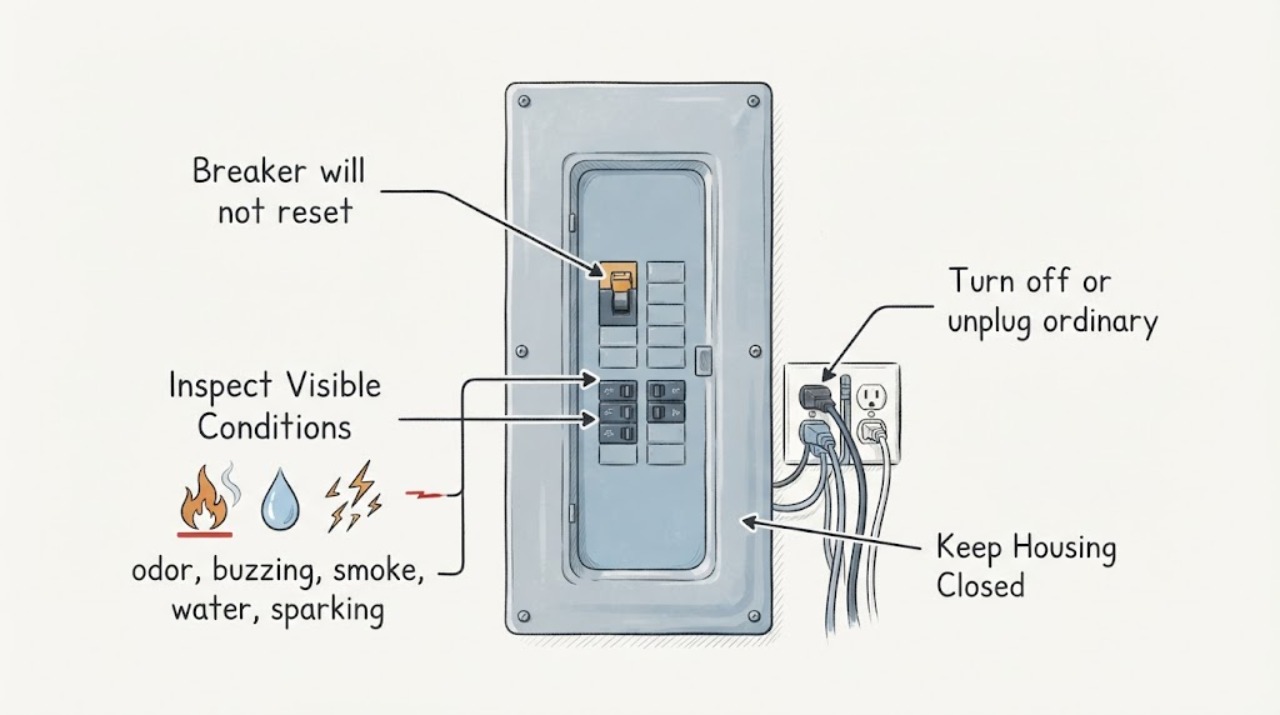
Work through in order
Diagnostic checks
Use only checks that match the exact appliance or system and its official guide.
-
Check 1
With the panel cover closed, identify the GE breaker from the circuit directory and observe whether its handle is fully OFF, fully ON, or in a middle position; do not remove the cover or touch anything besides the handle.
Expected result: The handle is in a middle or ambiguous position, the directory does not identify the circuit, or the breaker appears fully OFF but the circuit remains without power.
Next step: Use the visible labeling only to identify the affected circuit. If the handle will not move normally or the panel labeling is unclear, stop and arrange qualified electrical service rather than opening the panel.
Why this matters
Why: A middle position can indicate a trip even when the handle looks close to ON. An unclear directory or a power loss with the handle apparently ON leaves the circuit identity, upstream supply, and breaker condition unresolved.
-
Check 2
Turn off or unplug ordinary cord-and-plug appliances and other reachable loads on the affected circuit, one at a time if needed, without touching wet equipment, damaged cords, or fixed wiring.
Expected result: One appliance was operating when the trip occurred, several loads were running together, or no removable load explains the trip.
Next step: Leave a suspect appliance disconnected. Do not reconnect loads just to provoke another trip; have an electrician diagnose a circuit with no clear removable cause or any repeated trip.
Why this matters
Why: A single appliance can have an internal defect, while several simultaneous loads can overload a branch circuit. If no removable load explains the event, house wiring, the breaker, or a less visible connected load remains possible.
-
Check 3
After ordinary loads are off and only if there is no heat, odor, buzzing, smoke, water, sparking, or visible damage, make one reset attempt by moving the handle firmly to OFF and then to ON; do not force a handle that feels mechanically blocked.
Expected result: The handle latches ON and stays there, it will not latch, or it trips immediately while the loads remain disconnected.
Next step: If it will not latch or trips immediately, leave it OFF and call a qualified electrician. If it holds, keep suspect loads off and proceed to observe whether one specific load causes recurrence; do not repeatedly reset it.
Why this matters
Why: A successful reset with the circuit unloaded can fit a prior overload or transient event but does not prove the circuit is healthy. Failure to latch or an immediate trip points to a continuing fault, breaker problem, or wiring issue.
-
Check 4
If the breaker holds with loads disconnected, restore only ordinary loads one at a time while watching for an immediate trip; do not restore a suspected appliance, damaged cord, or fixed high-load equipment as a test.
Expected result: The breaker trips when one particular appliance is connected, only when several loads operate together, or not at all with the ordinary loads tested.
Next step: Keep the appliance or combination that triggers the trip out of use and provide the pattern to an electrician or appliance technician. Never substitute a higher-rated breaker to make the load run.
Why this matters
Why: A repeatable appliance-specific trip makes an appliance fault more likely. A combination-only trip makes an overload or capacity concern more likely. No recurrence does not rule out an intermittent fault or a fixed load that was not tested.
-
Check 5
From a safe distance, look and listen for a hot or discolored breaker or panel area, burning or unusual odor, buzzing or sizzling, flickering, sparks, smoke, water, or damaged insulation; do not touch the panel to check temperature.
Expected result: Any of these warning signs is present, even if the breaker can be moved.
Next step: Stop using the circuit and keep clear. Isolate power only if it can be done without approaching the hazard; for smoke, fire, or active sparking, leave the area and use emergency assistance, then arrange qualified electrical service.
Why this matters
Why: The circuit may have arcing, overheating, moisture exposure, a damaged connection, or another electrical hazard. A breaker that resets does not make those warning signs safe.
Use your observations
Decision map
Find the observation that best matches what you see, then follow the next safe action.
-
PATH 01Next step
What you see
The handle was in the middle position, the loads were removed, and it moved fully OFF then ON and stayed latched without warning signs.
Do this next
Leave the suspected load off, monitor without repeated resets, and restore ordinary loads cautiously one at a time. Arrange service if the trip recurs or the circuit behaves abnormally.
Why this path and its safety boundary
Why it matters: A prior overload or transient trip is possible, but a single successful reset does not establish that the circuit or breaker is fault-free.
-
PATH 02Next step
What you see
The breaker will not latch or opens immediately even after reachable loads are off.
Do this next
Leave the breaker OFF and do not keep resetting it. Have a qualified electrician diagnose the circuit and breaker box; do not open the panel or replace the breaker yourself.
Why this path and its safety boundary
Why it matters: A continuing short or ground fault, damaged appliance connection, wiring problem, or failed breaker is more likely than a handle-position misunderstanding.
-
PATH 03Next step
What you see
The breaker stays on until one particular appliance is connected, or it trips only when a group of loads operates together.
Do this next
Keep the triggering appliance or load combination disconnected. Use an appliance professional for a confirmed appliance pattern and an electrician for circuit loading, wiring, or breaker questions.
Why this path and its safety boundary
Why it matters: The appliance-specific pattern makes an appliance defect more likely, while the combination pattern makes overload or capacity more likely. Neither pattern supports a larger breaker without a circuit assessment.
-
PATH 04Next step
What you see
There is heat, discoloration, buzzing, sizzling, burning odor, flickering, water, damaged insulation, smoke, or sparking near the breaker or connected circuit.
Do this next
Stop using the circuit and keep clear. For smoke, fire, or active sparking, leave the area and use emergency assistance as appropriate; otherwise arrange prompt qualified electrical service. Do not touch or inspect inside the panel.
Why this path and its safety boundary
Why it matters: An electrical fire or shock hazard may be present and is more urgent than restoring power.
Helpful context
Understand the symptom
A breaker that will not reset is a symptom
The handle may be in an intermediate trip position that is easy to mistake for ON, or the breaker may be opening again because the protected circuit still has an overload or fault. The useful distinction is whether the handle can be moved fully OFF and then latches ON with the circuit unloaded, versus whether it will not move or immediately opens again. Neither pattern justifies fitting a larger breaker.
What you can check with the panel closed
Use the circuit directory and visible handle position to identify the affected circuit. Turn off or unplug ordinary cord-and-plug loads that you can reach safely, and note which appliance or combination of loads preceded the trip. Do not remove the panel cover, loosen terminals, probe outlets, or handle conductors.
GE-specific reset guidance still has a boundary
GE's consumer guidance describes moving a tripped breaker fully OFF and then ON, including a double breaker that can appear partly on. That is a single reset attempt after the load is removed, not a way to defeat a recurring trip. If the breaker keeps tripping with the appliance on, GE recommends service; an electrician may need to separate a house-wiring or breaker-box fault from an appliance fault.
Treat electrical warning signs as urgent
A hot or discolored panel area, unusual buzzing or sizzling, burning odor, sparks, smoke, water, flickering, or damaged insulation changes the task from resetting a breaker to controlling an electrical hazard. Stop using the circuit, keep clear, and obtain qualified help. If there is active smoke, fire, or sparking, leave the area and use emergency assistance as appropriate.
Safety boundary
Stop conditions
- Do not keep cycling a breaker, install a larger breaker, bypass protection, remove the panel cover, loosen terminals, or probe live wiring to make the circuit work.
- Leave the breaker off and arrange qualified electrical service when it will not latch, trips immediately or repeatedly, the circuit identity is unclear, or the cause is not a safely removable load.
- If there is smoke, fire, active sparking, severe heat, burning odor, water entering electrical equipment, or exposed or damaged wiring, leave the area and use emergency assistance when appropriate; do not touch the equipment.
When checks do not resolve it
Need a professional?
Safety scope: Electrical diagnosis inside the panel, breaker replacement, conductor inspection, and circuit changes belong to a qualified professional. The user can record the handle position, load pattern, and visible warning signs but should not expose live parts or alter protection.
Common questions
FAQ
How do I reset a GE breaker that looks on but will not restore power?
A tripped breaker can sit in a middle position and look close to on. With ordinary loads off and no warning signs, move the handle fully to OFF and then to ON once. If it will not latch or opens again, leave it off and arrange qualified electrical service.
Why does the GE breaker trip again as soon as I reset it?
An immediate return can indicate a continuing short or ground fault, an appliance problem, wiring, the breaker, or the breaker box. Disconnect reachable ordinary loads without touching damaged or wet equipment and do not keep resetting; a qualified electrician should diagnose a repeat or immediate trip.
Can I replace a GE breaker with a higher-rated one?
No, not as a troubleshooting step. The protective rating must suit the circuit and equipment. A higher rating can allow unsafe current through existing wiring. Have an electrician verify the circuit and any required change.
What if the breaker holds until one GE appliance is turned on?
That pattern makes an appliance fault more likely, although the circuit and wiring still need consideration. Leave the appliance disconnected and arrange appliance diagnosis; if the breaker also trips with other loads or the circuit shows warning signs, involve an electrician.
When is a breaker that will not reset an emergency?
Smoke, fire, active sparking, severe heat, burning odor, water entering electrical equipment, exposed wiring, or a hot or discolored panel area requires stopping immediately and keeping clear. Leave the area and use emergency assistance when appropriate, then arrange qualified electrical service.
Read the exact guide
Official sources
- Appliance - AFCI, GFCI and GFI UseGE Appliances · GE appliance use on circuits protected by AFCI or GFCI devices; device and local-code details vary by installation
- GE Appliance - Resetting Your Circuit BreakerGE Appliances · GE appliance power-supply guidance; the exact house circuit and breaker still require electrical diagnosis when the problem recurs
- GE Appliance - Circuit Breaker TripsGE Appliances · GE appliances whose house breaker or fuse trips; use the exact appliance installation instructions for its circuit requirement
- CPSC Guide to Home Wiring HazardsU.S. Consumer Product Safety Commission · General residential electrical safety guidance; it does not replace local code or qualified electrical diagnosis
Community feedback
Share a repair observation
Share a plain-text repair observation. Accepted observations are published automatically; this page may take a moment to update.