
On this page
Start here
Quick answer
A wobbling Casablanca ceiling fan is not automatically a blade-balance problem. First stop the fan and observe whether the ceiling plate, canopy, downrod, hanger ball, or whole fan moves, and keep people clear if the mount looks loose. A downrod fan depends on correct assembly, a seated hanger ball, a secure set screw, a fan-rated support, and properly fastened blades. If the mount is stable but the blade tips orbit, a blade screw, warped blade, unequal blade position, or balance issue is more likely; a balancing kit can be considered only after the structure and downrod are confirmed safe. A wobble that began after installation, downrod or direction work, or a ceiling change needs assembly and mounting inspection. Do not climb to tighten overhead hardware, remove the canopy, reuse unknown screws, or operate a fan with a loose mount, cracked blade, falling glass, exposed wire, or severe movement. Arrange qualified ceiling-fan or electrical service when the downrod, set screw, hanger ball, bracket, or ceiling box is in doubt.
Before you begin
Safety first
- This article supports floor-level observation, clearance review, model identification, and a balance procedure only after the mount is confirmed safe. Qualified service handles overhead support, set screws, hanger ball, bracket, ceiling box, downrod reassembly, wiring, blade replacement, and structural repairs.
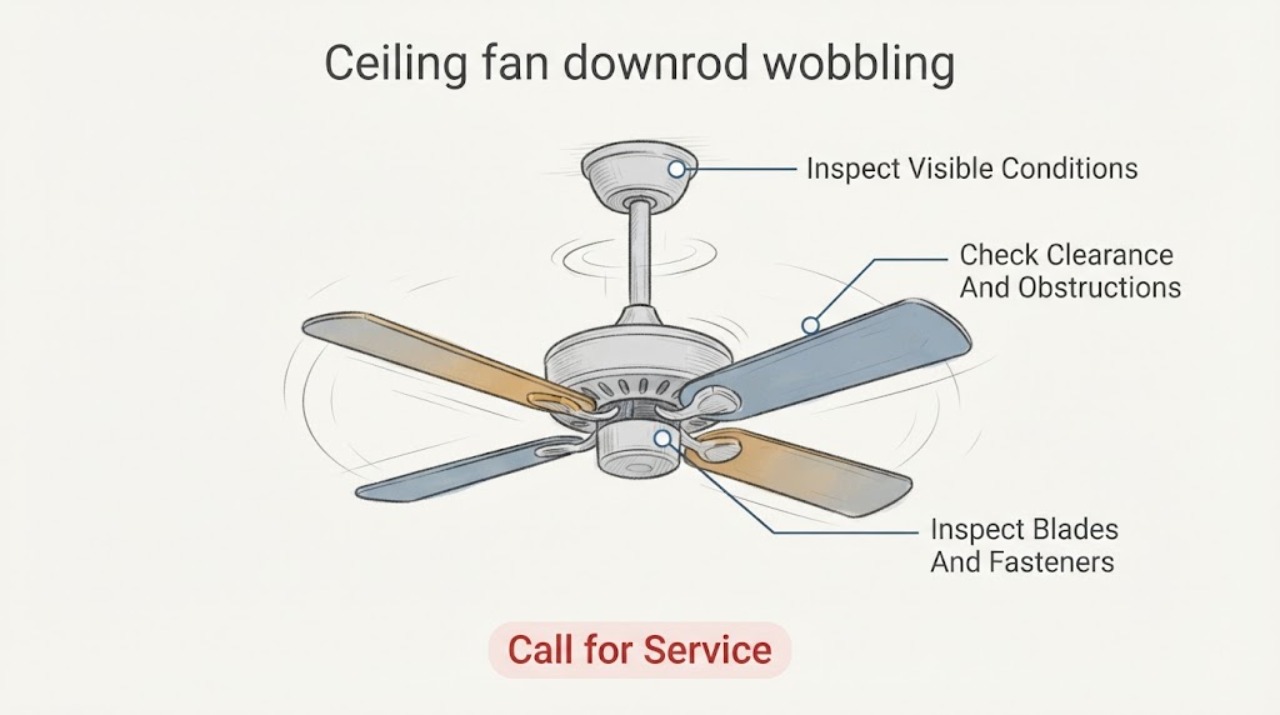
Work through in order
Diagnostic checks
Use only checks that match the exact appliance or system and its official guide.
-
Check 1
Turn the Casablanca fan off, let all blades stop, and observe the fan from floor level without standing beneath a visibly loose assembly.
Expected result: Record whether only blade tips move, the motor housing and downrod orbit, the canopy or ceiling plate shifts, the whole fan sags, or movement is accompanied by clicking, scraping, or a falling part.
Next step: Leave the fan off and use the matching branch; obtain qualified service before touching or re-energizing a fan whose support moves.
Stop if: Stop immediately for severe swing, a loose canopy, a dropped part, a cracked blade, exposed wiring, smoke, or any sign the fan could fall.
Why this matters
Why: Blade-tip movement with a stable ceiling connection supports balance or blade fastening. Movement at the downrod, canopy, bracket, or ceiling points to assembly or support failure and creates a fall hazard.
-
Check 2
From a safe position, check the visible blade path for a wall, cabinet, beam, light fixture, curtain, or other nearby object that could be contacted as the fan moves; do not move the fan to create clearance.
Expected result: Record a clear blade path, a tip that approaches or contacts an object, unequal clearance around the blade circle, or an obstruction that cannot be reached safely.
Next step: Keep the fan off if a blade can contact anything and arrange qualified repositioning or installation assessment; do not bend blades or alter the downrod to gain clearance.
Stop if: Do not operate a fan with blade contact, a narrowing clearance, or an obstruction that requires climbing or moving structural parts.
Why this matters
Why: An obstruction or unequal clearance can make normal blade movement look like downrod wobble and can amplify vibration. A clear path keeps downrod assembly, mounting, blade balance, and hardware as the leading checks.
-
Check 3
With the fan off and power disconnected at the breaker if overhead inspection is unavoidable, inspect the blade set from a stable, safe position for cracked, warped, loose, or visibly mismatched blades and blade hardware; do not reach over an unsupported fan.
Expected result: Record intact blades with consistent attachment, a loose blade or tip, a crack or bend, mismatched blade parts, missing hardware, or a fastener that cannot be safely assessed.
Next step: Leave power off and arrange model-matched blade or hardware service for damage or uncertainty; use a balance kit only after the blade set is intact and securely installed.
Stop if: Do not operate with a cracked, warped, loose, or incomplete blade set and do not climb on an unstable ladder.
Why this matters
Why: A damaged or mismatched blade cannot be corrected reliably with balancing weights. Loose blade hardware can create vibration even when the downrod and bracket are secure; missing or unknown hardware requires model-specific service.
-
Check 4
From floor level or only with qualified access, visually check whether the downrod is straight, the canopy is seated, the hanger ball appears to be in its bracket slot, and the downrod set-screw area shows no gap, missing hardware, or shifting.
Expected result: Record a straight, stable assembly; a downrod that twists or moves independently; a hanging ball not seated; a missing or loose-looking set screw; a canopy gap; or an assembly hidden from safe view.
Next step: Keep the breaker off and obtain qualified ceiling-fan service to support, disassemble, and reassemble the downrod using the exact Casablanca manual.
Stop if: Do not loosen or tighten overhead set screws, pull on the fan, remove the canopy, or support the fan by wires.
Why this matters
Why: Independent downrod movement, a displaced hanger ball, a canopy gap, or absent set-screw hardware makes assembly/support failure more likely than blade imbalance. The fan-fall risk takes priority over balancing.
-
Check 5
Read the Casablanca manual and record the ceiling angle, downrod length, fan-rated box or structural support, recent installation, direction change, downrod replacement, or other work without opening the ceiling or moving the fan.
Expected result: Record a recent installation or downrod change, angled ceiling, support that is unknown, a fan installed on a non-rated box, or no recent change with a newly appearing wobble.
Next step: Provide the installation history, ceiling type, downrod details, and model to a qualified installer for a support and assembly assessment.
Stop if: Do not replace the bracket, drill the ceiling, add improvised braces, or change downrod length without the exact model instructions and qualified support assessment.
Why this matters
Why: A wobble that follows installation or downrod work raises assembly, bracket, hanger-ball, support, or set-screw concerns. An angled ceiling may require the specified mounting arrangement and compatible downrod. An unknown box or support cannot be validated from wobble alone.
-
Check 6
Only when the mount, downrod, hanger ball, clearance, blades, and hardware are confirmed stable and intact, use the exact fan manual's balance-kit procedure; stop the fan before attaching or moving any clip or weight.
Expected result: Record whether one blade position consistently produces the orbit, the wobble improves with the approved balance method, remains unchanged, or increases with a particular speed.
Next step: Stop balancing and arrange service if the wobble persists, changes suddenly, or involves any movement at the ceiling or downrod.
Stop if: Do not balance a loose or damaged fan, use improvised weights, attach anything to the downrod, or run the fan while adjusting hardware.
Why this matters
Why: Improvement after a model-compatible balancing procedure supports blade imbalance. No improvement keeps downrod, bracket, blade damage, motor, and support issues in contention; a speed-specific increase can indicate resonance or a structural problem.
Use your observations
Decision map
Find the observation that best matches what you see, then follow the next safe action.
-
PATH 01Safety boundary
What you see
The canopy, hanger ball, downrod, ceiling plate, or whole motor housing moves at the ceiling, not just the blade tips.
Do this next
Leave power off and obtain qualified ceiling-fan service to support and verify the entire mounting system before use.
Why this path and its safety boundary
Why it matters: Downrod assembly, set screw, hanger-ball seating, bracket, support, or ceiling-box failure is more likely than blade imbalance and creates a fan-fall hazard.
Safety stop: Do not pull on the fan, climb to tighten the set screw, or continue balancing while the mount moves.
-
PATH 02Safety boundary
What you see
The ceiling plate, canopy, and downrod appear stable, but the blade tips orbit and one blade or blade position is visibly out of line.
Do this next
With the fan off, verify model-specific blade hardware and consider the approved balance procedure only if all blades are intact and the mount is sound.
Why this path and its safety boundary
Why it matters: Blade fastening, blade damage, unequal blade geometry, or imbalance is more likely than a loose downrod.
Safety stop: Do not use weights to compensate for a cracked, warped, loose, or mismatched blade.
-
PATH 03Safety boundary
What you see
The wobble began after installation, downrod replacement, a direction change, canopy work, or another overhead repair.
Do this next
Keep the fan off and have the installer or qualified technician verify the complete Casablanca downrod and support assembly against the manual.
Why this path and its safety boundary
Why it matters: Assembly sequence, hanger-ball seating, set-screw security, bracket/support, or disturbed wiring is more likely than gradual blade imbalance.
Safety stop: Do not reuse unknown hardware, alter the downrod, or open the ceiling to improvise support.
-
PATH 04Safety boundary
What you see
A blade approaches or contacts a wall, beam, light, cabinet, curtain, or another object as the fan moves.
Do this next
Stop using the fan and obtain qualified repositioning or downrod/mount assessment; do not bend or trim blades.
Why this path and its safety boundary
Why it matters: The apparent wobble may be clearance or installation geometry, and contact can damage the blade or amplify vibration.
Safety stop: Do not run with blade contact or move structural parts to gain clearance without the model instructions.
-
PATH 05Safety boundary
What you see
A blade is cracked, warped, loose, mismatched, or missing its specified hardware.
Do this next
Leave power off and obtain model-matched blade and hardware replacement guidance from qualified service or the manufacturer.
Why this path and its safety boundary
Why it matters: A balance kit cannot reliably correct the damaged blade set, and operation can worsen vibration or create a falling-part hazard.
Safety stop: Do not run the fan, substitute a visually similar blade, or add improvised weights or fasteners.
-
PATH 06Safety boundary
What you see
The fan is stable at some speeds but wobbles strongly at one speed, and no clearance or blade damage is found.
Do this next
Avoid the problem speed and arrange qualified inspection of blade balance, downrod, bracket, support, and motor before normal use resumes.
Why this path and its safety boundary
Why it matters: An imbalance, resonance, hardware looseness, or support flexibility may be amplified at that speed; speed behavior does not prove a blade-only fault.
Safety stop: Do not keep cycling speeds to reproduce the wobble or apply weights to a mount that has not been verified.
-
PATH 07Safety boundary
What you see
Wobble is accompanied by exposed wiring, a hot or sparking housing, smoke, a repeated breaker trip, glass movement, or a ceiling box that shifts.
Do this next
Keep people clear, leave power off if safe, and obtain licensed electrical or ceiling-fan service; use emergency help for smoke or fire.
Why this path and its safety boundary
Why it matters: The fan has crossed into an electrical, fire, falling-object, or structural hazard and should not be treated as a balance adjustment.
Safety stop: Do not touch wet or exposed wiring, restore power, stand below falling parts, or continue testing.
Helpful context
Understand the symptom
Determine whether the downrod or the blades are moving
A fan can look as if the downrod wobbles when only the blade tips are out of balance. Watch from a safe floor position with the fan off: movement at the ceiling plate, canopy, downrod, or hanger ball is a mounting/assembly concern; a stable canopy with an orbiting blade set is more consistent with balance, blade fastening, or a damaged blade. These paths should not be mixed because a balancing weight cannot correct a loose support.
Downrod assembly is a fall-safety issue
Casablanca installation instructions call for the downrod to be assembled correctly and the set screw to be secured as specified. The ceiling bracket must be attached to an appropriate support, the hanger ball must seat in its slot, and the canopy must not be carrying the fan by its wires. Because these parts are overhead, a homeowner should use only ordinary-access observation and should leave tightening, reassembly, or support repair to a qualified person when access or support is uncertain.
Balance only after the structure is known to be sound
If the mount and downrod are stable, the blades are intact and fastened, and clearance is adequate, a model-compatible balance kit can address a blade-set imbalance. Warped or cracked blades need the exact replacement guidance rather than more weights. A wobble that changes with speed or began after a direction change still deserves inspection for hardware and assembly before routine balancing.
Safety boundary
Stop conditions
- Stop using the fan for movement at the ceiling, canopy, downrod, hanger ball, or bracket; a balance kit cannot repair an unsafe support.
- Do not climb to tighten overhead hardware, pull on the fan, remove the canopy, or support the fan by its wires.
- Do not substitute downrods, set screws, brackets, blades, or fasteners by appearance, and do not drill or brace the ceiling without model-specific support guidance.
- Do not operate with a cracked, warped, loose, mismatched, or incomplete blade set, blade contact, falling glass, severe wobble, or a hot motor housing.
- Leave power off for exposed wires, scorch marks, smoke, sparking, repeated breaker trips, or a fan that may fall, and obtain licensed electrical or ceiling-fan service.
Only after diagnosis
Potential parts
- Casablanca downrod and set-screw assembly
Consider this category only when qualified inspection confirms a bent or incorrect downrod, missing/damaged set screw, or assembly that cannot be restored using the exact model instructions.
Match the exact Casablanca model, length, finish, thread/adapter, hanger-ball arrangement, and specified fasteners; do not substitute a generic downrod by appearance. - Casablanca hanger ball or ceiling mounting bracket
Consider this category only when service confirms a worn, damaged, incompatible, or improperly seated hanger ball or bracket is allowing movement at the ceiling.
Confirm the exact fan series, ceiling angle, support method, hardware, and fan-rated box/structure before ordering or installing. - Casablanca replacement blade set or blade hardware
Consider this category only when a blade is cracked, warped, mismatched, loose, or missing specified hardware after the mount and downrod are confirmed stable.
Match the exact model, blade position, pitch/shape, hardware, and full-set requirements; do not use one visually similar blade or improvised fastener. - ceiling-fan balancing kit
Consider this category only when the downrod, mount, support, clearance, blades, and fasteners are safe and intact and the remaining symptom is blade-set imbalance.
Follow the exact model procedure and confirm that clips or weights are appropriate for the fan; a balance kit cannot correct a loose mount or damaged blade.
When checks do not resolve it
Need a professional?
Arrange qualified ceiling-fan or electrical service when the Casablanca downrod, hanger ball, set screw, ceiling plate, bracket, fan-rated box, canopy, or support moves; when wobble began after installation or downrod/direction work; when blade damage or missing hardware is found; or when a model-compatible balance procedure does not restore stable operation. Seek urgent service for a loose or falling fan, exposed wiring, smoke, sparking, hot housing, repeated breaker trips, falling glass, or severe movement.
Safety scope: This article supports floor-level observation, clearance review, model identification, and a balance procedure only after the mount is confirmed safe. Qualified service handles overhead support, set screws, hanger ball, bracket, ceiling box, downrod reassembly, wiring, blade replacement, and structural repairs.
Common questions
FAQ
Why is my Casablanca ceiling fan downrod wobbling?
Movement at the downrod can come from an incorrectly assembled or loose set screw, hanger ball, canopy, bracket, support, or ceiling box. If only the blade tips orbit while the downrod is stable, blade balance or blade hardware is more likely. Stop the fan before inspecting and do not balance an unsafe mount.
Can a balancing kit fix a wobbling downrod?
Only when the downrod, mount, support, clearance, and blades are already stable and intact. A balance kit can address blade imbalance, but it cannot repair a loose set screw, displaced hanger ball, weak ceiling support, or cracked blade.
What should I check on a Casablanca downrod installation?
From a safe position, look for independent movement at the downrod, canopy, hanger ball, and ceiling plate, and record the downrod length and recent installation work. The exact manual controls set-screw, hanger-ball, bracket, and support assembly; overhead reassembly should be qualified service when anything is uncertain.
Why did the fan start wobbling after changing direction?
Direction change can reveal a set-screw, hanger-ball, blade, or hardware problem, but the switch itself should not be blamed without inspection. Stop the fan, avoid the problem condition, and have the downrod and mounting assembly verified if the wobble began after overhead work or direction changes.
Can I tighten the Casablanca downrod set screw myself?
Treat overhead set-screw and downrod work as a fall-safety task. Do not climb or pull on the fan to test it. Use the exact Casablanca manual and qualified service when the fan moves at the downrod, hanger ball, canopy, or ceiling support.
When is a wobbling Casablanca fan unsafe to run?
Stop for movement at the ceiling or downrod, severe wobble, blade contact, cracked or loose blades, falling glass, exposed wires, smoke, sparking, a hot housing, or a shifting ceiling box. Leave power off and obtain qualified ceiling-fan or electrical service.
Read the exact guide
Official sources
- M8523-01 Casablanca Ceiling Fan Installation and Operation ManualCasablanca Fan Company · Official Casablanca Fan Company manual hosted in the Hunter support asset system; exact model instructions control a particular fan.
- Hunter Ceiling Fan Balancing KitHunter Fan · Official Hunter balancing guidance; a balancing kit is not a substitute for verifying Casablanca mounting, downrod assembly, or damaged blades.
- Why is my fan wobbling?Hunter Fan Support Site and Help Center · Official Hunter guidance used for general wobble distinctions; Casablanca owners should confirm assembly and hardware with the Casablanca manual.
- Ceiling Fan Parts and Functions – Hunter Fan Support Site and Help CenterHunter Fan · Official Hunter component glossary used to distinguish downrod and mounting parts; Casablanca's exact fit and assembly must be confirmed from its model manual.
Community feedback
Share a repair observation
Share a plain-text repair observation. Accepted observations are published automatically; this page may take a moment to update.