
On this page
Start here
Quick answer
A Casablanca fan that appears to wobble at the mounting bracket should be switched off until you know whether the movement is at the ceiling support or only at the blades. From a safe position, note whether the ceiling plate, canopy, downrod, or the whole fan moves, then isolate power at the wall control and breaker before any accessible inspection. The manufacturer’s general wobble guidance calls for checking blade clearance, the ceiling plate, downrod, set screw, and other hardware, followed by the supplied balancing kit. A bracket that shifts at the ceiling, a loose or unsuitable fan-rated box, a cracked support, exposed wiring, or a fan that is pulling away from the ceiling is a structural/electrical stop condition: leave it off and use a qualified electrician or fan technician. Do not hold a running fan, bend blade irons, improvise a bracket, or tighten ceiling wiring while energized.
Before you begin
Safety first
- Homeowner-safe work is limited to observing movement from the floor, isolating a clearly identified circuit, recording the model and symptom pattern, and inspecting reachable external hardware without climbing or touching wiring. Ceiling-box, bracket, canopy, downrod, wiring, structural-support, and energized electrical work belongs to a qualified professional.
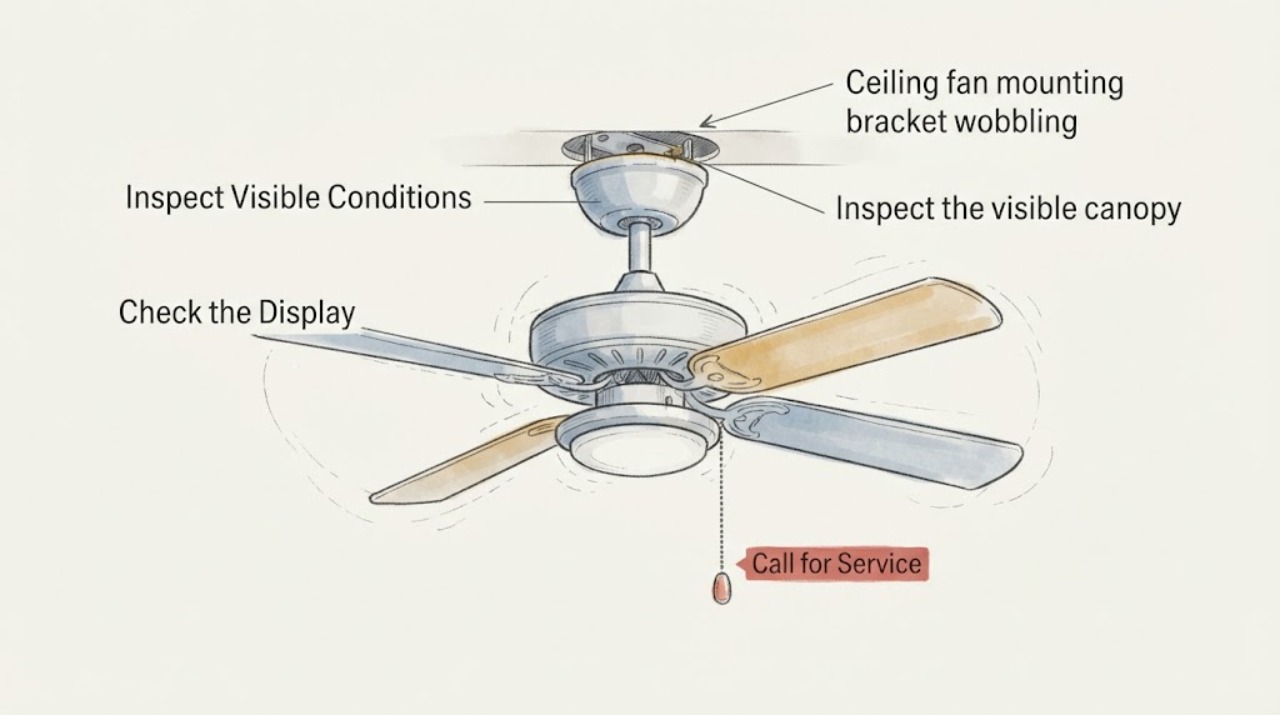
Work through in order
Diagnostic checks
Use only checks that match the exact appliance or system and its official guide.
-
Check 1
From the floor and from outside the blade sweep, run the fan only long enough to observe whether the visible movement is at the blade tips, the downrod/canopy, the mounting bracket, or the ceiling surface; stop it if movement is large, the fan rattles, or anything appears to loosen.
Expected result: Only the blade tips trace a circle, the downrod swings, the canopy or bracket shifts against the ceiling, or the ceiling moves with the fan.
Next step: Switch the fan off. Treat any canopy, bracket, box, or ceiling movement as a stop condition and do not restart it for a closer look; continue only with safe power isolation and professional assessment.
Why this matters
Why: Blade-only movement is more consistent with blade balance, blade hardware, or clearance. Movement at the downrod or ceiling support makes mounting, hanger-ball seating, box, bracket, or structural movement more likely and is more urgent.
-
Check 2
Turn the fan off at its wall control and the labeled circuit breaker before touching or approaching the fan assembly, and verify that the fan has stopped; use a properly rated tester only if you are qualified to verify de-energization.
Expected result: The fan stops and the circuit can be safely isolated, the wrong breaker was identified, or the fan or light remains energized.
Next step: Do not remove the canopy or bracket when power status is uncertain. Leave the circuit off and arrange qualified electrical help if the breaker, switch, or tester result is unclear.
Why this matters
Why: A stopped fan allows a limited visual inspection, but a wall switch position is not proof that ceiling wiring is safe. If the circuit cannot be positively isolated, there may be a wiring/control issue or an unsafe work condition.
-
Check 3
With power isolated and feet on the floor, inspect the visible canopy and mounting area for a gap that changes as the fan is gently steadied, missing hardware, a bracket that is not flush, a cracked ceiling surface, or a fan that is pulling away; do not climb or support the fan’s weight with one hand.
Expected result: The canopy is separating, the bracket or ceiling box visibly shifts, fasteners are missing, the ceiling is cracked, or the mounting area looks solid and stationary.
Next step: Leave a shifting, cracked, or separating installation off and have a qualified electrician or fan technician inspect the box, structure, bracket, and fasteners. Do not add random screws or shims.
Why this matters
Why: A gap, shift, missing fastener, or crack suggests that the support path may not safely carry fan vibration. A stationary visible canopy does not prove the concealed box is fan-rated or secure, but it makes an obvious bracket separation less likely.
-
Check 4
Identify the exact Casablanca model from its rating label or manual and compare the installed mounting bracket, downrod, hanger arrangement, and fastener locations with that model’s installation instructions; do not substitute a visually similar bracket.
Expected result: The model and manual are available, the bracket matches the manual, the model is unknown, or the installed bracket/box arrangement differs from the instructions.
Next step: Stop part selection until the model is confirmed. If the bracket or box arrangement does not match, leave power off and arrange professional inspection rather than drilling new holes or mixing mounting hardware.
Why this matters
Why: Casablanca mounting details are model-specific. A mismatch can leave the fan supported by the wrong geometry or hardware even if the fan initially appears to hang correctly; an unknown model prevents a reliable fitment decision.
-
Check 5
After the support is confirmed solid by the manual or a professional, check from a safe reach with power still isolated that accessible blade screws and blade-holder hardware are present and snug; do not bend blade irons or reach over an unstable fan.
Expected result: A blade or blade-holder screw is loose or missing, all visible blade hardware is secure, or the hardware cannot be reached safely.
Next step: Use only the fasteners and tightening method specified for the exact model. If the fan is inaccessible, damaged, or still moves at the ceiling, stop and arrange service rather than climbing or forcing parts.
Why this matters
Why: Uneven or loose blades can create vibration that looks like bracket wobble and can loosen other hardware over time. Secure visible hardware does not rule out a bent blade, warped blade, or concealed mounting fault.
-
Check 6
Check the blade-tip clearance from a safe position and compare the blades visually at rest; if the support is secure and the manual permits it, use the included balancing kit exactly as directed, without inserting anything into rotating blades.
Expected result: A blade is unusually close to a wall or obstruction, blade tips sit at different heights, or the clearance and blade plane look even.
Next step: Correct only the model-approved blade/balance issue with power off. If the fan still wobbles at the support, stop using it and have the mounting system inspected; do not bend blade brackets.
Why this matters
Why: Insufficient clearance, a blade out of plane, or an unbalanced blade set can produce apparent wobble while the bracket remains tight. Balancing cannot correct a loose box, shifting bracket, bent support, or cracked ceiling.
-
Check 7
After one controlled test from a safe distance, compare low and higher speeds and note whether the wobble is speed-dependent, whether the light shakes independently, and whether any noise, heat, odor, or electrical symptom appears; stop immediately for a hazard.
Expected result: The wobble is present only at one speed, present at every speed, reduced after balancing, or accompanied by rattling, scraping, a burning smell, sparks, flicker, heat, or a breaker trip.
Next step: Turn the fan off and leave it off for recurring support movement or any electrical warning. Give the technician the model, speed pattern, exact movement location, and checks already completed.
Why this matters
Why: Speed-dependent blade vibration is more consistent with balance or blade geometry when the support is solid. Wobble at all speeds, recurring bracket movement, or an electrical/heat symptom keeps mounting, motor, wiring, and control faults in consideration.
Use your observations
Decision map
Find the observation that best matches what you see, then follow the next safe action.
-
PATH 01Next step
What you see
The ceiling, canopy, mounting bracket, or downrod moves as a unit, or a gap opens between the fan and ceiling.
Do this next
Leave the fan and light off, keep people out from under it, and arrange a qualified electrician or fan technician to inspect and support the installation. Do not run it to see whether the movement improves.
Why this path and its safety boundary
Why it matters: This pattern makes a loose bracket, hanger, fan-rated box, fastener, or structural support more likely than a simple blade-balance issue.
-
PATH 02Next step
What you see
The mounting area stays stationary, but blade tips wobble and one blade sits differently or a blade screw is loose.
Do this next
With power isolated, use the exact manual’s hardware instructions and included balance kit. Stop if the blade is cracked, bent, unreachable, or the fan begins moving at the ceiling.
Why this path and its safety boundary
Why it matters: Blade hardware, blade alignment, clearance, or balance is more likely than a ceiling-box failure, provided the support has actually been verified.
-
PATH 03Next step
What you see
The fan was recently installed, the model is unknown, or the bracket/box fastener pattern does not match the Casablanca manual.
Do this next
Do not drill, shim, splice, or substitute a bracket. Leave power off and have the installation checked against the exact model and the supporting structure.
Why this path and its safety boundary
Why it matters: An installation or component mismatch is more likely; tightening an accessible screw cannot establish that the concealed box is rated for a vibrating fan or that the correct hanger system is installed.
-
PATH 04Next step
What you see
The support is solid and the wobble is speed-dependent, while blade clearance, visible blade hardware, and the blade plane point to imbalance.
Do this next
Use the model’s supplied balancing procedure with power off and test from a safe distance. If wobble remains or migrates to the ceiling support, stop and obtain service.
Why this path and its safety boundary
Why it matters: A balance or blade-geometry issue is more likely than a loose mounting bracket, though balancing is only appropriate after the support is secure.
-
PATH 05Next step
What you see
There is a crack, exposed wiring, repeated breaker trip, sparking, smoke, burning odor, unusual heat, scraping, or a fan that is visibly pulling away from the ceiling.
Do this next
Switch the fan and light off, leave the circuit off when safe, keep clear of the area, and arrange qualified help. For active smoke, fire, or immediate danger, leave and contact emergency services from a safe location.
Why this path and its safety boundary
Why it matters: The symptom may involve an electrical, fire, falling-object, or structural hazard; continued testing can increase damage or injury risk.
Helpful context
Understand the symptom
First separate bracket movement from blade movement
A blade tip that traces a wide circle can be an imbalance or clearance problem even when the ceiling support is solid. If the canopy, mounting bracket, or the ceiling itself visibly rocks, the load path deserves priority. The two symptoms can coexist, so balance the blades only after the fan is securely supported. Casablanca manuals vary by model; use the manual for the exact fan before exposing the canopy or wiring.
Why a wobbling mounting bracket is a safety concern
A ceiling fan transfers vibration into the mounting bracket and the ceiling fan-rated electrical box or structural support. Loose screws, a box not designed for a fan, damaged support, or a bracket that is not seated can worsen with use. A fan that shifts at the ceiling should not be kept running while you try to observe it closely.
The safe repair boundary
Turning off the wall switch alone does not prove that ceiling conductors are de-energized. Work involving the canopy, bracket fasteners, box, wiring, downrod set screw, or a replacement mounting part should follow the exact Casablanca manual with power isolated and suitable support. If the fan is overhead, the box is hidden, or the support is damaged, have a qualified professional inspect it.
Safety boundary
Stop conditions
- Do not continue operating a Casablanca fan when the bracket, canopy, downrod, ceiling box, or ceiling moves, separates, cracks, or appears to be pulling away. Keep people clear and arrange qualified inspection.
- Do not remove the canopy, handle ceiling wiring, replace a mounting bracket, alter the electrical box, discharge components, or test energized conductors unless you are qualified and following the exact model manual with power positively isolated.
- Stop if the model is unknown, the bracket or fastener pattern does not match the manual, or the fan cannot be reached without an unstable ladder or physically supporting its weight. Do not improvise screws, shims, brackets, or structural repairs.
- Leave the circuit off for repeated breaker trips, exposed wiring, sparks, smoke, burning odor, unusual heat, flicker, or scraping. For active smoke, fire, or immediate danger, leave the area and use emergency assistance from a safe location.
Only after diagnosis
Potential parts
- Casablanca ceiling fan balancing kit
Only consider a balancing kit after the mounting bracket, ceiling support, and visible blade hardware are confirmed secure and the remaining symptom is speed-dependent blade wobble.
Use the kit and placement method specified for the exact Casablanca model; balancing material cannot repair a loose box, bracket, structural support, or damaged blade. - Casablanca model-specific mounting bracket or hanger hardware
Only consider replacement mounting hardware after a qualified inspection identifies a damaged, missing, or incorrect bracket or hanger and the exact model is confirmed.
Bracket geometry, fasteners, hanger arrangement, and ceiling support requirements are model-specific; confirm the manufacturer’s fit information before ordering or installing.
When checks do not resolve it
Need a professional?
Safety scope: Homeowner-safe work is limited to observing movement from the floor, isolating a clearly identified circuit, recording the model and symptom pattern, and inspecting reachable external hardware without climbing or touching wiring. Ceiling-box, bracket, canopy, downrod, wiring, structural-support, and energized electrical work belongs to a qualified professional.
Common questions
FAQ
Why does the Casablanca mounting bracket wobble when the fan runs?
If the bracket, canopy, downrod, or ceiling moves, a loose mounting connection, unsuitable fan-rated box, hanger seating problem, or structural support issue is more likely than simple blade imbalance. Turn the fan off, isolate power, and have the support inspected rather than repeatedly running it.
Can blade imbalance look like a loose mounting bracket?
Yes. Uneven blade height, a loose blade-holder screw, insufficient clearance, or an unbalanced blade set can make the fan appear to wobble. First confirm that the ceiling support is solid; then use only the exact model’s blade and balancing procedure.
Should I tighten the Casablanca bracket myself?
Do not reach into a ceiling-mounted assembly or remove the canopy casually. If power cannot be positively isolated, the bracket or box is moving, the support is concealed, or the fan cannot be safely reached, leave it off and use a qualified professional. A model-specific manual is required before any permitted external hardware check.
Can I install a generic replacement mounting bracket?
Not safely by appearance alone. Casablanca bracket geometry, hanger parts, fasteners, and ceiling-support requirements vary by model. Identify the exact model and have any suspected mismatch or damaged support evaluated before ordering or installing a replacement.
When should I stop using a wobbling Casablanca fan?
Stop immediately for visible bracket or ceiling movement, a gap that is opening, a crack, exposed wiring, scraping, sparks, smoke, a burning odor, unusual heat, flicker, or a repeated breaker trip. Leave the circuit off when safe and get qualified help; leave the area for active smoke, fire, or immediate falling-object danger.
Read the exact guide
Official sources
- Hunter & Casablanca Fan Replacement PartsHunter Fan Support Site and Help Center · Manufacturer parts guidance for Hunter and Casablanca fans; it does not establish fitment for an unidentified Casablanca bracket.
- What Tools Do I Need In Order To Install a Ceiling FanHunter Fan Support Site and Help Center · General manufacturer guide that links to Casablanca support and supplements, but does not replace, the exact model manual.
- Why is my fan wobbling?Hunter Fan Support Site and Help Center · Manufacturer support article in the shared Hunter/Casablanca support center; use the exact Casablanca manual for model-specific hardware.
- Casablanca Fan Company M8509-01 Installation and Operation ManualCasablanca Fan Company · Official Casablanca manual hosted on the manufacturer’s Hunter image domain; its procedures are model-specific and should not be assumed identical for every Casablanca fan.
Community feedback
Share a repair observation
Share a plain-text repair observation. Accepted observations are published automatically; this page may take a moment to update.