
On this page
Start here
Quick answer
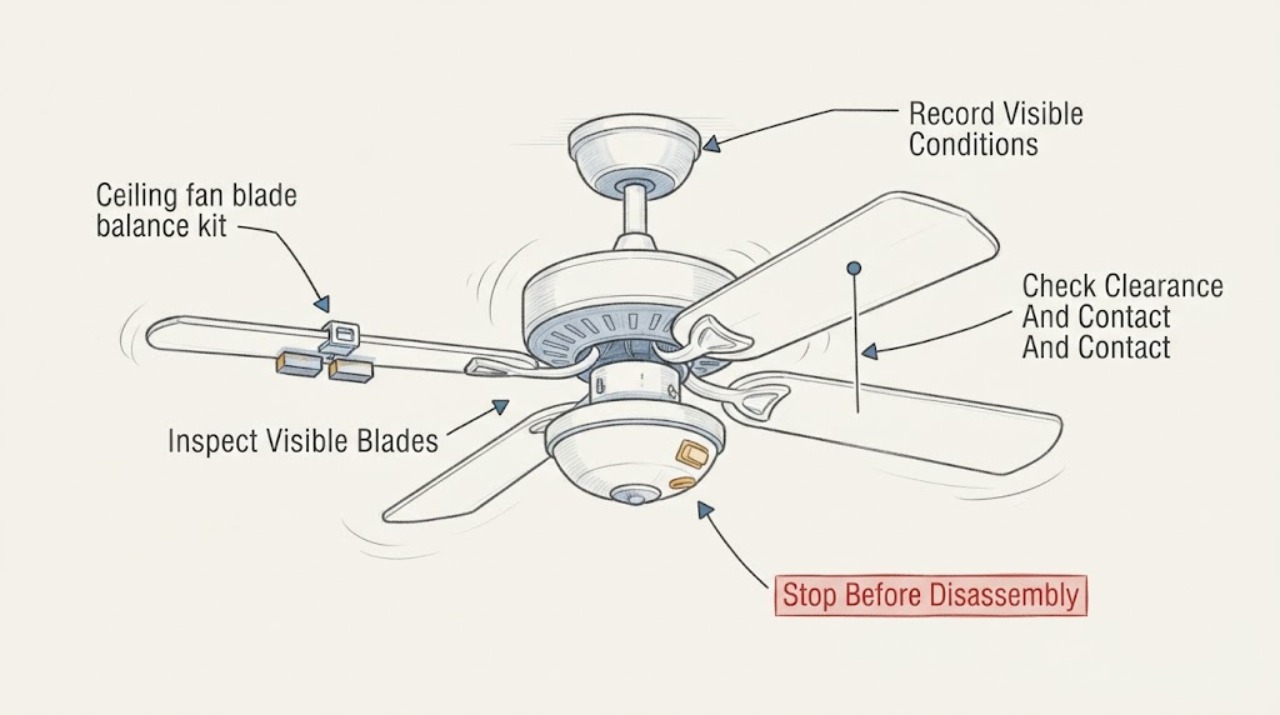
Stop using a ceiling fan that wobbles significantly, changes suddenly, scrapes, or makes the mount or canopy move. From the floor with the fan off, record whether the wobble was at the blades, light kit, downrod, or ceiling mount, then inspect the visible blade edges and lower hardware for dust, cracks, warping, loose-looking parts, or contact with nearby objects. Do not climb, remove the canopy, touch wiring, or run the fan to trial a balance clip. A balancing kit is only a model-authorized accessory for a sound, securely mounted fan; suspected mount movement, damaged blades, or wobble that persists needs a licensed electrician or qualified fan service professional.
Work through in order
Diagnostic checks
Use only checks that match the exact appliance or system and its official guide.
-
Check 1
With the fan switched off and stopped, write down what was observed during the last normal use: gentle sway, pronounced side-to-side wobble, clicking or scraping, light-kit movement, downrod movement, or visible ceiling-mount movement. Do not turn it back on to reproduce the symptom.
Expected result: Blade-only sway differs from movement at the light kit, downrod, canopy, ceiling attachment, or a noise that appears with movement.
Next step: Keep the fan off, photograph the fixture from the floor, and use the pattern to choose the next visual check or service handoff.
Stop if: Stop all inspection if the canopy or mount appears separated, the fan shifts when the room door closes, a blade is hanging, or any part has fallen.
Why this matters
Why: The location of the prior movement helps distinguish a balance clue from a mount, hardware, or fixture problem. It does not prove that a balance kit is safe to apply.
-
Check 2
From the floor with power off, visually inspect each blade and the visible lower edge of its holder for uneven dust, a crack, chip, bow, twist, missing fastener, or a blade that sits at a different angle. Do not touch the blade or use a ladder to view its upper surface.
Expected result: Even dust or a clean blade set differs from one visibly warped, cracked, chipped, loose-looking, or misaligned blade.
Next step: Photograph the affected blade from the floor, note its position relative to the light or downrod, and ask the manufacturer or electrician about the correct matched blade set or service.
Stop if: Stop if a blade is cracked, detached, sharp, drooping, or within reach of a person or if inspection would require climbing or touching the fixture.
Why this matters
Why: A warped or damaged blade cannot be made safe by adding a weight, and a missing or loose-looking fastener needs model-specific service. Uneven dust may explain a mild imbalance but should not be tested by running the fan under this safety scope.
-
Check 3
From the floor, look around the complete blade circle for contact with a light fixture, wall, cabinet, beam, curtain, cord, plant, or other object. Note whether anything has been moved or installed since the wobble began.
Expected result: An unobstructed blade path differs from a blade close to or contacting an object, a hanging item, or a changed room arrangement.
Next step: Remove only a light, loose, floor-level object that is clearly outside the fixture and safe to handle; otherwise keep the fan off and report the obstruction to service.
Stop if: Stop if an object is caught in the fan, a blade has struck a wall or fixture, or clearing the area would require reaching overhead or moving a mounted object.
Why this matters
Why: Contact or airflow interference can look like wobble and can damage a blade or object. Clearance and installation requirements are model-specific; do not measure from a ladder or move the fixture.
-
Check 4
From a safe standing position, inspect the visible canopy, downrod, light kit, and ceiling area for a gap, tilt, sag, cracked housing, water mark, or movement that was not present before. Also note recent installation, a blade or light-kit change, impact, water exposure, or ceiling work.
Expected result: A flush-looking, dry, stationary canopy differs from a separated or tilted canopy, sagging fixture, cracked housing, water mark, or a problem that followed installation or a component change.
Next step: Keep power off, keep people away, and request a licensed electrician or qualified fan professional. Provide the timeline and photos without removing anything.
Stop if: Stop immediately for a loose mount, exposed wiring, water or burn mark, smoke, heat, sparking, or a fixture that shifts visibly.
Why this matters
Why: Mount or housing clues override a balance-kit experiment: the fixture may need electrical or structural service, and a balancing weight cannot correct unsafe attachment or water damage.
-
Check 5
Read the fan model and any balance-kit instructions from paperwork, a floor-level label, or a manual already available. Note whether the kit is supplied for that model and whether the manual directs a professional for mounting, blade, or electrical access; do not substitute another fan's procedure.
Expected result: A manual that identifies a matching clip-and-weight kit differs from missing documentation, an unbranded kit, mismatched blades, or instructions that require a ladder, canopy removal, or powered testing.
Next step: Give the model, kit contents, prior wobble pattern, and photos to the manufacturer or electrician. Do not install the kit or operate the fan until the fixture is confirmed safe under the applicable instructions.
Stop if: Stop if the model cannot be identified safely, the kit is missing parts, or the next step requires overhead work, electrical access, or running the fan.
Why this matters
Why: Balance accessories and blade sets are not automatically interchangeable. Model identification is needed before selecting a kit, bracket, downrod, blade, or service approach.
Use your observations
Decision map
Find the observation that best matches what you see, then follow the next safe action.
-
PATH 01Next step
What you see
The canopy, downrod, light kit, ceiling attachment, or housing appears loose, tilted, cracked, wet, or visibly moving.
Do this next
Keep the fan off and the area clear. Request a licensed electrician or qualified fan professional; do not apply a balance kit or touch the mount.
-
PATH 02Next step
What you see
A blade is cracked, chipped, warped, twisted, detached, or visibly misaligned.
Do this next
Do not operate or rebalance the fan. Photograph the blade and obtain the exact matched replacement or professional service for the model.
-
PATH 03Next step
What you see
A blade contacts or approaches a wall, light, cabinet, beam, cord, curtain, plant, or other object.
Do this next
Keep the fan off and remove only a safe floor-level loose object. Do not reach overhead or move mounted objects; arrange service if the obstruction or clearance is uncertain.
-
PATH 04Next step
What you see
The prior symptom was mild blade-only sway, with no mount, housing, blade damage, contact, water, heat, or electrical clue.
Do this next
Use only the exact model manual to decide whether a balance kit is appropriate. Keep the fan off under this observation-only check and have a professional perform any overhead or powered test.
-
PATH 05Next step
What you see
The cause is unclear, the model or kit is unidentified, or wobble returned after an earlier balance attempt.
Do this next
Do not add more weights or continue testing. Keep the fan off and request model-specific electrical or fan service with the symptom record and photos.
Helpful context
Understand the symptom
A balance kit is not a fix for an unsafe mount
A ceiling fan can wobble because of uneven dust or blade weight, a warped blade, loose visible hardware, an installation or mounting issue, or an object too close to the blade path. A clip and weight can address a limited blade-balance problem only after the fan and mounting system are known to be sound. The same symptom can also precede a falling-object or electrical hazard, so the safe first step is to stop and observe from the floor.
Stay below the fixture
Do not use a ladder or chair, remove the canopy, reach over your head, straighten a blade holder, tighten hidden hardware, or test a wobbling fan. If the fixture is loose, damaged, wet, hot, or unpredictable, keep people out of the room and arrange qualified service.
Safety boundary
Stop conditions
- Do not run, spin, climb toward, or touch a wobbling fan under this observation-only check; do not use a ladder or chair.
- Do not remove the canopy, expose wiring, straighten blade holders, tighten hidden hardware, or install a balance kit without model-authorized and qualified service boundaries.
- Keep the fan off for a loose or moving mount, damaged blade, cracked housing, water exposure, heat, smell, sparking, scraping, or unpredictable movement.
- Call a licensed electrician or qualified fan professional when the cause is not clearly a minor model-authorized balance issue, the wobble persists, or any overhead, mounting, or electrical work is required.
Only after diagnosis
Potential parts
- ceiling fan balancing kit
Consider this only after a qualified person or the exact model manual confirms the fan is securely mounted, the blades are sound, and a balance kit is the appropriate remedy.
Confirm fan model, blade set, clip and weight design, and manufacturer fit information; do not assume a universal kit corrects mount or blade damage. - ceiling fan mounting bracket
Consider this only if a qualified electrician identifies a damaged or incompatible mounting bracket as the cause of unsafe movement.
Confirm the fan model, electrical-box support, ceiling structure, bracket geometry, and manufacturer fit information; installation is overhead electrical work. - fan downrod
Consider this only if a qualified professional identifies a damaged, loose, or incorrect downrod as the source of movement.
Confirm length, diameter, wiring path, finish, fan model, and manufacturer fit information; do not substitute a rod or change the mount without qualified service.
When checks do not resolve it
Need a professional?
Call a licensed electrician or qualified ceiling-fan professional when wobble is pronounced or persistent, the mount, canopy, downrod, light kit, or housing moves, any blade is cracked or warped, an object has been struck, water or electrical damage is visible, or the model-specific balance path requires overhead or electrical access. Provide the fan and kit model, prior wobble pattern, floor-level photos, visible blade and mount observations, clearance or contact clues, and the last installation or component change.
Common questions
FAQ
Can a balance kit fix every wobbling ceiling fan?
No. A balance kit is only a conditional option for a sound, securely mounted fan with a suitable model path. It cannot correct a warped or cracked blade, loose mount, damaged housing, clearance problem, or electrical issue.
What should I check first when a ceiling fan wobbles?
Turn it off and observe from the floor. Record whether prior movement came from the blades, light kit, downrod, canopy, or ceiling attachment, then look for visible blade damage, contact with nearby objects, water, heat, or a loose-looking mount.
Can I use a ladder to inspect the blade balance?
Not under this safe observation path. Do not climb, reach overhead, remove the canopy, or touch the fixture. Take floor-level photos and have a qualified person perform any overhead or powered inspection.
What if the fan still wobbles after a previous balance attempt?
Stop adding weights or repeating tests. Persistent wobble may involve warped blades, mounting, downrod, hardware, clearance, or housing conditions. Keep the fan off and request model-specific electrical or fan service.
When should I stop using a wobbling ceiling fan?
Stop for pronounced or changing wobble, scraping, a loose or moving mount, cracked or warped blade, object contact, water, heat, smell, sparking, exposed wiring, or unpredictable movement. Keep people clear and arrange qualified service.
Read the exact guide
Official sources
- Ceiling Fan Installation and Usage TipsENERGY STAR · Government-backed guidance used for general balance and mounting distinctions; the exact fan manual and qualified installer govern any overhead work.
- Why is my fan wobbling?Hunter Fan Company · Manufacturer troubleshooting guidance used for symptom separation and model-specific service boundaries; it is not a universal installation procedure.
- How to Balance a Ceiling Fan | Fix a Wobbly Fan with Simple StepsHunter Fan Company · Manufacturer guidance used only to explain potential causes and the conditional nature of balance kits; this article does not advise overhead or powered testing.
Community feedback
Share a repair observation
Share a plain-text repair observation. Accepted observations are published automatically; this page may take a moment to update.