
On this page
Start here
Quick answer
A Hampton Bay ceiling fan that still wobbles while you are using a blade balance kit should be checked in order: stop the fan completely, secure visible blade and blade-bracket fasteners, compare the height of every blade from the ceiling, and only then use the kit to identify a small weight imbalance. A balance kit can correct a minor difference in blade weight; it cannot correct a cracked or warped blade, a bent blade bracket, a loose downrod or hanger, an insecure ceiling support, or a fan that is moving at the mounting point. Use the kit exactly as its model instructions describe: place the clip only with the blades stopped, run the fan briefly from a clear position, stop it fully before moving the clip, and secure any permanent weight. Stop using the fan for severe or worsening wobble, a blade or bracket that looks damaged, loose mounting hardware, unusual grinding, a ceiling box that moves, or any part that could fall. Do not bend blade holders, place fingers or tools near rotating blades, or work on wiring unless the power is isolated and the work is performed by a qualified electrician.
Before you begin
Safety first
- This article supports power-off visual inspection from stable access, model-permitted accessible fastener checks, blade-level comparison, and a balance-kit test only when the fan and support are sound. Do not open wiring, remove weight-bearing hardware, bend blade holders, or operate a damaged or unstable fan.
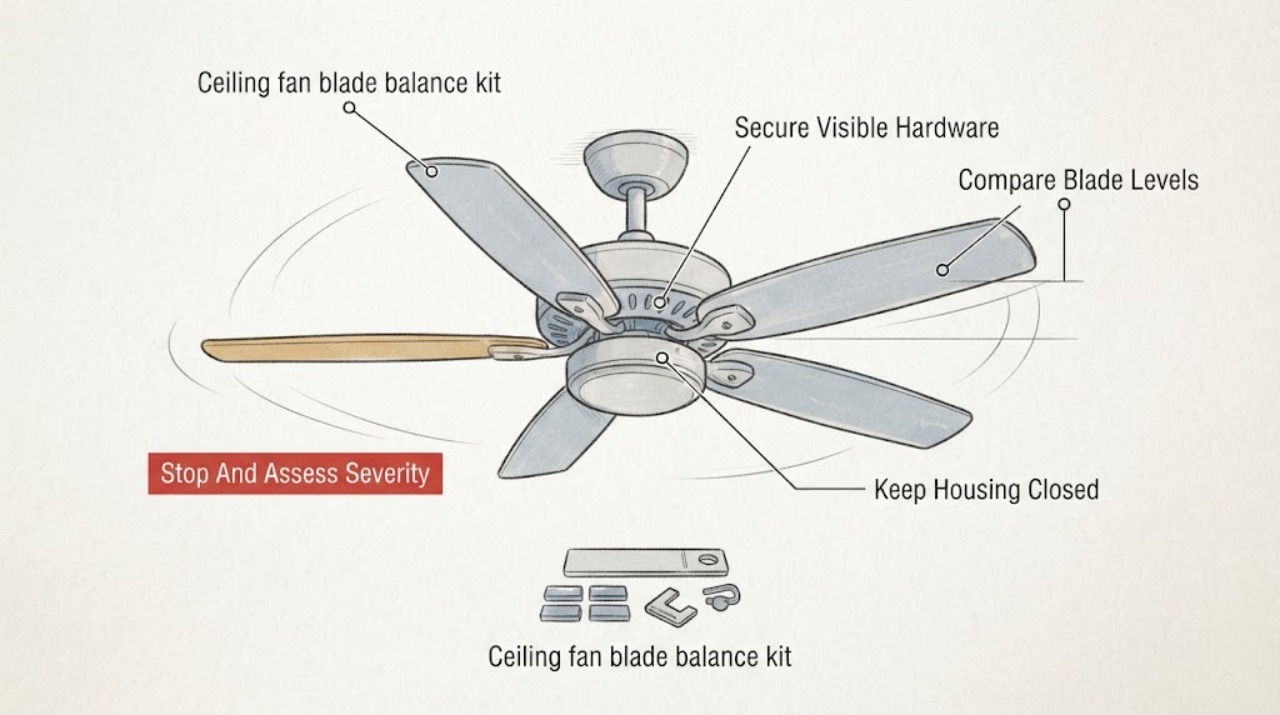
Work through in order
Diagnostic checks
Use only checks that match the exact appliance or system and its official guide.
-
Check 1
Turn the fan off using its normal control and wait until every blade has completely stopped before approaching; from the floor, observe whether the wobble is mild and steady, severe or worsening, accompanied by noise, or visible at the ceiling mount.
Expected result: The blades settle without contact, the fan body or canopy rocks, a blade or bracket appears cracked or bent, a screw or pin is visibly loose, or the fan makes grinding or impact noise.
Next step: Keep the fan off for severe, worsening, noisy, damaged, or mount-level wobble and arrange qualified service. Continue only with a stable fan whose blades and support look intact.
Stop if: Do not approach a fan with a loose, cracked, falling, or contacting blade, a moving ceiling box, smoke, sparking, or severe vibration.
Why this matters
Why: A mild, steady blade-only wobble may be suitable for a balance check. Movement at the mount, damage, loose hardware, or abnormal noise can indicate a support or mechanical fault that a kit will not safely correct.
-
Check 2
With power off and the blades stopped, inspect from a stable position and tighten only accessible fasteners identified by the model manual at the blade, blade bracket, downrod, and visible mounting points; do not open the canopy or touch wiring.
Expected result: A blade or bracket screw is loose, the downrod or set-screw area moves, the hanger or canopy is not seated, all visible hardware is secure, or tightening does not change the wobble.
Next step: After any permitted tightening, run the fan briefly from a clear position and observe. If the mount moves, the ceiling support is uncertain, or wobble remains severe, stop and arrange qualified service before using a balance kit.
Stop if: Do not remove the fan from the ceiling, loosen mounting hardware that supports its weight, open the canopy, or work on wiring as an ordinary balance check.
Why this matters
Why: Loose blade, bracket, downrod, or hanger hardware can create apparent imbalance and can worsen with operation. Secure visible hardware is a prerequisite for interpreting a balance-kit result; a moving mount needs a support assessment.
-
Check 3
With the fan off, use the same ceiling reference point to compare the tip or centerline of each blade at the same rotational position; rotate the blades by hand only while the power is isolated and the fan is stable.
Expected result: All blade levels are close, one blade sits distinctly higher or lower, a bracket is visibly twisted, a blade is bowed or cracked, or the comparison cannot be made safely from the floor.
Next step: If the blades are sound and the level comparison is consistent, proceed to the balance-kit test. If a blade or holder is damaged, the fan cannot be reached safely, or the ceiling support is uncertain, leave it off and request service or model-specific parts guidance.
Stop if: Do not bend a blade holder, climb on an unstable surface, stand under a damaged blade, or put fingers between blades.
Why this matters
Why: A level difference can indicate bracket seating, a bent holder, or a warped blade rather than a simple weight imbalance. A damaged blade cannot be made safe with adhesive weights, and an unsafe viewing position is a stop condition.
-
Check 4
Only when hardware, blade levels, support, and clearance are sound, attach the balance-kit clip to one blade while the fan is stopped, stand clear, run the fan briefly at the model-approved test setting, stop it fully, and repeat on the other blades as the kit instructions direct.
Expected result: One blade position reduces wobble, every position has little effect, the clip increases vibration, the fan becomes unstable, or the clip or blade surface cannot hold it securely.
Next step: If one position clearly improves the wobble, mark the location only after stopping and apply the kit's permanent weight there. If results are inconsistent or worse, remove the clip with the fan stopped and arrange inspection rather than adding more weight.
Stop if: Do not move the clip while blades rotate, hold a weight by hand during operation, add weights without a repeatable result, or test a fan that shakes severely.
Why this matters
Why: A repeatable improvement at one blade supports a small weight imbalance. No improvement points toward blade shape, alignment, mounting, downrod, support, or resonance; increased vibration or an insecure clip makes continued testing unsafe.
-
Check 5
With the fan stopped, place the permanent balance weight only at the tested clip position and according to the model kit instructions, then run one brief retest from a clear position at low and normal operating speed.
Expected result: Wobble is substantially reduced and repeatable, the weight loosens, the wobble returns or shifts to another speed, the fan still rocks at the mount, or a new noise or vibration appears.
Next step: Stop and remove or secure the weight only as the kit permits if it loosens. Leave the fan off and arrange qualified service for persistent wobble, mount movement, blade damage, or abnormal noise; do not keep stacking weights.
Stop if: Do not operate with a loose weight, cracked blade, bent bracket, shifting mount, contact noise, smoke, sparking, or worsening vibration.
Why this matters
Why: A stable improvement supports a minor blade-weight difference. A loose weight, speed-dependent or unchanged wobble, mount movement, or new noise indicates that balancing is not the underlying or complete repair.
Use your observations
Decision map
Find the observation that best matches what you see, then follow the next safe action.
-
PATH 01Safety boundary
What you see
The fan is stable at the ceiling, blades and brackets are intact and secure, blade levels are close, and one balance-clip position repeatedly reduces wobble.
Do this next
Apply the permanent weight at the tested position with the fan stopped, then perform one brief clear-area retest.
Why this path and its safety boundary
Why it matters: A small blade-weight difference is plausible and is the condition a balance kit is designed to address.
Safety stop: Stop if the weight loosens, wobble worsens, or the fan develops contact noise or mount movement.
-
PATH 02Safety boundary
What you see
One blade sits distinctly higher or lower than the others when compared with the same ceiling reference point.
Do this next
Stop and use the exact model instructions or qualified service to identify the damaged or mis-seated component; do not compensate by adding arbitrary weights.
Why this path and its safety boundary
Why it matters: Blade or bracket seating, a bent holder, or a warped blade is more likely than a simple weight imbalance.
Safety stop: Do not bend blade holders, force a blade flat, or operate a cracked or visibly warped blade.
-
PATH 03Safety boundary
What you see
The fan body, canopy, downrod, hanger, or ceiling mounting point moves independently while the blades are stopped or turning slowly.
Do this next
Leave the fan off and arrange qualified electrician or ceiling-fan service to inspect the fan-rated outlet box, mounting bracket, hanger, downrod, and fasteners.
Why this path and its safety boundary
Why it matters: The wobble is in the support or installation path and a blade balance kit cannot make that support safe.
Safety stop: Do not loosen or remove weight-bearing mounting hardware, open the canopy, or continue operating a moving or falling-risk fan.
-
PATH 04Safety boundary
What you see
All clip positions have little or inconsistent effect, or the fan remains wobbly after a properly placed permanent weight.
Do this next
Remove the clip or stop using the fan, document the speed and location of the wobble, and request model-specific or qualified inspection.
Why this path and its safety boundary
Why it matters: The cause may be blade shape, bracket alignment, downrod or mount, ceiling resonance, or a mechanical problem rather than a weight difference.
Safety stop: Do not keep adding or stacking weights, change the downrod, bend brackets, or open the motor housing as a balancing experiment.
-
PATH 05Safety boundary
What you see
A blade is cracked, warped, bowed, or loose, or a blade holder is bent, cracked, or not securely attached.
Do this next
Keep the fan off and identify the exact model for a compatible blade or bracket assessment by qualified service or the manufacturer.
Why this path and its safety boundary
Why it matters: The component cannot be made reliable by a balance weight and may shed parts or increase vibration while operating.
Safety stop: Do not bend, drill, glue, tape, or balance a damaged blade or holder.
-
PATH 06Safety boundary
What you see
The fan shakes severely, contacts the ceiling or light kit, produces smoke or sparking, or has a loose part that could fall.
Do this next
Keep people out of the area, leave the fan off, and arrange qualified electrical or fan service; follow local emergency guidance for smoke or fire.
Why this path and its safety boundary
Why it matters: This is an active injury, electrical, or falling-object hazard, not a routine blade-balance condition.
Safety stop: Do not restart the fan, approach rotating blades, catch a falling component, or touch exposed wiring.
Helpful context
Understand the symptom
What a balance kit can and cannot correct
A blade balance kit is a diagnostic and correction tool for a small weight difference between otherwise sound blades. It cannot make a cracked, warped, or badly misaligned blade safe, and it cannot stabilize a fan that rocks at the ceiling, downrod, hanger, or outlet box. Check the support and blade hardware first so a weight adjustment does not mask a mechanical or installation problem.
Use a repeatable blade comparison
Hampton Bay guidance compares each blade tip with the same point on the ceiling while the fan is stopped, then checks blade and bracket attachment. Unequal height can come from a loose fastener, bracket seating, a bent holder, or a warped blade. Record which blade is different and whether the fan body itself moves; those observations determine whether the balance kit is appropriate.
Keep the testing boundary narrow
Only test a stable fan with intact blades, secure support, and clear space. The clip and weights must be handled with the fan stopped, and the operator should stand clear of the rotating blade path. If wobble becomes severe, hardware loosens, a blade cracks, or the support shifts, stop immediately and arrange qualified electrical or fan service.
Safety boundary
Stop conditions
- Do not approach or operate a fan with severe or worsening wobble, a loose or falling part, blade contact, smoke, sparking, or a shifting ceiling support.
- Turn power off and wait for complete blade stoppage before attaching, moving, or removing a balance-kit clip or weight.
- Do not bend, drill, glue, tape, or otherwise modify blades, blade holders, mounting brackets, downrods, or the ceiling support.
- Do not open the canopy, touch wiring, remove weight-bearing hardware, or change the downrod as an ordinary balance-kit test.
- Stop adding weights when the kit has no repeatable effect, wobble changes unpredictably, or a new vibration or noise appears.
Only after diagnosis
Potential parts
- ceiling fan blade balance kit
Consider this part class only when the fan is stable, blades and brackets are intact and secure, blade levels are close, and a repeatable clip test identifies a minor weight imbalance.
Confirm the exact Hampton Bay model and the kit instructions; do not assume a generic clip or weight is suitable for every blade design. - Hampton Bay replacement blade set
Consider this part class only when a blade is cracked, warped, bowed, or otherwise confirmed unsuitable for balancing and a model-specific replacement is available.
Confirm the exact model, blade count, span, attachment pattern, finish, and manufacturer fit information before ordering. - ceiling fan blade bracket or blade arm
Consider this part class only when a bracket is bent, cracked, or damaged and qualified diagnosis confirms it is the source of unequal blade level or wobble.
Confirm the exact model, bracket geometry, attachment hardware, and manufacturer fit information; do not bend a bracket back into shape as a balancing step. - ceiling fan mounting or downrod hardware
Consider this part class only when qualified inspection confirms a worn, damaged, or model-incompatible support component after the fan is taken out of service.
Confirm the exact model, fan-rated outlet-box requirement, downrod dimensions, and installation instructions; weight-bearing and electrical work may require a qualified electrician.
When checks do not resolve it
Need a professional?
Arrange qualified ceiling-fan or electrical service when the fan body, downrod, hanger, bracket, or ceiling support moves; a blade or holder is cracked, warped, bent, or loose; the balance kit has no repeatable effect; wobble returns or worsens after balancing; or grinding, contact noise, smoke, sparking, or a falling-risk part appears. A blade balance kit is appropriate only for minor, repeatable blade-weight imbalance on an otherwise stable and intact fan.
Safety scope: This article supports power-off visual inspection from stable access, model-permitted accessible fastener checks, blade-level comparison, and a balance-kit test only when the fan and support are sound. Do not open wiring, remove weight-bearing hardware, bend blade holders, or operate a damaged or unstable fan.
Common questions
FAQ
Will a Hampton Bay blade balance kit fix every wobbling fan?
No. It is intended for a minor, repeatable blade-weight difference after screws, blade levels, brackets, and support are sound. It will not correct a cracked or warped blade, bent holder, loose downrod, moving ceiling support, or motor problem.
Can I move the balance clip while the fan is running?
No. Attach or move the clip only with the fan stopped and every blade still. Run a brief test from a clear position, stop completely, then move the clip to the next blade as the kit instructions direct.
What if the fan still wobbles after adding the balance weight?
Remove or secure the weight only as the kit permits and stop adding more. Persistent or speed-specific wobble can indicate blade shape, bracket, downrod, mounting, ceiling support, resonance, or mechanical trouble. Leave the fan off if it is severe, worsening, noisy, or moving at the mount and arrange service.
Should I bend a Hampton Bay blade bracket to level the blades?
Do not bend a blade holder or bracket as an ordinary balance step. A bent or damaged holder changes the safety and attachment geometry; keep the fan off and use the exact model manual or qualified service to identify a compatible replacement or repair.
Read the exact guide
Official sources
- Hampton Bay Customer Service - The Home DepotHampton Bay Customer Service · Official Hampton Bay brand customer-service guidance hosted by its retail support channel; use the exact fan manual for model-specific installation and parts.
- 60” Asbury Plus Ceiling Fan by Hampton BayHampton Bay · Official Hampton Bay instruction manual hosted as the product documentation PDF; the assigned fan model is not specified, so its exact manual takes precedence.
- How to Balance a Ceiling Fan | Fix a Wobbly Fan with Simple StepsHunter Fan · Cross-manufacturer reference for balance-kit mechanics and safety; it does not establish Hampton Bay compatibility or replace the Hampton Bay model manual.
Community feedback
Share a repair observation
Share a plain-text repair observation. Accepted observations are published automatically; this page may take a moment to update.