
On this page
Start here
Quick answer
A Casablanca wall control that buzzes may be reacting to an incompatible dimmer or control, a receiver or fan-load issue, loose or faulty wiring, or a problem at the circuit breaker. First locate the sound and note whether it happens with the fan, light, or a particular speed or dimming level. Turn the fan and light off and stop using the control if the sound is crackling, sizzling, accompanied by an odor, heat, flicker, smoke, or a tripping breaker. Do not remove the wall plate, tighten live terminals, bypass a control, or open the fan canopy unless power is isolated and the work is within a qualified electrician's scope. A persistent electrical buzz from the wall control needs model-specific Casablanca control guidance or qualified electrical service, especially if changing the control or wiring is required.
Before you begin
Safety first
- The homeowner-safe checks are locating the sound, observing its trigger, noting normal fan and light response, identifying the model, and observing the labeled breaker from a safe distance. Wall wiring, dimmer or receiver replacement, canopy connections, breaker work, and energized testing belong to a qualified professional.
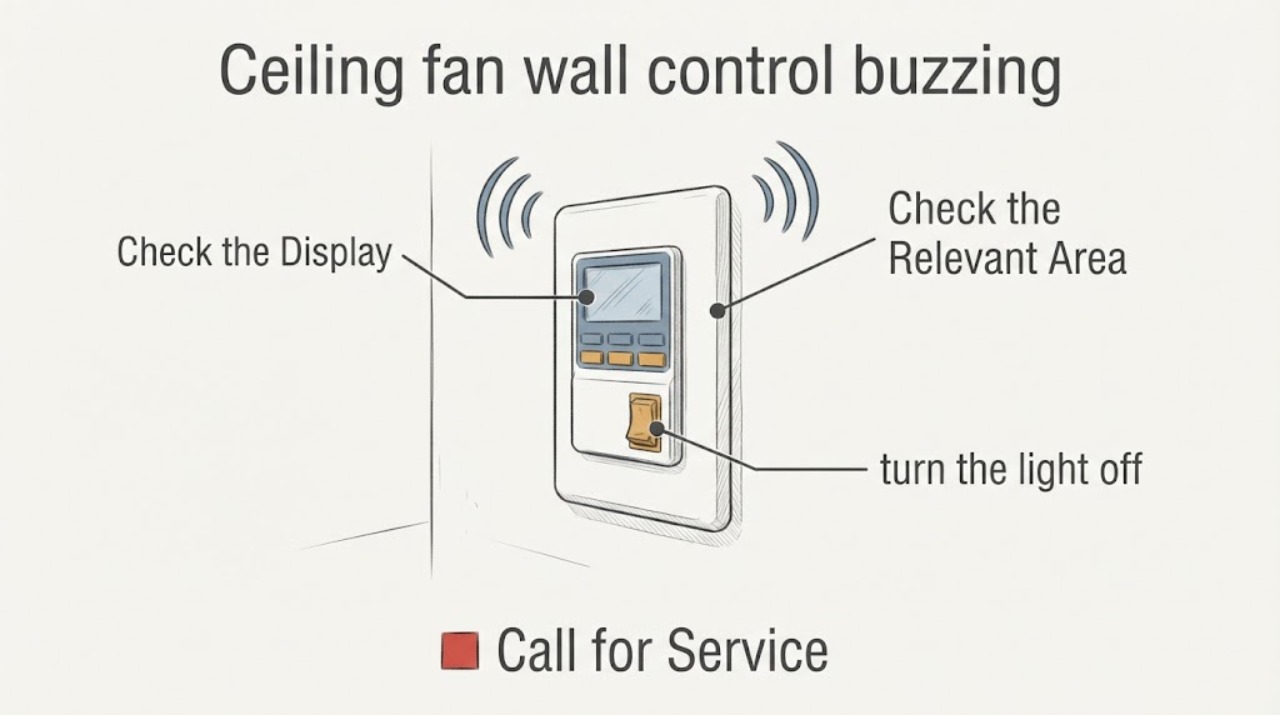
Work through in order
Diagnostic checks
Use only checks that match the exact appliance or system and its official guide.
-
Check 1
From a safe standing position, operate the fan and light once and identify whether the buzz is loudest at the wall control, fan canopy, light kit, or circuit-breaker area; do not touch energized parts or place objects near the blades.
Expected result: The wall control is loudest, the fan or canopy is loudest, the light kit is loudest, or the breaker or panel is buzzing.
Next step: Turn the fan and light off if the sound is persistent. Arrange qualified electrical or Casablanca service for a panel, wiring, or internal-fan source rather than opening the control or canopy yourself.
Why this matters
Why: The sound location narrows the path but does not prove the failed component. A wall-control sound keeps the control, dimmer, wiring, and connected load in consideration; a canopy sound keeps the receiver, motor, or fan wiring in consideration; panel noise raises an electrical hazard.
-
Check 2
With the area otherwise quiet, note whether the buzz begins with fan power, only at one speed, with the light, while dimming, or when the control is idle; make one comparison and stop if the control becomes hot or crackles.
Expected result: The buzz occurs only with the light or dimming, only at a fan speed, whenever the fan is powered, or even when the fan and light are off.
Next step: Record the trigger and avoid that setting. Do not bypass the dimmer, substitute an unverified control, or continue operating a control that buzzes at idle; arrange model-specific or qualified electrical diagnosis.
Why this matters
Why: A light-only buzz makes bulb wattage, dimmer compatibility, or the light load more likely. A speed-dependent buzz may involve the control, receiver, or motor load. Buzzing while idle keeps the control or wiring energized even without a fan command and should not be ignored.
-
Check 3
If the sound occurs only when the light is on, turn the light off and compare the installed bulb type and wattage with the Casablanca fan or light-kit manual without removing a hot bulb or changing wiring.
Expected result: The light is on a dimmer, the bulb wattage or type is unknown, the buzz disappears with the light off, or the buzz remains with the light off.
Next step: Use only the bulb type and wattage specified by the exact manual and stop using an incompatible dimmer or control until a qualified person confirms the replacement. Do not alter the wall wiring to silence the noise.
Why this matters
Why: An incorrect bulb load or a dimmer can produce electrical hum. If the light is not involved, a light-bulb explanation is less likely and the wall control, receiver, wiring, or circuit deserves attention.
-
Check 4
Identify the wall-control model and, only if the manual describes a user-accessible battery, check the battery's condition and polarity with power behavior otherwise normal; do not assume every Casablanca wall control uses the same battery or circuit.
Expected result: The control battery is low or incorrectly installed, the controls respond normally but buzz, the control is unresponsive, or the model and battery arrangement are unknown.
Next step: Use the exact model manual for any battery replacement or pairing step. If the buzz continues, do not replace the wall control with a generic dimmer; arrange qualified evaluation of control compatibility and the fan's receiver.
Why this matters
Why: A low battery can explain erratic control behavior on models that use one, but it does not by itself prove the cause of an electrical buzz. A responsive control with persistent buzzing keeps dimmer, receiver, load, wiring, and breaker causes in consideration.
-
Check 5
Observe the labeled circuit breaker only from a safe distance while the symptom is present and note whether it is warm, buzzing, flickering, overloaded by other equipment, or tripping; do not repeatedly reset it or remove the panel cover.
Expected result: The breaker is quiet and stable, the breaker buzzes or feels unusually warm, it trips, or other loads on the circuit flicker or lose power.
Next step: Turn off the fan and light and leave a repeatedly tripping or noisy circuit off when safe. Arrange qualified electrical service; do not keep resetting the breaker to test the fan.
Why this matters
Why: A stable breaker makes a panel fault less likely but does not clear the wall control or fan. Breaker noise, heat, flicker, or tripping may indicate overload or an electrical fault and is not a fan-control adjustment problem.
-
Check 6
If the wall control buzzes whenever the fan is powered, record whether the fan speed, light, and remote response change, then consult the exact Casablanca manual for the model; do not loosen the canopy or inspect connections unless power is isolated and a qualified person performs the work.
Expected result: The fan and light work normally but the wall control buzzes, the fan responds erratically, the receiver or canopy is noisy, or the fan does not respond at all.
Next step: Stop using the noisy control and arrange Casablanca or qualified electrical service with the model number. Do not select a receiver or wall control by appearance alone; compatibility is model-specific.
Why this matters
Why: Normal fan operation does not rule out a control or receiver hum. Erratic response or a canopy source makes receiver, pairing, motor, or internal wiring more likely. A nonresponsive fan broadens the issue to power, battery, pairing, or wiring.
-
Check 7
After one safe comparison with the fan and light off, document whether the buzz stops, whether the wall plate or control is warm, and whether there was odor, crackle, flicker, smoke, or a breaker trip; do not perform repeated on-off tests.
Expected result: The buzz stops and does not return, it returns whenever power is applied, or any heat, odor, crackle, smoke, spark, or trip was observed.
Next step: Keep the fan and light off for a recurring or hazardous symptom and arrange qualified electrical or Casablanca service. Use emergency assistance from a safe location for active smoke, fire, or immediate electrical danger.
Why this matters
Why: A one-time transient still needs monitoring, while a repeatable power-related buzz indicates an unresolved electrical or control condition. Heat, odor, crackling, smoke, sparking, or tripping raises the risk beyond a noise nuisance.
Use your observations
Decision map
Find the observation that best matches what you see, then follow the next safe action.
-
PATH 01Next step
What you see
The sound occurs only with the Casablanca light on or while dimming, and disappears when the light is off.
Do this next
Use the exact manual's bulb specification and stop using an incompatible dimmer. Have a qualified person confirm the control if the noise remains; do not rewire the control yourself.
Why this path and its safety boundary
Why it matters: The bulb load or dimmer/control compatibility is more likely than a fan motor problem.
-
PATH 02Next step
What you see
The buzz follows fan power or a particular speed, while the wall control and light otherwise respond normally.
Do this next
Avoid the noisy setting and arrange model-specific Casablanca or qualified electrical diagnosis of the control and receiver path.
Why this path and its safety boundary
Why it matters: The connected control, receiver, or motor load is more likely than a low battery alone; speed behavior cannot identify which part is at fault.
-
PATH 03Next step
What you see
The wall control buzzes even when the fan and light are off, or its plate becomes warm.
Do this next
Turn off the fan circuit when safe, stop using the control, and arrange qualified electrical service. Do not remove the wall plate or tighten terminals while energized.
Why this path and its safety boundary
Why it matters: An energized control, dimmer, wiring, or load fault is possible and should not be treated as normal fan noise.
-
PATH 04Next step
What you see
The sound is loudest at the fan canopy or receiver, or the fan responds erratically when the wall control is used.
Do this next
Keep the fan off if the noise persists and arrange qualified Casablanca or electrical service with the model number and symptom timing.
Why this path and its safety boundary
Why it matters: A receiver, internal fan wiring, motor load, or pairing issue is more likely than a wall-control battery; the canopy is not a homeowner diagnostic area.
-
PATH 05Next step
What you see
There is crackling or sizzling, a burning odor, heat, smoke, sparking, flicker, or a repeatedly tripping or buzzing breaker.
Do this next
Stop using the fan and light, leave the circuit off when safe, and obtain qualified electrical help. Leave the area and use emergency assistance for active smoke, fire, or immediate danger.
Why this path and its safety boundary
Why it matters: An electrical fault, overload, fire risk, or damaged control may be present regardless of whether the fan still operates.
Helpful context
Understand the symptom
Confirm that the wall control is actually the source
A buzz can travel through a wall or ceiling, so stand safely near the control, fan canopy, light kit, and electrical panel while the symptom occurs. A sound that changes when the wall control is pressed points toward the control or its load; a sound from the canopy may involve the receiver, motor, or light assembly; a sound from the panel is an electrical warning. Do not put an ear or hand against energized equipment.
The trigger matters more than the word buzzing
Note whether the noise starts with fan power, a particular speed, the light, dimming, or an idle state. A dimmer can hum under a lighting load, and a receiver can hum under a control system. A buzz that changes with speed or disappears when the light is off does not prove the wall control is defective; it changes which control or load should be evaluated.
Casablanca controls are model-specific
Casablanca wall controls can be paired with a receiver and may use a battery, while the fan still depends on the circuit breaker and fan wiring. The manual for one Casablanca family cannot establish compatibility for every control, fan, or dimmer. Use the model number and the exact manual before considering a replacement control, receiver, or battery.
Buzzing with heat, odor, or crackle is a stop condition
A faint hum without other symptoms still deserves diagnosis if it persists. Crackling or sizzling, a hot wall plate, burning or popcorn-like odor, flicker, smoke, sparking, or a repeatedly tripping breaker can indicate an electrical fault. Turn the fan and light off, keep clear of the equipment, and use qualified electrical help; do not keep cycling the control to see whether the sound returns.
Safety boundary
Stop conditions
- Do not remove the wall-control cover, tighten terminals, bypass a dimmer or receiver, change live wiring, open the fan canopy, or inspect a breaker panel. Isolate power first and use a qualified electrician for wiring or control work.
- Stop using the fan and light and arrange service when buzzing repeats, follows fan power or dimming, comes from the receiver or wiring, or the control becomes warm or erratic.
- Leave a noisy, hot, flickering, or repeatedly tripping breaker off when safe. Do not repeatedly reset it as a test.
- For crackling, sizzling, burning odor, smoke, fire, or active sparking, leave the area and use emergency electrical assistance from a safe location.
Only after diagnosis
Potential parts
- Casablanca-compatible wall control
Only consider a replacement control after the exact model, wiring, dimmer compatibility, and receiver path have been confirmed as the source of the buzz.
Casablanca control and receiver compatibility is model-specific; have a qualified person confirm the correct control before ordering or wiring it. - fan control receiver
Only consider a receiver if the noise is localized to the canopy or the control and fan response indicate a receiver path, after safe electrical diagnosis.
Confirm the fan model and control system with Casablanca documentation; do not assume a visually similar receiver will fit or operate safely.
When checks do not resolve it
Need a professional?
Safety scope: The homeowner-safe checks are locating the sound, observing its trigger, noting normal fan and light response, identifying the model, and observing the labeled breaker from a safe distance. Wall wiring, dimmer or receiver replacement, canopy connections, breaker work, and energized testing belong to a qualified professional.
Common questions
FAQ
Why is my Casablanca wall control buzzing?
A control-related buzz can come from an incompatible dimmer, a control receiver, house wiring, or an overloaded breaker. First locate the sound and note whether it follows fan power, a speed, or the light. A persistent electrical buzz needs model-specific or qualified electrical diagnosis rather than an unverified control swap.
Is a faint hum from a Casablanca fan wall control normal?
Do not assume it is normal, especially if the sound is new, gets louder, occurs while idle, or comes with heat, flicker, odor, or erratic operation. Turn the fan and light off and arrange service if the sound repeats; the sound alone cannot identify the control or receiver.
Can a dimmer make a ceiling-fan control buzz?
Yes. Hunter's support guidance says light dimmer switches often create electrical hum. If the buzz occurs only with the light or while dimming, stop using an incompatible dimmer and have a qualified person confirm the correct Casablanca control and light-load setup.
Should I open the Casablanca wall control to tighten a wire?
No. Turn off power only as part of a qualified wiring procedure, and do not remove the wall plate or tighten terminals while energized. Casablanca and Hunter guidance place wiring, receiver, and breaker repairs with qualified electrical service.
When is a buzzing fan control an electrical emergency?
Treat crackling or sizzling, a burning odor, a hot control or breaker, smoke, sparking, flicker, or repeated breaker trips as a stop condition. Turn the fan and light off, keep clear, and use qualified electrical help; leave and use emergency assistance for active smoke, fire, or immediate danger.
Read the exact guide
Official sources
- What can I do if my fan is making a noise?Hunter Fan Support Site and Help Center · Hunter support guidance for fan noise; exact Casablanca control and receiver behavior varies by model
- Casablanca Fan Company M8509-01 Installation and Operation ManualCasablanca Fan Company · Casablanca fan and wall-control model family identified in M8509-01; other Casablanca models may use different controls and procedures
Community feedback
Share a repair observation
Share a plain-text repair observation. Accepted observations are published automatically; this page may take a moment to update.