
On this page
Start here
Quick answer
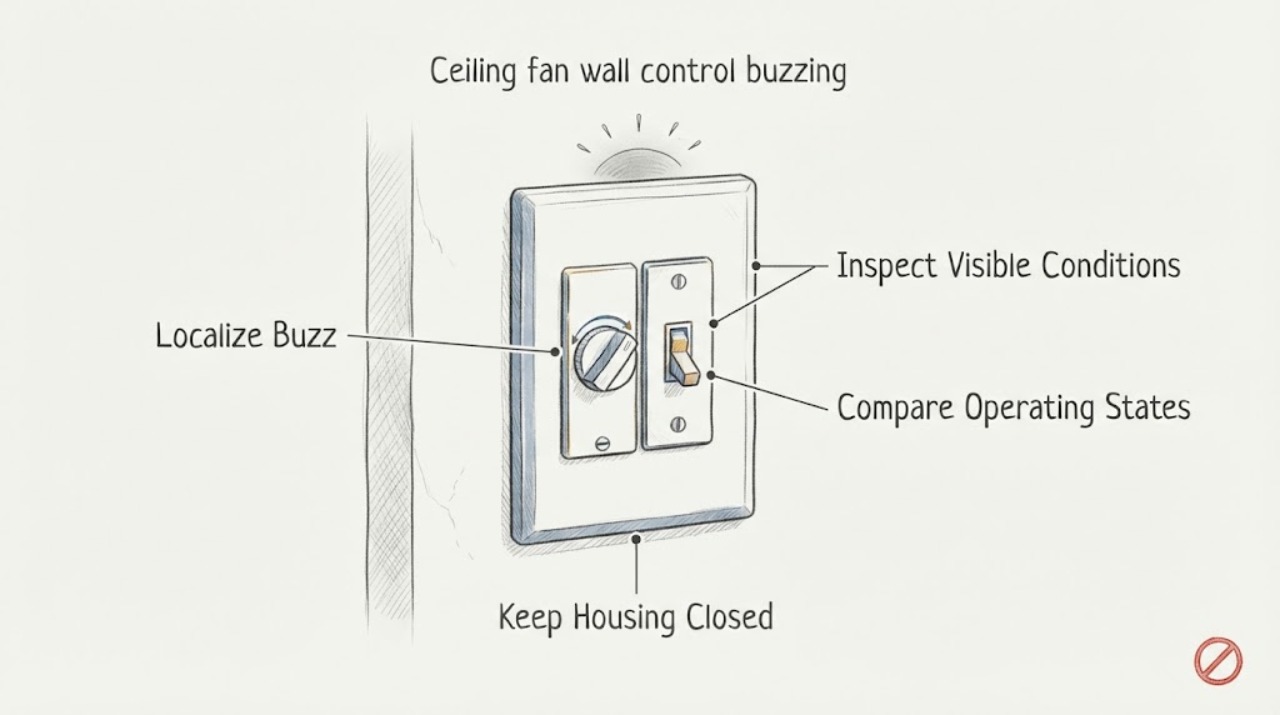
First determine whether the buzz is coming from the wall control, the fan, the light, or the electrical panel. A faint control hum can be associated with electronic speed control, but a new or loud buzz is not something to ignore. From the floor, note when the sound occurs, whether the wall plate is warm or discolored, whether the fan or light changes behavior, and whether the breaker trips. If there is heat, a burning odor, crackling, sparking, discoloration, repeated breaker action, or a sound from wiring or the breaker, turn the circuit off if it is safe to do so and call a qualified electrician. Do not open the wall control, test live wiring, or work inside the fan.
Work through in order
Diagnostic checks
Use only checks that match the exact appliance or system and its official guide.
-
Check 1
From the floor and with the fan and light in their normal off state, listen from the doorway and then from other safe room positions without touching the wall control or fan.
Expected result: Note whether the sound is strongest at the wall control, at the fan housing or light, near another outlet, or at the electrical panel, and whether it remains when the fan and light are not operating.
Next step: Record the location and operating state for the manufacturer or electrician; do not remove a cover to improve the diagnosis.
Stop if: Stop immediately if the sound is crackling or sizzling, or if you notice heat, burning odor, smoke, or sparking. Turn off power if safe and obtain professional help.
Why this matters
Why: A sound localized to the control points toward the control or its electrical connection; a sound at the fan may involve the receiver, light, or motor; a sound at the panel or wiring needs an electrician.
-
Check 2
Without touching the wall control, visually inspect its plate and surrounding wall from a normal standing position.
Expected result: Look for discoloration, warping, a loose-looking plate, a control that sits crooked, or signs of moisture; note whether the buzz changes when the control is operated normally, but do not repeatedly cycle it.
Next step: Stop using the fan circuit and arrange qualified electrical inspection when any warning sign is present; otherwise report the sound pattern and fan model for compatibility guidance.
Stop if: Do not remove the plate, tighten screws, probe the control, or perform a live test. Stop if the wall or control feels hot or smells burned.
Why this matters
Why: Heat, discoloration, looseness, moisture, or a buzz that changes abruptly with control operation can indicate an electrical or device fault rather than an acceptable operating hum.
-
Check 3
If there are no heat, odor, crackling, or electrical warning signs, use the existing controls only as intended and briefly compare the sound with the fan off, fan running at different normal speeds, and light on or off.
Expected result: Note whether the buzz occurs only at one speed, only when the light is on, only when the wall control is active, or continuously regardless of the selected state.
Next step: Stop further operation if the sound grows, the fan or light flickers, the control heats, or the breaker trips; provide the pattern to a professional.
Stop if: Do not keep running the fan to reproduce a hazardous sound and do not bypass, bridge, or replace the control.
Why this matters
Why: A speed- or light-dependent pattern can distinguish control electronics from a fan or light source; a continuous or worsening buzz is not cleared by a brief comparison.
-
Check 4
From the floor, observe the fan and light response during one ordinary command from the existing wall control or remote, without reaching the ceiling or opening any housing.
Expected result: Note delayed starting, speed changes that do not match the setting, light flicker, loss of response, unusual heat from the fan area, or normal operation with only a faint sound.
Next step: Write down the command and response, then use the model manual or arrange professional service rather than substituting an unverified component.
Stop if: Stop operation if there is smoke, a burning odor, visible sparking, a harsh grinding or crackling sound, or repeated loss of power.
Why this matters
Why: Abnormal response makes a control, receiver, light, or motor fault more likely and calls for model-specific professional diagnosis; normal response does not justify ignoring a hot, discolored, or worsening control.
-
Check 5
From a safe position, review whether the fan circuit or nearby circuits have recently tripped, flickered, or lost power; do not open the electrical panel or repeatedly reset a breaker.
Expected result: Note whether the buzzing began with a trip, whether lights dim or flicker, and whether other devices on the circuit show a related symptom.
Next step: If a breaker has tripped or electrical symptoms are present, leave the circuit off when safe and call a qualified electrician with the timeline.
Stop if: Do not repeatedly reset the breaker, remove the panel cover, change breaker size, or continue operating a circuit with warning signs.
Why this matters
Why: Breaker activity, flicker, or multiple affected devices broadens the concern beyond a fan control and warrants electrical inspection.
Use your observations
Decision map
Find the observation that best matches what you see, then follow the next safe action.
-
PATH 01Safety boundary
What you see
The wall control or plate is hot, discolored, warped, or associated with a burning odor.
Do this next
Turn off the circuit if safe, stop using the fan, and obtain qualified electrician service.
Why this path and its safety boundary
Safety stop: Do not touch the control further or open the wall box.
-
PATH 02Safety boundary
What you see
The sound is crackling or sizzling, or there is smoke, sparking, or visible arcing.
Do this next
Leave the area as needed, turn off power only if it can be done safely without approaching a hazard, and use emergency assistance for active fire or immediate danger.
Why this path and its safety boundary
Safety stop: Do not operate the control again or investigate behind a cover.
-
PATH 03Safety boundary
What you see
The circuit trips, lights flicker, or other devices show related electrical symptoms.
Do this next
Keep the circuit off when safe and arrange electrician inspection rather than repeated resets.
Why this path and its safety boundary
Safety stop: Do not bypass or upsize a breaker and do not open the panel.
-
PATH 04Safety boundary
What you see
The sound is clearly at the fan or light and not at the wall control.
Do this next
Use the fan manufacturer's model-specific noise guidance and arrange service if the sound persists or the fan response is abnormal.
Why this path and its safety boundary
Safety stop: Do not climb, remove the canopy, access the motor or receiver, or work on wiring.
-
PATH 05Safety boundary
What you see
The hum is faint and consistent, there are no warning signs, and fan and light behavior is normal.
Do this next
Record the model and monitor it without opening the control; ask the manufacturer whether the control type is compatible with the fan.
Why this path and its safety boundary
Safety stop: Escalate if the sound becomes louder, changes character, or any heat, odor, flicker, or breaker activity appears.
Helpful context
Understand the symptom
Separate a normal control hum from a warning sign
Electronic fan-speed controls can produce a small hum, and the fan itself may have a receiver, light, or motor-related sound. The location and timing matter more than the word buzzing alone. A wall control that is hot, discolored, crackling, or associated with an odor or repeated breaker action needs electrical attention rather than a part swap.
Keep the checks external
Use a stable floor position and listen without removing a cover, using a ladder, touching the control, or placing hands near the fan. If you cannot clearly localize the sound without getting closer, stop and describe the uncertainty to an electrician or the fan manufacturer.
Compatibility is model-specific
A control, receiver, capacitor, or remote is not interchangeable just because it looks similar. Record the fan brand and model from an accessible label or existing paperwork and use the manufacturer's manual or support channel to confirm compatibility.
Only after diagnosis
Potential parts
- fan wall control
Consider only if a professional or the manufacturer's model-specific guidance identifies the wall control as the source and confirms that replacement is appropriate.
Confirm the exact fan model, control system, light function, and wiring configuration before ordering; appearance alone is not enough. - ceiling fan capacitor
Consider only if a qualified technician diagnoses a capacitor-related fan symptom; a wall-control buzz by itself does not identify this part.
Capacitor selection and replacement are model- and electrical-system-specific professional work. - ceiling fan remote
Consider only when the existing control system or receiver is diagnosed as incompatible or defective and a model-specific alternative is approved.
Confirm the fan model and receiver/control pairing requirements through the manufacturer before purchase or installation.
When checks do not resolve it
Need a professional?
Call a qualified electrician promptly for heat, burning odor, discoloration, crackling, sparking, flicker, breaker trips, or a buzz traced to wiring or the electrical panel. For a persistent fan-only sound without electrical warning signs, contact the fan manufacturer or a qualified service professional.
Common questions
FAQ
Is a faint buzz from a ceiling fan wall control always dangerous?
Not always. Some electronic controls can produce a small hum, but heat, odor, discoloration, crackling, flicker, breaker activity, or a worsening sound requires the circuit to be stopped and professionally inspected.
Can I remove the wall-control plate to check the wires?
No. Keep this assessment external. Do not open the control, perform a live test, or work on wiring; arrange qualified electrician service instead.
Why does the buzz happen only at one fan speed?
A speed-dependent pattern can involve the control electronics, receiver, or fan system, but it does not identify a replacement part. Record the setting and have the model-specific system evaluated if the sound persists.
Should I replace the wall control with a standard dimmer?
Do not substitute a control based on appearance. Fan control compatibility depends on the fan's control system and model; use the manufacturer's guidance or a qualified electrician.
Read the exact guide
Official sources
- Wiring Your Fan On a Single or Dual Wall SwitchHunter Fan · Understanding that wall switch behavior and control systems vary by fan configuration and that wiring should be professionally handled when uncertain
- What can I do if my fan is making a noise?Hunter Fan · Using sound location and operating symptoms to distinguish control, receiver, wiring, breaker, and motor concerns
Community feedback
Share a repair observation
Share a plain-text repair observation. Accepted observations are published automatically; this page may take a moment to update.