
On this page
Start here
Quick answer
If a ceiling fan is wobbling and the mount is secure or unknown, do not treat the mount as verified. From the floor, classify whether only the blades orbit unevenly or whether the downrod, body, canopy, or ceiling moves; observe the fan stopped when the wobble is severe. Blade-only motion may lead to a model-compatible balance or blade-hardware review, but any ceiling-side movement, new worsening wobble, cracking, dropped parts, or unstable support means stop use and request qualified mounting-box inspection. Do not climb, remove the canopy, push or pull the mount, add weights, or perform energized work.
Before you begin
Safety first
- Floor-level visual observation only: no ladder, canopy removal, overhead tightening, pushing or pulling the mount, added weights, live testing, wiring access, or operation of a severe or uncontrollable wobble.
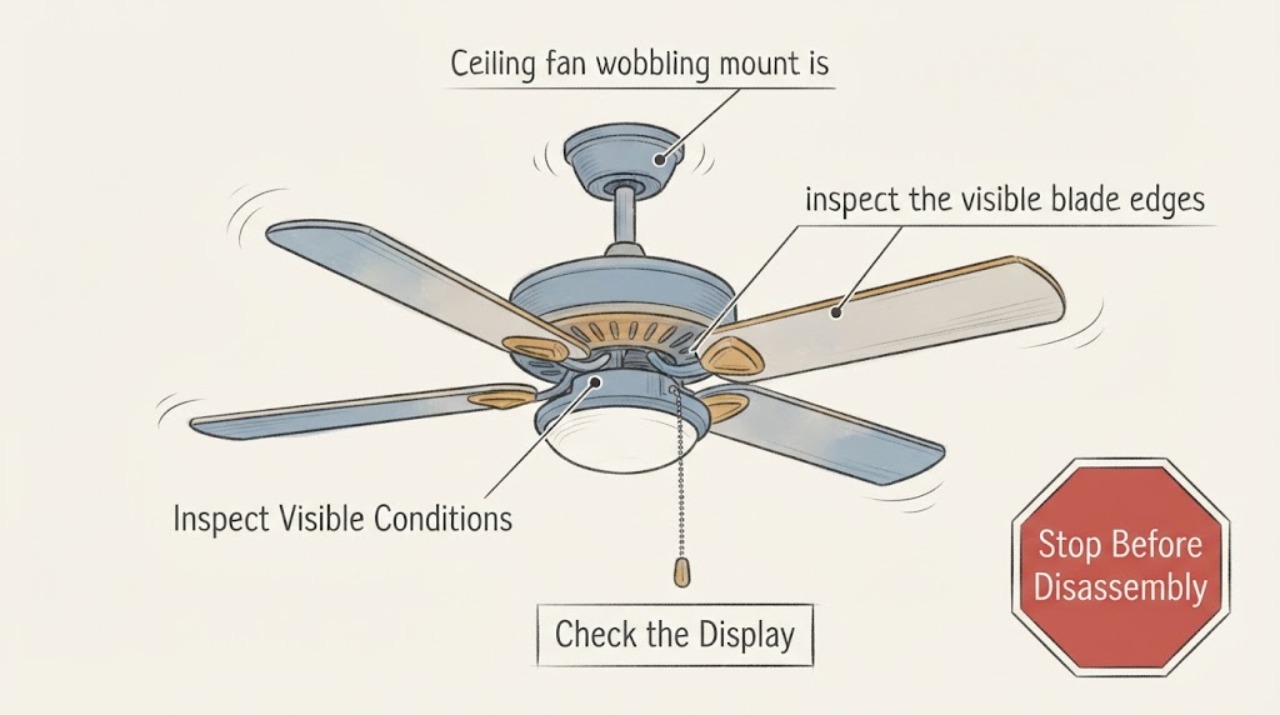
Work through in order
Diagnostic checks
Use only checks that match the exact appliance or system and its official guide.
-
Check 1
From the floor, observe the ceiling fan only if it is already operating gently and can be stopped with its normal control; otherwise leave it off. Compare the blade-tip orbit, the fan body, the downrod, and the canopy without touching them.
Expected result: Record whether the blades alone appear to orbit unevenly, the downrod or body sways, the canopy gap changes, or the whole fixture moves at the ceiling. Note whether the movement is slight, intermittent, speed-related, or severe.
Next step: Photograph the stationary fixture and note the response pattern; do not restart a fan with pronounced movement to obtain more evidence.
Stop if: Stop and keep people clear if the fan swings, drops, scrapes, sheds a part, makes a new crack or bang, or cannot be stopped normally.
Why this matters
Why: Blade-only motion can point toward balance, blade alignment, or blade hardware, while movement at the downrod, canopy, or ceiling changes the concern to mounting or support. A visually secure mount remains unverified from this view.
-
Check 2
With the fan stopped and viewed from a stable floor position, inspect the visible blade edges, blade holders, downrod, canopy, and ceiling finish for an obvious change without tightening or pulling anything.
Expected result: Look for a visibly bent or mismatched blade, a shifted blade holder, a loose-looking fastener, a bent downrod, a changing canopy gap, ceiling cracks, staining, or a fixture that no longer hangs straight.
Next step: Record the exact visible location and provide a close photograph to qualified service before ordering a part or applying force.
Stop if: Do not climb, touch moving or elevated parts, remove a blade, loosen a fastener, remove the canopy, or reach above normal standing height.
Why this matters
Why: A blade or holder clue supports a blade-balance or blade-hardware scope; a bent downrod, changing gap, ceiling crack, or fixture tilt makes the mounting support a priority. Appearance alone cannot certify fastener or electrical-box security.
-
Check 3
Compare the wobble timeline with recent blade cleaning, installation, light-kit work, a storm or impact, a moved control, or a change in fan speed, without recreating a severe condition.
Expected result: Note whether the wobble began immediately after a change, appears at one speed or all speeds, is accompanied by noise, or has progressively increased; distinguish a stable long-standing pattern from new movement at the ceiling.
Next step: Include the timeline and any before-and-after photos in the service request; keep the fan off if movement is new, worsening, or not clearly limited to the blades.
Stop if: Do not run repeated speed tests, catch a blade, add weight, or continue operating a fan that swings or produces impact noise.
Why this matters
Why: A change after blade or accessory work can guide a blade, holder, or balance review, while a new or worsening ceiling-side movement raises a mounting-box or bracket concern regardless of a prior belief that the mount was secure.
-
Check 4
From the floor, compare the fan's visible clearance and position with a nearby stable reference such as the ceiling line, downrod, or canopy edge; do not assume that a gap or alignment can be corrected by pushing it.
Expected result: Record a stationary canopy that stays centered, a downrod that leans, a canopy that rocks or has a growing gap, ceiling damage, or any sign that the mounting surface moves with the fan.
Next step: Stop use and request an electrician or qualified installer to inspect the mounting bracket, fan-rated box, fasteners, and support with power safely isolated.
Stop if: Do not remove the canopy, expose the mounting box, perform live or elevated work, or test the support by pushing, pulling, or hanging weight from it.
Why this matters
Why: A stable-looking canopy with blade-only wobble supports a narrower balance investigation. A moving canopy, leaning downrod, or damaged ceiling is a mounting-support boundary that cannot be cleared by an external visual check.
-
Check 5
Prepare a service brief with the wobble location, severity and timing, speed relationship, blade and body observations, canopy or ceiling movement, recent work or impact, photos, and whether the mount was actually inspected or only assumed secure.
Expected result: Confirm the brief separates blade-only motion from downrod, canopy, ceiling, or mounting movement and identifies any noise, cracks, dropped parts, water, or unexpected electrical behavior.
Next step: Request qualified electrical or ceiling-fan service before replacing a bracket, downrod, or balance kit when the cause or mount security is unknown.
Stop if: Do not continue DIY checks if any diagnosis needs a ladder, cover removal, energized testing, force, or operation of a severely wobbling fan.
Why this matters
Why: This lets service decide between a balance or blade review and a mounting-box or support inspection without asking the user to access a hazardous overhead assembly.
Use your observations
Decision map
Find the observation that best matches what you see, then follow the next safe action.
-
PATH 01Next step
What you see
The blades appear to orbit unevenly, but the downrod, body, canopy, and ceiling remain visibly stable while the fan is off.
Do this next
Ask qualified service to assess blade alignment, blade holders, and balancing before considering a compatible balance kit; do not add weights or remove blades based on appearance alone.
-
PATH 02Next step
What you see
The downrod, fan body, canopy, ceiling finish, or mounting area moves, tilts, gaps, cracks, or changes position.
Do this next
Stop using the fan, keep people clear, and request qualified electrical or installer inspection of the bracket, fan-rated box, fasteners, and support. Do not test the mount by pushing or pulling it.
-
PATH 03Next step
What you see
The wobble began after blade, light-kit, cleaning, installation, or other accessory work, while ceiling-side movement is not observed.
Do this next
Provide the timeline and photos for a blade, holder, accessory, or balance review; use the exact model manual and do not assume the recent part is compatible or correctly installed.
-
PATH 04Next step
What you see
The wobble is new, worsening, severe, accompanied by scraping or impact noise, or the fan cannot be stopped normally.
Do this next
Leave the fan off, keep the area clear, and request prompt qualified service; do not restart it at another speed to compare the movement.
-
PATH 05Next step
What you see
A blade, holder, downrod, canopy, ceiling, or light assembly shows a crack, bent part, dropped hardware, water damage, heat, or exposed wiring.
Do this next
Stop use and arrange qualified inspection of the damaged component and support. Do not tape, glue, tighten overhead hardware, or operate the fixture to test it.
-
PATH 06Next step
What you see
The mount looks secure but cannot be verified from the floor, or the only way to inspect it is a ladder, canopy removal, or energized access.
Do this next
Treat the mount as unknown, limit or stop use until assessed according to the wobble severity, and request qualified service rather than trying to certify the mounting box yourself.
Helpful context
Understand the symptom
Secure or unknown changes the first question
A mount that looks secure from below has not been proven secure. First classify where the movement occurs: blade tips, blade holders, downrod and body, canopy, or ceiling. Blade-only motion may lead to balance or blade hardware; any ceiling-side movement makes the bracket, fan-rated box, and support a professional boundary.
Observe from the floor with the fan stopped when needed
Use a stable floor position and ordinary visual references. Do not restart a fan with pronounced movement, reach for a blade, push the canopy, add weights, or climb. Record the wobble severity, speed relationship, noise, cracks, dropped parts, and whether the fixture can be stopped normally.
Blade balance is not the same as mounting security
A fan can show an uneven blade orbit while the ceiling-side parts remain still, but the same visual complaint can come from a bent downrod, shifted canopy, loose support, or damaged ceiling. A recent installation or accessory change is useful context, not proof of the cause. Do not select a balance kit, bracket, or downrod until the exact fan model and failed scope are confirmed.
When mounting-box inspection is required
Movement at the canopy, downrod, body, or ceiling cannot be cleared by an external check. Keep the fan off and have qualified service inspect the mounting bracket, fan-rated box, fasteners, and support with power safely isolated. Hunter's official troubleshooting guidance likewise directs users to model-specific instructions and professional help for installation, wiring, and unsafe access.
Only after diagnosis
Potential parts
- ceiling fan balancing kit
Consider this only after qualified assessment confirms blade-only imbalance or alignment as the cause and finds no mounting movement; do not use it to mask an unknown support problem.
Confirm the exact fan model, blade set, holder design, manufacturer instructions, and safe access before purchase or use. - ceiling fan mounting bracket
Consider this only after qualified inspection identifies the bracket as damaged or incompatible and verifies the fan-rated box, support, fasteners, and installation requirements.
Match the exact fan model and bracket system, box and support requirements, dimensions, fasteners, and manufacturer instructions; installation requires safe power isolation and appropriate access. - fan downrod
Consider this only when qualified diagnosis identifies a bent, damaged, or model-incompatible downrod rather than blade imbalance or a loose mounting support.
Confirm exact fan model, downrod length and diameter, connection hardware, wiring path, ceiling angle, manufacturer limits, and professional installation requirements.
When checks do not resolve it
Need a professional?
Call promptly when the downrod, body, canopy, ceiling, or mounting area moves; the wobble is new, worsening, severe, or noisy; a part is cracked or dropped; the fan cannot be stopped normally; or mount inspection requires elevated, concealed, or electrical access.
Safety scope: Floor-level visual observation only: no ladder, canopy removal, overhead tightening, pushing or pulling the mount, added weights, live testing, wiring access, or operation of a severe or uncontrollable wobble.
Have this ready
- Provide wobble location and severity, fan and light behavior, speed relationship, noise, cracks, dropped parts, canopy or ceiling movement, recent installation or accessory work, exact model labels, photos, and whether mounting security was observed or only assumed.
Common questions
FAQ
Does a ceiling fan mount that looks secure count as verified?
No. A floor-level view cannot certify the fan-rated box, bracket, fasteners, or support. Observe whether the canopy, downrod, body, and ceiling move, and have qualified service inspect the mount if the cause is unknown or any ceiling-side movement appears.
How can I tell whether the wobble is in the blades or the mount?
From a stable floor position, compare blade-tip motion with the downrod, fan body, canopy, and ceiling while the fan is safely stopped or only gently operating without a severe wobble. Blade-only motion narrows the scope; movement at the ceiling side requires professional mounting inspection.
Should I keep running a severely wobbling fan to find the speed that causes it?
No. Leave a new, worsening, severe, scraping, impact-producing, or uncontrollable wobble off and keep people clear. Do not use repeated speed tests to investigate a potentially loose support.
Can I add a balancing weight or tighten a blade from below?
Do not add weight, catch a blade, climb, or reach overhead based only on the symptom. Record the visible pattern and ask qualified service to confirm blade, holder, accessory, or model-specific balance work and safe access.
When does a wobble require mounting-box inspection?
Request it when the canopy, downrod, fan body, ceiling, or mounting area moves, tilts, gaps, cracks, or changes position, or when the mount is merely assumed secure. Inspection behind the canopy or at the fan-rated box is not a safe floor-level DIY check.
Read the exact guide
Official sources
- How to Fix a Ceiling Fan That Won't Turn On, Wobbles, or Makes NoiseHunter Fan Company · Use the distinctions as general guidance; the fan model, installation, mounting box, bracket, and manufacturer instructions control any repair or replacement.
- Appliance and Electrical Fire SafetyU.S. Fire Administration · Supports stopping and escalating visible electrical hazards; it does not diagnose a ceiling-fan wobble or certify mounting security.
Community feedback
Share a repair observation
Share a plain-text repair observation. Accepted observations are published automatically; this page may take a moment to update.