
On this page
Start here
Quick answer
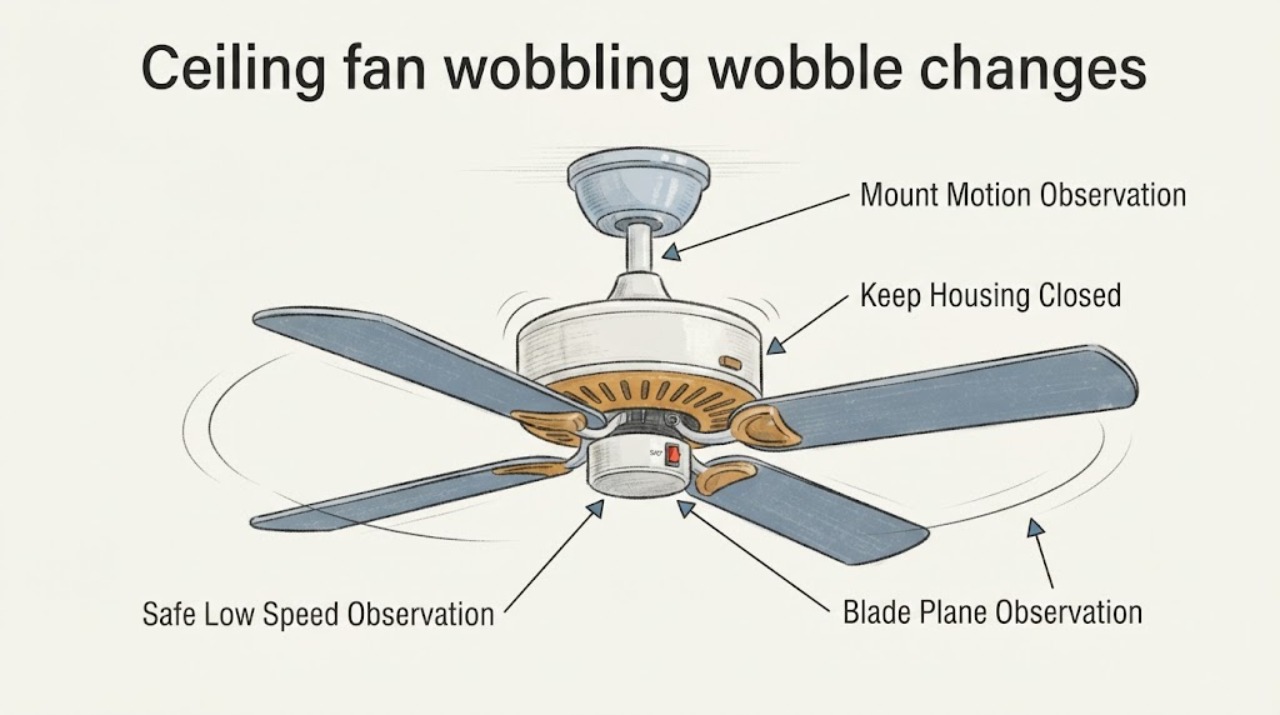
When a ceiling fan's wobble changes with speed, do not assume a balancing kit is the answer. From the floor, and only if the fan is stable with no visible damage, make one brief observation at the lowest speed; record whether the blades appear uneven, the wobble grows as speed changes, or the canopy, downrod, or mounting point moves with the ceiling. Speed-dependent wobble can come from blade imbalance, dust, a warped blade, loose blade hardware, or a loose mounting system. A violently increasing wobble, visible mount movement, scraping, falling hardware, or a crack means stop the fan immediately and arrange qualified electrical service. Do not use a ladder, remove a canopy, tighten anything overhead, run at high speed, or test with power exposed.
Before you begin
Safety first
- This article covers only a brief lowest-speed observation from the floor and stationary visual checks. An electrician should isolate power and handle canopy access, mounting hardware, electrical boxes, wiring, blade replacement, balancing work that requires height, and any part installation.
Work through in order
Diagnostic checks
Use only checks that match the exact appliance or system and its official guide.
-
Check 1
From a clear floor-level position, confirm that no one is underneath and that there is no visible crack, hanging blade, loose shade, or moving mount. If the fan appears stable, use the normal wall or remote control for one brief observation at the lowest speed only; do not increase speed or approach the fan.
Expected result: The fan is stable with mild movement; the wobble is pronounced even at the lowest setting; the wobble increases in the reported higher-speed setting; or a blade, shade, canopy, or mount visibly moves independently.
Next step: Turn the fan off normally, record the lowest-speed result and any prior speed comparison, and continue only with stationary floor-level observations. Arrange an electrician if the wobble is severe or the mount moves.
Stop if: Stop immediately for violent oscillation, visible mount movement, falling material, scraping, a hanging blade or shade, smoke, sparking, or any need to approach the fan.
Why this matters
Why: A stable, speed-sensitive wobble keeps blade balance and loose blade hardware in scope. Pronounced low-speed movement or independent mount movement is a stop condition, not a balancing exercise. A report that the wobble changes with speed is useful even when higher-speed retesting would be unsafe.
-
Check 2
With the fan off and fully still, look upward from the floor for unequal blade height or angle, bowed or twisted blade surfaces, heavy dust on one blade, missing visible hardware, or a blade that does not track with the others; do not touch a blade or use a ladder.
Expected result: One blade appears warped, lower, heavier with dust, or out of line; all blades look even from the floor; or the blade plane cannot be judged safely.
Next step: Photograph the blade pattern from below and tell the electrician which blade appears different. Do not bend a blade, add a weight, or tighten a screw overhead.
Stop if: Stop if a blade is cracked, delaminated, loose, sharply bent, or close enough to contact a person or object.
Why this matters
Why: One warped or uneven blade can create a speed-sensitive imbalance, while uneven dust or visible loose hardware can shift the balance. A visually even set does not rule out a hidden fastener or motor-side issue.
-
Check 3
From the floor with the fan off, compare the canopy or ceiling plate and the downrod to the ceiling line; if a brief lowest-speed observation was safe, note whether the entire fan moves relative to that line. Do not touch the canopy, downrod, or ceiling.
Expected result: Yes: the canopy, downrod, or ceiling attachment shifts relative to the ceiling; no: only the blade plane appears to move; or the relationship cannot be seen clearly.
Next step: If the mount moves, keep the fan off and arrange qualified electrical inspection. If only the blades move, provide the speed pattern and blade photos without attempting an overhead correction.
Stop if: Stop for any movement at the ceiling, cracking, a widening gap, falling dust or hardware, or a mount that cannot be viewed safely from the floor.
Why this matters
Why: Movement at the ceiling attachment is more urgent than ordinary blade imbalance and can indicate loose mounting hardware, an unsuitable box, or a downrod connection problem. Blade-only movement keeps balance and blade condition in scope but does not prove the mount is secure.
-
Check 4
Write down the speed settings at which the wobble was previously mild, strongest, or absent, without running the fan again to recreate the strongest setting. Note whether the pattern began after installation, cleaning, a move, a storm, or a light-kit change.
Expected result: The wobble increases at a particular reported speed; appears at all speeds; began after a change; or has no reliable speed or timing pattern.
Next step: Give the timeline and speed history to service and leave the fan off if the strongest setting is unsafe. Do not compensate by operating only at a faster setting.
Stop if: Stop if the fan starts unexpectedly, the remote or wall control behaves abnormally, or the observation would require opening wiring or reaching overhead.
Why this matters
Why: A repeatable speed-dependent peak supports an imbalance or resonance question. A change after installation or hardware work raises mounting and fastener history, while a new pattern after a blade or light change raises compatibility and balance questions. No reliable pattern means the electrician should inspect rather than infer from the label.
-
Check 5
From the floor, look for a visible gap between the canopy or motor housing and the ceiling, nearby objects that could be struck, or a light shade and pull chain that could be vibrating; do not move the fan or touch the fixture.
Expected result: The housing or canopy appears to contact the ceiling; a nearby object or shade is visibly vibrating; the area is clear; or the source cannot be judged from below.
Next step: Photograph the clearance and tell service what moves. Keep the fan off if contact or interference is possible; do not sand, bend, or reposition anything overhead.
Stop if: Stop for a cracked shade, loose light component, contact with the ceiling, or any need to move furniture or climb for a better view.
Why this matters
Why: Housing-to-ceiling contact, a vibrating shade, or nearby interference can amplify movement and sound without a blade being warped. A clear area does not prove the mounting or blade balance is correct.
-
Check 6
Photograph the fan's model label from a normal accessible location and record the blade count, approximate fan size, mount style, downrod presence, light-kit changes, and every safe observation; do not remove a cover to find the label.
Expected result: The complete model is readable; only a partial identifier is available; or the label cannot be reached without a ladder or cover removal.
Next step: Leave the fan off when wobble is severe or the mount moves and provide the photos, speed history, and blade-versus-mount result to a qualified electrician. Ask for the mounting and blade-balance diagnosis before ordering a part.
Stop if: Do not move furniture, climb, open the canopy, expose wiring, or energize the fan to obtain a model number.
Why this matters
Why: Balancing kits, blades, mounting brackets, and downrods are not interchangeable by appearance. Exact model and mount information lets an electrician confirm compatible parts and determine whether the ceiling support is suitable.
Use your observations
Decision map
Find the observation that best matches what you see, then follow the next safe action.
-
PATH 01Next step
What you see
The blades alone appear to wobble mildly at the lowest safe speed and the reported motion becomes stronger at another speed, with no visible ceiling-mount movement.
Do this next
Keep the observation limited to the lowest safe speed, leave the fan off if the stronger setting is unsafe, and ask an electrician to assess blade balance and model-matched accessories.
Why this path and its safety boundary
Why it matters: Uneven blade weight, dust, a warped blade, or loose blade hardware is more plausible than a loose ceiling attachment, but none is confirmed from below.
-
PATH 02Next step
What you see
The canopy, downrod, ceiling plate, or the fan's attachment point shifts relative to the ceiling.
Do this next
Stop the fan immediately, keep people clear from underneath, and arrange qualified electrical service. Do not tighten overhead hardware or use the fan at a lower setting as a workaround.
Why this path and its safety boundary
Why it matters: The mounting path takes priority because a loose or unsuitable attachment can worsen as speed changes and can make balancing ineffective.
-
PATH 03Next step
What you see
A blade is visibly bowed, twisted, cracked, delaminated, lower than the others, or has missing visible hardware.
Do this next
Keep the fan off and have service confirm an exact-model replacement blade or compatible blade set. Do not bend, drill, tape, or weight a damaged blade.
Why this path and its safety boundary
Why it matters: A blade condition can create speed-dependent imbalance and may not be correctable with a balancing weight.
-
PATH 04Next step
What you see
Wobble or humming follows contact between the housing and ceiling, a vibrating shade, a nearby object, or a control behavior rather than blade-plane movement.
Do this next
Leave the fan off if contact or a loose accessory is present and have an electrician assess clearance, accessory fit, controls, and the mounting system without an overhead DIY adjustment.
Why this path and its safety boundary
Why it matters: Resonance, interference, or an accessory issue may be amplifying the motion; a balancing kit alone may not solve it.
-
PATH 05Next step
What you see
The speed relationship is unclear, the fan was not safe to observe, or the wobble occurs at every setting without a visible blade or mount clue.
Do this next
Keep the fan off if it is worsening or severe, provide the model and observations, and request qualified electrical diagnosis.
Why this path and its safety boundary
Why it matters: The symptom cannot safely identify the source and could involve a concealed mechanical, electrical, or installation condition.
Helpful context
Understand the symptom
Speed change is a clue, not a diagnosis
A fan that sways differently at different speeds is reacting to changing rotational forces, but that reaction does not identify one failed part. Uneven blade weight, dust buildup, a bowed or twisted blade, loose blade hardware, a downrod connection, or a mounting system that moves can all change the visible wobble. The useful distinction is whether only the blade plane moves, whether the fan's canopy or downrod moves against the ceiling, and whether the effect is mild and repeatable or suddenly severe.
Keep the check at floor level
Do not climb, use a ladder, remove the canopy or light cover, reach toward a blade, or tighten overhead hardware. Do not run the fan at high speed or operate it with exposed wiring. If the fan shakes violently, the mounting point shifts, a blade or shade appears loose, or anything falls, turn it off from a safe position and keep people out from underneath. A qualified electrician should isolate power and inspect the mounting system.
What the speed pattern changes
If the reported wobble is mild at low speed but becomes pronounced as speed changes, blade balance, blade shape, or loose blade hardware stays in scope. If the canopy, downrod, or ceiling plate moves with the ceiling, the mounting path takes priority even if balancing would reduce the visible motion. If the wobble is unchanged but the housing hums or resonates, contact with the ceiling, control compatibility, or another installation issue may be involved. The speed observation helps set the service scope; it does not authorize overhead adjustment.
Safety boundary
Stop conditions
- Do not use a ladder, climb, remove the canopy or light cover, reach toward a blade, or tighten overhead hardware.
- Do not run the fan at high speed, test with exposed wiring, bypass a control or safety device, or keep operating when the mount moves.
- Turn the fan off and keep people clear for violent wobble, a cracked or hanging blade, falling hardware, scraping, sparking, smoke, burning odor, or a visible ceiling attachment shift.
- A speed-sensitive wobble is a diagnostic clue only; confirm exact model, blade condition, mount stability, and compatibility before selecting a balancing kit, bracket, or downrod.
Only after diagnosis
Potential parts
- ceiling fan balancing kit
Consider only when the electrician confirms a mild blade-plane imbalance with a stable mount and no warped or damaged blade.
Match the exact fan model and the manufacturer's balancing instructions; a kit is not a fix for a moving mount, cracked blade, or loose electrical box. - ceiling fan mounting bracket
Consider only when an inspection confirms the bracket or ceiling attachment is the source of movement and the replacement is approved for that fan and support.
Confirm the exact fan model, bracket pattern, ceiling support, box rating, mount style, and installation instructions with a qualified electrician. - fan downrod
Consider only when the electrician identifies a downrod, coupling, or length/fit issue rather than blade imbalance.
Match the exact fan model, diameter, length, finish, wiring length, ball or coupling style, and approved ceiling angle before ordering.
When checks do not resolve it
Need a professional?
Stop using the fan and request prompt service for violent or rapidly increasing wobble, a cracked or hanging blade, falling hardware, ceiling or canopy movement, sparking, burning odor, exposed wiring, or a fan that starts unexpectedly.
Safety scope: This article covers only a brief lowest-speed observation from the floor and stationary visual checks. An electrician should isolate power and handle canopy access, mounting hardware, electrical boxes, wiring, blade replacement, balancing work that requires height, and any part installation.
Have this ready
- Provide the complete model number, blade count and size, mount style and downrod presence, reported speed at which wobble changes, lowest-speed observation, blade-versus-mount movement, recent installation or accessory changes, and photos from the floor.
Common questions
FAQ
Why does a ceiling fan wobble more at one speed?
Changing speed changes the forces acting on the blades and mount. A peak at one speed can be consistent with uneven blade weight, a warped blade, loose hardware, or resonance, but it does not identify which condition is present.
Can I run the fan on high to see whether balancing worked?
No. This page limits observation to one brief lowest-speed check from the floor. Do not increase speed, use a ladder, or test a fan whose mount or blades move noticeably.
How can I tell blade imbalance from a loose mount?
From the floor, compare the blade plane with the ceiling line. Blade-only movement keeps balance or blade shape in scope; movement of the canopy, downrod, or ceiling attachment is a mounting concern and requires the fan to remain off. Do not touch overhead hardware.
Will a balancing kit fix a warped blade?
Not necessarily. A visibly bowed, twisted, cracked, or damaged blade may need an exact-model replacement, and a loose mount must be corrected separately. Have an electrician confirm the cause and compatibility first.
When is wobbling an emergency?
Turn the fan off and keep people clear for violent or rapidly worsening wobble, ceiling or canopy movement, a hanging or cracked blade, falling hardware, scraping, sparks, smoke, burning odor, or exposed wiring. Arrange qualified electrical service before using it again.
Read the exact guide
Official sources
- Why is my fan wobbling?Hunter Fan · Used as general manufacturer guidance for the categories of blade imbalance, loose mounting hardware, and model-specific balancing; its elevated steps are intentionally excluded from this floor-level safety article.
- Ceiling Fans Support FAQWestinghouse Lighting · Supports the distinction between unbalanced blades, an unsecured ceiling attachment, downrod or canopy movement, and resonance; this article does not assume a Westinghouse fan.
- CPSC Guide to Home Wiring HazardsU.S. Consumer Product Safety Commission · Supports the boundary against exposed electrical work and directs defective electrical-system assessment and repair to qualified professionals.
- Fan Blade Balancing KitWestinghouse Lighting · Supports treating a balancing kit as a conditional blade-balance accessory rather than a universal fix for mount movement or damaged blades.
Community feedback
Share a repair observation
Share a plain-text repair observation. Accepted observations are published automatically; this page may take a moment to update.