
On this page
Start here
Quick answer
If a ceiling fan's light flickers, first determine whether only that fixture flickers or other lights do too. Turn the fan off and check the breaker and visible switch or outlet condition from a safe, dry position. A single bad bulb or incompatible control may be a low-risk fixture issue, but flicker with a tripping breaker, buzzing, warmth, discoloration, burning odor, sparks, or a shock can signal an electrical hazard. Do not open the electrical panel, touch ceiling wiring, or repeatedly reset the breaker; leave the circuit off and call a licensed electrician when those signs appear.
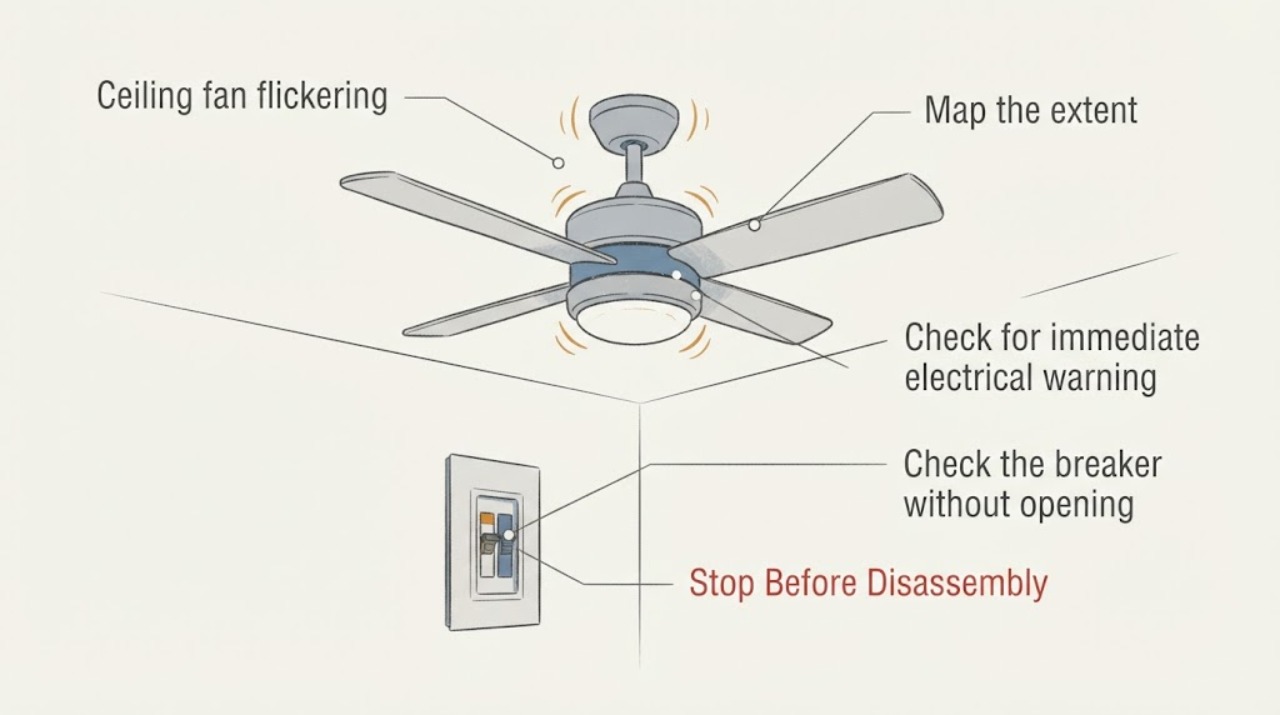
Work through in order
Diagnostic checks
Use only checks that match the exact appliance or system and its official guide.
-
Map the extent of the flicker
From the floor, observe whether the flicker is limited to the ceiling fan light, affects the fan motor or other lights in the room, or appears throughout the home. Note whether it begins when the fan, light, heater, or another load is switched on; do not climb to the fan or repeatedly operate a suspect switch.
Expected result: Only the fan light flickers, several fixtures on the same room circuit flicker, or the whole home changes brightness.
Next step: Use the matching branch below. If the extent is unclear, turn the fan and light off and arrange an electrician rather than reproducing the flicker.
Why this matters
Why: A single fixture points toward the bulb, socket, light kit, or control. Several lights or a whole-home symptom raises concern about the branch circuit, service connection, or utility supply and should not be treated as a bulb problem.
-
Check for immediate electrical warning signs
With the fan and light switched off, look and listen from a safe position for a breaker that trips, a warm or discolored wall plate, buzzing or sizzling, a burning odor, smoke, sparks, a shock or tingle, or damaged visible insulation. Do not touch a hot plate, exposed conductor, ceiling canopy, or breaker-panel interior.
Expected result: One or more warning signs are present, or the switch, outlet, cord, and surrounding surfaces remain cool, quiet, and undamaged.
Next step: If any warning sign is present, turn the affected branch off if it can be done safely and call a licensed electrician. If there is no warning sign, continue with the power and control distinction without opening wiring.
Stop if: Stop immediately for smoke, active arcing, a strong burning smell, or a painful shock; leave the area and use the appropriate emergency response, then keep the circuit off.
Why this matters
Why: Flicker combined with heat, noise, odor, arcing, shocks, or repeated breaker operation is an electrical safety issue, not a normal ceiling-fan behavior. Absence of visible signs does not prove that hidden wiring is sound, but it permits only low-risk fixture checks.
-
Check the breaker without opening the panel
Look only at the breaker handle and label from outside the closed panel. If the handle is visibly tripped, turn the fan and light controls off before following the panel manufacturer's reset direction once. Never remove the panel cover, install a larger breaker, hold a breaker on, or repeatedly reset one that trips.
Expected result: The breaker is stable and the fan-light flicker remains, or the breaker trips again when the fan-light circuit is used.
Next step: Leave a repeatedly tripping circuit off and call a licensed electrician. If the breaker is stable, continue only with a power-off bulb or control check; do not treat a single reset as a repair.
Why this matters
Why: A recurring trip indicates an overload, short, arc fault, defective fixture, or wiring problem that requires diagnosis. A stable breaker does not rule out a loose connection or control problem at the fixture.
-
Rule out a bulb or control mismatch safely
If only the fan light flickers and there are no electrical warning signs, turn the circuit off and let the lamp cool. Verify the bulb is seated, undamaged, and the type and wattage match the fixture and fan manual. If the light uses a dimmer or electronic wall control, verify that the control is approved for that fan and light type; do not bypass or rewire it.
Expected result: A loose or failed bulb, wrong bulb specification, or incompatible control is found, or the bulb and control match the manufacturer's instructions.
Next step: Replace only a cool bulb with the exact specification permitted by the manual and restore power once. If flicker continues, turn the circuit off and arrange service; do not remove the canopy to inspect connections unless a qualified person does so.
Why this matters
Why: A fixture-level mismatch can make one fan light flicker. A matching bulb and compatible control shift suspicion toward the socket, light kit, receiver, ceiling connection, or branch wiring.
-
Check for a fan-control interaction
With power restored only when the circuit is safe, observe whether the light flickers when the fan starts, changes speed, or responds to a remote or wall control. Do not use a standard dimmer or speed control as a substitute for a fan-rated control, and do not open the receiver or switch housing.
Expected result: Flicker occurs only with a particular speed, control position, remote command, or fan start, or it happens while the fan is off.
Next step: Turn the fan and light off and use the model manual to identify the approved control. Persistent or fan-start-related flicker needs a qualified electrician or manufacturer service; do not probe internal wiring.
Why this matters
Why: A control, receiver, capacitor, or internal fan connection may interact with the light kit when the symptom follows fan operation. Flicker while the fan is off points away from the motor and toward the light or circuit.
-
Check whether other loads trigger the symptom
Without touching the fan wiring, note whether the flicker starts when another high-load device or motor in the home operates, or whether it changes with wind or an outdoor service event. Do not add an extension cord, move a breaker to a different position, or disconnect household wiring to isolate the load.
Expected result: The flicker follows another load or occurs across the home, or it remains isolated to the fan light regardless of other loads.
Next step: For whole-home or weather-related flicker, keep clear of service equipment and contact the utility or a licensed electrician. For an isolated symptom, keep the circuit off if it persists and arrange fixture or branch diagnosis.
Why this matters
Why: A load-related or whole-home flicker can involve a shared branch, service connection, or utility supply. An isolated symptom keeps the fixture, control, or local branch as the more focused path.
-
Prepare a safe electrician handoff
Record whether the fan is lighted, the fan and light control type, the bulb specification, the breaker behavior, which fixtures flicker, and when the symptom occurs. Photograph visible labels only from the floor; do not remove covers or climb to reach the ceiling canopy.
Expected result: The model and symptom pattern are available, or identifying information would require opening or moving energized equipment.
Next step: Give the record to a licensed electrician and keep the affected circuit off if the flicker is persistent, worsening, or accompanied by any warning sign.
Why this matters
Why: A precise symptom pattern helps distinguish a lamp/control issue from a branch or service problem. Inaccessible wiring or labels are a service boundary, not a reason to improvise a test.
Use your observations
Decision map
Find the observation that best matches what you see, then follow the next safe action.
-
PATH 01Next step
What you see
Only the ceiling fan light flickers, the breaker is stable, and there is no heat, noise, odor, spark, or shock.
Do this next
With power off, check the bulb specification, seating, socket condition, and control compatibility using the fan manual. If a correct bulb does not solve the flicker, leave the circuit off and arrange service.
-
PATH 02Next step
What you see
The breaker trips again when the fan or light is used, or several room fixtures flicker together.
Do this next
Leave the affected branch off and call a licensed electrician. Do not install a higher-rated breaker, hold the breaker on, or repeatedly reset it.
-
PATH 03Next step
What you see
The switch plate, outlet, cord, or visible fixture area is warm, discolored, buzzing, or smells burned.
Do this next
Stop using the fan and light, switch the branch off if safe, and obtain qualified electrical service. Do not touch the hot or damaged area or remove the canopy.
-
PATH 04Next step
What you see
Flicker changes when another load starts or appears across the home, especially with wind or a service event.
Do this next
Treat it as a branch, service-entrance, or utility problem. Do not touch service equipment; contact the utility or a licensed electrician and keep the fan circuit off if it is unsafe.
-
PATH 05Next step
What you see
Flicker follows a fan speed, wall control, remote, or light-control setting but no other circuit shows the symptom.
Do this next
Turn the fan and light off and confirm the approved fan-rated control in the model manual. Persistent control or receiver symptoms require qualified diagnosis; do not rewire the control yourself.
-
PATH 06Next step
What you see
There is smoke, active arcing, a strong burning odor, a shock, exposed energized wiring, or water near the electrical area.
Do this next
Leave the area if necessary, use the appropriate emergency response for active fire, and disconnect the circuit only from a safe location. Do not restart the fan or investigate the ceiling wiring; obtain licensed electrical service.
Helpful context
Understand the symptom
First separate a lamp symptom from a circuit symptom
A ceiling fan may have a light kit, wall control, remote receiver, and motor on the same branch circuit. If only the fan light flickers, the bulb, socket, light kit, or control is a reasonable first distinction. If the room lights also flicker, the breaker trips, or the flicker follows other loads, treat the symptom as a circuit or wiring problem. A changing brightness across the home, especially with weather-related movement, needs utility or electrician attention rather than a fixture repair.
Do not turn a flicker into an arc fault
Flickering lights, frequent breaker operation, buzzing, warm or discolored switch plates, burning odor, sparks, and shocks are warning signs. Turn the fan and light off. If there is smoke or active arcing, leave the area and use the appropriate emergency response. If it is safe to do so, switch the affected branch off at the breaker, but do not remove the panel cover or investigate energized wiring.
Only after diagnosis
Potential parts
- compatible ceiling-fan light bulb
Consider this only when the flicker is isolated to the light, the fixture is cool and undamaged, and the fan manual confirms the required bulb type and rating.
Confirm the exact fixture and control requirements before replacing a bulb; a bulb that fits physically may still be unsuitable for the control. - fan-rated wall control or dimmer
Consider this only when a qualified diagnosis finds that the existing wall control is incompatible with the fan or light kit and the wiring is otherwise safe.
Use the fan and control manufacturer's model information and local electrical requirements; do not substitute a general light dimmer or wire it while energized. - ceiling fan light kit or socket
Consider this only when a qualified person confirms a failed socket or light kit after the bulb, control, and branch-circuit checks pass.
Verify the exact fan model and approved light-kit fit before ordering; installation may require licensed electrical work. - branch-circuit overcurrent device
Consider this only when a licensed electrician identifies a failed or incorrectly rated breaker after testing the circuit and connected load; flicker alone is not evidence that the breaker should be replaced.
Breaker selection and installation are panel- and code-specific professional work; never install a larger rating as a workaround.
When checks do not resolve it
Need a professional?
Call a licensed electrician when flicker is accompanied by a tripping breaker, multiple affected lights, buzzing, warmth, discoloration, burning odor, sparks, shock, damaged insulation, or a whole-home or weather-related change. Also arrange service when a correct bulb and approved control do not stop an isolated fan-light flicker, because the socket, receiver, ceiling connection, branch wiring, or breaker may need testing.
Common questions
FAQ
Why does my ceiling fan light flicker when the fan starts?
The symptom may follow an incompatible control, receiver, light kit, or internal connection, but it can also be a branch-circuit problem. Turn the fan off, check for electrical warning signs, and have a qualified person diagnose persistent fan-start flicker.
Can a bad bulb cause a ceiling fan light to flicker?
Yes, an isolated fixture symptom can come from a failed, loose, or incorrectly specified bulb. With power off and the lamp cool, verify the bulb requirements in the fan manual. If the correct bulb does not help, stop and arrange service.
What does a flickering ceiling fan light and tripping breaker mean?
Treat that combination as a possible overload, short, arc fault, defective fixture, or wiring issue. Leave the affected circuit off, never install a larger breaker or repeatedly reset it, and call a licensed electrician.
Is it safe to open the ceiling fan canopy to check wires?
Not as a casual troubleshooting step. Ceiling-fan wiring can remain energized, and flicker is an electrical warning sign. Keep the circuit off and have a qualified electrician inspect the canopy or connections.
Why are all the lights in my home flickering?
A whole-home or weather-related change can involve the service connection or utility supply rather than the fan. Do not touch service equipment; keep the fan off and contact the utility or a licensed electrician, especially if there is heat, buzzing, odor, or arcing.
Read the exact guide
Official sources
- Home Wiring Safety TipsElectrical Safety Foundation International · Residential wiring hazard signs and licensed-electrician safety guidance
- Electrical Safety DosElectrical Safety Foundation International · Electrical warning signs and qualified-electrician guidance for flickering lights
- How to Fix a Ceiling Fan That Won't Turn On, Wobbles, or Makes NoiseHunter Fan Company · Ceiling fan controls, light kits, breaker checks, wiring safety, and model-specific troubleshooting
- Don’t Overload Your HomeElectrical Safety Foundation International · Overloaded circuit warning signs and home electrical safety
- CPSC Guide to Home Wiring HazardsU.S. Consumer Product Safety Commission · Home wiring, circuit breaker, flickering-light, arcing, overheating, and qualified-repair safety guidance
Community feedback
Share a repair observation
Share a plain-text repair observation. Accepted observations are published automatically; this page may take a moment to update.